
How much Vitamin D is needed varies
From Routine Supplementation to Targeted Repletion: Vitamin D Deficiency in UVB-Constrained, Pollution-Exposed, and Ageing Populations—Musculoskeletal and Extra-Skeletal Perspectives
Nutrients, 21 August 2026, https://doi.org/10.3390/nu18162736
Yonghyun Yoon, Jihyo Hwang, Jungyoun Kim, Ki-Tae Kim, Chan-Mo Yang, Rowook Park, Jaehyun Shim, Jonghyeok Lee, Seungbeom Kim, Youngmo Kim, King Hei Stanley Lam
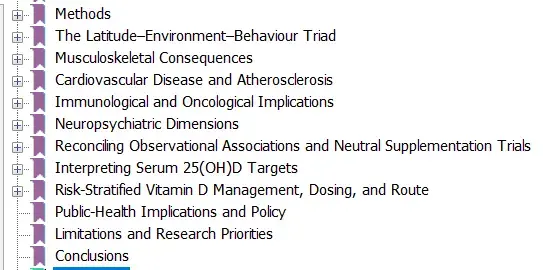
Table of contents (condensed)
Summary by Claude Opus 5 - August, 2026
Correcting a documented deficiency and handing fixed-dose pills to everyone are two different interventions, and this review argues the vitamin D literature keeps scoring one using trials of the other. It is a narrative review — no PRISMA counts, no risk-of-bias scoring, no pooled estimates — from a Korean orthopedic and pain group, with a literature cutoff of 30 June 2026.
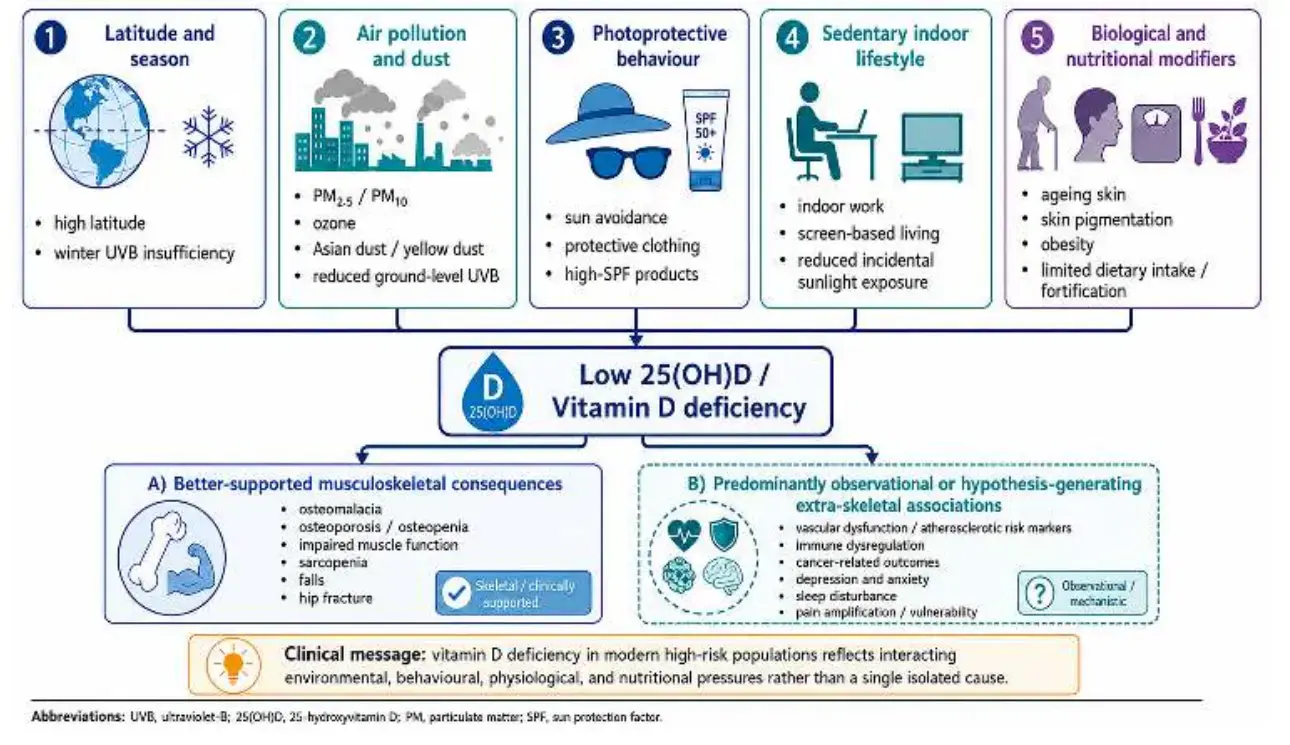
The strongest case for repletion stays musculoskeletal: osteomalacia, muscle weakness, sarcopenia, falls, and support of osteoporosis treatment. Cardiovascular, cancer, mood, sleep, and pain links are treated as observational or mechanistic only.
On why the large trials read neutral: in VITAL the median baseline 25(OH)D was about 31 ng/mL, so few participants were deficient; fixed doses raise levels less in heavier bodies; endpoints like cancer incidence need long latency; and bolus dosing behaves unlike daily. Key figures cited: a 2026 BMJ meta-analysis of 69 RCTs and 153,902 adults found vitamin D alone gave RR 1.00 for any fracture, and calcium+D gave RR 0.91 but with absolute effects the authors judged below clinical importance. An individual-patient meta-analysis of 14 trials and 104,727 people found cancer mortality RR 0.94 overall, 0.88 with daily dosing, 1.07 with boluses.
Doses discussed: maintenance 800–2,000 IU/day; 6,000 IU/day for 4–12 weeks when rapid correction is indicated; 1,000 IU/day, 7,000 IU/week and 30,000 IU/month biochemically equivalent. A single 100,000 IU intramuscular dose left roughly half of recipients still deficient at 4 weeks (mean 28.4 ng/mL).
What this does not show: no new data, no systematic search, and no test of whether targeted repletion actually improves outcomes — that remains the unproven hypothesis. The authors treat ≥20 ng/mL as adequate for most people and call 50–80 ng/mL targets investigational.
Related in VitaminDWiki
- 25 experts recommended Vitamin D levels 30 - 100 ng - Nov 2009
- Non-musculoskeletal benefits of vitamin D - Sunil
- Grade A recommendations for vitamin D
- Vitamin D is needed before many surgeries – many studies and RCTs
- Diseases treated by high-dose Vitamin D - many studies
- Vitamin D levels needed to protect against various diseases - meta-analysis
- Air Pollution reduces Vitamin D production - many studies
- Ultra-processed foods associated with worse health and lower Vitamin D - many studies
- PFAS (forever chemicals) reduce Vitamin D and VDR, cause health problems - many studies
- Pesticides increase risk of Cancers, Alz, ALS, Asthma, ADHD, etc. (all related to low vitamin D)
- Cancer clusters reveal recurring stressors – 110 analyzed (toxins vitamin D may fight)
- US vs Italy: Ultra-processed foods: 74%, 14%, Obesity 40%, 24%, Lifespan 78 vs 82
- Endocrine Disrupting Chemicals - book
- Understanding vitamin D deficiency - Editorial in Age and Aging
- 30 to 50 ng of vitamin D is optimal – Central Europe consensus
- Consensus Vitamin D
- Individualized – RCT
- Overview Vitamin D Receptor
- Berberine: an antioxidant that activates the Vitamin D Receptor - many studies
- Gastrointestinal Health, Vitamin D, and VDR - May 2026
- 2X higher risk of Alzheimer’s if poor Vitamin D Receptor – Meta-analysis
- Alzheimer’s (1.2X) and Parkenson’s (1.3X) more likely if poor Vitamin D Receptor – meta-analysis
- Alzheimer's and Parkinson's risk should decrease if increase Vitamin D Receptor activation
- Resveratrol for Alzheimer's disease
- Alzheimer's disease 9X more likely in females with a poor Vitamin D Receptor
- Alzheimer’s is associated with all 7 of the genes which restrict vitamin D from getting to tissues
- More depression if less vitamin D gets to cells (poor VDR)
- Risk of Major Depressive Disorder increased 2.2 X by a poor Vitamin D receptor
- Overview Vitamin D Dose-Response
- Overview How Much vitamin D
- Autistics have half of the response to Vitamin D – RCT
- 25 experts recommended Vitamin D levels 30 - 100 ng - Nov 2009
- Non-musculoskeletal benefits of vitamin D - Sunil
- Grade A recommendations for vitamin D
- Vitamin D is needed before many surgeries – many studies and RCTs
- Birth rates doubled with Vitamin D - 300,000 IU for infertile men – RCT
- Diseases treated by high-dose Vitamin D - many studies
- Cancer clusters reveal recurring stressors – 110 analyzed (toxins vitamin D may fight)
- US vs Italy: Ultra-processed foods: 74%, 14%, Obesity 40%, 24%, Lifespan 78 vs 82
- Understanding vitamin D deficiency - Editorial in Age and Aging
When you may need much higher doses of vitamin D - video and summary
- Vitamin D testing typically not needed, but in 9 cases it is
- Overview Loading of vitamin D
- Grade A recommendations for vitamin D
- Vitamin D is needed before many surgeries – many studies and RCTs
- Diseases treated by high-dose Vitamin D - many studies
- Vitamin D levels needed to protect against various diseases - meta-analysis
- Consensus Vitamin D
- When you may need much higher doses of vitamin D - video and summary
- Vitamin D levels needed to protect against various diseases - meta-analysis
Obese
- Obese need 2.5 IU of vitamin D per kg to increase 1 ng (about 3.4 X more) – RCT
- Obese people still need 2X to 3X more vitamin D (Mg and weekly help) - review 2026
- Obese need 2X to 3X more vitamin D
- Obesity increases risk of 13 to 18 Cancers
Dark Skin
- Overview Dark Skin and Vitamin D
- Rickets was known to be associated with dark skin and breastfeeding a century ago - 2005
Response
Microplastics
- Microplastics and Nanoplastics associated with 8 Cancers
- Microplastics causing problems in humans, etc. (Vitamin D can help) - many studies
- Many reasons to suspect that microplastics cause weight gain in humans
- Microplastics change the gut microbiome
50 ng
- 30 to 50 ng of vitamin D is optimal – Central Europe consensus
- Is 50 ng of vitamin D too high, just right, or not enough
- 40-50 ng level of Vitamin D often recommended
Stressors which often require larger Vitamin D dosing
- Air Pollution reduces Vitamin D production - many studies
- Ultra-processed foods associated with worse health and lower Vitamin D - many studies
- PFAS (forever chemicals) reduce Vitamin D and VDR, cause health problems - many studies
- Pesticides increase risk of Cancers, Alz, ALS, Asthma, ADHD, etc. (all related to low vitamin D)
- Cancer clusters reveal recurring stressors – 110 analyzed (toxins vitamin D may fight)
- US vs Italy: Ultra-processed foods: 74%, 14%, Obesity 40%, 24%, Lifespan 78 vs 82
20+ chronic stressors result in poor health (most are fought by Vitamin D)