
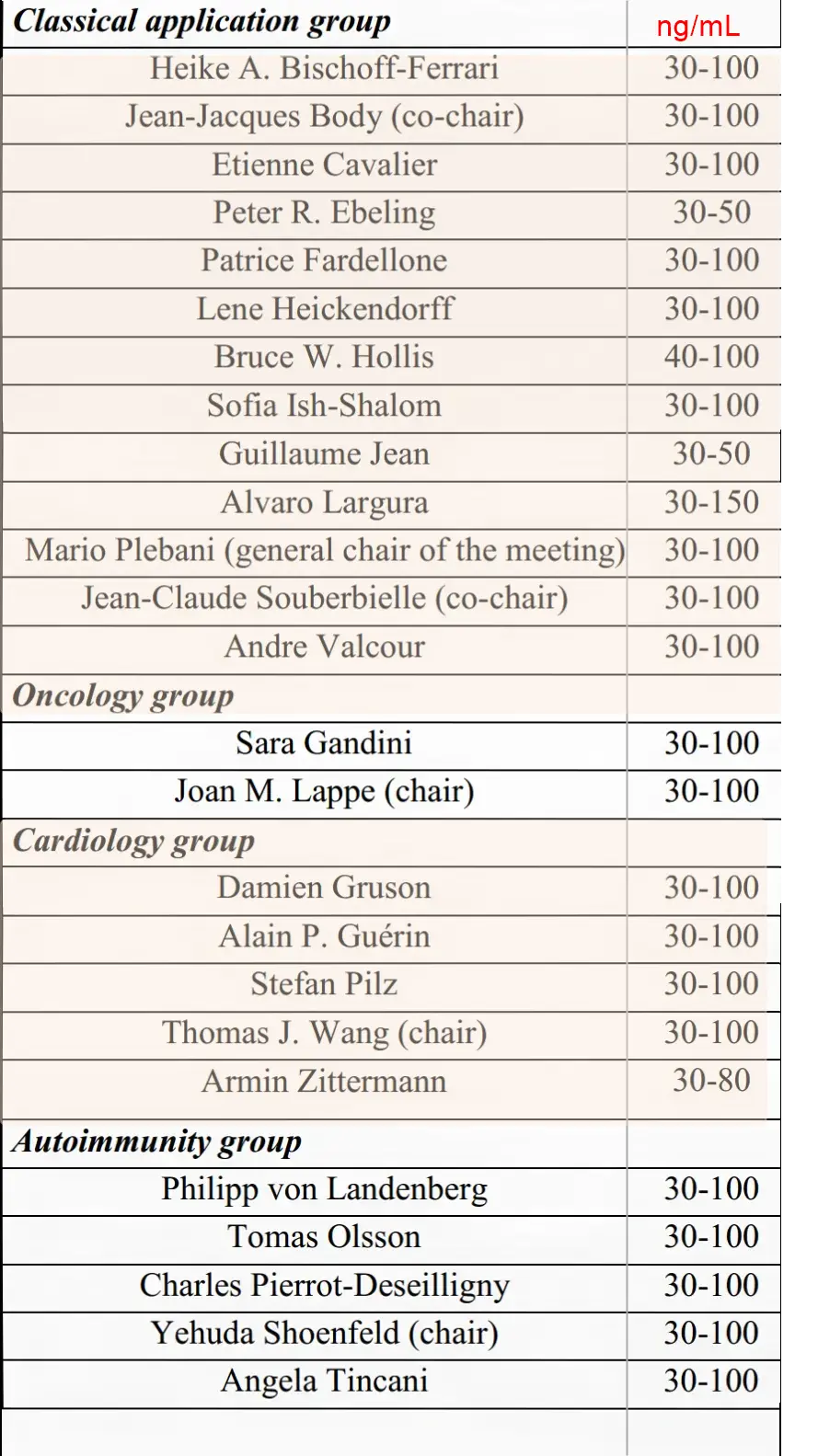
25 experts recommended Vitamin D levels 30 - 100 ng - Nov 2009
Publication of the Nov 2009 meeting was Sept 2010
MINIMUM recommended vitamin D by 25 experts was higher than the 20 ng/ml proclamation of the Institute of Medicine

Vitamin D and musculoskeletal health, cardiovascular disease, autoimmunity and cancer: Recommendations for clinical practice
Autoimmunity Reviews
Volume 9, Issue 11, Sept. 2010, Pages 709-715; doi:10.1016/j.autrev.2010.06.009
Jean-Claude Souberbielle a, Jean-Jacques Body b, Joan M. Lappe c, Mario Plebani d, Yehuda Shoenfeld e, Thomas J. Wang f, Heike A. Bischoff-Ferrari g, Etienne Cavalier h, Peter R. Ebeling i, Patrice Fardellone j, Sara Gandini k, Damien Gruson l, Alain P. Guérin m, Lene Heickendorff n, Bruce W. Hollis o, Sofia Ish-Shalom p, Guillaume Jean q, Philipp von Landenberg r, Alvaro Largura s, Tomas Olsson t, Charles Pierrot-Deseilligny u, Stefan Pilz v, Angela Tincani w, Andre Valcour x and Armin Zittermann y
Meeting was held in Paris Nov, 2009 , online July 2010.
Background
There is increasing evidence that, in addition to the well-known effects on musculoskeletal health, vitamin D status may be related to a number of non-skeletal diseases. An international expert panel formulated recommendations on vitamin D for clinical practice, taking into consideration the best evidence available based on published literature today. In addition, where data were limited to smaller clinical trials or epidemiologic studies, the panel made expert-opinion based recommendations.
Methods
Twenty-five experts from various disciplines (classical clinical applications, cardiology, autoimmunity, and cancer) established draft recommendations during a 2-day meeting. Thereafter, representatives of all disciplines refined the recommendations and related texts, subsequently reviewed by all panelists. For all recommendations, panelists expressed the extent of agreement using a 5-point scale.
Results and conclusion
Recommendations were restricted to clinical practice and concern adult patients with or at risk for fractures, falls, cardiovascular or autoimmune diseases, and cancer. The panel reached substantial agreement about the need for vitamin D supplementation in specific groups of patients in these clinical areas and the need for assessing their 25-hydroxyvitamin D (25(OH)D) serum levels for optimal clinical care.
A target range of at least 30 to 40 ng/mL was recommended. As response to treatment varies by environmental factors and starting levels of 25(OH)D, testing may be warranted after at least 3 months of supplementation . An assay measuring both 25(OH)D2 and 25(OH)D3 is recommended. Dark-skinned or veiled individuals not exposed much to the sun, elderly and institutionalized individuals may be supplemented (800 IU/day) without baseline testing.
