
Obese people still need 2X to 3X more vitamin D (Mg and weekly help) - review 2026
Vitamin D in Obesity: Mechanisms and Clinical Impact
Obesities (MDPI), 6 Feb 2026, https://doi.org/10.3390/obesities6010012
Jirků J, Kršáková Z, Křížová J (Charles University, Prague)
Summary by Claude - July, 2026
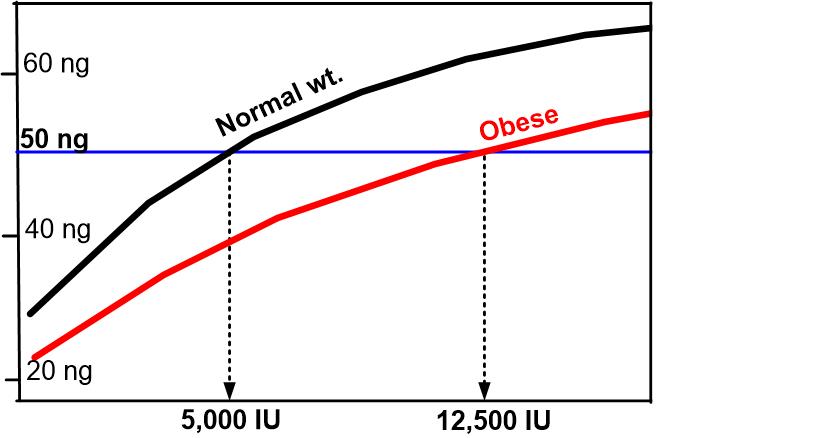
The practical takeaway: if you carry excess weight, standard vitamin D doses won't move your blood level as much — obese people need roughly 2–3× higher doses, and overweight people about 1.5×, to reach the same 25(OH)D as lean people (from Ekwaru's analysis of 22,214 measurements). This is a narrative review (78 references, peer-reviewed, MDPI journal), so treat it as a synthesis of others' work rather than new data.
Its central argument: the low 25(OH)D seen in obesity mostly reflects altered distribution, not true tissue deficiency. Vitamin D gets diluted across a larger body and stored in fat, so blood levels drop even when total body stores are comparable. Each 1 kg/m² of BMI is tied to about a 1.15% lower 25(OH)D. Supporting the reversible-storage idea, weight loss modestly raises levels — roughly +6 nmol/L per 10 kg lost, or +9 nmol/L per 10% fat-mass reduction — and losing visceral fat (which holds ~20% more vitamin D than subcutaneous fat) matters most: one study saw a 26% rise in 25(OH)D after a 50% cut in intra-abdominal fat.
The review reproduces three weight-based dosing equations (Zittermann, Drincic, van Groningen) for readers who want to individualize dose by body weight and baseline level. Polish guidelines (2023) recommend 2000–4000 IU/day for obese adults with a 10,000 IU/day upper limit; the Endocrine Society (2024) declines to recommend routine screening on obesity alone.
What this does not show / limitations: As a narrative (non-systematic) review it pools no effect sizes of its own and doesn't grade study quality formally. It does not show that supplementation improves hard clinical outcomes in obesity — the big RCTs (VITAL, D-HEALTH, WHI, FIND) were largely null, though most enrolled vitamin-D–sufficient people at low doses, leaving the deficient-obese question open. Whether "free" or bioavailable 25(OH)D is the better biomarker here remains unresolved. Published in a lower-tier MDPI journal; funded by a Czech hospital grant, no declared conflicts.
Related in VitaminDWiki
Obese get more vitamin D into blood if add Mg, take D weekly