
Non-calcaemic vitamin D: 51 studies in 7 disease areas - review Nov 2026
Expanding non-calcaemic roles of vitamin D in therapeutics and their mechanisms
The National Medical Journal of India, 2026 (article in press), https://doi.org/10.25259/NMJI4202024
Sahil Kumar, Arun Ghosh, Ijasul Haque, Vandana Tayal
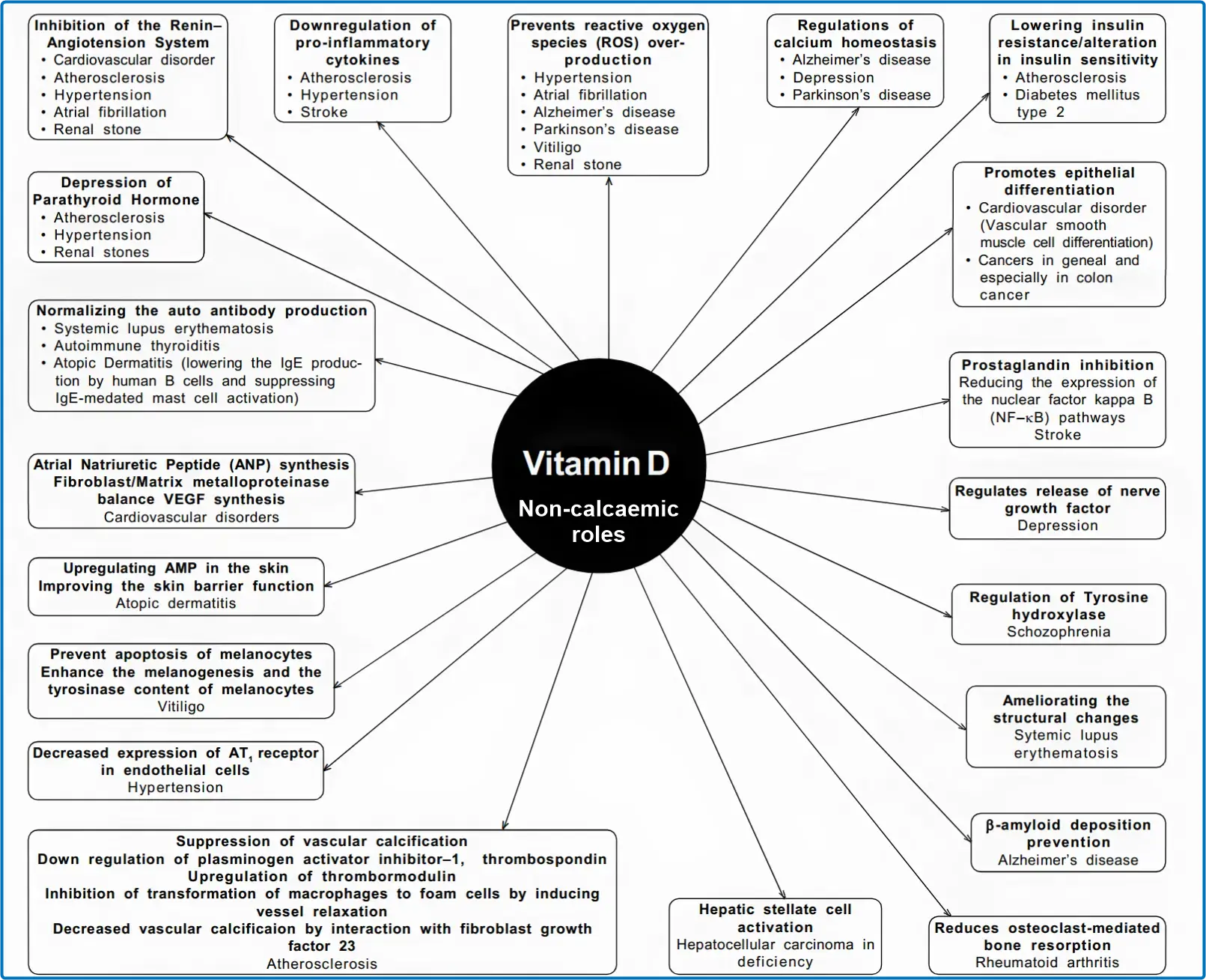
Summary by Claude Opus 5.5 - November, 2026
Takeaway: Low vitamin D is repeatedly linked to heart disease, stroke, diabetes, depression, several cancers, autoimmune disease and respiratory infections. But in this review, supplementation trials showed clear benefit for only a few conditions. The authors conclude that supplementation "is not found to provide beneficial effects in most of these disorders" and that a preventive or add-on role may matter more.
This is a narrative review (no systematic search, no pooling, no new data) by four pharmacologists in New Delhi and Faridabad, India. It tables 51 studies published 2001–2024 (28 of them meta-analyses) across 7 disease areas, plus a map of proposed mechanisms.
Benefit reported
- Pregnancy: less pre-eclampsia, preterm birth and low birthweight. A 1,300-woman RCT giving 60,000 IU monthly from before 16 weeks cut pre-eclampsia by 64% (RR 0.36)
- Asthma: fewer attacks needing steroids (aIRR 0.74)
- Diabetes: in prediabetes, less progression to type 2 diabetes with >1,000 IU/day (RR 0.88). In type 2 diabetes, lower insulin resistance (HbA1c unchanged) and less albuminuria in diabetic kidney disease
- Lupus: less anti-dsDNA; lower disease activity in juvenile lupus with 50,000 IU/week
- Depression: better ratings (meta-analysis of 4 RCTs)
No benefit found: cardiovascular events, stroke, blood pressure (mostly), Alzheimer's, Parkinson's, MS relapses, breast, ovarian and colorectal cancer, total cancer incidence, prostate-cancer outcomes, TB sputum conversion, COVID-19 deaths (RCTs), cystic fibrosis.
What this does NOT show / limitations
- No new evidence, and studies were not graded for quality.
- Trials were not sorted by dose, loading dose, baseline deficiency, achieved 25(OH)D or duration. The null verdicts rest on megatrials whose participants were mostly not deficient (the review notes a baseline above 50 nmol/L) and on low doses (400 IU/day in WHI). VITAL and WHI gave no loading dose and counted events from the first dose. The authors themselves say WHI's 7 years may have been too short for colorectal cancer. This may explain small or absent effects; it is not proof of a hidden benefit.
- Omitted: the meta-analysis cited for "no reduction in cancer incidence" also found 13% fewer cancer deaths Keum 2019. VITAL also found 25% fewer cancer deaths after excluding the first 2 years VITAL lagged analysis.
- Errors:
- calls vitamin D "1,25-dihydroxyvitamin D3", which is calcitriol
- says the Endocrine Society set 20 ng/ml as the requirement; its 2011 guideline recommended at least 30 ng/ml
- calls a significant drop in systolic blood pressure (p=0.016) "not statistically significant"
- calls the observational Nurses' Health Study "interventional"
- several reference numbers don't match the studies described
Related in VitaminDWiki
- Proof that Vitamin D Works
- Cancer incidence and mortality is decreased if 40-60 ng of Vitamin D – April 2019
- Overview Diabetes and vitamin D
- Overview Cancer and vitamin D
- Dementia is associated with low vitamin D - many studies
- After COVID infection, Vitamin D helps - many studies
Some Vitamin D meta-analyses
- Cancer with low Vitamin D increases Mortality by 13 percent – meta-analysis Feb 2019
- Overview of Vitamin D Meta-analysis and RCT for Caucasians
- Overview of Vitamin D Meta-analysis and RCT for Caucasians
- Heart Failure and Vitamin D meta-analyses - many studies
- Diabetic Foot Ulcers helped by Vitamin D - meta-analyses many studies
- Pregnancy, offspring health, and Vitamin D - umbrella of 250,000 pregnancies - meta-analysis
- Stroke and Vitamin D meta-analyses - many studies
- Colorectal cancer 14 percent less likely if 10 ng more Vitamin D – 22nd meta-analysis
VitaminDWiki · Review · November 2026
Vitamin D beyond bone
Low vitamin D was linked to disease in all 7 areas this review covered. Supplement trials clearly helped in only 2 areas.
Low vitamin D linked to disease
7 of 7
Supplement trials clearly helped
2 of 7
2 helped 3 mixed 2 not shown
What the trials showed, area by area
Verdicts are VitaminDWiki’s reading of the review’s 7 tables. In every area, observational studies linked low vitamin D to more disease.
| Area | Low vitamin D linked? | Trial verdict | What the trials showed |
|---|---|---|---|
| Heart and stroke | Low vitamin D linked: Yes | Trials: Not shown | No reduction in major heart events (21 RCTs, 83,000 people, RR 1.00) or in stroke. Blood pressure: little or no change. |
| Brain and mood | Low vitamin D linked: Yes | Trials: Mixed | Depression scores improved (4 RCTs, 948 patients). No benefit for Alzheimer’s, Parkinson’s or multiple sclerosis relapses. |
| Diabetes | Low vitamin D linked: Yes | Trials: Helped | Progression from prediabetes to diabetes was reduced 12% at more than 1,000 IU/day (RR 0.88). Low-dose trials showed no effect. Insulin resistance improved. |
| Cancer | Low vitamin D linked: Yes | Trials: Not shown | No reduction in breast, ovarian, colorectal or total cancer incidence. Left out: 13% fewer cancer deaths (see below). |
| Autoimmune | Low vitamin D linked: Yes | Trials: Mixed | Lupus: less anti-dsDNA, and lower disease activity in juvenile lupus with 50,000 IU/week. Rheumatoid arthritis relapse: borderline (p = 0.05). |
| Lungs and infections | Low vitamin D linked: Yes | Trials: Mixed | Asthma attacks needing steroids −26%; influenza A −40% in schoolchildren (1,200 IU/day). No benefit for tuberculosis, COVID-19 deaths (in RCTs) or cystic fibrosis. |
| Pregnancy | Low vitamin D linked: Yes | Trials: Helped | Pre-eclampsia −64% with 60,000 IU monthly from before week 16 (RCT, 1,300 women). Less preterm birth and low birthweight. |
Why so many trials found no benefit
Each of these can make a real effect look smaller. None of them proves a hidden benefit.
1 Most people were not deficient
The very large trials VITAL, ViDA and D2d enrolled adults already above 20 ng/ml (50 nmol/L). Signs of benefit came mainly from people who were deficient.
2 Doses were small
The WHI trial gave 400 IU a day. Diabetes prevention appeared only in trials using more than 1,000 IU a day.
3 Too little time
No loading dose was given, and events were counted from day one. The authors note that the 7 years of the WHI trial may be too short for colon cancer.
Source: Kumar S, Ghosh A, Haque I, Tayal V. Expanding non-calcaemic roles of vitamin D in therapeutics and their mechanisms. Natl Med J India 2026 (in press). doi.org/10.25259/NMJI_420_2024
This is a narrative review: it has no new data, and its studies were not graded for quality.