
Stroke and Vitamin D meta-analyses - many studies
Association between serum vitamin D levels and functional outcomes in ischemic stroke patients: A systematic review and meta-analysis - April 2026
Meta-Analysis J Int Med Res. 2026 Apr;54(4):3000605261438342. doi: 10.1177/03000605261438342.
Objective: To evaluate the correlation between serum vitamin D levels and neurological function prognosis, including the overall cognitive level, in patients with ischemic stroke in a meta-analysis using Pearson or Spearman correlation coefficients.
Methods: PubMed, Cochrane Library, Web of Science, and Embase databases were searched for relevant studies published from inception to June 2025. Stata version 16.0. was used to conduct the meta-analysis.
Results: A total of fifteen studies involving 2030 participants aged 18-94 years were included. The meta-analysis demonstrated a significant inverse association between serum vitamin D levels and stroke severity and outcomes, as reflected by the admission Modified Rankin Scale score, admission National Institutes of Health Stroke Scale score, and Modified Rankin Scale score at 3 months (combined Fisher's Z/r: -0.37/-0.35, 95% confidence interval: -0.68 to -0.06; -0.46/-0.43, 95% confidence interval: -0.55 to -0.37; and -0.21/-0.21, 95% confidence interval: -0.38 to -0.05, respectively). Higher serum vitamin D levels may be positively correlated with post-stroke cognitive improvement (combined Fisher's Z = 0.34, 95% confidence interval: 0.24 to 0.45).
Conclusion: Serum vitamin D levels in patients with ischemic stroke were significantly negatively correlated with neurological function prognosis and, possibly, better cognitive outcomes.
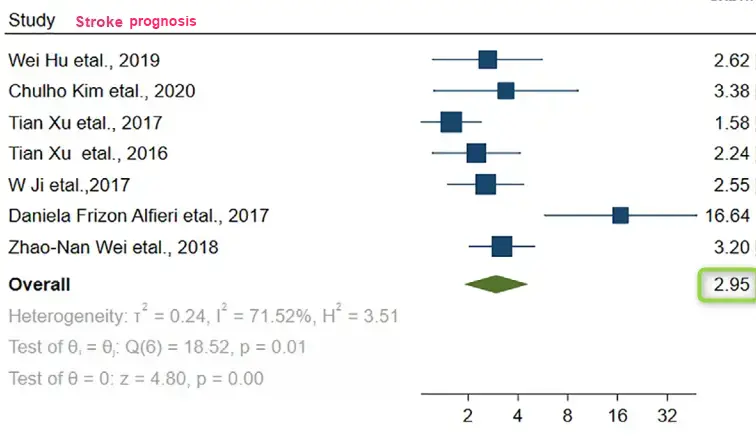
Stroke prognosis 2.95 X more likely if low vitamin D – meta-analysis June 2024
A systematic review and meta-analysis of the linkage between low vitamin D and the risk as well as the prognosis of stroke
Brain and Behavior 14 June 2024 https://doi.org/10.1002/brb3.3577
Jianrong Xiong, Chenliang Zhao, Jinhui Li, Yongxiang Li
Objective
The research intended to probe the connection between the risk of stroke and serum vitamin D levels.
Methods
Three electronic databases (Cochrane Library, EMBASE, PubMed) were searched according to the subject terms from inception until July 29, 2022, and retrieved researches were screened on the basis of inclusion and exclusion criteria. Two investigators conducted the quality assessment and data extraction. Using Stata 16.0 software, a meta-analysis was conducted on the extracted data.
Findings
In total, 27 studies with 45,302 participants were included. Among these studies, 20 focused on stroke risk, while 7 examined stroke prognosis. According to the meta-analysis findings, it was observed that a higher stroke risk is connected to reduced levels of serum vitamin D. This association was reflected in a combined relative risk (RR) of 1 .28 (95% confidence interval (CI): 1.15–1.42) and a worse prognosis after stroke (RR = 2.95, 95% CI: 1.90–4.60). Additional analysis indicated that no apparent relationship between a decrease in vitamin D and the probability of experiencing a hemorrhagic stroke was found. The RR found was 1.93 (95% CI: 0.95–3.95). On the other hand, it was observed that a reduction in serum vitamin D levels was linked to an elevated likelihood of developing an ischemic stroke.
The RR identified was 1.72 (95% CI: 1.78–2.03). Moreover, a lower level of vitamin D in the bloodstream was associated with a more unfavorable prognosis for individuals who suffered from a stroke. The RR for this correlation was 2.95 (95% CI: 1.90–4.60). However, further research is required to confirm the above-mentioned findings.
Conclusion
In conclusion, lower concentration vitamin D was found to be related to an increased risk of stroke, which could mainly be reflected in ischemic stroke patients but not in patients with hemorrhagic stroke. A lower serum vitamin D level was correlative with the poor prognosis of stroke.
Download the PDF from VitaminDWiki
Related in VitaminDWiki
- Tag below: Stroke -Mega-analysis, shows 11+ titles