
Re-Evaluating Vitamin D Guidelines - Wimalawansa, Holick, Cheng, Grant, et. al.
Re-Evaluating Vitamin D Guidelines: Scientific Evidence and Recommendations from a 2026 Vitamin D Expert Panel
Sunil J. Wimalawansa¹,*, Jennifer L. Aliano², Michael F. Holick³, Richard Z. Cheng⁴, Beth S. Sanford⁵, Leigh A. Frame⁶ and William B. Grant⁷
Nutrients 2026, 18, 3963. https://doi.org/10.3390/nu18233963
¹ CardioMetabolic and Endocrine Institute, North Brunswick, NJ 08902, USA
² GrassrootsHealth, Nutrient Research Institute, Encinitas, CA 92024, USA
³ Chobanian & Avedisian School of Medicine, Boston University, 85 East Newton Street, Boston, MA 02118, USA
⁴ Orthomolecular Medicine News Service (OMNS), Columbia, SC 29212, USA
⁵ North Dakota Nurses Association, 1515 Burnt Boat Dr, Suite C #325, Bismarck, ND 58503, USA
⁶ Office of Integrative Medicine and Health, George Washington University, Washington, DC 20037, USA
⁷ Sunlight, Nutrition, and Health Research Center, 1745 Pacific Ave., Ste. 504, San Francisco, CA 94109, USA; wbgrant@infionline.net
* Correspondence: suniljw@hotmail.com or wimalasu@scarletmail.rutgers.edu
Academic Editors: Lutz Schomburg, Umberto Goglia, Marco Gallo and Laura Gianotti
Abstract
Background: Despite decades of research, vitamin D deficiency remains widespread globally. Advances in vitamin D biology have challenged outdated guidelines, yet debate continues over optimal intake, target serum 25-hydroxyvitamin D [25(OH)D] concentrations, individualized dosing, and their application in clinical practice and public health policy. Objective: To provide an up-to-date, evidence-based framework for updating and modernizing vitamin D guidelines by integrating scientific evidence and expert consensus for clinical decision-making and policy considerations, as discussed by a 2026 Vitamin D Dosing Policy Update Expert Panel to inform research, clinical practice, and public health strategies.
Methods: A panel of experts reviewed current evidence on vitamin D biology and physiology, dosing, serum 25(OH)D targets, statistical methods used, research methodology, individual and biological variability, and public health policies. Their consensus was synthesized into a narrative review providing an evidence-based framework for new vitamin D guideline development.
Results: Current vitamin D recommendations rely on flawed statistical assumptions and underestimate physiological requirements. Emerging evidence indicates that vitamin D functions as a threshold nutrient and systems regulator, with effects determined by achieved serum 25(OH)D concentrations rather than dose alone. The panel concluded that conventional RCTs are often poorly suited to nutrient research, as they fail to account for baseline status, achieved concentration, biological variability, and nutrient principles and interactions. Based on these findings, the panel recommends reevaluating vitamin D guidelines using contemporary nutrient science, individualized assessment, and adherence to public health principles.
Conclusions: Vitamin D guidelines should be revised to incorporate advances in biology, nutrient science, evidence-based medicine, and statistical methodology. Future recommendations should distinguish population-wide deficiency prevention from individualized, monitored approaches to optimize vitamin D status, thereby improving clinical practice, public health, and long-term outcomes.
Keywords: 25-hydroxyvitamin D; health policy; public health; nutrient research; personalized medicine; vitamin D deficiency; treat-to-target
1. Introduction
Vitamin D deficiency (VDD) remains one of the most common nutrient deficiencies worldwide. In addition to skeletal health, decades of research have demonstrated its importance for immune function, cardiometabolic health, autoimmune disorders, pregnancy outcomes, reduction in risk, cancers, dementia, diabetes, infectious disease, and reduction in overall mortality [1,2]. Despite this, most current guidelines and recommendations have not yet incorporated these advantages.
Rates of VDD, defined by 25-hydroxyvitamin D [25(OH)D] concentration below <20 ng/mL (50 nmol/L) in adults reported in 2021 were high: 63% in China [3], 57% in southern Italy [4], and 45% in Saudi Arabia [5]. Consequently, many individuals do not fully benefit from this essential micronutrient, which can also be obtained freely through ultraviolet-B (UVB) exposure from sunlight. Despite substantial advances in understanding vitamin D biology, the translation into consistent clinical and public health recommendations remains incomplete, with disagreement over testing, supplementation, and target 25(OH)D concentrations [6,7].
Ongoing debate continues regarding optimal intake, target serum 25(OH)D concentration, screening strategies, supplementation approaches, and the broader role of vitamin D beyond skeletal health in overall health promotion, disease prevention, and improved clinical care. Debates over vitamin D intake, targets, screening, supplementation, and nonskeletal benefits remain shaped by older evidence and a disputed Institute of 2011 Medicine (IoM) report in [6]. Notably, most current guidelines advise against routine vitamin D supplementation and testing above recommended dietary intakes in generally healthy adults younger than 75 years without specific indications [8]. However, this does not preclude supplementation to achieve adequate intake [9].
1.1. Purpose of the 2026 Expert Panel
Most current guidelines also target older adults, people with osteoporosis, and those considered at risk of vitamin D deficiency, recommending 400–1000 IU/day (presumably to prevent osteomalacia, though such is not mentioned), with sufficient/minimum serum 25(OH)D targets generally ranging from 20 to 30 ng/mL [8]. The Vitamin D Expert Panel (2026) considers these doses and thresholds to be inadequate for optimizing vitamin D-related benefits in all extra-skeletal tissues. Accordingly, the panel gathered information through critical analyses and advocates for weight-, age- and risk-specific recommendations rather than uniform targets (see below) [10]. These gaps in the evidence and related controversies are also examined in the Vitamin D Expert Review.
To examine these issues, GrassrootsHealth.net, IPAK-edu.org, and collaborating organizations convened the 2026 Vitamin D Dosing Policy Update Expert Panel. The panel brought together internationally recognized experts in vitamin D metabolism, endocrinology, epidemiology, maternal-child health, human nutrition, public health, statistics, clinical research, systems medicine, implementation science, and process consulting. Rather than conducting a broad review of the vitamin D literature, the panel focused on whether current public health recommendations accurately reflect recently published scientific evidence, the strength of that evidence, and opportunities to improve vitamin D policy and guidelines, research methodology, clinical practice, and, collectively, reduce healthcare costs [10]. This narrative report has been prepared to inform and guide the development of future vitamin D guidelines in 2027.
1.2. The Process of Selecting the Expert Panel
Panelists were chosen for their expertise in vitamin D research, practical participation, needs assessment, and ability to combine rigorous scientific evidence with expert insight to update vitamin D guidelines. Selection also considered a socioecological framework, evaluating evidence across policy, community, institutional, interpersonal, and individual levels. The panel included experts with complementary backgrounds in vitamin D research, clinical practice, health policy, public and population health, institutional protocols, and healthcare professional education. This multidisciplinary composition enabled comprehensive evaluation of the evidence and its implications for clinical decision-making, public health strategies, and policy development.
GrassrootsHealth sought panel member recommendations from international vitamin D leaders. The scientific leadership selected an initial panel based on scientific contributions, credibility, publication records, and long-term commitment to vitamin D research. Participation was open to those outside GrassrootsHealth. The proposed panel was then reviewed with additional vitamin D experts, leading to the final Expert Panel.
Before the expert panel discussion, key themes and proposed policy recommendations were shared by email for review and feedback. Drafts were revised based on participant input. To streamline development and avoid overlap, panelists provided written contributions in their areas of expertise. The recommendations in this manuscript represent the authors’ consensus, informed by the broader panel discussions. As the panel covered many topics and this manuscript has a specific focus, not all participants contributed to or endorsed every recommendation. This manuscript addresses selected themes; prenatal and infant health topics will be covered separately by other Expert Panel members.
Following the expert panel discussion, participating experts collaboratively developed this manuscript through iterative drafting and multiple revisions. All authors contributed to the process, reviewed the evidence, contributed to the sections within their expertise, provided feedback on the full manuscript development, and approved the final consensus statements and recommendations. Table 1 summarizes the major themes that emerged from the presentations and panel discussion.
Table 1. Key concepts that emerged during the vitamin D expert panel conference and supporting references.
| Major Themes Emerged from the 2026 Expert Panel on Vitamin D | Supporting References |
|---|---|
| Current vitamin D recommendations assume that generally healthy populations do not need additional vitamin D supplementation above the RDA recommendations established by the IoM; however, statistical methods significantly underestimated the intake required to achieve adequate vitamin D status across the population. In this review, IoM is used instead of IOM to avoid confusion with other organizations, including orthomolecular medicine. | [11] |
| Traditional randomized controlled trial (RCT) designs have inherent limitations when applied to nutrient research, particularly when baseline vitamin D status and achieved serum concentration are not considered. | [12,13] |
| Vitamin D guideline development should consider the totality of scientific evidence, especially recent evidence—including well-designed longer-term observational studies, mechanistic research, ecological studies, and nutrient-specific clinical trials—rather than relying on RCTs alone. | [1,14] |
| While the physiologically effective serum 25(OH)D concentrations do not differ between sexes, age groups, vitamin D intakes of individuals vary substantially. The latter is due to differences in genetic variations, age, body composition, medications, health status, diets, lifestyle, and environmental factors. | [15] |
| A treat-to-target approach based on measured serum 25(OH)D concentrations provides a more individualized strategy than fixed daily intake recommendations. Achieving the targeted serum 25(OH)D concentration is facilitated by using body weight-based (kg/IU) vitamin D calculations that were emphasized by the expert panel. | [16–20] |
| Empirical vitamin D supplementation (based on clinical judgment and the patient’s clinical circumstances, rather than waiting for laboratory confirmation of deficiency) may be warranted in acute illness, injury, hospitalization, autoimmune disease, cancer, and gastrointestinal disorders causing impaired absorption. Hospitalized patients may benefit from vitamin D assessment on admission. Because vitamin D can decline rapidly without replacement, a loading dose followed by maintenance therapy may facilitate faster repletion and potentially shorten hospital stay. | [21,22] |
| Medical and nursing education (curricula) should be reformed to include vitamin D physiology, biology, and the importance of vitamin D for disease risk reduction, overall health and wellbeing, risk factors for deficiency, and protocols for addressing VDD, along with individualized response variability and interpretation. | [23] |
| Public health policies, clinical guidelines, and medical education have not kept pace with the current scientific evidence. Most curricula used are outdated, as are the government guidelines. | [24] |
| Recognize that vitamin D functions as a systems-concentration regulator influencing numerous physiological processes throughout the lifespan, extending far beyond its traditional role in skeletal health and calcium homeostasis. | [25] |
Using an open, evidence-based approach, the panel concluded that existing clinical and public health vitamin D guidelines require revision to reflect advances in current scientific understanding to improve public health. The following sections examine these themes and present a framework for modernizing vitamin D guidelines.
1.3. The Limitations of This Manuscript
This manuscript is a narrative reflecting the Expert Panel’s consensus. The authors detail their methodology, including databases searched, search dates, study selection criteria, and limitations. As a result, the review does not follow PRISMA guidelines or conduct a comprehensive systematic literature search [26,27]. In this Expert Review, the evidence is organized according to clinical outcomes, observational associations, mechanistic findings, and expert panel interpretations, recognizing the complementary contributions of different study designs to evidence synthesis [10].
The authors refined their position through iterative discussion, as formal grade appraisal, a pre-specified Delphi process, and a voting threshold were deemed unnecessary for established consensus policy priorities. This review article presents a policy-focused expert perspective. The methods for identifying and appraising evidence, including literature searches, are described transparently. The authors did not use a pre-specified review protocol, systematic risk-of-bias assessment, or a formal evidence-to-decision framework. The non-systematic literature selection may limit completeness and introduce selection bias. This limitation is inherent to expert narrative reviews and should be considered when interpreting the panel’s conclusions and recommendations.
1.4. The Guidance and Objectives of the Expert Panel
Within established safety limits, the expert panel believes that the goal of vitamin D research and practice should not stop at minimal nutritional adequacy, which is unlikely to deliver the full benefit of any micronutrient. Instead, researchers should test whether higher nutrient status, up to a physiological threshold, confers additional and sustainable physiological and clinical benefits. Most current guidelines still rest on the IoM 2011 report [28], which was centered primarily on skeletal health (see below for detail), while existing evidence may not yet support universally recommended higher targets.
The panel does not claim that higher 25(OH)D concentrations are automatically better, or that their safety and efficacy have been established. The data summarized in this manuscript do suggest, however, that tissues differ in the 25(OH)D concentrations they need to function optimally [29]. The absence of definitive evidence of added benefit should not be mistaken for evidence that none exists, and the possibility of safe, beneficial optimization justifies further high-quality research. Our guiding principle is that safety defines the boundaries, optimization defines the aspiration, and evidence determines the recommendations.
Serum 25(OH)D is the only practical and valid marker of vitamin D status [30], and this panel hypothesizes that the optimal concentration lies above the range conventionally recommended based on skeletal safety, disregarding other body tissues [28]. Testing that hypothesis requires establishing causality. Randomized controlled trials (RCTs) are essential for demonstrating clinical effectiveness, but RCTs and conventional nutrient trials have recognized limitations [12], particularly when participants already have adequate baseline levels [31].
Better trial designs can reduce these limitations by enrolling only participants with low 25(OH)D and by using a treat-to-target approach, in which doses are adjusted to reach a predefined serum 25(OH)D concentration [31]. Higher doses and targets also require an appropriate clinical indication, individualized assessment, and monitoring of both serum 25(OH)D and adverse effects. The aim of the expert panel is to identify the 25(OH)D concentrations that offer the greatest demonstrable clinical benefit within safe, adverse-effect-free boundaries, while recognizing individual variability in response.
2. Historical Development of Vitamin D Guidelines
The evolution of vitamin D guidelines over the last three decades reflects only a slight transition from recognizing vitamin D for its role in maintaining bone health and calcium homeostasis (i.e., prevention of rickets and osteomalacia) [32] to a greater understanding of its extraskeletal roles. In addition, differences in objectives, methodologies, and approaches to evidence assessment have resulted in variations among guideline-setting organizations and debate regarding optimal 25(OH)D concentrations, screening, and supplementation strategies. A 2024 consensus statement by 27 international vitamin D researchers outlined the problems associated with vitamin D status assessment and supplementation [6]. Two problems were highlighted: lack of 25(OH)D assay standardization and the general lack of positive findings from vitamin D RCTs due to not enrolling enough participants with VDD.
2.1. Evolution of Vitamin D Recommendations
In the United States and Canada, Dietary Reference Intakes (DRIs) have been developed by expert committees convened by the IoM, now the National Academy of Medicine (NAM), at the request of government agencies [33]. The DRI report is a public health policy document intended to guide population-concentration nutrition policies [33], food fortification programs, and dietary guidance, not a clinical guideline for diagnosing or treating VDD or for defining optimal vitamin D status. Yet many organizations worldwide have adopted these values as clinical recommendations and practice guidelines among patient populations.
Notable direct examples include the 2024 ES guideline, which explicitly treats the IoM DRI as its baseline standard [33] and the Indian Academy of Pediatrics guideline, which uses the ≥20 ng/mL sufficiency framework and cites IoM-based intake recommendations [32,33]. Additional examples are provided in Table 2.
Table 2. Examples of key scientific societies and organizations’ publications on guidelines and recommendations on vitamin D.
| Organization/Body | Guideline or Article Type | IoM Framework Used or Incorporated | Interpretive Note | Reference |
|---|---|---|---|---|
| Institute of Medicine/National Academies (United States–Canada DRI framework) | Dietary Reference Intakes for Calcium and Vitamin D | Foundational source: RDA 600 IU/day for ages 1–70 years and 800 IU/day for >70 years; 25(OH)D ≥20 ng/mL (50 nmol/L) intended to meet requirements of ≥97.5% of the population. | Primary source; not a downstream guideline. | [33] |
| Endocrine Society (2011) | Original Endocrine Society clinical practice guideline for vitamin D | This clinical practice guideline was independent of IoM/NAM. It recommended sufficiency as serum 25(OH)D concentrations above 30 ng/mL. | Developed by the committee for individual patient care and not for public health. | [34] |
| Endocrine Society (2024) | Vitamin D for the Prevention of Disease: An Endocrine Society Clinical Practice Guideline | Explicitly treats IoM/NAM, DRIs as the baseline standard; advises healthy adults <75 years to follow the IoM RDA (600 IU/day; 800 IU/day in older adults). Does not establish an empirical serum 25(OH)D target concentration for disease prevention. | Direct, explicit use of IoM DRIs. | [9] |
| Indian Academy of Pediatrics | Indian Academy of Pediatrics Revised (2021) Guidelines on Prevention and Treatment of VDD and Rickets | Uses ≥20 ng/mL as sufficiency and recommends 400 IU/day in infancy; cites IoM/AAP recommendations in its evidence base. Older children/adolescents: estimated average requirements of 400–600 IU/day. | Use the 20-ng/mL framework; IoM cited as supporting source. | [35] |
| Indian Endocrinologists’ consensus guidelines on vitamin D | Deficiency and Rickets. Treatment regimens for adolescents, adults, the elderly, pregnant and lactating women, and those with co-morbid conditions | Used the 2011 IoM DRI framework as a baseline standard. It includes an RDA of 600–800 IU/day and a serum 25(OH)D concentration of ≥20 ng/mL as adequate for skeletal health in most of the population. | However, recommendations include maintaining serum 25(OH)D concentrations of 40–60 ng/mL, without explaining how this target was derived from the evidence reviewed. | [36] |
| European Calcified Tissue Society/International Osteoporosis Foundation–affiliated expert group | Vitamin D supplementation guidelines | Classifies bone-centric guidance as targeting 25(OH)D 20 ng/mL with daily vitamin D doses of 400–800 IU—values aligned with the IoM/NAM skeletal framework; contrasts these with higher-target pleiotropic guidance. | Comparative guideline paper; documents IOM-concordant bone-health approach. | [37] |
| Central and Eastern European Expert Consensus Group | Clinical Practice in Prevention, Diagnosis and Treatment of VDD | Reviews and harmonizes heterogeneous guideline positions; recognizes 20 ng/mL as a commonly used adequacy threshold while recommending 30–50 ng/mL targets for at-risk clinical populations. | Explicitly incorporates the IoM-aligned 20-ng/mL framework in its comparison. | [38] |
| National Institute for Health and Care Excellence (NICE), United Kingdom: public-health guideline body in the UK | Supplement Use in Specific Population Groups (Public Health Guideline PH56, 2014) | Does not directly adopt the 2011 IoM RDA or serum 25(OH)D concentration ≥20 ng/mL framework. NICE prevention guidance is aligned with UK government/SACN advice, recommending 10 μg/day (400 IU/day) for at-risk groups. | Vitamin D prevention guidance is classified as UK SACN-based. The guideline is a web/public-health document rather than a journal article, and not a clinical guideline. | [39] |
| Scientific Advisory Committee on Nutrition (SACN), United Kingdom | Vitamin D and Health (2016) SACN’s report is the evidence review for current UK government vitamin D advice | Did not use the IoM DRI as its formal basis. SACN independently recommended a UK Reference Nutrient Intake of 10 μg/day (400 IU/day) for people aged ≥4 years, including pregnancy/lactation. | 400 IU recommendation is distinct from the U.S.–Canada IoM/NAM RDA of 600–800 IU/day. | [40] |
| U.S. National Academy of Medicine/IoM committee members | IoM Committee Members Respond to Endocrine Society Vitamin D Guideline | Clarifies the IoM position: 20 ng/mL is the upper range of requirements and meets the needs of almost all members of the general population; defends the DRI interpretation used by downstream guidance. | Position paper, not a new clinical guideline, but restating the previous interpretation of the IoM standard in 2011, without correcting statistical and calculation errors. | [41] |
In addition to the recommendations presented in Table 2, several other professional organizations have provided varied guidance on vitamin D status and supplementation in general and disease conditions. For example, for patients undergoing bariatric surgery, the American Society for Metabolic and Bariatric Surgery (ASMBS) 2013 guidelines recommend that a serum 25(OH)D concentration >30 ng/mL (>75 nmol/L) is an adequate concentration [42]. The American Association of Clinical Endocrinology (AACE), ASMBS, The Obesity Society (TOS), and ES guidelines recommend vitamin D supplementation for patients undergoing bariatric surgery, with suggested regimens ranging from 3000 IU daily to 50,000 IU one to three times weekly, depending on individual requirements and clinical circumstances [43].
Recommendations for individuals vary widely and are often contradictory. IoM suggested that daily intakes of 800 and up to 4000 IU are safe [32,41]. ES-2011 [19] and AACE [44] recommended 1500–2000 IU/day and suggested that 800 IU/day would achieve >30 ng/mL. For osteoporosis and fractures, they further recommend maintenance of 25(OH)D concentration >30 ng/mL [19,45]. Mayo Clinic definitions and recommendations were based on IoM, with the exception that the optimal serum 25(OH)D concentration range is 25 to 80 ng/mL [46], closely reflecting the major US-based laboratories’ use of wide normal ranges published for total 25(OH)D, 30 to 100 ng/mL—Quest Diagnostics labs [47] and LabCorp [48]. In contrast, the European Menopause and Andropause Society (EMAS) recommendation for older adults was based on IoM: 600 IU/day [49]. Meanwhile, others suggested VDD should be treated in adults >65 years with 600,000 IU cumulatively over 2–4 months, divided into 5000–10,000 IU/day [50] and even ineffective, intermittent high-dose D₃: 97,333 IU every 4 months initially, or 100,000 IU every 90 days [51].
2.2. Dietary Reference Intakes and the IoM Report (2011)
In 2010, the IoM revised its original vitamin D recommendations, increasing the RDA for most adults from 200 IU/day to 600 IU/day (800 IU/day for those 71 years and older) and increasing the UL for adults from 2000 IU/day to 4000 IU/day [32,52]. These revisions represented an upward adjustment made for nutrients and acknowledged that previous recommendations underestimated vitamin D requirements and the amount of vitamin D that could potentially cause toxicity [28,33].
The original DRIs published in 1997 recommended modest vitamin D intakes, reflecting the prevailing understanding that vitamin D’s principal role was the maintenance of bone health [53]. The Recommended Dietary Allowance (RDA) for most adults was set at 200 IU/day, with a Tolerable Upper Intake Level (UL) for adults’ of 2000 IU/day [33,52]. The evolution of vitamin D recommendations began in 2010. Table 3 illustrates the basis of vitamin D guideline development and how recommendations evolved from the IoM to the Endocrine Society (ES), the definitions, goals, and intended uses of the changes, along with suggestions for the new vitamin D recommendations [10].
Table 3. Vitamin D Recommendations: Evolution of Definitions, Goals, Intentions. The historical evolution of vitamin D recommendations, including those from the IoM and ES, and their basis, definitions, goals, and intended uses.
| Recommendation | Key Suggestions | RDA | Intended Use | Basis | Upper Level | Reference |
|---|---|---|---|---|---|---|
| 1997–RDA: | Exclusively based on Prevention of Rickets & Osteomalacia among a generally healthy population | 200 IU/day (ages 19–70) | Population-concentration Policies | Prevention of rickets & osteomalacia | 2000 IU/day | [53] |
| 2010–IoM | Correction, again based exclusively on bone health | 600 IU/day (ages 19–70); 800 IU/day (ages >70) | Population-concentration Policies | Prevention of rickets & osteomalacia | 4000 IU/day | [32] |
| 2011–ES | Intended for Prevention and Treatment of VDD and use in Clinical Practice; based exclusively on bone health RCTs | 400–1000 IU/day (infants); 600–1000 IU/day (children); 1500–2000 IU/day (adults); Higher doses for obese (2–3 times more) | Clinical practice; prevention, evaluation & treatment of VDD (<30 ng/mL) | Skeletal & overall health | 10,000 IU/day | [19] |
| 2024–ES | Intended for generally healthy, vitamin D-sufficient individuals for prevention of selected chronic diseases | Same as 2010-IoM with special considerations | Unclear | Prevention of select chronic diseases | Unclear | [9,41] |
Although these changes represented important progress, the methodology used to establish the RDA relied on the conclusion that a serum 25(OH)D concentration of 20 ng/mL represents sufficiency, based primarily on skeletal health outcomes, and disregarded the broader extraskeletal roles of vitamin D [32,41,54]. Furthermore, during the creation of this 20 ng/mL threshold, they made another significant statistical error, making it a third less than it ought to be even for bone health (described in detail in Section 3.1).
2.3. Endocrine Society (ES) Clinical Practice Guidelines
The IoM Guidelines were “not intended to direct physicians on care of patients”; it is up to professional associations to establish guidelines for care. IoM used a population model, not a medical model, for their recommendations. In the 2011 ES Clinical Practice Guideline, developed by Holick and colleagues [19] had a different objective. Unlike population-concentration nutrient recommendations designed for public health policy, the 2011 ES guideline was intended to support healthcare providers in the prevention, evaluation, and treatment of VDD in community-dwelling individuals [19]. Therefore, it represented a clinical practice recommendation.
Recognizing substantial inter-individual variation in vitamin D requirements, the ES 2011 guideline recommended daily intakes of approximately 400–1000 IU for infants, 600–1000 IU for children, and 1500–2000 IU for adults to maintain adequate vitamin D status [19]. They recognized that individuals with obesity require two to three times higher doses due to altered fat-soluble vitamin D distribution in adipose tissue and metabolism. Daily intakes up to 10,000 IU were considered a generally safe upper limit [19].
In contrast, in 2024, the ES [9] published an updated guideline with a substantially narrower scope that excluded many clinically important, critical populations. Rather than addressing the diagnosis and treatment of VDD, this guideline focused primarily on supplementation in generally healthy, vitamin D-sufficient individuals for prevention of selected diseases. Nevertheless, the 2024 ES committee did recognize that improving vitamin D status above a serum concentration of 25(OH)D to at least 30 ng/mL could improve birth outcomes, reduce risk for upper respiratory tract infections in children, autoimmune disorders, and the progression of prediabetes to diabetes [9].
Unfortunately, and inexplicably, the 2024 ES presumed that children and adults had sufficient vitamin D and therefore were not in need of additional vitamin D supplementation to take advantage of these well-documented health benefits [19], not accounting for environmental conditions, population vulnerabilities [9] or individual risk profile. Of note, there is a VDD epidemic worldwide, with more than half the population estimated to be vitamin D-deficient at some time of the year [55], including children and adults in the United States [56].
The proposed 10,000 IU/day limit here is a policy suggestion to enhance the benefit of vitamin D across the population within the safety limits [57,58], as the current recommended upper intake of 4000 IU/day is grossly insufficient, especially for those with comorbidities, overweight, and obesity [11,59–66]. In addition, higher-dose treatment requires specific indications, assessment of comorbidities and contraindications, and tailored monitoring for hypercalcemia, hypercalciuria, nephrolithiasis, and potential skeletal harm (see Section 6.3). In a three-year randomized trial of 311 healthy adults, 4000 and 10,000 IU/day produced lower radial volumetric BMD than 400 IU/day—relevant counterevidence, although not definitive for all clinical questions [67].
3. Scientific Basis for Re-Evaluating Current Vitamin D Recommendations
The unresolved issues mentioned above have increased attention to scientific assumptions, methodologies, and evidence frameworks underlying current vitamin D recommendations. The following section examines in detail the statistical and methodological concerns discussed by the expert panel that have prompted many investigators to advocate for re-evaluating existing vitamin D intake guidelines.
3.1. Evaluation of Micronutrients Like Vitamin D
The review evaluates the totality of published evidence, especially in recent years, encompassing the strengths and limitations of RCTs, observational studies, and mechanistic research, emphasizing study design when assessing causality and clinical effectiveness [68]. Despite significant design limitations, RCTs are not invalidated as a class and can complement observational studies for causation [62] (more information in Section 4.6). For example, the VITAL study [69] provides evidence for its tested dose, population, and endpoints, but does not directly resolve questions concerning correction of severe vitamin D deficiency or treat-to-target strategies [18,70]. Randomization remains central to causal estimation for pharmaceutical agents but not necessarily for micronutrients [62,70,71]. Nevertheless, multiple RCT study design failures during evaluation of vitamin D are illustrated, taking the VITAL study as a classic example [68,69]. However, observational studies generally account for confounding factors, and prospective cohort studies are minimally affected by reverse causality [68].
Null RCT findings require consideration of baseline nutrient status, adherence, achieved serum 25(OH)D concentrations, and dose [72]. Inadequate attention to these factors can complicate interpretation and contribute to disagreement or misleading interpretation. Conversely, associations between higher 25(OH)D concentrations and favorable outcomes do not independently demonstrate causality or clinical benefit.
This narrative review focuses on policy-oriented expert-panel consensus rather than a systematic review or formal clinical practice guideline. It outlines search selection criteria and methods, and limitations, and distinguishes between clinical outcomes, observational associations, mechanistic findings, and expert interpretations. While non-systematic literature selection may reduce completeness and introduce selection bias, it does not affect the analysis or the relevance of the current literature to prevailing guidelines, policies, or the panel’s conclusions and recommendations.
3.2. Statistical Foundations of the Existing Recommended Dietary Allowances (RDAs)
The RDA is meant to represent the average daily nutrient intake estimated to meet the physiological requirements of approximately 97.5% of healthy individuals in each population [33]. The 2010 IoM derived the vitamin D RDA by combining data from multiple supplementation studies (but limited to bone health) to estimate the intake required to achieve a target serum 25(OH)D concentration of 20 ng/mL [32]. However, subsequent independent evaluations identified important flaws and limitations in the statistical methodology used to derive the RDA (see Section 3.2), suggesting that it substantially underestimated the vitamin D intake needed for nearly all individuals to achieve the intended target serum 25(OH)D concentration, yet no action has been taken to correct it.
Specifically, the original analysis used the variability of “means” of studies rather than the much greater variability observed among individual participants within each study. Because study means exhibiting far less variation than individual responses, this statistical approach substantially underestimated the range of vitamin D intakes required to meet the needs of nearly all individuals [1,29]. Figure 1 illustrates this concept. Rather than using the full distribution of individual vitamin D responses, the original analysis relied on “averages” from individual studies to determine that an intake of 600 IU/day would get 97.5% of the population to 20 ng/mL (or 50 nmol/L) (Figure 1A)—a flawed statistical methd
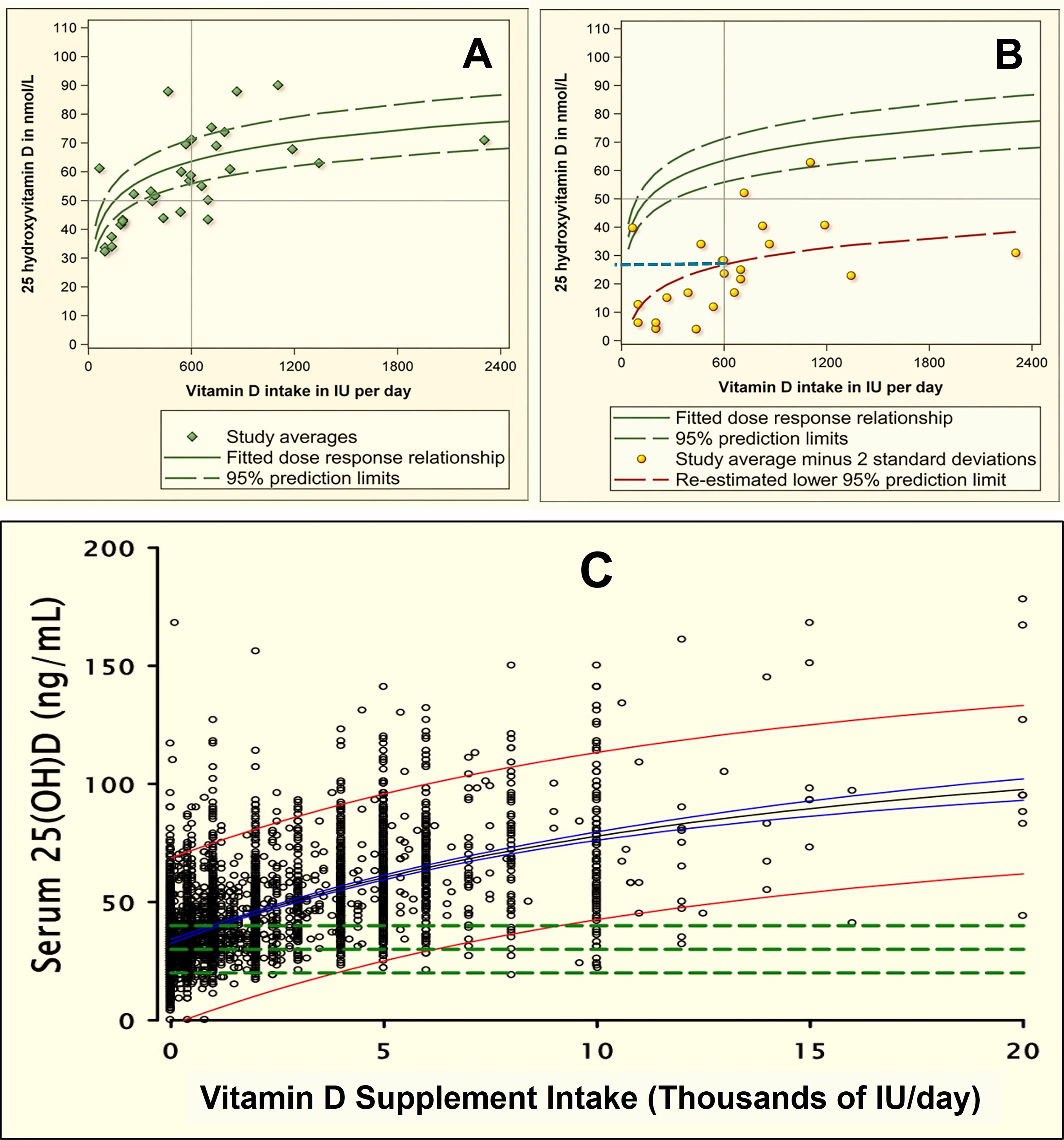
Figure 1. Vitamin D dose–response curves show the relationship between vitamin D intake and serum 25(OH)D concentration. (A), the dose–response relationship curves used by the IoM to compute the RDA based on the collection of average serum 25(OH)D concentrations from 32 studies. 25(OH)D concentrations (Y-axis). In (A,B), 25(OH)D concentrations are shown in nmol/L. Reproduced from Veugelers and Ekwaru, 2014, with permission [11]. (B), comparison of dose–response curves of the study averages (in green) compared to the re-estimated relationship (in red, bottom line), showing that with a supplemental intake of 600 IU/day, 97.5% of the population would achieve a serum concentration of approximately 27 nmol/L (10.8 ng/mL), not 50 nmol/L (20 ng/mL) (1B-horizontal, dashed, blue line). Reproduced from Veugelers and Ekwaru, 2014 [11], with permission. (C), dose–response curve for 3657 individuals showing both the best-fit regression line through the data and the 95% confidence limits for the total dataset. Reproduced from Heaney et al., 2015 with permission [11,61].
While study means are useful for comparing outcomes across studies, they cannot adequately characterize the nutrient requirements of a diverse population because they do not account for normal inter-individual biological variability (i.e., the distribution of requirements) [73]. An example of this from vitamin D is provided in Figure 1B. This illustrates that a supplemental intake of 600 IU/day would get 97.5% of the population only to a serum concentration of approximately 10.8 ng/mL (27 nmol/L), not 20 ng/mL (50 nmol/L) (Figure 1B, horizontal blue line).
This statistical limitation was first described by Veugelers and Ekwaru in 2014 [11] and subsequently confirmed by several independent analyses, including studies using the GrassrootsHealth cohort (Figure 1C) and other datasets. Collectively, these investigations demonstrated that substantially higher vitamin D intakes (approximately an order of magnitude higher) than those estimated by the original 2010 IoM model are required for nearly all individuals to achieve target serum 25(OH)D concentrations [11,61]. Beyond its implications for the RDA, this statistical framework also influenced the derivation of the Tolerable Upper Intake (UL). It contributes to ongoing debate about whether current upper intake recommendations adequately reflect the available scientific evidence on vitamin D safety and toxicity [74].
3.3. Optimal Serum 25(OH)D Concentration for Bone Health: Foundational Insights and Analytical Errors
There continues to be additional controversy regarding what the minimum circulating concentration of 25(OH)D necessary for maximum bone health is. VDD causes rickets in children and osteomalacia in adults. Therefore, understanding what concentration of 25(OH)D is necessary to prevent osteomalacia (a bone disease, hallmark of VDD) is essential to maximize bone health.
The IoM/NAM established a serum 25(OH)D concentration of 20 ng/mL (50 nmol/L) as sufficient for skeletal health based primarily on histomorphometric evidence related to the prevention of rickets and osteomalacia [75], with little attention to fractures, calcium homeostasis, or suppression of parathyroid hormone (PTH, threshold) [19,76]. Histomorphometric studies of iliac-crest biopsies demonstrate that vitamin D-deficiency osteomalacia is characterized by increased osteoid surface and osteoid volume, thickened osteoid seams, and delayed mineralization [77]. Histomorphometric diagnostic features of osteomalacia include increased osteoid volume, increased osteoid thickness, and prolonged mineralization lag time [75]. Impaired bone mineralization, osteoid volume/bone volume (OV/BV) over 2%, is considered a classical parameter of osteomalacia [77,78]. Others have quoted a diagnostic threshold of osteoid volume >5%, uncorrected osteoid thickness ≥15 μm, and mineralization lag time >100 days as diagnostic of osteomalacia [77].
The bone histomorphometric analysis used by the IoM to illustrate the prevalence of osteomalacia versus serum 25(OH)D concentrations [78] used data from the foundational article by Priemel et al. [78] from 675 individuals (401 males, mean age 59 ± 17 years, and 274 females, mean age 68 ± 17 years) who died by road traffic accidents, train accidents, assaults, or suicide, and other unnatural or unexpected causes in Germany [78]. In this study, pathological osteoid accumulation was not observed at serum 25(OH)D concentrations above 75 nmol/L (30 ng/mL). The authors therefore concluded that their analysis revealed that these adults had no evidence of osteomalacia when the circulating concentration of 25(OH)D was at least 30 ng/mL [78] (Figure 2).
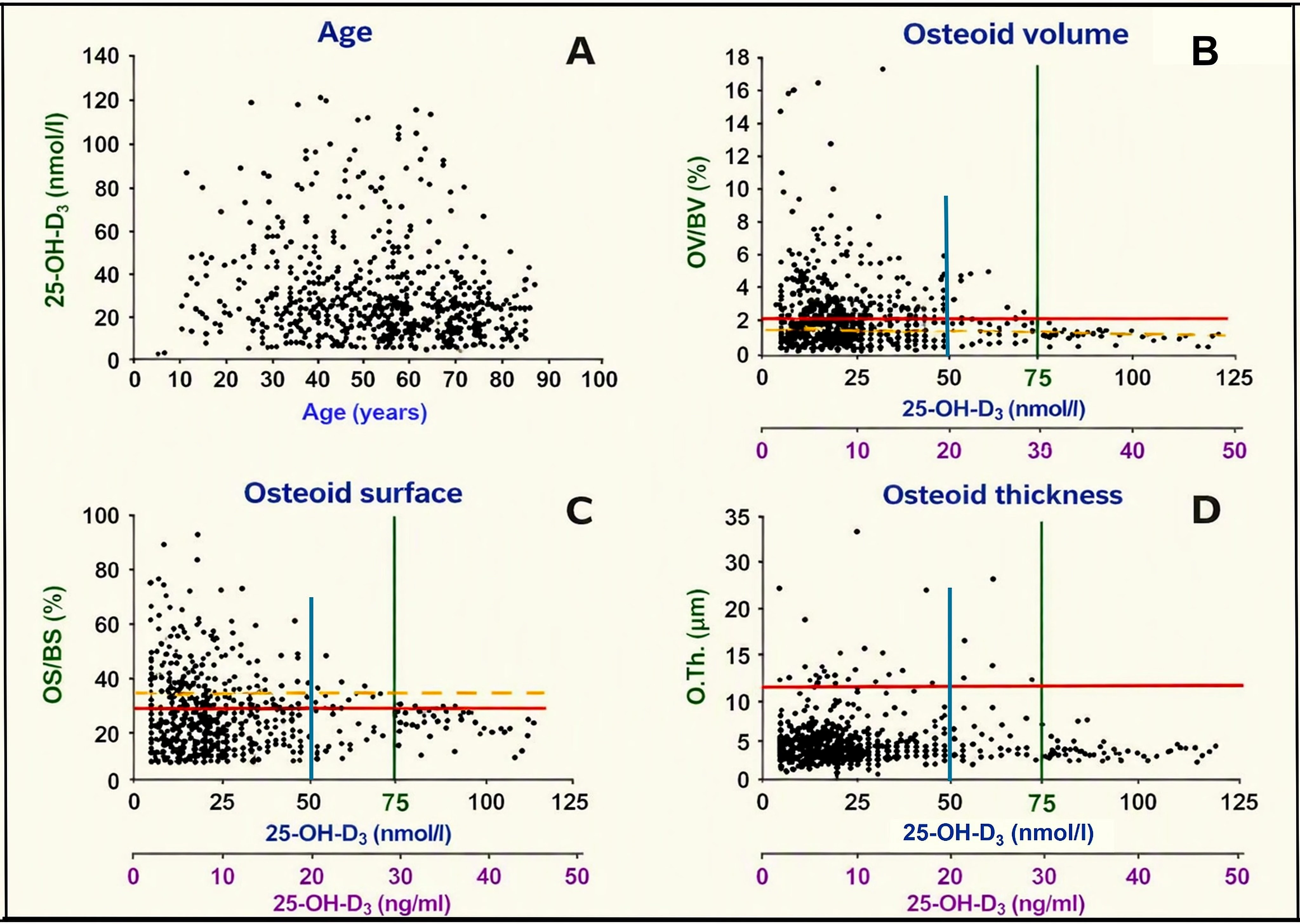
Figure 2. (A). Data on serum 25(OH)D concentrations and age. (B–D) illustrate bone mineralization defects (i.e., osteomalacia) indicated by osteoid volume in those with VDD. Histomorphometric analysis was carried out in iliac-crest bone biopsies, and 25(OH)D (X-axis) was measured in 675 people. Among individuals with a 25(OH)D greater than 30 ng/mL, there were no cases of accumulation of osteoid tissue (i.e., no histomorphometric evidence of osteomalacia). Meanwhile, 21.5% (6 of 28) of those whose 25(OH)D was between 20 and 30 ng/mL (50 and 75 nmol/L) had evidence of VDD-induced metabolic bone disease, osteomalacia (between blue and green vertical lines in (B–D) The solid red and dashed yellow lines represent the thresholds of osteoid volume, with the red line at 2% osteoid volume (used as a conservative histopathologic border to osteomalacia in this study) and the yellow line at 1.2% (as used by other studies). [reproduced from Priemel et al., [32,78], with permission. © American Society for Bone and Mineral Research].
The relevance here is an error made by IoM [32]. As pointed out by Heaney and Holick, the IoM took the number of subjects who had a circulating concentration of 25(OH)D between 21–29 ng/mL with osteoid volumes consistent with osteomalacia and incorrectly divided that number by the “total” number of adults from 0 to 29 ng/mL (74 nmol/L). With this, they concluded that less than 1% had evidence for osteomalacia [32,78]. Using that method, the IoM concluded that to prevent VDD bone disease, a circulating concentration of 25(OH)D needed to be at least 20 ng/mL [32]. This flawed value was incorporated as sufficient [32].
Instead, the numerator should have been the number of subjects with evidence of osteomalacia above 20 ng/mL divided by the number of subjects who had “no evidence of osteomalacia” above 20 ng/mL [77]. When one does that, 21.5% of adults who had a circulating concentration of 25(OH)D of 20–29 ng/mL had evidence of osteomalacia. Meanwhile, there was no evidence of osteomalacia in any of the adults who had a circulating concentration of at least 30 ng/mL [78], as illustrated in Figure 2. Thus, the proper interpretation of these data is that serum 25(OH)D concentrations should be >30 ng/mL to reduce risk of osteomalacia (i.e., no evidence of osteomalacia (not at 20 ng/mL) [76] (Figure 2). This therefore should have been the recommended concentration for sufficiency in terms of skeletal health, not 20 ng/mL as recommended by the IoM [32].
Histomorphometric findings in Figure 2 are informative yet observational, with limitations related to subgroup size and selection; thus, they carry the potential for confounding. In addition, they had no means to show that raising serum 25(OH)D above 30 ng/mL reduces fractures compared with 20 ng/mL. These values are presented as satisfactory for prevention of rickets and osteomalacia, but context-dependent cutoffs for fracture-prevention thresholds. The benefit of the higher target requires future clinical outcome evidence.
Meanwhile, the two fundamental errors described above (the incorrect calculation and the use of study mean), which remained uncorrected, were used by the 2011 IoM group regarding evidence selection and interpretation of the scientific basis underlying the current DRIs, leading to their flawed conclusions [32].
3.4. Plateauing of PTH and the 25(OH)D Threshold
Parathyroid hormone status (PTH) is a surrogate for vitamin D status; i.e., it is inversely related to serum 25(OH)D concentrations. The relationship between 25(OH)D concentrations and PTH has been widely investigated as a physiological indicator of vitamin D sufficiency. The IoM also recognized that elevated PTH concentrations are a risk factor for osteoporosis [32]. Based on their selected limited review of the literature to fit the conclusion mentioned in Section 3.2, IoM determined that for maximum bone health related to PTH concentrations, circulating concentrations of 25(OH)D needed only to be 20 ng/mL.
The relationship between PTH and 25(OH)D has been debated for decades and is influenced by multiple factors, including age, kidney function, calcium intake, magnesium status, assay variability, and other physiological determinants. As pointed out in the previous section, the risk of osteomalacia is eliminated only with serum 25(OH)D concentrations above 30 ng/mL. Subsequent reviews have reaffirmed that this recommendation was intended to define the minimum concentration required for bone health in the general population and was not designed to suppress PTH or optimize other physiological systems [79].
While addressing chronic kidney disease (CKD) is beyond the scope of this manuscript, it substantially alters mineral metabolism and PTH-FGF23 regulation, limiting the interpretation of serum 25(OH)D concentrations as indicators of treatment efficacy or safety [80]. Patients with CKD or disorders of calcium-phosphate metabolism require disease-specific evaluation and management in accordance with established CKD guidelines and specialist care [81–83]. General vitamin D dosing and target recommendations in this article should not be used for these special populations without individualized clinical assessment.
Independent observational and mechanistic evidence has demonstrated an inverse relationship between serum 25(OH)D and circulating PTH concentrations up to just over 30 ng/mL, after which PTH begins to plateau. This is particularly important in those with obesity [84]. Several studies suggest that maximal suppression of PTH is achieved only at higher concentrations of 25(OH)D than 30 ng/mL, as discussed in the next paragraph. A review by Sai et al. concluded that no single universal PTH plateau exists because the threshold varies according to population characteristics, assay methodology, age, ethnicity, calcium intake, and renal function, although most reported plateau values clustered between 30 and 35 ng/mL [85,86]. The cited 30 to 35 ng/mL range reflects physiological observation rather than a validated therapeutic threshold. Moreover, PTH suppression alone does not establish a universally optimal 25(OH)D concentration and has not been shown to reliably predict patient-important clinical outcomes [86].
Subsequent studies have more consistently identified PTH inflection and plateauing points at 25(OH)D concentrations around 30–32 ng/mL. Shibli-Rahhal et al. demonstrated significant reductions in PTH once serum 25(OH)D concentrations reached ≥30 ng/mL in individuals with elevated baseline PTH [87]. Similarly, Mukhopadhyay et al. reported a PTH inflection point in adults, approximately 32 ng/mL [86], beyond which increases in serum 25(OH)D produced little additional suppression of PTH, confirming that this amount is sufficient from a skeletal biology point of view [88,89], while a larger cross-sectional study disagrees with this [56].
Comparable thresholds have also been reported in pediatric populations, with plateau concentrations of approximately 33.2 ng/mL in adolescent boys and 36 ng/mL in adolescent girls [87]. They reported that the deflection points begin to plateau between 30–35 ng/mL and were consistent with the threshold for vitamin D status with hip and nonvertebral fracture prevention from a meta-analysis of RCTs [90]. These findings support the concept that serum 25(OH)D concentrations above 30–32 ng/mL are sufficient to prevent classical skeletal deficiency diseases, bone mineralization (rickets in children and osteomalacia in adults), maintain calcium homeostasis, and suppress PTH [55,88,91]. Below this range, rising PTH is associated with impaired mineral metabolism and secondary hyperparathyroidism [19,79,92]. One large cross-sectional retrospective database study suggested, instead of a threshold, an age-dependent PTH—25(OH)D continuum [86]. Methodological differences are thought to be the anomaly and the explanation for this.
3.5. Limitations of Current Guideline Assumptions
The above concerns surrounding the derivation of the RDA have implications beyond the numerical values of the IoM [32] and 2011-ES [19] recommendations. Because the RDA underpins many clinical guidelines, public health policies, educational resources, and research protocols, the assumptions used in its development have broadly influenced the interpretation of vitamin D in healthcare and public health, as VDD is common in the general population [93]. They influence daily supplementation recommendations, Tolerable ULs, clinical trial design, medical practice and recommendations, and public perceptions of vitamin D safety and efficacy. Consequently, re-evaluating the statistical methods and calculations used to derive the current RDA and updating them properly using recent observational study data, considering contemporary evidence, is an essential first step toward modernizing vitamin D guidelines.
4. Re-Evaluating the Evidence Base for Vitamin D Guidelines
In recent years, more than 100,000 peer-reviewed publications have examined the extraskeletal effects of vitamin D. According to PubMed.gov, there have been 78,115 publications since 2000 with vitamin D in the title or abstract, over 60,000 of them since 1 January 2011. A substantial body of evidence supports broader roles in immune regulation and autoimmunity [94,95], pregnancy [31,96], musculoskeletal health [97], metabolism [98], cancer [99], diabetes and healthy aging [100], and Alzheimer’s disease and dementia [101,102]. Higher vitamin D has also been associated with better immune and metabolic health and lower risks of infectious and cardiovascular diseases [14], cancer [99,103], and all-cause mortality [104–106]. Despite this growing evidence, some governmental recommendations, including those from the NIH [107], as well as primary outcomes of mega-vitamin D RCTs [108] like the VITAL study [69] and certain scientific-society guidelines, continue to overlook this evidence of extraskeletal beneficial effects.
In addition, there have been major advances in understanding vitamin D biology and physiology and increasing recognition that research methods such as RCTs developed for pharmaceutical agents are often inappropriate for evaluating nutrients, as discussed below. This has prompted renewed calls to re-evaluate existing guidelines. During the expert panel, speakers expressed concern that the 2024-ES guideline placed disproportionate emphasis on large RCTs, most of which were poorly designed for nutrients [9,70], while disregarding well-designed observational studies, mechanistic research, encompassing nutrient-specific trial design principles, and evidence from studies fulfilling multiple Hill’s criteria for causality [2].
For vitamin D, baseline 25(OH)D status, achieved 25(OH)D concentration, dose, treatment duration, adherence, cofactors and co-interventions, and dosing frequency can materially affect whether a trial can produce and/or detect benefit. New guidelines should incorporate contemporary scientific knowledge, updated statistical methods, and research frameworks specifically designed for nutrient interventions, with the goal of identifying recommendations specific to both public health and clinical practice, as outlined in detail in the following sections.
4.1. Limitations of Conventional RCTs for Nutrient Research
RCTs are considered the gold standard for evaluating pharmaceutical therapies (synthetic agents) because participants are assigned to receive or not receive the intervention under controlled conditions. RCTs are the principal study design used to establish drug efficacy and generate pivotal evidence supporting regulatory approval of novel therapeutic agents [109]. RCTs are essential for assessing the causal effects of interventions and the clinical effectiveness of pharmaceutical agents, offering valuable insights beyond observational studies. However, nutrients such as vitamin D differ fundamentally from pharmaceutical agents and should not be evaluated using conventional drug development models (i.e., nutrients vs. synthetic drugs) [70,110].
Nutrient trials present additional methodological challenges, particularly when baseline nutrient status, background intake, individual dose–response variability, and achieved serum concentrations are not adequately considered [110]. These limitations do not invalidate evidence from RCTs but emphasize the importance of nutrient-specific trial design and careful interpretation of both positive and null findings. The fundamental biological distinction between drugs and micronutrients is particularly important when designing and interpreting clinical studies [70]. Nutrients are essential for normal physiological function and are subject to homeostatic regulation [111]. In contrast, drugs are generally intended to treat diseases [112]. Micronutrients, however, function across interconnected biological systems and primarily contribute to health maintenance and disease prevention [113].
Pharmaceutical agents are generally administered to exert a pharmacological effect that is not normally present in the body, whereas micronutrients participate in physiological pathways that are essential for normal cellular function [70]. Unlike most pharmaceuticals, nutrients are already present in the body at baseline, and individuals enter a trial with widely varying levels of intake and physiological status. There is therefore rarely a true “zero-exposure” control group [70]. Nutrient responses therefore frequently exhibit nonlinear, sigmoid, or threshold-dependent relationships with intake and biological status [114] rather than the relatively straightforward dose–response relationships often assumed in pharmaceutical research [115,116].
Unlike most non-natural medications, which typically exhibit steep dose–response relationships (i.e., high Hill slope) [117] and are designed to produce pharmacological effects with fixed doses, vitamin D is an essential nutrient with a relatively shallow dose–response curve that produces threshold-dependent biological effects [115,118]. The Hill slope is a parameter describing the steepness of a dose–response or concentration–response curve; it is not synonymous with the Hill coefficient. It quantifies the steepness of a dose–response curve: a value of 1 represents the standard slope, values >1 indicate a steeper response, and values <1 indicate a shallower response [117]. Concentration–response relationships for vitamin D, as an essential nutrient, generally exhibit a shallower, threshold-dependent biological response than pharmaceutical agents [70].
4.2. Why Nutrient RCTs Require Different Evaluation Frameworks
Vitamin D has a nonlinear, threshold-dependent dose–response relationship, with benefits greatest in individuals with low baseline vitamin D status and diminishing once physiological adequacy is achieved [1,14,118]. Nutrient studies must therefore account for differences in baseline nutritional status, physiological requirements, absorption, metabolism, and utilization [70]. Conventional fixed-dose RCTs are not appropriate for assessment of any nutrient [70]. They often fail to account for baseline status, concentration achieved in the blood, biological variability, and threshold effects [1,14,119]. Consequently, such designs may increase false-negative findings and underestimate biological effects [1,14].
Baseline vitamin D status is particularly important because individuals who are already sufficient are unlikely to show additional benefit from supplementation [1,14,70]. Moreover, the same dose can produce varied serum 25(OH)D concentrations in different individuals, because of differences in absorption, metabolism, body composition, genetics, and other factors (more detail in Section 5.1). Evidence should be triangulated, not treated as equivalent. Intervention claims should be based on adequately powered randomized trials and systematic syntheses. Cohort studies identify risk markers and generate hypotheses, while Mendelian randomization provides complementary causal evidence, though limited by instrument validity. Subgroup analyses by baseline deficiency or achieved levels are exploratory unless they maintain causal identification. Strong associations alone do not prove treatment effectiveness.
Achieved serum 25(OH)D is biologically informative but should not be considered as a confounder. Conditioning on this post-randomization measure may introduce adherence-related, disease-severity, collider, or selection bias. Intention-to-treat analysis should remain the primary approach. Instrumental-variable methods or prospectively randomized target strategies may supplement, but not replace, assigned-treatment comparisons. Achieved-level analyses must address these biases explicitly and should not be considered superior by default.
The goal of vitamin D supplementation is not a uniform dose but achieving and maintaining adequate serum 25(OH)D concentrations that support normal physiological functions—a treat-to-target rather than fixed-dose approach [1,14,18]. Serum 25(OH)D concentrations reflect the vitamin D status, not the supplementation; therefore, this biomarker best indicates sufficiency and treatment response [120]. Most of the potent effects of vitamin D are mediated by intracellularly generated 1,25(OH)₂D intracrine and paracrine signaling, and its binding to VDR that drives genomic actions [119,121].
Many peripheral cells and organs are capable of locally converting vitamin D to 25(OH)D, and 1,25(OH)D to 1,25(OH)₂D as needed. This extra-renal production is triggered by Toll-like and other receptor signaling [122]. These biological effects highlight that in clinical studies, analyses based on administered dose are not only inappropriate but also likely underestimate true effects. Consequently, outcomes should be evaluated according to achieved and maintained serum 25(OH)D concentrations rather than administered dose [1,14,70,110,112,119,123] and vitamin D metabolite [124–127].
4.3. Suboptimal Study Designs Distort Outcomes and Conclusions
Study design can substantially influence trial outcomes. Serum 25(OH)D concentrations may require several months to reach a new steady state after supplementation begins (i.e., the length of the study) [119,128]. Therefore, studies with short follow-up periods are likely to underestimate potential benefits when vitamin D is administered [129]. This can be, however, overcome by administering either (a) an upfront loading dose or (b) using partially hydroxylated vitamin D, calcifediol [25(OH)D] [100,127,130–132].
Table 1 presents a practice that experienced clinicians worldwide, including the panel, have used for decades. It is based on physiological and biological principles and supported by clinical experience, indicating improved recovery and earlier hospital and ICU discharge [22,133]. In addition, the consumption of vitamin D and magnesium markedly increases with acute conditions [22,134], especially during infections and acute exacerbations of autoimmune disorders, making replacement of them during hospitalizations beneficial [134–137]. For example, in acute settings, vitamin D repletion may be achieved with a loading dose of vitamin D, or if available, a partially activated vitamin D analog, calcitriol [17,138], as in the case of severe SARS-CoV-2 infection [139,140].
Observational studies and implementation cohorts can generate important hypotheses but may not prove that target-based dosing is better than well-chosen fixed-dose regimens for reducing mortality, infection, ICU transfer, length of stay, or other major clinical outcomes. [141,142]. Acute illness often increases the consumption and depletion of vitamin D and magnesium, both essential for metabolic and immune function [143]. Consequently, vitamin D deficiency is common in hospitalized and critically ill patients and is linked to adverse outcomes [133,141,144]. Assessing and correcting vitamin D deficiency in selected hospitalized patients is a reasonable part of clinical care, while recognizing the difference between biochemical correction and proven effects on clinical outcomes [22,141]. The panel recommends considering this for inclusion in updated clinical guidelines.
In addition, many RCTs have been conducted for insufficient duration or have failed to cover the relevant etiologic period necessary for diseases with long, multistage development, such as cancer and cardiovascular disease. In most mega-vitamin D RCTs, placebo groups are often allowed to continue background multivitamins and vitamin D intake, reducing the difference in achieved vitamin D status between groups and limiting the ability to detect meaningful effect sizes. These further emphasize the need for nutrient-specific study designs that account for the biological characteristics of nutrients rather than relying solely on pharmaceutical trial paradigms [70].
As Heaney emphasized in Guidelines for optimizing design and analysis of clinical studies of nutrient effects [115] nutrient trials should be designed around nutrient-specific physiological criteria and the characteristic sigmoid relationship between nutrient status and measurable biological responses [115,145,146]. In particular, the response to supplementation may be substantial in individuals whose baseline status is inadequate but progressively diminish as physiological sufficiency is approached [1,14].
This distinction has major implications for the interpretation of RCTs. Once an individual has reached an adequate physiological concentration of a nutrient, additional supplementation may produce little or no measurable benefit for a particular outcome [70]. Consequently, enrolling predominantly nutrient-replete participants, or comparing two groups whose baseline nutrient status is already adequate, can substantially reduce the ability of an RCT to detect a genuine biological effect [70,146]. Lappe and Heaney [110] demonstrated how failure to account for baseline nutrient status, dose adequacy, achieved biological exposure, co-nutrient status, and nutrient-specific dose–response characteristics can contribute to apparently null findings in calcium and vitamin D trials [70].
Below is an example of analysis by treatment group versus serum 25(OH)D concentration in a nutrient study design, along with the difference in study outcome, based on data from an RCT by Wagner et al. in 2016 [147]. When re-analyzing the same data by treatment group versus serum 25(OH)D achieved in the circulation with the intended clinical outcomes, there was a significant reduction in preterm deliveries in mothers who achieved higher serum 25(OH)D concentrations that was not recognized in the analysis based on supplement intake dose [147] (Figure 3).
Figure 3. Importance of nutrient study design shows the difference in outcome conclusion between analysis by treatment group vs. analysis by achieved serum concentration. Left side of the figure (A): rate of preterm delivery by intake of 400 IU/day (Blue) versus 4000 IU/day (Red). Right side (B): those same participants, rate of preterm delivery, analysis by achieved serum 25(OH)D concentration; treatment group, comparing those who achieved ≤ 20 ng/mL versus those who achieved ≥ 40 ng/mL [147].
4.4. Limitations of This Evaluation and Confounders
Another often overlooked issue in nutrient research is that vitamins frequently require specific cofactors (co-nutrients) for optimal biological function [148]. Yet this principle has rarely been considered in vitamin D trials [70,119]. Although RCTs could provide useful evidence, their major limitations should be recognized. For example, recent large RCTs like the VITAL study reported several null results but had multiple design issues. These included the use of fixed-dose supplementation, enrollment of populations with relatively adequate baseline vitamin D status (in baseline and one-year samples, only 17.8% had concentrations below 20 ng/mL at baseline, meaning most participants were not deficient), and continued routine vitamin D supplementation up to 800 IU/day for each of the control and intervention groups [69].
Multiple clinical studies have confirmed that supplementation is less effective in vitamin D-replete populations. Despite the null primary cancer-incidence result [69], a prespecified secondary analysis of VITAL found that daily vitamin D₃ supplementation (2000 IU) was associated with a lower incidence of metastatic or fatal cancer among participants with normal BMI (<25 kg/m²; HR, 0.62; 95% CI, 0.45–0.86), but not among participants with overweight or obesity (p for interaction = 0.03) [149].
4.5. Redesigning Evidence in Micronutrient Research: Beyond Conventional RCTs
Hebert et al. identified important methodological challenges in nutrition research, including limitations in exposure and outcome measurement, analytical methods, and appropriate controls [70,145,146]. These considerations are particularly important for micronutrients, as their biological effects depend on an individual’s baseline nutritional status, intake level, achieved circulating concentrations, duration of exposure, co-nutrient status, and the physiological range of nutrient concentrations [55,119]. Thus, although RCTs may remain important, their conventional pharmaceutical-style design may not adequately assess micronutrient efficacy [115,150–152].
Importantly, the difficulty is not simply a question of whether RCTs should or should not be used. Rather, the central issue is whether the study design adequately reflects the biology of the nutrient being investigated [70]. Unlike most pharmaceuticals, nutrients are already present in the body at baseline, and individuals enter a trial with widely varying concentrations of intake and physiological status. There is therefore rarely a true “zero-exposure” control group [70]. Moreover, the response to supplementation may depend critically on whether participants are deficient, insufficient, or already physiologically replete at baseline [70,72]. Failure to account for these factors can dilute the treatment effect and increase the likelihood of a misleading null result [1,14].
Because conventional RCTs often fail to address key criteria for nutrient research, their findings require careful interpretation and should not be the sole basis for clinical guidelines. The ES-2024 guideline [9] relied heavily on RCTs involving vitamin D-sufficient participants and adopted the IoM DRI [32] for routine supplementation. Although conditional recommendations were provided for selected groups, including older adults, pregnant individuals, and children, many vitamin D RCTs have important design, conduct, or analytical limitations [12]. Consequently, their findings may differ from observational evidence [1,29,153]. Future guideline committees should therefore consider the totality of evidence rather than relying predominantly on RCTs.
Based on the above considerations, the panelists questioned the validity and generalizability of findings from the recent “mega” RCTs that recruited vitamin D–sufficient participants predominantly and were considered in the 2024 ES report [9]. Examples of these mega-vitamin RCTs include VITAL—Manson et al. [69]; ViDA—Scragg et al. [154]; D-Health—Neale et al. [155]; and DO-HEALTH—Bischoff-Ferrari et al. [156]. All mentioned studies considered serum 25(OH)D concentrations above 20 ng/mL sufficient (i.e., bone-centric levels) and had major design limitations, including enrolling vitamin D-sufficient participants, failing to measure baseline or achieved 25(OH)D concentrations, and not correlating achieved levels with clinical outcomes [70,72,157]. These limitations undermine the validity of their findings and recommendations.
The panel unanimously concluded that data from sub-optimally designed and/or poorly conducted RCTs, despite their large sample sizes and substantial costs, can provide unreliable conclusions and have limited generalizability to the broader population, particularly to individuals with VDD. The panel also broadly agreed that the 2024 ES recommendations have limited applicability as clinical guidelines and should not be used as the basis for designing future RCTs or making global health policy decisions.
4.6. Approach Best Suited to Evaluate Micronutrients
These concerns have been recognized by several investigators in the field of nutritional science. Blumberg et al., in Evidence-based criteria in the nutritional context [145] emphasized that the evidence required for evaluating nutrients and establishing nutrient requirements differs fundamentally from that used to evaluate pharmaceutical drugs. They concluded that RCTs are valuable but cannot, by themselves, adequately address the complex interactions and physiological functions of nutrients; instead, nutritional decisions should consider the totality of available evidence, including biomarkers, observational data, mechanistic evidence, and intervention studies [145].
Similarly, Weaver and Miller, in Challenges in conducting clinical nutrition research [158] highlighted several methodological issues unique to clinical nutrition research, including baseline nutritional status, appropriate control groups, difficulties with blinding, ethical considerations, and the tension between recruiting nutritionally vulnerable individuals and selecting representative populations [70]. These considerations are especially important when the purpose of an intervention is to correct a deficiency or restore a physiological function rather than to produce a pharmacological effect on an otherwise nutritionally adequate population [14,158,159].
The Expert Panel reemphasized and recommended that continuing application of conventional drug-oriented RCT methodology to micronutrients may therefore lead to systematic underestimation of their biological effects [1,14,119,160]. This does not imply that RCTs should be abandoned. Rather, they should be appropriately designed and interpreted within the biological framework of nutrient science [2]. As Heaney further noted, nutrient trials should consider baseline status, dose, duration, and co-nutrient status when interpreting heterogeneity among studies [2]. Systematic reviews and meta-analyses should likewise consider these biological characteristics when determining whether apparently heterogeneous studies are genuinely comparable [70].
Accordingly, the continuing debate should not be framed as RCTs versus observational or mechanistic studies, but rather as whether the research methodology is biologically appropriate for the substance being investigated [14,136]. Micronutrients are physiological agents with nonlinear dose–response characteristics [114], complex interactions with other nutrients, and effects that depend strongly on baseline status [70]. Their evaluation therefore requires research designs that recognize these properties and integrate RCTs preferentially with observational, mechanistic, biomarker, and other forms of evidence [2,70,146].
A more appropriate framework for micronutrient research therefore integrates multiple complementary forms of evidence rather than relying exclusively on conventional RCTs. Observational studies can identify dose–response relationships and associations across broad populations; mechanistic and experimental studies can establish biological plausibility and elucidate pathways [70]. In addition, appropriately designed clinical trials (without bias) can test whether correction of an established deficiency or alteration of nutrient status produces the predicted clinical response [2]. The convergence of these independent lines of evidence provides a stronger basis for causal inference than reliance on any single study design [2,14,136,161,162].
Biological plausibility and improved surrogate markers do not demonstrate reductions in fractures, infections, cardiovascular events, cancer, hospitalization, or mortality. Proposed physiologic thresholds and system-level models are still hypotheses that require prospective clinical validation; they generate testable predictions but do not confirm clinical benefits. Observational studies, combined with other data such as RCTs, can help confirm causality in Hill’s criteria analyses, as recently published [2].
Long-term prospective observational studies are best suited to assess sustained exposure, dose–response relationships of micronutrient status and clinical outcomes [72]. Consistent observational evidence should not be dismissed solely because an RCT lacks statistical significance. Rather than automatically privileging (bias) RCTs, studies should be judged by methodological quality, confounding, bias, biological plausibility, and relevance to the micronutrient question. RCTs offer useful causal evidence when dose, duration, baseline nutrient status, adherence, and outcomes suit the question [70,72,157].
Recommendations should reflect the full body of evidence and prioritize clinically meaningful outcomes from well-designed intervention studies. Current vitamin D clinical guidelines, however, have not addressed this. The strength of evidence depends on the intervention, comparator, population, achieved vitamin D status, and outcomes assessed. A balanced interpretation weighs the strengths and limitations of both randomized and observational studies, as well as biological plausibility and consistency [150].
4.7. Need for Integrating Multiple Forms of Scientific Evidence
No single study design can adequately address all questions regarding the health effects of vitamin D. Evidence regarding vitamin D should be evaluated using a broader systems framework that integrates complementary approaches, including well-designed prospective longitudinal studies, epidemiological cohorts, mechanistic investigations, and, in specific cases, clinical trials, to provide a more comprehensive understanding of its biological and health effects [113].
Although RCTs provide strong evidence for causality for synthetic agents (drugs) when appropriately designed and demonstrate positive effects, null findings require careful interpretation with nutrient trials because they are vulnerable to methodological factors that may produce false-negative results [2]. And, as with many disorders, vitamin D requirements differ for “prevention and treatment,” and this distinction should be considered when designing studies and developing recommendations [14,136].
Observational studies are significantly better suited than RCTs and Mendelian randomization (MR) studies, while heterogeneous, to evaluate disease prevention because they assess long-term vitamin D status before disease onset. In contrast, appropriately designed clinical trials may be more suitable for evaluating therapeutic effects after the disease has developed (i.e., treatment effects). Nevertheless, prospective supplementation studies with careful monitoring of serum 25(OH)D concentrations have also demonstrated significant benefits for outcomes such as pregnancy complications [163], blood pressure control [164], and risk of myocardial infarction [165]. Nevertheless, vitamin D supplementation without monitoring 25(OH)D concentrations has been found to reduce the risk of COVID-19 [166] and Alzheimer’s disease and vascular dementia [167].
Observational studies, including ecological analyses, prospective cohort studies, and large population datasets such as NHANES and the UK Biobank, have consistently demonstrated associations between higher serum 25(OH)D concentrations and improved outcomes across multiple disease categories. Mechanistic studies further provide biological plausibility by demonstrating vitamin D effects on gene regulation, immune function, and cellular physiology. Although MR studies have limitations for evaluating nutrients with relatively small effect sizes, appropriately conducted analyses may provide additional insights into genetically determined differences in lifelong vitamin D status.
Many RCTs run for insufficient duration or miss the relevant etiologic window for diseases with long, multistage development, such as cancer and cardiovascular disease. In the Women’s Health Initiative calcium-plus-vitamin-D trial, 18,176 postmenopausal women received calcium carbonate 1000 mg/day plus vitamin D₃ 400 IU/day, and 18,106 received placebo. Over the roughly 7-year intervention, supplementation did not reduce overall colorectal cancer incidence (168 vs. 154 cases; HR 1.08, 95% CI 0.86–1.34; p = 0.51) [168]. However, at postintervention follow-up (median 22.3 years), women not using personal calcium or vitamin D supplements at randomization who received calcium plus vitamin D showed 31% lower colorectal-cancer incidence than placebo (HR 0.69, 95% CI 0.54–0.87) [169]. Thus, short trial duration and dilution from non-study supplementation likely contributed to the initial null result [129].
A recent review of MR analyses found genetically high 25(OH)D concentrations associated with reduced risk of multiple sclerosis incidence and relapse, non-infectious uveitis and scleritis, psoriasis, femur and leg fracture, amyotrophic lateral sclerosis, anorexia nervosa, delirium, heart failure, ovarian cancer, non-alcoholic fatty liver disease, dyslipidemia, and bacterial pneumonia [170]—causal etiologies corroborated by other MR studies [171], lending further support to observational findings. This integrated approach aligns with Bradford Hill’s causal-inference criteria [172], which emphasize weighing the totality of evidence rather than relying solely on individual RCTs [2]. Converging mechanistic, observational, genetic, and interventional evidence offers a more appropriate framework for evaluating nutrients like vitamin D, whose effects depend on achieving and maintaining adequate status rather than administering a fixed dose.
4.8. Implications for Future Guideline Development
The evolving understanding of vitamin D biology and nutrient research methodology discussed here has important implications for the development of future micronutrient guidelines [70]. All future vitamin D clinical studies should incorporate key nutrient-specific design principles, including measurement of baseline and achieved serum 25(OH)D concentrations, and individualized dosing to reach predefined target concentrations [72,153]. Consideration of body composition and other factors affecting vitamin D metabolism, assessment of relevant nutrient cofactors, and analyses based on achieved vitamin D status rather than assigned dose alone [119]. Realistically, more than a decade will be needed to conduct higher-quality RCTs that meet the improved criteria outlined above. In the interim, observational studies will continue to provide the best available evidence.
The above-mentioned approaches, consistent with principles proposed by Heaney and colleagues [115], would improve the ability of future studies to accurately evaluate the relationship between vitamin D status and health outcomes and will better reflect the unique characteristics of nutrient biology, therefore improving the accuracy and clinical relevance of vitamin D recommendations [70,72,157]. Taken together, the statistical concerns discussed in Section 3, advances in vitamin D biology, and improved understanding of nutrient research methodology support a comprehensive re-evaluation and recreation of the evidence base underlying current vitamin D guidelines. Future recommendations should integrate modern concepts of nutrient physiology, apply study designs specifically developed for nutrient interventions, and consider the totality of available evidence rather than relying on any single category of research.
5. Advancing Vitamin D Science: Optimization in Clinical Practice and Personalized Care
A central theme emerging from contemporary vitamin D research is that individuals exhibit substantial inter-individual variability in their biological response to the same vitamin D intakes [173]. While population-based recommendations remain important for public health and community-level disease prevention, a single dose cannot be expected to produce uniform biological effects across diverse individuals [119]. In addition, a single RDA value is unlikely to meet the diverse requirements of a diverse population given substantial interindividual variability in baseline 25(OH)D concentrations, metabolism, biological responses, physiology, genetics, lifestyle, body composition, and health status, as all influence individual vitamin D requirements.
Closely related to this issue are questions regarding the validity of the current UL. A single UL cannot reasonably account for individuals ranging from 50 kg to 250 kg body weight, just as a single dose recommendation cannot meet the substantially different physiological requirements across such a wide range. Although the adult UL of 4000 IU/day, along with the no observed adverse effects concentration of 10,000 IU/day, was established for the general population, numerous clinical studies have demonstrated the safe use of higher vitamin D intakes under appropriate monitoring. These findings have prompted ongoing discussion regarding whether current dose and UL recommendations remain appropriate or require revision.
5.1. Why a Single Vitamin D Dose Cannot Meet Everyone’s Needs
Individuals receiving the same daily dose of vitamin D may achieve substantially different serum concentrations of 25(OH)D, as illustrated in the dose–response curves in Figure 4. This is due to variations in body weight and adiposity, as well as gastrointestinal disorders affecting absorption, concurrent medication use, sun exposure, pregnancy, aging, chronic disease, dietary factors and medications, baseline 25(OH)D status, and cofactor availability [15].
Additional sources of variability include genetic polymorphisms affecting vitamin D-activating and catabolic enzymes, vitamin D receptors, transport proteins, and metabolic pathways, as well as inflammatory conditions and infections that may increase vitamin D utilization [173]. Deficiencies of key cofactors like magnesium and other nutrients further modify biological responses to supplementation. Collectively, these factors contribute to substantial interindividual variability in vitamin D requirements and biological responses (e.g., blood concentrations and clinical responses), highlighting the limitations of uniform (fixed) dosing strategies in clinical trials and practice [174].
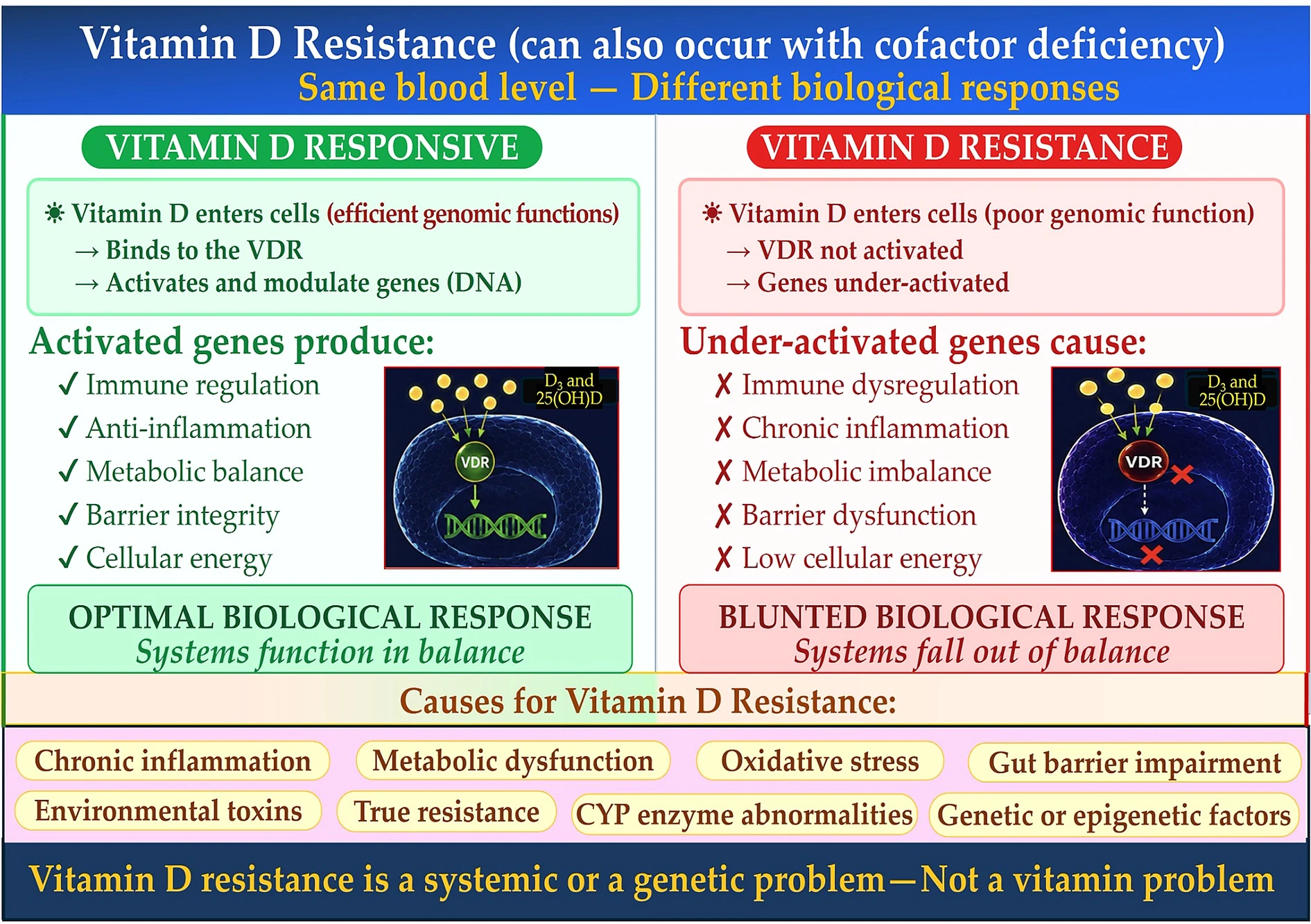
Figure 4. Vitamin D dose–response curves illustrate variability by body mass index, defined as underweight, normal weight, overweight, and obesity, with 25(OH)D concentration in nmol/L (Y-axis). (A), The dose–response relationship between oral dose of vitamin D supplementation and 25(OH)D serum concentrations categorized by body mass index, adjusted for age, gender, and season. [11,175]. (B), The dose–response relationship between oral dose of vitamin D supplementation and 25(OH)D serum concentrations based on data from 22,214 healthy volunteers. The mean plasma 25(OH)D concentration for all doses is represented by each bubble, with bubble size proportional to the number of assessments at each dose. Vertical, blue double arrow indicates large scatter of data. Reproduced from Ekwaru et al., 2014, with permission [175].
The variability in achieved serum 25(OH)D concentrations after supplementation reflects differences in vitamin D absorption, distribution, storage, availability, metabolism, and utilization. Body composition is an important determinant of vitamin D intake. Individuals with obesity (higher body fat content) generally require substantially higher vitamin D intakes to achieve serum 25(OH)D concentrations comparable to those with lower body mass indices [65,176], largely due to volumetric dilution and altered vitamin D distribution [177].
Lower serum 25(OH)D concentrations found in overweight and obese persons reduce bioavailability, resulting in a smaller rise in serum vitamin D status after UV exposure/oral dosing and less efficient attainment of adequate serum concentrations of vitamin D₃ and 25(OH)D, and a shorter half-life of 25(OH)D and its biological availability in the blood [175,178]. Lower serum 25(OH)D concentrations in individuals with obesity (BMI >30 kg/m²) reflect a combination of altered distribution, volumetric dilution, and increased catabolism of vitamin D and its metabolites [175–179]. Regardless of whether this represents absolute deficiency or altered distribution, what is clinically relevant is the reduced availability of vitamin D₃ and 25(OH)D in circulation; therefore, their ability to diffuse into peripheral target cells is reduced [17,119].
Although adipose tissue sequesters and stores vitamin D, it remains unclear whether it releases vitamin D back into the circulation in a bioavailable and physiologically regulated manner when needed [180]. Obesity-related metabolic changes may further increase its breakdown (i.e., catabolism via 25-hydroxyvitamin D-24-hydroxylase; CYP24A1), resulting in lower circulating concentrations and smaller increases in 25(OH)D after supplementation [178]. Consequently, reduced vitamin D availability may limit delivery to target tissues, including immune cells, despite similar intake. In addition, adipose tissue increases disease risk of diseases through sustained chronic inflammation and other mechanisms in ways that vitamin D cannot counter [181,182].
Likewise, differences in gastrointestinal absorption, liver and kidney function, medication use, chronic disease, aging, and habitual sun avoidance/exposure influence vitamin D status and requirements. Among these factors, body weight/ body mass [183] is one of the strongest and most predictable determinants of vitamin D needs, suggesting that weight- or BMI-based dosing strategies may be more appropriate than fixed daily intake recommendations alone [11,17,20,175]. For example, serum 25(OHD concentration above 50 ng/mL can be achieved with 1000 IU per 10 kg of body weight, but based on an individual’s metabolism and body fat, the variability can be high [14,136].
5.2. Treat-to-Target-Achieve and Maintain Serum 25(OH)D in Therapeutic Concentrations
The authors recommend sensible sun exposure, dietary vitamin D, food fortification, and supplementation as needed to maintain adequate vitamin D levels and support public health [19]. UVB exposure guidelines should weigh benefits against skin cancer risk and local conditions. Population strategies should aim to prevent deficiency, while individuals with confirmed deficiency or high-risk factors may require personalized testing, treatment, and monitoring. Food fortification is an effective public health approach to improving population vitamin D status [184–187].
Although observational studies support higher serum 25(OH)D levels for many extraskeletal benefits, large RCTs have not established routine treat-to-target testing or a universal minimum 25(OH)D concentration of 40 ng/mL for healthy adults. The latter is primarily due to limitations in RCT design and their reduced suitability for evaluating the efficacy of micronutrients. [18,69,188]. This gap likely reflects the limitations of conventional RCT designs in nutrient research and significant methodological flaws in many large vitamin D trials [70]. Currently, observational studies represent the best available evidence for many health outcomes from vitamin D; therefore, they should be incorporated when developing new guidelines.
An increase in serum 25(OH)D indicates a biochemical response to supplementation but does not, by itself, establish a corresponding clinical benefit [55], as seen in the VITAL study and other mega-vitamin D RCTs [69,189]. However, implementation cohorts and nonrandomized studies show that target-based dosing is more effective than fixed-dose regimens in reducing mortality, fractures, and other major outcomes, such as blood pressure control [190] and pregnancy outcomes [147,163]. Well-designed trials in pregnancy and vitamin D deficiency demonstrate that using prespecified outcomes, appropriate comparators, and statistical adjustments can address these methodological concerns [31,163,191].
Dose calculations based on body weight or BMI, such as those proposed by the GrassrootsHealth “Vitamin D*Calculator,” and the tables and simple formulas (see below) in publications by Prof. Sunil Wimalawansa, provide more accurate individualized estimates and could be easily incorporated into population-based guidelines to help achieve and maintain physiological serum 25(OH)D concentrations, using such targets as above 50 ng/mL [17,119]. The following formulae automatically corrects and provides the amount of vitamin D needed (in IU) based on an individual’s body weight (BW) or Body Mass Index (BMI): I.
Not obese (average wt.: BMI ≤ 29): 70–90 IU/kg BW; II.
Moderately obese (BMI 30–39): 100–130 IU/kg BW; III.
Morbid obesity (BMI ≥ 40): 140–180 IU/kg BW.
The factors described in Section 5.1 indicate that a universal, fixed-dose RDA is less effective. Instead, individualized targets should be implemented, or, at most, RDAs should serve as general population-concentration guidance [1,14]. The limitations described underscore the need for more individualized, evidence-based approaches to vitamin D recommendations, with important implications for vitamin D research and clinical practice. Additionally, individualized dosing strategies aimed at achieving an appropriate serum 25(OH)D concentration are generally more informative than prescribing a uniform daily vitamin D intake [173,174].
While daily intake recommendations remain useful for public health policy, future guidelines could incorporate weight-based or BMI-adjusted dosing strategies to better account for predictable differences in vitamin D requirements [17]. In clinical practice, however, achieving optimal vitamin D status requires measurement of serum 25(OH)D concentrations and adjustment of supplementation according to individual biological response [112].
5.3. Genetics, BMI, etc. Affecting Vitamin D Biological Variability
Beyond environmental influences, genetic variability contributes substantially to differences in vitamin D metabolism and biological responsiveness. Polymorphisms can affect the vitamin D receptor (VDR) [192], vitamin D-binding protein [193], cytochrome P450 enzymes involved in the activation and inactivation of vitamin D metabolites [98] and other components of the vitamin D signaling pathway. One or more of these could influence circulating 25(OH)D concentrations, tissue availability, and cellular responses to vitamin D, and may even present as a vitamin D-resistant syndrome. These genetic differences further contribute to interindividual variation in vitamin D requirements and responses to supplementation [15].
Clinical studies have demonstrated substantial variability in response to vitamin D supplementation, with some individuals achieving large increases in serum 25(OH)D concentrations after modest doses, while others require considerably higher doses to reach comparable concentrations [179]. The variation in dose–response between individuals has been associated with baseline 25(OH)D concentration, BMI, and genetic factors [176]. For example, as with other recent large studies, in the VITAL trial, vitamin D supplementation produced a blunted increase in vitamin D-related biomarkers (and hence clinical outcomes) among participants with overweight or obesity, providing robust evidence that body size materially influences response to a standardized dose [65,179].
In addition, vitamin D regulates the expression of over 2000 genes involved in immune function, cellular differentiation, metabolism, and numerous other physiological processes [194]. However, the expression of these genes is also influenced by other factors, including polymorphisms. For example, Shirvani et al. reported that in healthy adults who were vitamin D-deficient or insufficient [25(OH)D <30 ng/mL] and who received 600, 4000, or 10,000 IUs/d for 16 weeks, they showed a dose-dependent increase in 25(OH)D concentrations and in broad gene expression with, 162, 320, and 1289, respectively, modifying genes (up-or down-regulated) in their white blood cells [97]. It was also observed that in approximately 40% of the subjects, gene expression was muted in response to the same dose of vitamin D₃.
These variations most likely reflect the combined influence of genetic, physiological, metabolic, anthropometric (body size and BMI), lifestyle, and general health-related determinants rather than the effect of any single factor [179]. Recognizing this biological variability provides a compelling rationale for a treat-to-target approach [19,20]. In these cases, supplementation is titrated against the achieved serum 25(OH)D concentration and the individual’s biochemical response (biological variability supports a treat-to-target approach), rather than if a fixed, uniform dose will produce equivalent effects across all individuals [116].
5.4. Different Body Tissues Require Varied Thresholds of Vitamin D
Vitamin D is a threshold nutrient, with baseline status varying between individuals and biological benefits achieved only after sufficient serum 25(OH)D concentrations and hence sufficient concentrations within tissue/peripheral target cells are attained; additional intake beyond this threshold generally provides little added benefit for a given outcome [70].
Rather than suggesting that a single serum 25(OH)D concentration is sufficient for every biological function or health outcome, an increasing body of evidence indicates that different tissues, organ systems, and physiological processes may have distinct vitamin D requirements [55,119]. The threshold required to achieve maximal biological responses may vary depending on the specific function or organ system being evaluated, including skeletal health, immune regulation, metabolic function, reproductive health, and disease prevention. Table 4 summarizes examples of these tissue-specific and outcome-specific thresholds discussed throughout the expert panel and highlights the complexity of defining a universal target for vitamin D status.
Although the mechanisms underlying this hierarchy remain incompletely understood, it may reflect evolutionary prioritization of essential survival functions, such as neuromuscular performance and the fight-or-flight response, followed by higher thresholds for metabolic regulation, immune defense, cancer biology, and other less immediate processes [116]. These findings highlight the limitations of defining vitamin D sufficiency for overall health solely at serum 25(OH)D concentrations of 20, 30, or possibly even 40 ng/mL, as such may support only a subset or a smaller percentage of the benefits from vitamin D-dependent biological functions and health outcomes.
For example, although a minimum serum 25(OH)D concentration of 30 ng/mL may be sufficient for skeletal health, it is not adequate to support broader extraskeletal benefits. Evidence from both observational studies and randomized controlled trials suggests that serum 25(OH)D levels of at least 40 ng/mL, and potentially higher, may be required to optimize extraskeletal health outcomes, while remaining within the generally accepted safe upper limit of 100 ng/mL. Table 5 illustrates some examples of different concentrations of vitamin D shown to be beneficial for various disorders [minimum serum 25(OH)D].
Table 4. Serum 25(OH)D concentrations as they relate to specific physiological systems and outcomes *.
| Physiological System | Examples Discussed During the Panel | Serum 25(OH)D Concentrations Commonly Discussed in the Literature * | Reference |
|---|---|---|---|
| Skeletal health | Prevention of rickets and osteomalacia | ≥20–30 ng/mL | [77,195] |
| Pregnancy and early development | Maternal, fetal, and infant health | Approximately 40–60 ng/mL | [163,196,197] |
| Immune function | Respiratory infections and immune regulation | Approximately 40–60 ng/mL | [114,198–200] |
| Metabolic health | Obesity, insulin resistance, and diabetes | Often >40 ng/mL | [65,201] |
| Cancer prevention | Breast and other cancers | Higher concentrations associated with lower risk in observational studies | [202–204] |
| Critical illness | Sepsis and severe infections | Higher concentrations associated with improved outcomes | [205,206] |
* These examples are intended to illustrate differences in the serum concentrations evaluated across areas of research and should not be interpreted as definitive treatment targets for every individual or condition Reproduced from M.F. Holick, 2024, with permission [29].
Table 5. Reduction in clinical risks/outcomes and the minimum serum 25(OH)D reported across selected disease states [29].
| Clinical Outcome | Percent Reduction | 25(OH)D | Ref. |
|---|---|---|---|
| Osteomalacia | 100% | ≥30 ng/mL | [29,78] |
| Pre-eclampsia | 60% | ≥60 ng/mL | [207,208] |
| Premature births | 58% | ≥40 ng/mL | [147,163] |
| Cesarean section births | 74% | ≥40 ng/mL | [208] |
| Gestational diabetes | 50% | ≥20 ng/mL | [31,208] |
| Infant dental caries | 75% | ≥40 ng/mL | [209] |
| Prediabetes to diabetes | 76% | ≥50 ng/mL | [62] |
| Peripheral artery disease | 80% | ≥29.2 ng/mL | [210] |
| Upper respiratory tract infections | 58% | ≥30 ng/mL | [211] |
| COVID infectivity | 54% | ≥34 ng/mL | [198,212–214] |
| COVID respiratory distress syndrome | 78% | ≥30 ng/mL | [215] |
| COVID mortality | 66% | ≥30 ng/mL | [216–218] |
| Multiple sclerosis | 62% | ≥40 ng/mL | [219] |
| Autoimmune disorders | 39% | ≥41.8 ng/mL | [63] |
| Colon cancer | 80% | 33–41 ng/mL | [103] |
| Breast cancer | 50% | ≥52 ng/mL | [220] |
| Digestive cancers relapse and death | 73% | ≥40 ng/mL | [221] |
| All-cause mortality | Significantly | ≥33 ng/mL | [222] |
| Cardiovascular mortality | 67% | ≥30 ng/mL | [223] |
| Cancer mortality | 25% | ≥30 ng/mL | [69,224] |
In contrast, more recent clinical studies have shown that maintaining serum 25(OH)D concentrations of at least 40 ng/mL (as a general recommendation) (for the communities), and optimally above 50 ng/mL for individuals in treat-to-target approaches, may maximize vitamin D-mediated health benefits without increasing adverse effects [225]. Based on recent data, this range between 50 and 80 ng/mL is estimated to support approximately 99.8% of vitamin D-responsive physiological functions and disorders.
A substantial literature base demonstrates that a 25(OH)D range of 40–80 ng/mL can support optimal physiological benefits, including but not limited to improved perinatal health outcomes, lower risk of certain cancers, decreased autoimmune disorders [135,191], reduced blood pressure [164], and progression of prediabetes to diabetes [201]. As illustrated in Section 6.3, higher 25(OH)D may provide additional benefit for a small group of patients who have specific concerns like vitamin D-resistant syndromes, due to genetic polymorphisms, cofactor deficiencies, inherited defects in vitamin D metabolism or signaling, and rare true vitamin D-resistance syndromes, estimated to occur in fewer than 0.2% of individuals [116,120].
5.5. Vitamin D Resistance—Cofactor Deficiencies, and Genetic Abnormalities
Differences in clinical response may also reflect variation in biological sensitivity to vitamin D [176]. Although true hereditary vitamin D-resistance syndromes caused by pathogenic VDR variants are rare, interindividual variability in vitamin D responsiveness is increasingly recognized. Genetic variation, adiposity, baseline vitamin D status, absorption, and metabolism can attenuate the rise in serum 25(OH)D after supplementation and may contribute to heterogeneous tissue-concentration responses despite apparently adequate circulating concentrations [176,226]. One example is hereditary vitamin D-resistant rickets (HVDRR; also termed vitamin D-dependent rickets type 2), a rare autosomal-recessive disorder caused by loss-of-function mutations in the VDR (technically, calcitriol receptor CTR), resulting in target-organ resistance to 1,25-dihydroxyvitamin D [226,227].
In addition, variants in vitamin D-binding protein (GC/DBP) and CYP2R1, baseline 25(OH)D, and BMI contributed to varied individual response. In addition, individuals carrying certain variants had smaller increases in 25(OH)D after supplementation [176]. In others, this may result from genetic polymorphisms affecting CYP enzymes and vitamin D receptor polymorphisms, vitamin D transport systems (vitamin D-binding protein defects) as discussed above, and components of the vitamin D signaling pathway. In the majority of clinical practice, non-genetic reasons for poor responses are due to insufficient cofactors, like magnesium deficiency [148]. Some of the key causes of vitamin D-resistance syndromes and poor responsiveness are summarized in Figure 5.
The schematic in Figure 5 emphasizes that vitamin D resistance should be viewed as a system-level concentration dysfunction rather than simply a deficiency of vitamin D itself. Physiological and internal environmental factors may contribute to reduced vitamin D responsiveness, including chronic inflammation [228] metabolic dysfunction, oxidative stress, impaired biological barrier function, and deficiencies of essential nutrient cofactors. Magnesium is required for vitamin D-related cytochrome P450-hydroxylation-enzymatic functions and receptor functions [229]. In addition, other biological modifiers, such as omega-3 fatty acids, influence vitamin D signaling and downstream biological responses through related pathways [230].
Genetic variation in the vitamin D receptor and related vitamin D pathway genes may alter receptor signaling and downstream biological pathways and responses, contributing to interindividual heterogeneity in the physiological effects of vitamin D supplementation despite apparently adequate circulation of 25(OH)D concentrations [231]. In addition, pathogenic loss-of-function variants in VDR impair calcitriol-mediated receptor signaling and cause hereditary 1,25-dihydroxyvitamin D-resistant rickets, demonstrating that circulating vitamin D metabolite concentrations alone may not fully predict end-organ vitamin D responsiveness [226]. Direct evidence for clinically meaningful tissue-concentration resistance at a given “adequate” serum concentration remains unclear and outcome-specific, as with VDR/CTR variants [226]. Recognizing these factors is important for understanding individual variability in vitamin D response and for optimizing clinical strategies.
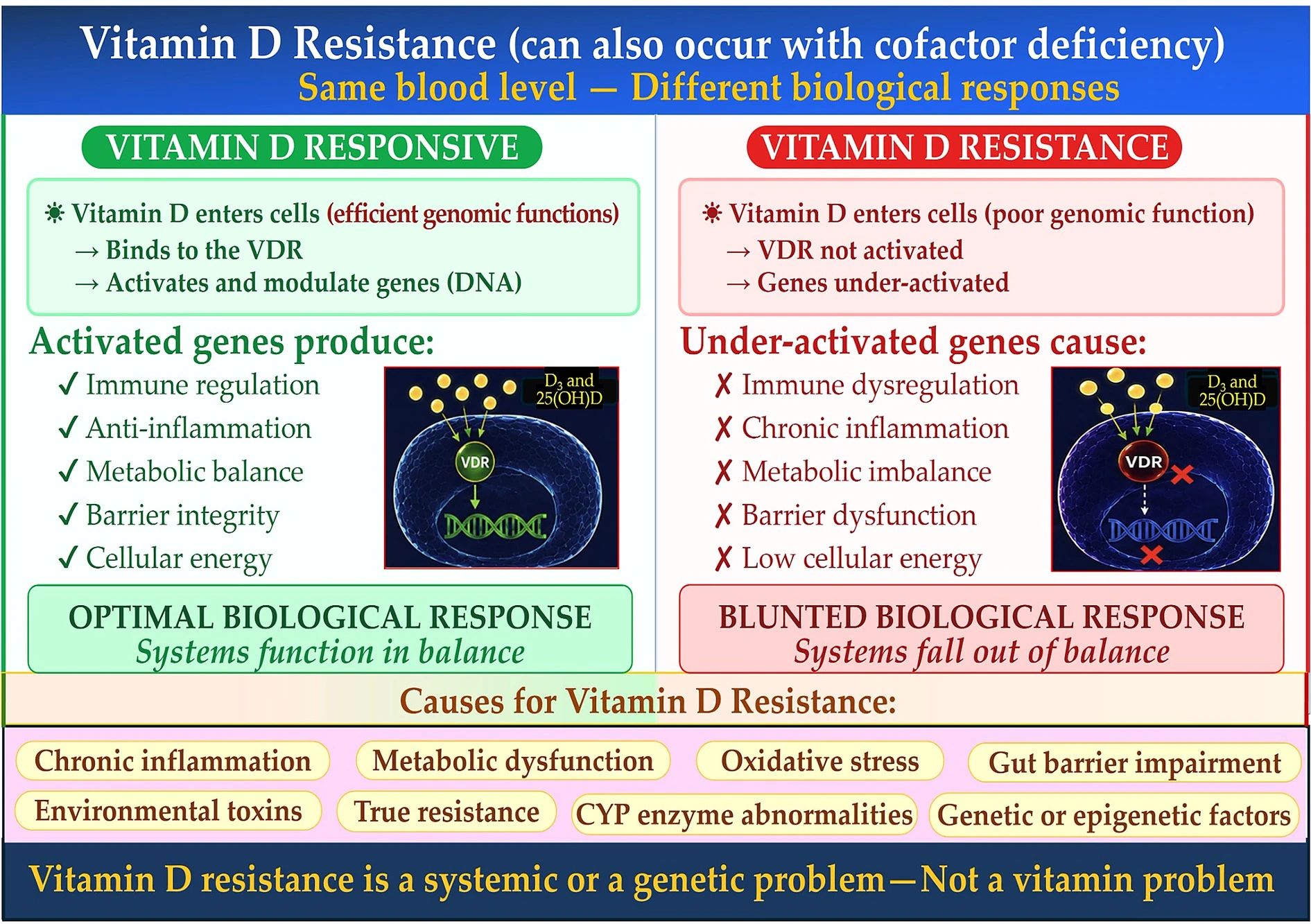
Figure 5. Vitamin D resistance is an impairment of biological responses at the same concentration. Individuals with similar circulating vitamin D concentrations may exhibit markedly different biological responses depending on gene polymorphisms, vitamin D receptor (VDR) signaling, and the cellular environment. In a vitamin D-responsive state (left panel), effective VDR activation promotes downstream gene expression supporting immune regulation, anti-inflammatory activity, metabolic balance, barrier integrity, and cellular energy production. In a vitamin D-resistant state (right panel), impaired VDR signaling results in under-activation of genomic activity in vitamin D-responsive genes and a blunted biological response despite comparable or even higher circulating 25(OH)D concentrations. Chronic inflammation, metabolic dysfunction, oxidative stress, impaired barrier function, genetic or epigenetic factors, and environmental toxicants may contribute to this resistant phenotype.
From this perspective, optimizing vitamin D status may require more than simply increasing vitamin D intake or increasing safe daily sun exposure [112]. Achieving optimal biological responses may also depend on identifying and addressing underlying physiological disturbances, essential nutrient cofactor sufficiency, particularly magnesium, chronic inflammatory states, and metabolic abnormalities [229]. Correcting these limiting factors may enhance vitamin D metabolism, receptor activation, and downstream cellular responses while simultaneously improving broader physiological functions and health outcomes [14,136]. Thus, a comprehensive approach that considers both vitamin D status and the biological environment in which vitamin D functions may provide greater benefits than its supplementation alone.
5.6. A Systems Medicine Perspective
Recognition of interindividual biological variability has contributed to a broader systems-medicine perspective on vitamin D physiology: a biological resilience [232,233]. Vitamin D does not act as an isolated nutrient. Instead, calcitriol–VDR signaling intersects with immune, metabolic, endocrine, mitochondrial, redox, inflammatory, and tissue-repair pathways [234,235]. It is interconnected with a regulatory network involving immune regulation, metabolism, endocrine signaling, mitochondrial activity, oxidative balance, inflammation, and tissue repair [234,236]. Within this framework, “biological resilience” denotes the capacity to maintain homeostasis, adapt to stressors, and recover after challenge. Thus, the expert panel proposes that adequate vitamin D status may support integrated physiological function and adaptive capacity across multiple systems.
Biological resilience refers to the capacity of cells, tissues, and organisms to maintain physiological stability, adapt to challenges, and recover from internal or external stressors [232,233]. Vitamin D and VDR signaling may support this resilience by regulating systemic inflammation, oxidative stress, mitochondrial biogenesis and respiration, energy metabolism, and endocrine–immune pathways; VDR loss reduces mitochondrial respiration and ATP production from oxidative phosphorylation [234,237]. Thus, adequate vitamin D status may support not only individual biological pathways but also the integrated function and adaptive capacity of multiple physiological systems [232,233]. This perspective is emphasized by the Expert Panel, which proposes that adequate vitamin D status may support not only individual biological pathways but also the integrated function and adaptive capacity of multiple physiological systems.
Vitamin D appears to support biological resilience in part through its role in maintaining the integrity of multiple biological barriers [234]. These important mechanisms include the gut barrier, lung barrier, vascular endothelium and other vascular barriers, the skin barrier, the eye, and even the blood–brain barrier. Healthy biological barriers are highly selective, responsive to vitamin D, protective, and serve as essential defenses against environmental stressors, pathogens, and inflammatory triggers. Disruption of barrier integrity has been implicated as a contributing factor in chronic inflammation, immune dysregulation, metabolic dysfunction, and tissue injury.
When epithelial barriers become inflamed or dysfunctional, permeability may increase (i.e., a “leaky” barrier), allowing microbial products and luminal antigens to translocate into the circulation and promote systemic immune activation and inflammation [238]. Inflammation may also alter local vitamin D metabolism and VDR signaling, while chronic inflammatory and metabolic conditions can contribute to heterogeneous vitamin D responses; however, the extent to which this increases individual vitamin D requirements remains condition-specific and incompletely defined [237,238].
Gut microbiota, intestinal permeability, and systemic inflammation are closely interconnected components of the gut–immune axis [239,240]. Dysbiosis may impair epithelial-barrier integrity, increase intestinal permeability, and facilitate translocation of microbial products—particularly lipopolysaccharide—and inflammatory mediators into the circulation, thereby promoting systemic immune activation and low-grade inflammation [238]. These processes are implicated in metabolic, cardiovascular, and autoimmune diseases, although their relative causal importance varies by condition [241].
Overall, calcitriol–VDR signaling influences innate and adaptive immunity, inflammatory regulation, epithelial-barrier integrity, and tissue repair, representing interconnected rather than isolated biological actions [242,243]. Considering these, vitamin D insufficiency may have greater physiological consequences when several systems are simultaneously challenged—such as during infection, hospitalization, surgery, or tissue injury. A systems-biology perspective may therefore better contextualize vitamin D’s contribution to immune homeostasis, physiological resilience, and responses to biological stress.
5.7. Immune Competence and Physiologic Resilience
The prevention of “infections and modulation of autoimmune responses” represents some of the strongest biological rationales for maintaining higher optimal vitamin D [135,244]. Infectious diseases and sepsis together account for more than 11 million deaths annually worldwide (~20% of all global deaths) and affect a substantial proportion of the global population each year [245]. Most of the affected people are thought to have significant VDD. Beyond their direct mortality burden, infections and associated hypovitaminosis D contribute significantly to hospitalization, healthcare costs, and long-term complications. Despite declining age-standardized incidence and mortality, sepsis remains a major cause of mortality worldwide [245].
Vitamin D functions as a systemic concentration regulator of immune competence, inflammatory responses, and tissue repair [239] and plays an important role in immune regulation by enhancing innate immune defenses, supporting antimicrobial responses, and modulating excessive inflammatory reactions that can contribute to immune-mediated disorders [135,244]. Vitamin D supplementation may improve host defense against pathogen invasion via the production of cathelicidin and specific cytokines [246].
Acting through the vitamin D receptor expressed in immune cells, calcitriol supports innate immune responses by inducing antimicrobial peptide production (e.g., cathelicidin and beta-defensins), which provide direct microbial defense at epithelial surfaces [245,247–249]. It modulates adaptive immune responses by influencing T-cell differentiation and function [250] supports the regulation and timely resolution of inflammatory responses, and maintains the integrity of epithelial and mucosal barriers that represent the body’s first line of defense against pathogen entry [251,252]. These coordinated functions become particularly consequential during acute illness, when immune demand is elevated, and the consequences of impaired immune coordination are most clinically apparent.
Accumulating evidence from several independent research groups indicates that the serum 25(OH)D concentration associated with greater protection against severe infections is above 50 ng/mL rather than the commonly cited thresholds of 20–40 ng/mL. In particular, landmark studies by Quraishi and colleagues in critically ill and surgical patients identified a deflection point of serum 25(OH)D at approximately 50 ng/mL, where the immune system physiologically activates and presumably becomes robust [253–255]. While this is higher than our recommended minimum target of 40 ng/mL, there is evidence to support this minimum in these situations and conditions, such as infectious diseases and autoimmune conditions [94].
Other studies, like Kaufman et al. [198] (see below in Figure 6), support this. This is unsurprising: above this threshold, circulating vitamin D₃ and 25(OH)D (precursors to produce intracellular calcitriol) diffuse sufficiently into peripheral target cells—such as immune cells in adequate quantities—enabling robust immune responses in response to incoming signals from detection cells like Toll-like cells [256–258], as needed [17]. This operates as a threshold-dependent response: sufficient circulating vitamin D₃ and 25(OH)D must be available to diffuse and provide substrate for immune cells—particularly macrophages and dendritic cells—to synthesize calcitriol locally to initiate signaling [17,20].
The above-mentioned calcitriol–VDR-mediated intracrine and paracrine signaling promotes a variety of responses, including antimicrobial peptide expression, autophagy, and balanced innate and adaptive immune responses [259] and enhances the host defense system [260]. VDD is associated with higher susceptibility to severe infection and sepsis, although the benefits of supplementation for preventing or treating sepsis remain uncertain and require further large, well-designed, preferably larger observational studies [261]. This is a switch-on-and-off phenomenon that requires sufficient D₃ and 25(OH)D to synthesize calcitriol to activate the immune cells’ intracrine and paracrine signaling system [20]. This results in enhanced immune system functions and a significant reduction in the risk of severe infections and sepsis.
5.8. Vitamin D Status and Infectious Disease Outcomes
Vitamin D status influences susceptibility to infection, although associations vary across diseases and populations. Low serum 25(OH)D concentrations have been associated with increased risk of developing upper respiratory tract infections [262–265], especially with intracellular bacteria like tuberculosis [266] and leprosy [267]. However, associations with baseline vitamin D status and responses to supplementation address different clinical questions, making baseline status and achieved changes important considerations when interpreting intervention trials [115].
Prospective evidence links low serum 25(OH)D concentrations with increased risk of developing active tuberculosis, supporting the importance of nutritional status before disease onset [266]. Supplementation trials provide complementary evidence, with respiratory infection outcomes varying across populations and regimens and pooled estimates indicating, at most, a modest overall preventive effect [268]. Interpretation should therefore distinguish infection acquisition from disease severity and recovery and sustain balanced nutritional prevention from treatment initiated during established illness [268].
The COVID-19 pandemic provided substantial examples of the clinical relevance of adequate vitamin D status in infectious disease outcomes [112,269,270], with one example illustrated in Figure 6. Over 120 independent RCTs published during the COVID-19 era substantiated that the higher the serum 25(OH)D concentration at the time of SARS-CoV-2 infection, the less symptomatic the disease, the fewer hospitalizations, intensive care unit admissions, and deaths [269,270]. These relatively small, independently conducted RCTs have been amalgamated in the c19vitamind.com tracker (non–peer-reviewed, credible, continuously updated aggregator) [269,270]. Thus, maintaining higher physiological 25(OH)D concentrations (i.e., between 50 and 80 ng/mL), as described above, to maintain a robust immune system [55] may offer greater protection than accepting customarily lower concentrations (i.e., current government recommendations) associated with less complete biological responses [139,271], without evidence of additional risk within this range [1,17,272].
These findings highlight the importance of maintaining adequate vitamin D levels, especially for those at high risk of infections [273]. Optimizing vitamin D status may be a cost-effective way to reduce the global impact of infectious and autoimmune diseases [112,274]. Lower community serum 25OHD levels are linked to higher inpatient healthcare costs and hospitalizations, suggesting vitamin D deficiency increases healthcare expenses in the general population [22,274]. Veterans diagnosed with vitamin D deficiency have lower survival rates after prostate cancer diagnosis, supporting the recommendation to correct deficiency in all veterans with prostate cancer [275]. In the Southeastern United States, vitamin D deficiency and insufficient monitoring are associated with higher inpatient costs among veterans, though these factors do not fully explain cost differences between sites [274]. Testing and monitoring vitamin D levels are recommended for high-risk veterans [273,274].
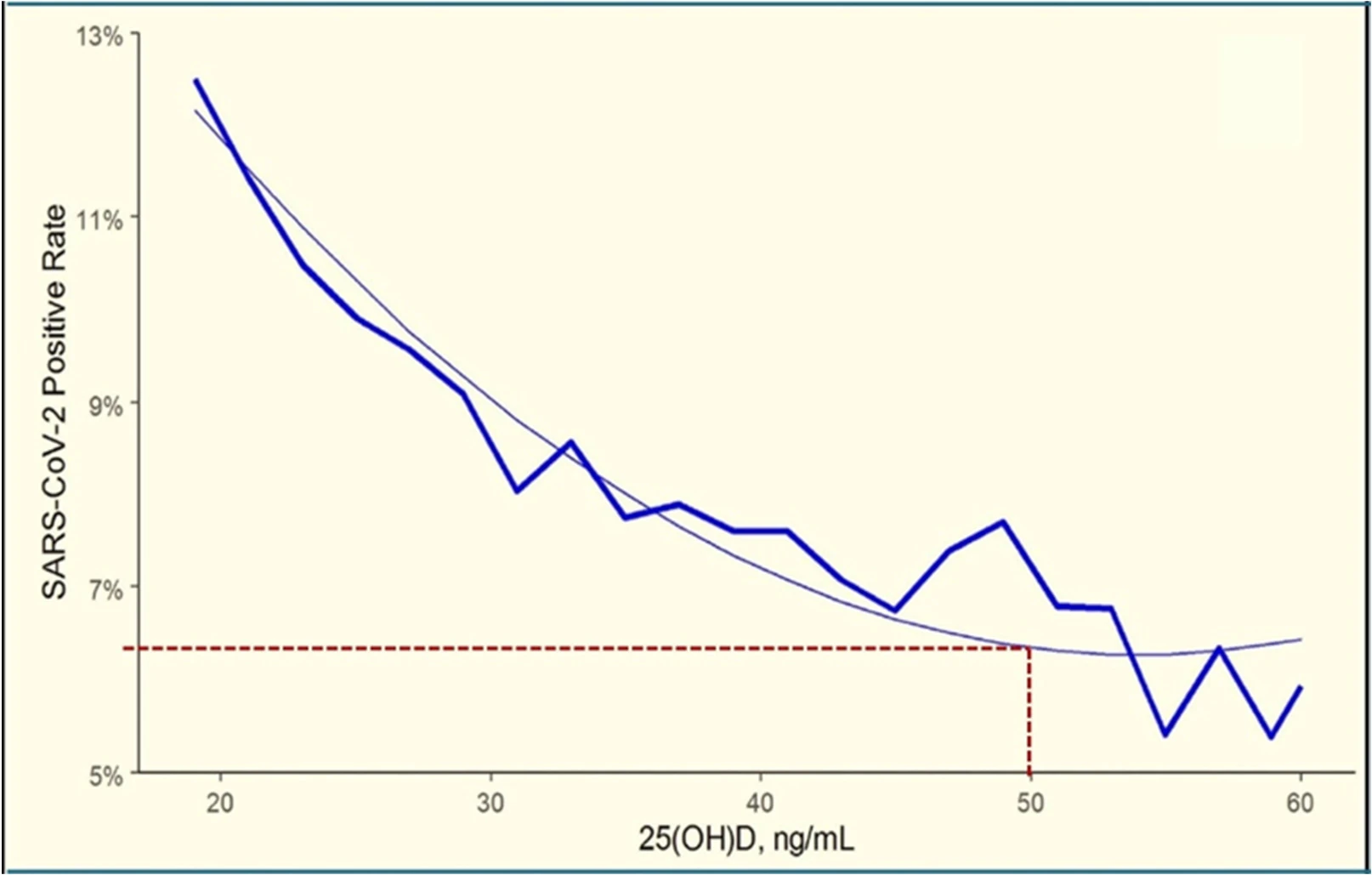
Figure 6. Association between 25(OH)D serum concentrations and SARS-CoV-2. In the total population, with circulating 25(OH)D concentrations from 20 ng/mL to 50 ng/mL (which then plateaus off), there was a 47% lower positivity rate for SARS-CoV-2 NAAT among those who had concentrations above 50 ng/mL (shown in the dashed red line). Risk reduction remained similar after adjusting for gender, age, latitude, and predominant race/ethnicity within the zip code of residency. 25(OH)D concentrations above 50 ng/mL had the lowest SARS-CoV-2 infection rate. Reproduced from Kaufman et al., 2020, with permission [198].
6. Defining Optimal Vitamin D Status
Perhaps the greatest area of ongoing debate concerns the definition of vitamin D sufficiency. Many organizations continue to define adequate serum 25(OH)D concentrations based on skeletal outcomes, reflecting the limited framework used by the above-described flawed IoM report [32]. Because the skeletal benefits represent only a fraction of vitamin D’s broader biological effects, achieving optimal extraskeletal benefits likely requires higher vitamin D intakes and maintaining higher serum 25(OH)D concentrations than those recommended by the IoM [32] and the 2024 ES guideline [32,41], as briefly discussed above and explained in more detail below.
Accumulating experimental, mechanistic, and clinical evidence that calcitriol–VDR signaling has important effects beyond the musculoskeletal system has increased interest in defining target serum 25(OH)D concentrations that support optimal function across multiple organ systems; however, outcome-specific extra-skeletal targets have not yet been established [276]. This evolving understanding has contributed to differing recommendations among professional organizations and underscores the importance of distinguishing between merely preventing deficiency and achieving vitamin D status associated with broader health optimization [1,14,112,120]. While a minimum of 30 ng/mL may be adequate for skeletal health [34], it needs revision of the current vitamin D sufficiency thresholds, including aiming for a minimum target serum 25(OH)D range of 40 ng/mL for broader health outcomes and improved health. Meanwhile, levels up to 100 ng/mL are considered safe for specific clinical conditions; thus, the optimal range is 40 to 80 ng/mL.
The 2011 recommendations of the ES are still relevant today [34], which encourage a minimum circulating 25(OH)D serum concentration of at least 30 ng/mL (primarily for musculoskeletal benefits). Whereas substantial the recent literature reported a 25(OH)D range of 40–60 ng/mL, with levels up to 100 ng/mL appearing to be safe and providing many additional health benefits. The latter includes improved perinatal health outcomes, lower risk of several cancers [202], decreasing autoimmune disorders [94], reduction in blood pressure and presence of hypertension [164], and progression of prediabetes to diabetes [201]. These targets differ from those of guideline-setting bodies such as the IoM. The authors also recommend reassessing the adult tolerable upper intake level of 4000 IU/day and considering a limit of 10,000 IU/day based on available safety evidence.
6.1. Measuring Vitamin D Status
Vitamin D screening recommendations remain controversial. Most current guidelines discourage routine population-wide testing and limit screening to individuals considered at increased risk of deficiency [277]. This risk-based approach has been questioned, as VDD is highly prevalent, typically asymptomatic, and often clinically undetectable until severe [55]. Consequently, relying solely on clinical judgment fails to identify a large proportion of individuals with low vitamin D status, leaving many vulnerable to preventable adverse outcomes [25,112,278,279].
Health-risk-based screening alone is therefore insufficient and may adversely affect population health. In high-prevalence settings, such as northern latitudes, low-income suburban communities, pregnant individuals, people with multiple comorbidities, and older adults, the risk of undetected deficiency is even greater. These groups experience higher rates of inadequate vitamin D and related complications [277,280–285].
In addition, barriers related to policy, insurance coverage, and public awareness further limit the implementation of effective screening programs. Without markedly reducing the cost of vitamin D testing, establishing better accuracy of point-of-care testing, expanding broader testing strategies, and improving access to testing, substantial numbers of individuals with inadequate vitamin D status will remain unidentified [55]. This inability to diagnose and treat chronic hypovitaminosis D results in increased risk of downstream metabolic and skeletal consequences, while significantly contributing to increasing healthcare costs [1,14,120,286,287].
Serum 25(OH)D is widely accepted as the most appropriate biomarker for assessing vitamin D status because it reflects vitamin D contributions from sunlight exposure, dietary intake, and supplementation and provides a reliable indicator of overall vitamin D availability. 25(OH)D circulates in ng/mL (or measured as nmol/L concentrations), approximately 900-fold higher than its biologically active hormone form, 1,25-dihydroxyvitamin D [1,25(OH)₂D], in pmol/L [55,288]. The latter has a short half-life of just a few hours and is tightly regulated by parathyroid hormone, calcium, and phosphate homeostasis. It can remain normal or even increase during VDD (i.e., while serum 25(OH)D concentration is low). Therefore, measurement of 1,25(OH)₂D is not suitable for evaluating vitamin D status; it is only indicated in specific clinical conditions affecting vitamin D metabolism, such as renal failure [55,120].
Assay standardization has advanced substantially over the past decade. The Vitamin D Standardization Program, Centers for Disease Control and Prevention reference Measurement Procedures, National Institute of Standards and Technology-traceable reference standards, and laboratory certification programs have improved comparability among participating laboratories [289]. However, adoption of standardized or certified assays remains inconsistent across clinical practice, research studies, and public health surveillance programs [120,290]. Continued efforts toward universal implementation of standardized assays, harmonized reporting, and validated analytical methods are essential to ensure reliable and comparable measurements across clinical practice, research studies, and public health surveillance programs.
6.2. The Value of Targeted Testing:
The panel instead recommends targeted testing for individuals with specific risk factors or those in high-risk groups, along with healthcare education to support risk assessment, management, testing, interpretation, and follow-up.
When supplementation is tailored to body weight, clinical presentation, or baseline serum 25(OH)D concentration, reassessment is recommended about three to four months after starting treatment to adjust the dose and evaluate response. This approach is well established in clinical practice, has been used by some panel members for decades, and aligns with vitamin D pharmacokinetics and the time needed to reach a new steady-state serum 25(OH)D concentration [128].
Subsequent testing should be based on clinical needs, not a fixed schedule. Reassessment aims to confirm that the prescribed regimen achieves and maintains the target serum 25(OH)D concentration, given significant individual variability in response. Factors such as baseline vitamin D status, body mass index, body weight, age, genetics, and adherence can all affect serum levels [175,291,292]. The panel notes that standard supplementation often fails to reach the proposed target of at least 40 ng/mL (100 nmol/L), especially in individuals with comorbidities such as obesity or severe deficiency [20,65,175].
Several clinical studies have used treat-to-target designs to evaluate the relationship between achieved serum 25(OH)D concentrations and health outcomes. At the Medical University of South Carolina, an observational study individualized prenatal vitamin D supplementation according to baseline 25(OH)D concentrations, with follow-up testing and dose adjustments to achieve concentrations ≥40 ng/mL [163]. Women who achieved this target had a 62% lower risk of preterm birth than those with concentrations <20 ng/mL. Similarly, Pure North clinics individualized vitamin D dosing (another observational study), based on measured serum concentrations, averaging approximately 6000 IU/day, and targeting levels ≥40 ng/mL [157]. Analyses revealed that serum 25(OH)D concentrations ≥50 ng/mL were strongly associated with improved thyroid outcomes [191].
Recently, the TARGET-D randomized trial used individualized vitamin D dosing, adjusted through serial testing, to achieve serum concentrations of 40 to 80 ng/mL after myocardial infarction [293]. While the primary cardiovascular outcome was not statistically significant, participants who reached the target 25(OH)D concentration had fewer recurrent myocardial infarctions as a secondary outcome [293]. These studies highlight the need to individualize vitamin D supplementation according to baseline and achieved serum 25(OH)D levels, while accounting for biological variability in clinical outcome assessments.
The Expert Panel considered targeted testing and individualized supplementation to complement population-based strategies, including food fortification, public health supplementation, and sun exposure education. A comprehensive vitamin D strategy should provide region-specific guidance on safe UVB exposure and tailored patient education on diet, lifestyle, body weight, comorbidities, and other risk factors.
Modeling studies show that vitamin D testing and treatment are more cost-effective when focused on high-risk groups rather than universal screening [294]. In older adults, deficiency assessment and treatment reduce fractures, falls, and healthcare costs, making them cost-effective [295]. Systematic reviews also find that targeted screening and treatment are generally more economically efficient than population-wide testing [294,295]. These economic findings help clarify the value of targeted testing and individualized supplementation compared to fortification and standard-dose supplementation.
6.3. Target Serum 25(OH)D Concentrations
Current recommendations for vitamin D sufficiency vary considerably among professional organizations because they are based on different clinical priorities, outcome measures, and interpretations of the available evidence [55,289]. While some guidelines continue to define sufficiency primarily in relation to skeletal health outcomes, others increasingly recognize vitamin D’s broader physiological roles and consider additional health outcomes when proposing target serum 25(OH)D concentrations [290]. These differences highlight the ongoing debate regarding whether vitamin D recommendations should focus solely on deficiency prevention or also address health optimization.
Historically, serum 25(OH)D concentrations of approximately 20 ng/mL have been considered sufficient to prevent overt skeletal disease in most healthy individuals [32]. The ES 2011 recommended a minimum of 30 ng/mL, particularly for those at increased risk of deficiency [19]. Meanwhile, the laboratory reference ranges often remain between 30–100 ng/mL. More recently, vitamin D researchers and clinicians have recommended higher targets of 40–80 ng/mL, with higher targets potentially appropriate for selected individuals with disorders or clinical circumstances when appropriately monitored.
Some clinicians and researchers, however, advocate individualized higher 25(OH)D targets, within the 40–60 ng/mL range, for selected patients under clinical and biochemical monitoring [1,14,37,296]. While effective for some, the range is not wide enough to be used in clinical practice and omits specific conditions that respond to serum concentrations higher than 60 ng/mL, such as immune abnormalities like multiple sclerosis, even cancer, and reduction in all-cause mortality.
In ambulatory adults without disorders or those taking medications that predispose to vitamin D-mediated hypersensitivity and hypercalcemia, it would be beneficial to implement individualized, target-based vitamin D supplementation to maintain serum 25(OH)D concentrations of approximately 50–80 ng/mL. This approach is intended to account for interindividual variation in vitamin D metabolism, adiposity, absorption, sunlight exposure, and baseline status. In clinical practice, such concentrations can generally be achieved with moderate, individualized supplementation and periodic assessment of 25(OH)D and calcium, rather than chronic or intermittent high pharmacological dosing.
The minimum of 40 ng/mL, as depicted in Figure 7, which is a hypothetical diagram, while capturing all musculoskeletal needs, encompasses all other extra-skeletal benefits of vitamin D, including metabolic needs [1,14,37,296]. Benefits of vitamin D are illustrated along with potential risks with rising 25(OH)D serum concentrations. These observations support the concept that optimal vitamin D targets may vary according to individual characteristics, biological requirements, underlying health conditions, and the specific clinical outcomes being considered.
6.4. Hypercalcemia Secondary to Vitamin D
An elevated serum 25(OH)D concentration alone does not establish vitamin D toxicity. Clinically significant toxicity needs to be associated with hypercalcemic syndrome, typically with hypercalciuria, suppressed PTH, symptoms, and/or renal impairment, and should be interpreted in the context of vitamin D intake, calcium status, renal function, and conditions affecting calcitriol metabolism [297]. These should not be conflated with ordinary clinical supplementation or used as blanket discouragement of appropriately managed vitamin D therapy. Thus, elevated 25(OH)D concentrations do not by themselves diagnose toxicity but require prompt assessment of vitamin D and over-the-counter supplement intake, especially calcium, rather than being considered for toxicity by itself [298].
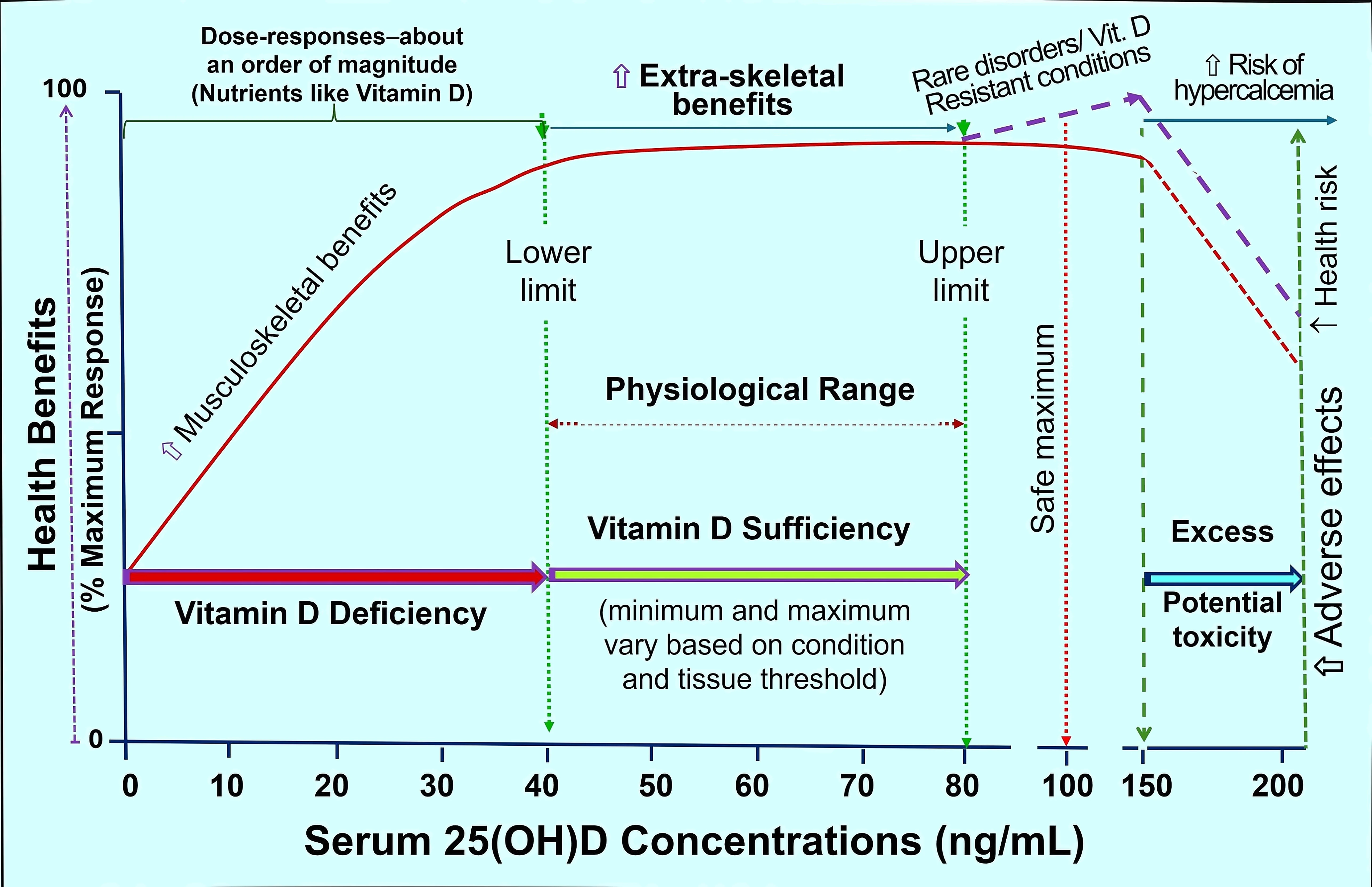
Figure 7. Illustration of the 25(OH)D concentrations (X-axis) achieved in the circulation vs. responses (clinical health benefits and potential risks; Y-axis). It also provides the basic pharmacodynamics of a typical nutrient, vitamin D, as an example. When tissue sufficiency occurs (threshold), there generally would not be additional benefits from raising the circulatory concentration further by increasing intake (achieving the desired clinical goals; red, curved line). However, there are exceptions in a small percentage; pharmacological doses are needed under medical guidance in less than 0.01% of the population to overcome vitamin D-resistant disorders and achieve the desired clinical goals (indicated in the dashed purple line in the upper right corner). After Wimalawansa, SJ, Infections & Autoimmunity, Nutrients [135].
Hypercalcemic adverse effects have not been identified or reported with therapeutic 25(OH)D concentrations in the circulation up to about 125 ng/mL [1,14,160,299]. Adverse effects like hypercalcemia, hypercalciuria, and suppressed PTH are unlikely to manifest under 150 ng/mL [300] (see below). Levels up to 100 ng/mL appear to be safe; thus, maintaining serum 25(OH)D concentrations between 50 and 80 ng/mL is a safe and effective strategy to optimize immune functions and reduce the risk of severe infections [255]. This is known to reduce intensive care admission and sepsis [17,213,253–255,301].
In otherwise healthy ambulatory adults, appropriately prescribed vitamin D replacement is generally well tolerated and devoid of any adverse effects [116,300]. Clinically significant toxicity is rare and usually results from prolonged excessive intake or errors in product manufacturing, labeling, prescribing, dispensing, or administration, although unusual susceptibility related to dysregulated vitamin D metabolism can also contribute [300,302,303]. Most of the cases of hypercalcemia in hospital settings arise from cancer and metastatic bone diseases [304–310], followed by granulomatous diseases [311,312], autosomal dominant mutations [313,314], CYP24A1 genetic defects [315,316], milk-alkali syndrome, and vitamin D toxicity.
The appropriate clinical response is to distinguish a laboratory finding of elevated 25(OH)D from actual hypercalcemic toxicity, then assess the patient’s dose, formulation, calcium status, symptoms, renal function, and potential predisposition to altered calcitriol metabolism [297]. Upon cessation of vitamin D, calcium, and multivitamin supplements, proper rehydration usually leads to recovery within a few days. Such people rarely require hospitalization.
6.5. Early Signs and Symptoms of Vitamin D Toxicity
Vitamin D toxicity is rare and may initially be asymptomatic; when symptoms occur, initially, they are often nonspecific and primarily reflect hypercalcemia [300]. Hypercalciuria can precede overt hypercalcemia and recognizable symptoms; therefore, the absence of symptoms does not exclude developing toxicity [303]. Clinical warning features include new or persistent loss of appetite, nausea, constipation, fatigue, muscle weakness, increased thirst, and frequent urination, particularly in patients taking high-dose supplements or overlapping vitamin D-containing products [303]. Polyuria and polydipsia warrant particular attention because hypercalcemia can impair renal concentrating capacity and promote dehydration. These findings should prompt assessment rather than attribution to the underlying illness alone [300,303].
When toxicity is suspected, clinicians should review all vitamin D and calcium sources—including prescription preparations, over-the-counter supplements, dosing frequency, and possible dispensing or administration errors—and measure serum calcium, creatinine/eGFR, 25(OH)D, and parathyroid hormone; urinary calcium assessment may help identify an early biochemical abnormality [303]. Supplement-related toxicity typically features hypercalcemia and/or hypercalciuria with suppressed parathyroid hormone and markedly elevated 25(OH)D, often above 150 ng/mL (375 nmol/L) [300].
An elevated 25(OH)D concentration above 150 ng/mL alone does not establish clinical toxicity: it must be associated with hypercalcemia and hypercalciuria [55]. Conversely, vitamin D-mediated hypercalcemia associated with granulomatous disease or active vitamin D preparations may occur without markedly elevated 25(OH)D, because such cases can be driven by excess calcitriol [116,311] and in rare autosomal dominant mutations like CYP24A1 [313]. Suspected supplement-induced toxicity warrants withholding vitamin D and supplemental calcium pending assessment; persistent vomiting, confusion, substantial dehydration, or deteriorating renal function requires urgent evaluation [300,303].
6.6. Physiological and Evolutionary Context
Vitamin D recommendations should also be considered in the context of human evolution and contemporary lifestyles. For most human history (evolutionary), regular, year-round exposure to sunlight likely maintained serum 25(OH)D concentrations substantially higher than those observed in many modern populations [317,318]. Studies of people living traditional outdoor lifestyles in sun-rich environments consistently report that serum 25(OH)D concentrations are well above current minimum definitions of sufficiency.
Examples are two traditional East African tribes, the Maasai and Hadzabe, who have hunter-gatherer-like lifestyles and live at the equator in Tanzania. The mean circulating concentrations of 25(OH)D were 48 ng/mL in the Maasai and 44 ng/mL in the Hadzabe [317,318] (see Figure 8). For a normal-weight adult to achieve a circulating concentration like that, they would need to ingest approximately 4000 IU of vitamin D/day.
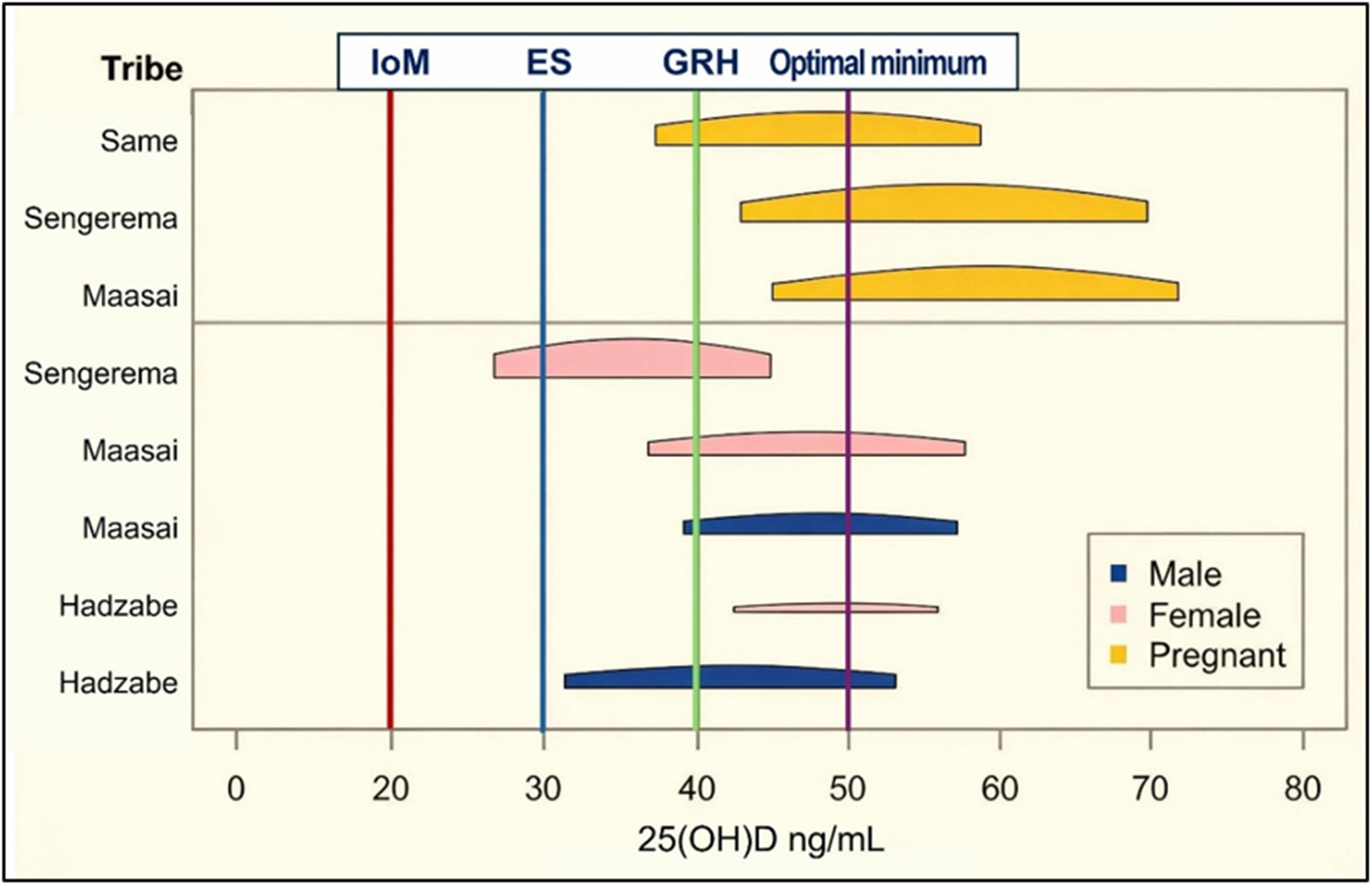
Figure 8. Serum 25(OH)D concentrations of East African population: Plot of assessed 25(OH)D concentrations among 449 traditionally living Africans from five ethnic groups, in which the average concentration was 44 ng/mL (109 nmol/L) in non-pregnant adults and 56 ng/mL (139 nmol/L) in pregnant women. Vertical lines represent serum 25(OH)D concentrations defined as sufficient by the IoM (red), ES (blue), and GrassrootsHealth (green). Based on a range of recent clinical data, the authors propose an optimal minimum serum 25(OH)D level of 50 ng/mL that addresses nearly all human disorders, as indicated by the vertical purple line on the right. Chart courtesy of Keith Baggerly, PhD, based on data from Luxwolda et al., 2012 and 2013 [317,318].
It is possible that daily exposure to direct sunlight develops a feedback mechanism that downregulates 25-hydroxylase activity, preventing them from developing hypervitaminosis D [319]. This is supported by intermittent sun-exposed pregnant adults having higher serum 25(H)D concentrations (Figure 8). These observations suggest that contemporary 25(OH)D concentrations in industrialized societies may not reflect the physiological range under which human biology evolved and raise important questions about whether current recommendations are adequate.
In contrast, modern lifestyles, including sun avoidance, indoor living, urbanization, reduced outdoor activity, seasonal variation, air pollution, sunscreen and clothing use, skin pigmentation, aging, obesity, and limited dietary sources, have contributed to the widespread prevalence of VDD worldwide [3,65,320,321]. These changes suggest that VDD is largely a consequence of modern living, false understandings, and attitudes, rather than climate change or a normal feature of human physiology [322]. Overall, evidence from evolutionary biology, epidemiology, and clinical research indicates that optimal vitamin D status should consider the environment in which humans evolved, modern lifestyle changes, and current evidence on health outcomes [3,320–322].
7. Translating Contemporary Vitamin D Science into Policy and Practice
The scientific advances reviewed by the vitamin D experts panel, and their recommendations, have important implications for clinical practice, public health and policy, medical education, research, quality improvement, and guideline development. They highlighted that addressing VDD requires coordinated action at multiple levels (educational, clinical, political, and legislative) rather than relying on population-level or clinical interventions alone. This includes addressing vitamin D misinformation through public and professional education, social and mass media, and promptly translating reliable evidence into accessible language to inform public understanding, policymaking, and clinical practice [323]. It also requires complementary, population- and risk-tailored public health strategies, evaluated for cost-effectiveness, alongside regular updates to vitamin D clinical practice guidelines [1,120,324].
The above includes countering persistent myths and misinformation about vitamin D through both public and medical education, translating sound scientific evidence rapidly into lay language for the benefit of the public and lawmakers to make policies and right practices, implementing complementary, precision-based, and cost-effective public health strategies, and updating vitamin D clinical practice guidelines.
The next stage will require integrating precision public health, big-data analytics, and using artificial intelligence to predict risk, identify vulnerable populations before disease develops (i.e., disease prevention), and deliver the right intervention (doses of vitamins and essential cofactors) to the right population at the right time [1,14]. Combined with holistic and personalized approaches to individual management, these strategies will be crucial for improving health outcomes [14,287,288].
7.1. Vitamin D Optimization Protocols for Individual and Clinical Use
It is most effective to use individualized vitamin D optimization using a treat-to-target approach [18]. Here, the supplementation is individualized to achieve target serum 25(OH)D concentrations, which better reflect nutrient biology, and is more likely to achieve consistent physiological and clinical benefits across diverse populations. This approach combines baseline testing, personalized dosing, follow-up monitoring, and dose adjustment to improve dose selection, reduce uncertainty, and demonstrate how personalized vitamin D optimization can be efficiently integrated into routine clinical practice [23].
Hospitalization and surgery represent distinct and predictable models of acute physiologic stress. Unlike infectious illness, elective surgery is scheduled in advance, creating a unique opportunity for proactive assessment and optimization before physiologic demand is imposed. Successful surgical recovery depends on coordinated immune activation and resolution, inflammatory regulation, metabolic and endocrine adaptation, and tissue repair, with these overlapping processes regulated in both timing and intensity [325]. Disruption of any component of this coordinated response can alter recovery trajectory, extend hospitalization, and increase the risk of complications. Meanwhile, lower vitamin D status has been associated with wound complications, longer hospitalization, and higher healthcare utilization.
The panel recommended preoperative assessment of serum 25(OH)D concentrations to identify patients with inadequate D status before physiologic stress is imposed, allowing individualized targeted repletion with sufficient lead time to achieve meaningful increases in circulating concentrations before the procedure [326,327]. In addition, repeat 25(OH)D measurements are indicated in those who are kept in the hospital for a prolonged period [101,102,136], as there is increased vitamin D consumption during infections [328] and autoimmune conditions [135]. This approach is feasible within existing preoperative evaluation workflows.
Perioperative vitamin D optimization may be one of the most practical and immediately implementable, important strategies that can reduce hospital-associated healthcare costs [144]. The patient population is identifiable, the physiologic stress of surgery is predictable, and the intervention window is well defined [329,330]. Optimizing vitamin D status before surgery may reduce postoperative infections, complications, intensive care unit admissions, and length of hospital stay [253,254,329]. These improvements could translate into meaningful reductions in healthcare costs [144].
Experts do not support universal or repeated 25(OH)D testing but strongly recommend targeted testing based on early diagnosis and clear clinical indications. Reducing opportunity costs, fortification, and age- or risk-based supplementation may provide more scalable and cost-effective strategies for the population. The panel did not conduct a comparative cost-effectiveness analysis; such work requires specifying the setting, prices, deficiency prevalence, outcomes, and time horizon, and should be addressed separately.
7.2. Future Guideline Development and Implementation Priorities
The evidence reviewed throughout this article supports a broader framework for future vitamin D guideline development. Table 6 outlines panelist themes with correlating recommended action points categorized into five domains: Population Health Policy, Public Health & Prevention Strategies, Research & Quality Improvement, Provider Education, and Clinical Practice Guidelines. These domains correlate with the socioecological model of policy, community, organizational/institutional, interpersonal, and individual.
Table 6. Expert Panel Recommendations for Socioecological Levels and Domains.
| Socioecological Model Concentration | Domain | Recommended Action |
|---|---|---|
| Policy | Population Health Policy | Replace outdated, skeletal-centric guidelines. Re-evaluate current vitamin D guidelines using the totality of contemporary scientific evidence and updated statistical analyses, distinguishing between recommendations intended to prevent deficiency and those strategically designed to optimize vitamin D status. |
| Policy | Population Health Policy | Expand policy & guidelines to include precision public health approaches that consider regional environmental context, population vulnerability, and individual risk and biological variability. |
| Community | Public Health & Prevention Strategies | Integrate vitamin D optimization strategies into existing public health initiatives, including but not limited to maternal health, healthy aging, chronic disease prevention, workforce wellness, and military health programs, focusing on the most common and costly causes of morbidity and mortality. |
| Organizational & Institutional | Research & Quality Improvement | Standardize vitamin D research/quality improvement methodology to incorporate nutrient-specific principles congruent with the Heaney Criteria of Nutrient Study Design, including cost-savings data, when appropriate. |
| Organizational & Institutional | Provider Education | Strengthen vitamin D education for healthcare professionals, focusing on interpreting vitamin D science, translating evidence to practice, and increasing professional competency to meet the needs of populations and individuals from diverse cultures and backgrounds across a wide array of healthcare and community settings. |
| Organizational & Institutional and Interpersonal | Clinical Practice | Promote evidence-based precision medicine treat-to-target strategies that include serum 25(OH)D measurement, weight-based dosing, recognizing biological variability, and appropriate follow-up needed for individualized health promotion and disease prevention across the lifespan, and when there is a change in health status or is clinically indicated |
Figure 9 illustrates the pathway for translating scientific advances in a micronutrient field, such as vitamin D, into the generation of new evidence and the development of updated, evidence-based guidelines. This iterative process can improve clinical care, optimize health outcomes, and potentially reduce healthcare cost
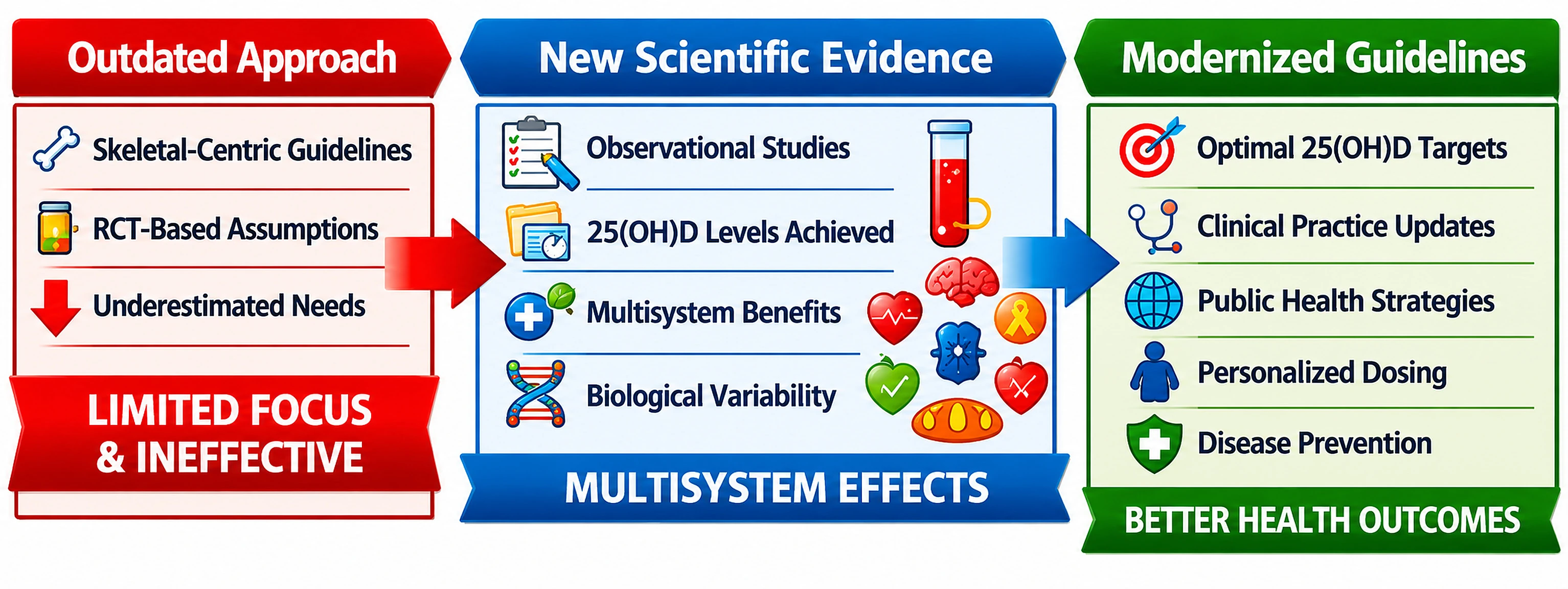
Figure 9. Illustration of the natural progression toward modern vitamin D guidelines needed for clinical practice. These updated guidelines should replace outdated skeletal-centric recommendations and be grounded in the totality of evidence, including observational clinical studies, mechanistic research, and well-designed RCTs that enroll individuals who are not vitamin D-sufficient. They should emphasize achieved serum 25(OH)D concentrations rather than supplemental dose alone, incorporate multisystem physiology, threshold-nutrient behavior, and principles of precision nutrient science, recognize the need for individualized dosing, and address both modernization of clinical practice and public-health prevention strategies.
7.3. Healthcare Provider Education and Clinical Competency in Vitamin D Management
Despite the substantial advances in vitamin D science and increasing recognition of its multisystem importance [31,55,86,90,91,94–96] as described previously, many clinicians continue to encounter uncertainty regarding how to accurately assess vitamin D status, determine appropriate supplementation strategies, or integrate evolving evidence into patient care [21,32]. This uncertainty reflects the rapid pace of scientific developments and the variability in guidance across organizations, rather than any deficit in provider skill or commitment. As a result, clinical practices may vary, contributing to underdiagnosis of deficiency and missed opportunities to improve patient outcomes [11–13].
Updating vitamin D guidelines without also supporting clinician education risks perpetuating these challenges. Strengthening provider competency in vitamin D assessment and management will help ensure that emerging evidence is translated into safe, effective, and consistent clinical care. Enhancing educational resources aligns with evidence-based practice, supports patient safety, and improves clinicians’ ability to respond to the widespread prevalence of VDD [19].
7.4. Interdisciplinary Collaboration, Education, and Implementation Strategies
The expert panel emphasized the importance of translating vitamin D science into practical, coordinated clinical and public health action. Vitamin D influences musculoskeletal, endocrine, immune, and metabolic functions [6,322,331]. Coordinated efforts across primary care, endocrinology, nutrition, public health, and research can therefore support consistent evidence-based messaging and comprehensive approaches to preventing and managing deficiency [323]. Encouraging interdisciplinary collaboration does not expand the scope of vitamin D guidelines; rather, it supports alignment across specialties and promotes shared decision-making.
Addressing provider knowledge gaps also requires practical implementation strategies that help clinicians apply guideline recommendations within real-world workflows. Embedding evidence-based recommendations in electronic health records and clinical decision support tools, alongside continuing education and integration into routine primary care workflows, can support more consistent implementation [332]. Incorporating implementation science principles will help ensure that updated vitamin D guidance is feasible, scalable, and adaptable across diverse clinical settings without imposing additional burden.
Guidelines should integrate scientific evidence with environmental, population, and individual circumstances to identify groups at increased risk or bearing a disproportionate disease burden and tailor recommendations accordingly [7,333]. Prioritizing education, screening, and supplementation for high-risk groups can improve health outcomes and reduce disparities. Precision public health should distinguish population-based prevention, such as supplementation and public education, from individualized care involving assessment, monitoring, and treat-to-target dosing [18]. Serum 25(OH)D should be reassessed after dose adjustments to confirm that therapeutic concentrations are achieved and maintained. Clear screening and monitoring guidance can promote consistent clinical practice and reduce underdiagnosis while remaining aligned with recommendations from major organizations [333].
7.5. Population Surveillance and Data Infrastructure
The expert panel suggested that strengthening vitamin D surveillance systems would support monitoring deficiency trends, evaluating intervention effectiveness, and guiding future policy updates. These recommendations are intended to inform public health planning and do not impose requirements on clinical practice. Improved data infrastructure ensures that guideline recommendations remain responsive to population needs and emerging evidence. Incorporating surveillance and population-concentration monitoring can help public health agencies identify high-risk groups, track progress over time, and refine interventions based on real-world outcomes.
When leveraged collectively in a coordinated effort, these actions create a multi-pronged approach for rapid reduction in the global burden of VDD and subsequent health disparities across diverse populations while preserving healthcare resources.
8. Conclusions
Scientific understanding of vitamin D has advanced substantially since current recommendations were established in 2010. Advances in understanding vitamin D biology and physiology, statistical methodology, nutrient science, and recognition of environmental context, population vulnerability, and individual variability support a comprehensive re-evaluation of the evidence base underlying existing guidelines. Future vitamin D guidelines should incorporate evidence from randomized trials, observational studies, mechanistic research, and other sources, while acknowledging the strengths and limitations of each. Integrating updated analyses, nutrient-specific research methods, serum 25(OH)D monitoring, and personalized dosing will provide a scientifically robust framework to improve clinical care, public health policy, and health outcomes worldwide.
Future recommendations should distinguish between population-based strategies and individualized approaches to optimize vitamin D status and address specific health outcomes. Cost-effective public health recommendations are important for preventing widespread VDD and population-level and community-based disease prevention. Future clinical guidance should reflect contemporary science while recognizing that vitamin D requirements and biological responses vary among individuals, utilizing individualized assessment, serum 25(OH)D measurement, personalized dosing, and appropriate monitoring when clinically indicated. The information from this expert panel should be shared with the public and policymakers to keep them informed about advances in vitamin D science and its application in population-concentration health policy, public-health strategy, research, quality-improvement initiatives, and the development of institutional curricula and patient-care protocols, ultimately improving health outcomes and reducing healthcare costs.
Author Contributions: Data curation and original draft preparation by S.J.W. Conceptualization, methodology, validation, investigation, and formal analysis, writing, and review by S.J.W., W.B.G., J.L.A. Project administration by J.L.A. and S.J.W. The manuscript was reviewed and edited by all authors. All authors have read and agreed to the published version of the manuscript.
Funding: All authors have declared that no financial support was received from any organization for the submitted work. Neither this Expert Panel nor the research organizers received any funding from an agency, commercial, or non-profit sector.
Institutional Review Board Statement: Not applicable.
Informed Consent Statement: Not applicable.
Data Availability Statement: The data referenced in the article are included within the text.
Acknowledgments: The authors are grateful for the general input of Crystal Rahman.
Conflicts of Interest: W.B.G. receives funding from Bio-Tech Pharmacal, Inc. (Fayetteville, AR, USA), a supplier of vitamin D supplements. M.F.H. reports receiving grants from Carbogen-Amcis, KBD/Sperti, and Solius; served as a consultant for Solius, Biogena, and KBD; and was the speakers’ bureau for Sanofi, Abbott Pharmaceuticals. He served as chairman for the Endocrine Society’s Guidelines on Vitamin D 2011. GrassrootsHealth.net receives revenue from its online vitamin D Course and home vitamin D testing programs. The other authors received no funding, grants, or consulting fees. The panel received no professional assistance, including AI support, in conducting the expert-panel discussions or writing this review.
Abbreviations
The following abbreviations are used in this manuscript:
| Abbreviation | Definition |
|---|---|
| 25(OH)D | 25-hydroxyvitamin D |
| BMI | Body Mass Index |
| DRI | Dietary Reference Intakes |
| ES | Endocrine Society |
| IoM/NAM | Institute of Medicine/National Academy of Medicine |
| MR | Mendelian randomization |
| NHANES | National Health and Nutrition Examination Survey |
| PTH | Parathyroid hormone |
| RCT | Randomized controlled trial |
| RDA | Recommended daily allowance |
| SACN | Scientific Advisory Committee on Nutrition |
| UL | Tolerable Upper Intake |
| UVB | Ultraviolet-B |
| VDR/CTR | Vitamin D (calcitriol) receptor |
| VDD | Vitamin D deficiency |
References
- Grant, W.B.; Wimalawansa, S.J.; Pludowski, P.; Cheng, R.Z. Vitamin D: Evidence-Based Health Benefits and Recommendations for Population Guidelines. Nutrients 2025, 17, 277. CrossRef PubMed
- Grant, W.B.; Wimalawansa, S.J. Vitamin D and Health: Establishing Causal Relationships Through Observational Evidence and Hill’s Criteria in a Biological Framework. Nutrients 2026, 18, 2902. CrossRef PubMed
- Liu, W.; Hu, J.; Fang, Y.; Wang, P.; Lu, Y.; Shen, N. Vitamin D status in Mainland of China: A systematic review and meta-analysis. eClinicalMedicine 2021, 38, 101017. CrossRef PubMed
- Capuano, R.; Marchese, F.; Sica, R.; Capuano, E.; Manilia, M.; Iannone, A.G.; D’Ambrosio, A.; Bisecco, A.; Tedeschi, G.; Gallo, A.; et al. Epidemiologic Data of Vitamin D Deficiency and Its Implication in Cardio-Cerebrovascular Risk in a Southern Italian Population. J. Nutr. Metab. 2021, 2021, 5550222. CrossRef PubMed
- Al-Daghri, N.M.; Hussain, S.D.; Ansari, M.G.A.; Khattak, M.N.K.; Aljohani, N.; Al-Saleh, Y.; Al-Harbi, M.Y.; Sabico, S.; Alokail, M.S. Decreasing prevalence of vitamin D deficiency in the central region of Saudi Arabia (2008–2017). J. Steroid Biochem. Mol. Biol. 2021, 212, 105920. CrossRef PubMed
- Giustina, A.; Bilezikian, J.P.; Adler, R.A.; Banfi, G.; Bikle, D.D.; Binkley, N.C.; Bollerslev, J.; Bouillon, R.; Brandi, M.L.; Casanueva, F.F.; et al. Consensus statement on vitamin D status assessment and supplementation: Whys, whens, and hows. Endocr. Rev. 2024, 45, 625–654. CrossRef PubMed
- Pottie, K.; Welch, V.; Morton, R.; Akl, E.A.; Eslava-Schmalbach, J.H.; Katikireddi, V.; Singh, J.; Moja, L.; Lang, E.; Magrini, N.; et al. GRADE equity guidelines 4: Considering health equity in GRADE guideline development: Evidence to decision process. J. Clin. Epidemiol. 2017, 90, 84–91. CrossRef PubMed
- Zemp, J.; Erol, C.; Kaiser, E.; Aubert, C.E.; Rodondi, N.; Moutzouri, E. A systematic review of evidence-based clinical guidelines for vitamin D screening and supplementation over the last decade. Arch. Public Health 2025, 83, 221. CrossRef PubMed
- Demay, M.B.; Pittas, A.G.; Bikle, D.D.; Diab, D.L.; Kiely, M.E.; Lazaretti-Castro, M.; Lips, P.; Mitchell, D.M.; Murad, M.H.; Powers, S.; et al. Vitamin D for the prevention of disease: An endocrine society clinical practice guideline. J. Clin. Endocrinol. Metab. 2024, 109, 1907–1947. CrossRef PubMed
- Sarri, G.; Patorno, E.; Yuan, H.; Guo, J.J.; Bennett, D.; Wen, X.; Zullo, A.R.; Largent, J.; Panaccio, M.; Gokhale, M.; et al. Framework for the synthesis of non-randomised studies and randomised controlled trials: A guidance on conducting a systematic review and meta-analysis for healthcare decision making. BMJ Evid. Based Med. 2022, 27, 109–119. CrossRef PubMed
- Veugelers, P.J.; Ekwaru, J.P. A statistical error in the estimation of the recommended dietary allowance for vitamin D. Nutrients 2014, 6, 4472–4475. CrossRef PubMed
- Pilz, S.; Trummer, C.; Theiler-Schwetz, V.; Grubler, M.R.; Verheyen, N.D.; Odler, B.; Karras, S.N.; Zittermann, A.; Marz, W. Critical Appraisal of Large Vitamin D Randomized Controlled Trials. Nutrients 2022, 14, 303. CrossRef PubMed
- Pilz, S.; Pludowski, P.; Kraus, D.A.; Schmitt, L.; Riedmann, U. The 2024 endocrine society guideline on vitamin D: Comprehensive summary and critical appraisal. Nutrients 2026, 18, 1472. CrossRef PubMed
- Grant, W.B.; Boucher, B.J.; Cheng, R.Z.; Pludowski, P.; Wimalawansa, S.J. Vitamin D and Cardiovascular Health: A Narrative Review of Risk Reduction Evidence. Nutrients 2025, 17, 2102. CrossRef PubMed
- Gospodarska, E.; Ghosh Dastidar, R.; Carlberg, C. Intervention Approaches in Studying the Response to Vitamin D(3) Supplementation. Nutrients 2023, 15, 3382. CrossRef PubMed
- Paparodis, R.D.; Angelopoulos, N.; Livadas, S.; Karvounis, E.; Askitis, D.; Jaume, J.C.; Papadimitriou, D.T. The Effects of Vitamin D Replacement with a High-Dose Treat-to-Goal Strategy. Nutrients 2026, 18, 477. CrossRef PubMed
- Wimalawansa, S. Overcoming infections including COVID-19, by maintaining circulating 25(OH)D concentrations above 50 ng/mL. Pathol. Lab. Med. Int. 2022, 14, 37–60. CrossRef
- Mirhosseini, N.; Rainsbury, J.; Kimball, S.M. Vitamin D supplementation, Serum 25(OH)D concentrations and cardiovascular disease risk factors: A systematic review and meta-analysis. Front. Cardiovasc. Med. 2018, 5, 87. CrossRef PubMed
- Holick, M.F.; Binkley, N.C.; Bischoff-Ferrari, H.A.; Gordon, C.M.; Hanley, D.A.; Heaney, R.P.; Murad, M.H.; Weaver, C.M.; Endocrine, S. Evaluation, treatment, and prevention of vitamin D deficiency: An Endocrine Society clinical practice guideline. J. Clin. Endocrinol. Metab. 2011, 96, 1911–1930. CrossRef PubMed
- Wimalawansa, S.J. Rapidly increasing serum 25(OH)D boosts the immune system, against infections-sepsis and COVID-19. Nutrients 2022, 14, 2997. CrossRef PubMed
- Mattioli, A.V.; Coppi, F.; Severino, P.; Penna, C.; Pagliaro, P.; Dei Cas, A.; Bucciarelli, V.; Madonna, R.; Tarperi, C.; Schena, F.; et al. A Personalized Approach to Vitamin D Supplementation in Cardiovascular Health Beyond the Bone: An Expert Consensus by the Italian National Institute for Cardiovascular Research. Nutrients 2024, 17, 115. CrossRef PubMed
- Matthews, L.R.; Ahmed, Y.; Wilson, K.L.; Griggs, D.D.; Danner, O.K. Worsening severity of vitamin D deficiency is associated with increased length of stay, surgical intensive care unit cost, and mortality rate in surgical intensive care unit patients. Am. J. Surg. 2012, 204, 37–43. CrossRef PubMed
- Sanford, B.S.; Aliano, J.L.; Omary, C.S.; McDonnell, S.L.; Kimball, S.M.; Grant, W.B. Exposure to a Vitamin D Best Practices Toolkit, Model, and E-Tools Increases Knowledge, Confidence, and the Translation of Research to Public Health and Practice. Nutrients 2023, 15, 2446. CrossRef PubMed
- Vitamin D Fact Sheet for Health Professionals. Available online: https://ods.od.nih.gov/factsheets/VitaminD-HealthProfessional/ (accessed on 31 December 2024).
- Holick, M.F. Vitamin D deficiency. N. Engl. J. Med. 2007, 357, 266–281. CrossRef PubMed
- Moher, D.; Shamseer, L.; Clarke, M.; Ghersi, D.; Liberati, A.; Petticrew, M.; Shekelle, P.; Stewart, L.A.; Group, P.-P. Preferred reporting items for systematic review and meta-analysis protocols (PRISMA-P) 2015 statement. Syst. Rev. 2015, 4, 1. CrossRef PubMed
- Welch, V.; Petticrew, M.; Tugwell, P.; Moher, D.; O’Neill, J.; Waters, E.; White, H.; group, P.R.-E.B. PRISMA-Equity 2012 extension: Reporting guidelines for systematic reviews with a focus on health equity. PLoS Med. 2012, 9, e1001333. CrossRef PubMed
- Ross, A.C. The 2011 report on dietary reference intakes for calcium and vitamin D. Public Health Nutr. 2011, 14, 938–939. CrossRef PubMed
- Holick, M.F. Revisiting vitamin D guidelines: A critical appraisal of the literature. Endocr. Pract. 2024, 30, 1227–1241. CrossRef PubMed
- Cashman, K.D.; van den Heuvel, E.G.; Schoemaker, R.J.; Preveraud, D.P.; Macdonald, H.M.; Arcot, J. 25-Hydroxyvitamin D as a Biomarker of Vitamin D Status and Its Modeling to Inform Strategies for Prevention of Vitamin D Deficiency within the Population. Adv. Nutr. 2017, 8, 947–957. CrossRef PubMed
- Rostami, M.; Tehrani, F.R.; Simbar, M.; Bidhendi Yarandi, R.; Minooee, S.; Hollis, B.W.; Hosseinpanah, F. Effectiveness of Prenatal Vitamin D Deficiency Screening and Treatment Program: A Stratified Randomized Field Trial. J. Clin. Endocrinol. Metab. 2018, 103, 2936–2948. CrossRef PubMed
- Ross, A.C.; Manson, J.E.; Abrams, S.A.; Aloia, J.F.; Brannon, P.M.; Clinton, S.K.; Durazo-Arvizu, R.A.; Gallagher, J.C.; Gallo, R.L.; Jones, G.; et al. The 2011 report on dietary reference intakes for calcium and vitamin D from the Institute of Medicine: What clinicians need to know. J. Clin. Endocrinol. Metab. 2011, 96, 53–58. CrossRef PubMed
- Ross, A.; Taylor, C.L.; Yaktine, A.L.; Del Valle, H.B. Dietary Reference Intakes for Calcium and Vitamin D; Institue of Medicine: Washington, DC, USA, 2011.
- Holick, M.F.; Binkley, N.C.; Bischoff-Ferrari, H.A.; Gordon, C.M.; Hanley, D.A.; Heaney, R.P.; Murad, M.H.; Weaver, C.M. Guidelines for preventing and treating vitamin D deficiency and insufficiency revisited. J. Clin. Endocrinol. Metab. 2012, 97, 1153–1158. CrossRef PubMed
- Gupta, P.; Dabas, A.; Seth, A.; Bhatia, V.L.; Khadgawat, R.; Kumar, P.; Balasubramanian, S.; Khadilkar, V.; Mallikarjuna, H.B.; Godbole, T.; et al. Indian academy of pediatrics revised (2021) guidelines on prevention and Treatment of vitamin D deficiency and rickets. Indian. Pediatr. 2022, 59, 142–158. CrossRef
- Kalra, S.; Zargar, A.H.; Das, A.K.; Baidya, A.; Dasgupta, A.; Selvan, C.; Bantwal, G.; Kapoor, N.; Lakhani, O.J.; Agarwal, P.K.; et al. Prevention and Treatment of Vitamin D Deficiency in India: An Expert Group Consensus. Indian J. Endocrinol. Metab. 2025, 29, 13–26. CrossRef PubMed
- Pludowski, P.; Holick, M.F.; Grant, W.B.; Konstantynowicz, J.; Mascarenhas, M.R.; Haq, A.; Povoroznyuk, V.; Balatska, N.; Barbosa, A.P.; Karonova, T.; et al. Vitamin D supplementation guidelines. J. Steroid Biochem. Mol. Biol. 2018, 175, 125–135. CrossRef PubMed
- Pludowski, P.; Takacs, I.; Boyanov, M.; Belaya, Z.; Diaconu, C.C.; Mokhort, T.; Zherdova, N.; Rasa, I.; Payer, J.; Pilz, S. Clinical Practice in the Prevention, Diagnosis and Treatment of Vitamin D Deficiency: A Central and Eastern European Expert Consensus Statement. Nutrients 2022, 14, 1483. CrossRef PubMed
- NICE (National Institute for Health and Care Excellence). Vitamin D: Supplement Use in Specific Population Groups. Available online: https://www.nice.org.uk/guidance/ph56 (accessed on 3 August 2021).
- Anonymous. Vitamin D: Call for Evidence. Available online: https://www.gov.uk/government/calls-for-evidence/vitamin-d-call-for-evidence/vitamin-d-call-for-evidence (accessed on 12 July 2026).
- Rosen, C.J.; Abrams, S.A.; Aloia, J.F.; Brannon, P.M.; Clinton, S.K.; Durazo-Arvizu, R.A.; Gallagher, J.C.; Gallo, R.L.; Jones, G.; Kovacs, C.S.; et al. IOM committee members respond to Endocrine Society vitamin D guideline. J. Clin. Endocrinol. Metab. 2012, 97, 1146–1152. CrossRef PubMed
- Alsareii, S.; Elbashir, A.M.; Shalayel, M.H.F. Obesity and bariatric surgery: Ultimate need for vitamin D supplementation. Biomed. Pharmacol. J. 2017, 10, 1187–1195. CrossRef
- Chakhtoura, M.T.; Nakhoul, N.; Akl, E.A.; Mantzoros, C.S.; El Hajj Fuleihan, G.A. Guidelines on vitamin D replacement in bariatric surgery: Identification and systematic appraisal. Metabolism 2016, 65, 586–597. CrossRef PubMed
- AACE. Vitamin D Deficiency. Available online: https://pro.aace.com/sites/default/files/2019-02/VitaminDDeficiency_formatted.pdf (accessed on 20 July 2026).
- Camacho, P.M.; Petak, S.M.; Binkley, N.; Clarke, B.L.; Harris, S.T.; Hurley, D.L.; Kleerekoper, M.; Lewiecki, E.M.; Miller, P.D.; Narula, H.S. American Association Of Clinical Endocrinologists and American College of Endocrinology clinical practice guidelines for the diagnosis and treatment of postmenopausal osteoporosis—2016—executive summary. Endocr. Pract. 2016, 22, 1111–1118. CrossRef PubMed
- Kennel, K.A.; Drake, M.T.; Hurley, D.L. Vitamin D deficiency in adults: When to test and how to treat. Mayo Clin. Proc. 2010, 85, 752–757; quiz 757–758. CrossRef PubMed
- Quest Diagnostics. Vitamin D Numbers: What They Really Mean. Available online: https://www.questdiagnostics.com/healthcare-professionals/about-our-tests/endocrine-disorders/vitamin-d-numbers (accessed on 15 July 2026).
- LabCorp. 25-Hydroxy Vitamin D (D2+D3 Fractionated), LC/MS-MS. Available online: https://www.labcorp.com/tests/504115/25-hydroxy-vitamin-d-d2-d3-fractionated-lc-ms-ms (accessed on 15 July 2026).
- Anagnostis, P.; Livadas, S.; Goulis, D.G.; Bretz, S.; Ceausu, I.; Durmusoglu, F.; Erkkola, R.; Fistonic, I.; Gambacciani, M.; Geukes, M.; et al. EMAS position statement: Vitamin D and menopausal health. Maturitas 2023, 169, 2–9. CrossRef PubMed
- Boucher, B.J. The problems of vitamin D insufficiency in older people. Aging Dis. 2012, 3, 313–329. PubMed
- Pekkarinen, T.; Valimaki, V.V.; Aarum, S.; Turpeinen, U.; Hamalainen, E.; Loyttyniemi, E.; Valimaki, M.J. The same annual dose of 292000 IU of vitamin D (cholecalciferol) on either daily or four monthly basis for elderly women: 1-year comparative study of the effects on serum 25(OH)D concentrations and renal function. Clin. Endocrinol. 2010, 72, 455–461. CrossRef PubMed
- Aloia, J.F. Clinical Review: The 2011 report on dietary reference intake for vitamin D: Where do we go from here? J. Clin. Endocrinol. Metab. 2011, 96, 2987–2996. CrossRef PubMed
- Institute of Medicine. Dietary Reference Intakes for Calcium, Phosphorus, Magnesium, Vitamin D, and Fluoride; Institute of Medicine: Washington, DC, USA, 1997.
- Cashman, K.D.; Dowling, K.G.; Skrabakova, Z.; Gonzalez-Gross, M.; Valtuena, J.; De Henauw, S.; Moreno, L.; Damsgaard, C.T.; Michaelsen, K.F.; Molgaard, C.; et al. Vitamin D deficiency in Europe: Pandemic? Am. J. Clin. Nutr. 2016, 103, 1033–1044. CrossRef PubMed
- Wimalawansa, S.J. Physiology of vitamin D-focusing on disease prevention. Nutrients 2024, 16, 1666. CrossRef PubMed
- Cui, A.; Xiao, P.; Ma, Y.; Fan, Z.; Zhou, F.; Zheng, J.; Zhang, L. Prevalence, trend, and predictor analyses of vitamin D deficiency in the US population, 2001–2018. Front. Nutr. 2022, 9, 965376. CrossRef PubMed
- Kimball, S.M.; Holick, M.F. Official recommendations for vitamin D through the life stages in developed countries. Eur. J. Clin. Nutr. 2020, 74, 1514–1518. CrossRef PubMed
- McCullough, P.J.; Lehrer, D.S.; Amend, J. Daily oral dosing of vitamin D3 using 5000 TO 50,000 international units a day in long-term hospitalized patients: Insights from a seven year experience. J. Steroid Biochem. Mol. Biol. 2019, 189, 228–239. CrossRef PubMed
- Bilezikian, J.P.; Formenti, A.M.; Adler, R.A.; Binkley, N.; Bouillon, R.; Lazaretti-Castro, M.; Marcocci, C.; Napoli, N.; Rizzoli, R.; Giustina, A. Vitamin D: Dosing, levels, form, and route of administration: Does one approach fit all? Rev. Endocr. Metab. Disord. 2021, 22, 1201–1218. CrossRef PubMed
- Kimball, S.M.; Mirhosseini, N.; Holick, M.F. Evaluation of vitamin D3 intakes up to 15,000 international units/day and serum 25-hydroxyvitamin D concentrations up to 300 nmol/L on calcium metabolism in a community setting. Dermato-Endocrinology 2017, 9, e1300213. CrossRef PubMed
- Heaney, R.; Garland, C.; Baggerly, C.; French, C.; Gorham, E. Letter to Veugelers, P.J. and Ekwaru, J.P., A statistical error in the estimation of the recommended dietary allowance for vitamin D. Nutrients 2014, 6, 4472–4475; doi:10.3390/nu6104472. Nutrients 2015, 7, 1688–1690. CrossRef PubMed
- Pittas, A.G.; Kawahara, T.; Jorde, R.; Dawson-Hughes, B.; Vickery, E.M.; Angellotti, E.; Nelson, J.; Trikalinos, T.A.; Balk, E.M. Vitamin D and risk for type 2 diabetes in people with prediabetes: A systematic review and meta-analysis of Individual participant data from 3 randomized clinical trials. Ann. Intern. Med. 2023, 176, 355–363. CrossRef PubMed
- Hahn, J.; Cook, N.R.; Alexander, E.K.; Friedman, S.; Walter, J.; Bubes, V.; Kotler, G.; Lee, I.M.; Manson, J.E.; Costenbader, K.H. Vitamin D and marine omega 3 fatty acid supplementation and incident autoimmune disease: VITAL randomized controlled trial. BMJ 2022, 376, e066452. CrossRef PubMed
- Drincic, A.; Fuller, E.; Heaney, R.P.; Armas, L.A. 25-Hydroxyvitamin D response to graded vitamin D(3) supplementation among obese adults. J. Clin. Endocrinol. Metab. 2013, 98, 4845–4851. CrossRef PubMed
- Dhaliwal, R.; Mikhail, M.; Feuerman, M.; Aloia, J.F. The vitamin D dose response in obesity. Endocr. Pract. 2014, 20, 1258–1264. CrossRef PubMed
- Hollis, B.W.; Johnson, D.; Hulsey, T.C.; Ebeling, M.; Wagner, C.L. Vitamin D supplementation during pregnancy: Double-blind, randomized clinical trial of safety and effectiveness. J. Bone Miner. Res. 2011, 26, 2341–2357. CrossRef PubMed
- Burt, L.A.; Billington, E.O.; Rose, M.S.; Raymond, D.A.; Hanley, D.A.; Boyd, S.K. Effect of high-dose vitamin D supplementation on volumetric bone density and bone strength: A randomized clinical trial. JAMA 2019, 322, 736–745. CrossRef PubMed
- Hernan, M.A.; Robins, J.M. Using big data to emulate a target trial when a randomized trial is not available. Am. J. Epidemiol. 2016, 183, 758–764. CrossRef PubMed
- Manson, J.E.; Cook, N.R.; Lee, I.M.; Christen, W.; Bassuk, S.S.; Mora, S.; Gibson, H.; Gordon, D.; Copeland, T.; D’Agostino, D.; et al. Vitamin D supplements and prevention of cancer and cardiovascular disease. N. Engl. J. Med. 2019, 380, 33–44. CrossRef PubMed
- Wimalawansa, S.J. Enhancing the design of nutrient clinical trials for disease prevention-A focus on vitamin D: A systematic review. Nutr. Rev. 2025, 83, e1740–e1781. CrossRef PubMed
- Heaney, R.P. Design and analysis of clinical trials of nutrients: Author reply. Nutr. Rev. 2014, 72, 354. CrossRef PubMed
- Grant, W.B.; Boucher, B.J.; Bhattoa, H.P.; Lahore, H. Why vitamin D clinical trials should be based on 25-hydroxyvitamin D concentrations. J. Steroid Biochem. Mol. Biol. 2018, 177, 266–269. CrossRef PubMed
- French, C.D.; Arsenault, J.E.; Arnold, C.D.; Haile, D.; Luo, H.; Dodd, K.W.; Vosti, S.A.; Slupsky, C.M.; Engle-Stone, R. Variance Components of Nutrient Intakes Data Working, G. Within-person variation in nutrient Intakes across populations and settings: Implications for the use of external estimates in modeling usual nutrient intake distributions. Adv. Nutr. 2021, 12, 429–451. CrossRef PubMed
- Barnard, N.D.; Leroy, F. Children and adults should avoid consuming animal products to reduce the risk for chronic disease: Debate Consensus. Am. J. Clin. Nutr. 2020, 112, 937–940. CrossRef PubMed
- Bhan, A.; Qiu, S.; Rao, S.D. Bone histomorphometry in the evaluation of osteomalacia. Bone Rep. 2018, 8, 125–134. CrossRef PubMed
- Heaney, R.P.; Holick, M.F. Why the IOM recommendations for vitamin D are deficient. J. Bone Miner. Res. 2011, 26, 455–457. CrossRef PubMed
- Minisola, S.; Colangelo, L.; Pepe, J.; Diacinti, D.; Cipriani, C.; Rao, S.D. Osteomalacia and vitamin D status: A clinical update 2020. JBMR Plus 2021, 5, e10447. CrossRef PubMed
- Priemel, M.; von Domarus, C.; Klatte, T.O.; Kessler, S.; Schlie, J.; Meier, S.; Proksch, N.; Pastor, F.; Netter, C.; Streichert, T.; et al. Bone mineralization defects and vitamin D deficiency: Histomorphometric analysis of iliac crest bone biopsies and circulating 25-hydroxyvitamin D in 675 patients. J. Bone Miner. Res. 2010, 25, 305–312. CrossRef PubMed
- Bertoldo, F.; Cianferotti, L.; Di Monaco, M.; Falchetti, A.; Fassio, A.; Gatti, D.; Gennari, L.; Giannini, S.; Girasole, G.; Gonnelli, S.; et al. Definition, Assessment, and Management of Vitamin D Inadequacy: Suggestions, Recommendations, and Warnings from the Italian Society for Osteoporosis, Mineral Metabolism and Bone Diseases (SIOMMMS). Nutrients 2022, 14, 4148. CrossRef PubMed
- Ketteler, M.; Evenepoel, P.; Holden, R.M.; Isakova, T.; Jorgensen, H.S.; Komaba, H.; Nickolas, T.L.; Sinha, S.; Vervloet, M.G.; Cheung, M.; et al. Chronic kidney disease-mineral and bone disorder: Conclusions from a Kidney Disease: Improving Global Outcomes (KDIGO) Controversies Conference. Kidney Int. 2025, 107, 405–423. CrossRef PubMed
- Elendu, C.; Elendu, R.C.; Enyong, J.M.; Ibhiedu, J.O.; Ishola, I.V.; Egbunu, E.O.; Meribole, E.S.; Lawal, S.O.; Okenwa, C.J.; Okafor, G.C.; et al. Comprehensive review of current management guidelines of chronic kidney disease. Medicine 2023, 102, e33984. CrossRef PubMed
- Keung, L.; Perwad, F. Vitamin D and kidney disease. Bone Rep. 2018, 9, 93–100. CrossRef PubMed
- Kidney Disease: Improving Global Outcomes, C.K.D.M.B.D.U.W.G. KDIGO 2017 clinical practice guideline update for the diagnosis, evaluation, prevention, and treatment of chronic kidney disease-mineral and bone disorder (CKD-MBD). Kidney Int. Suppl. 2017, 7, 1–59. CrossRef PubMed
- Shapses, S.A.; Lee, E.J.; Sukumar, D.; Durazo-Arvizu, R.; Schneider, S.H. The effect of obesity on the relationship between serum parathyroid hormone and 25-hydroxyvitamin D in women. J. Clin. Endocrinol. Metab. 2013, 98, E886–E890. CrossRef PubMed
- Sai, A.J.; Walters, R.W.; Fang, X.; Gallagher, J.C. Relationship between vitamin D, parathyroid hormone, and bone health. J. Clin. Endocrinol. Metab. 2011, 96, E436–E446. CrossRef PubMed
- Valcour, A.; Blocki, F.; Hawkins, D.M.; Rao, S.D. Effects of age and serum 25-OH-vitamin D on serum parathyroid hormone levels. J. Clin. Endocrinol. Metab. 2012, 97, 3989–3995. CrossRef PubMed
- Shibli-Rahhal, A.; Paturi, B. Variations in parathyroid hormone concentration in patients with low 25 hydroxyvitamin D. Osteoporos. Int. 2014, 25, 1931–1936. CrossRef PubMed
- Mukhopadhyay, P.; Ghosh, S.; Bhattacharjee, K.; Chowdhury, S. Inverse relationship between 25 hydroxy vitamin D and parathormone: Are there two inflection points? Indian J. Endocrinol. Metab. 2019, 23, 422–427. CrossRef PubMed
- Wimalawansa, S. Biology of vitamin D. J. Steroids Horm. Sci. 2019, 10, 1–8. CrossRef
- Bischoff-Ferrari, H.A.; Willett, W.C.; Wong, J.B.; Stuck, A.E.; Staehelin, H.B.; Orav, E.J.; Thoma, A.; Kiel, D.P.; Henschkowski, J. Prevention of nonvertebral fractures with oral vitamin D and dose dependency: A meta-analysis of randomized controlled trials. Arch. Intern. Med. 2009, 169, 551–561. CrossRef PubMed
- Saliba, W.; Barnett, O.; Rennert, H.S.; Lavi, I.; Rennert, G. The relationship between serum 25(OH)D and parathyroid hormone levels. Am. J. Med. 2011, 124, 1165–1170. CrossRef PubMed
- Wimalawansa, S.J. Comment on Bertoldo et al. Definition, Assessment, and Management of Vitamin D Inadequacy: Suggestions, Recommendations, and Warnings from the Italian Society for Osteoporosis, Mineral Metabolism and Bone Diseases (SIOMMMS). Nutrients 2022, 14, 4148. Nutrients 2023, 15, 4148. CrossRef PubMed
- Chapuy, M.C.; Preziosi, P.; Maamer, M.; Arnaud, S.; Galan, P.; Hercberg, S.; Meunier, P.J. Prevalence of vitamin D insufficiency in an adult normal population. Osteoporos. Int. 1997, 7, 439–443. CrossRef PubMed
- Sirbe, C.; Rednic, S.; Grama, A.; Pop, T.L. An Update on the Effects of Vitamin D on the Immune System and Autoimmune Diseases. Int. J. Mol. Sci. 2022, 23, 9784. CrossRef PubMed
- Ghaseminejad-Raeini, A.; Ghaderi, A.; Sharafi, A.; Nematollahi-Sani, B.; Moossavi, M.; Derakhshani, A.; Sarab, G.A. Immunomodulatory actions of vitamin D in various immune-related disorders: A comprehensive review. Front. Immunol. 2023, 14, 950465. CrossRef PubMed
- Wagner, C.L.; Hollis, B.W. The implications of vitamin D status during pregnancy on mother and her developing child. Front. Endocrinol. 2018, 9, 500. CrossRef PubMed
- Shirvani, A.; Kalajian, T.A.; Song, A.; Holick, M.F. Disassociation of vitamin D’s calcemic activity and non-calcemic genomic activity and Individual responsiveness: A randomized controlled double-blind clinical trial. Sci. Rep. 2019, 9, 17685. CrossRef PubMed
- Bikle, D.D. Vitamin D: Production, Metabolism, and Mechanism of Action. In Endotext; Feingold, K.R., Adler, R.A., Ahmed, S.F., Anawalt, B., Blackman, M.R., Chrousos, G., Corpas, E., de Herder, W.W., Dhatariya, K., Dungan, K., et al., Eds.; MDText.com, Inc.: South Dartmouth, MA, USA, 2000.
- Muñoz, A.; Grant, W.B. Vitamin D and Cancer: An Historical Overview of the Epidemiology and Mechanisms. Nutrients 2022, 14, 1448. CrossRef PubMed
- Giustina, A.; Bouillon, R.; Dawson-Hughes, B.; Ebeling, P.R.; Lazaretti-Castro, M.; Lips, P.; Marcocci, C.; Bilezikian, J.P. Vitamin D in the older population: A consensus statement. Endocrine 2023, 79, 31–44. CrossRef PubMed
- Jayedi, A.; Rashidy-Pour, A.; Shab-Bidar, S. Vitamin D status and risk of dementia and Alzheimer’s disease: A meta-analysis of dose-response (dagger). Nutr. Neurosci. 2019, 22, 750–759. CrossRef PubMed
- Chai, B.; Gao, F.; Wu, R.; Dong, T.; Gu, C.; Lin, Q.; Zhang, Y. Vitamin D deficiency as a risk factor for dementia and Alzheimer’s disease: An updated meta-analysis. BMC Neurol. 2019, 19, 284. CrossRef PubMed
- Garland, C.F.; Comstock, G.W.; Garland, F.C.; Helsing, K.J.; Shaw, E.K.; Gorham, E.D. Serum 25-hydroxyvitamin D and colon cancer: Eight-year prospective study. Lancet 1989, 2, 1176–1178. CrossRef PubMed
- Zhang, C.; Cui, J.; Li, S.; Shen, J.; Luo, X.; Yao, Y.; Shi, H. Combined effects of vitamin D deficiency and systemic inflammation on all-cause mortality and cause-specific mortality in older adults. BMC Geriatr. 2024, 24, 122. CrossRef PubMed
- Wong, Y.Y.; McCaul, K.A.; Yeap, B.B.; Hankey, G.J.; Flicker, L. Low vitamin D status is an independent predictor of increased frailty and all-cause mortality in older men: The Health in Men Study. J. Clin. Endocrinol. Metab. 2013, 98, 3821–3828. CrossRef PubMed
- Vogt, S.; Decke, S.; de Las Heras Gala, T.; Linkohr, B.; Koenig, W.; Ladwig, K.H.; Peters, A.; Thorand, B. Prospective association of vitamin D with frailty status and all-cause mortality in older adults: Results from the KORA-Age Study. Prev. Med. 2015, 73, 40–46. CrossRef PubMed
- McCullough, P.J.; McCullough, W.P.; Lehrer, D.; Travers, J.B.; Repas, S.J. Oral and Topical Vitamin D, Sunshine, and UVB Phototherapy Safely Control Psoriasis in Patients with Normal Pretreatment Serum 25-Hydroxyvitamin D Concentrations: A Literature Review and Discussion of Health Implications. Nutrients 2021, 13, 1511. CrossRef PubMed PubMed Central
- Infante, M.; Ricordi, C.; Baidal, D.A.; Alejandro, R.; Lanzoni, G.; Sears, B.; Caprio, M.; Fabbri, A. VITAL study: An incomplete picture? Eur. Rev. Med. Pharmacol. Sci. 2019, 23, 3142–3147. CrossRef PubMed
- Zhang, A.D.; Puthumana, J.; Downing, N.S.; Shah, N.D.; Krumholz, H.M.; Ross, J.S. Assessment of clinical trials supporting US Food and Drug administration approval of novel therapeutic agents, 1995-2017. JAMA Netw. Open 2020, 3, e203284. CrossRef PubMed
- Lappe, J.M.; Heaney, R.P. Why randomized controlled trials of calcium and vitamin D sometimes fail. Dermato-Endocrinology 2012, 4, 95–100. CrossRef PubMed
- Heaney, R.P. Nutrients, endpoints, and the problem of proof. J. Nutr. 2008, 138, 1591–1595. CrossRef PubMed
- Autier, P.; Boniol, M.; Pizot, C.; Mullie, P. Vitamin D status and ill health: A systematic review. Lancet Diabetes Endocrinol. 2014, 2, 76–89. CrossRef PubMed
- Evans, M.; Lewis, E.D.; Antony, J.M.; Crowley, D.C.; Guthrie, N.; Blumberg, J.B. Breaking new frontiers: Assessment and re-evaluation of clinical trial design for nutraceuticals. Front. Nutr. 2022, 9, 958753. CrossRef PubMed
- Lei, P.; Wu, S.; Luo, R.; Tang, B.; Wu, S. Serum 25(OH)D concentrations are differentially associated with innate and adaptive immune cell markers, with threshold effects near 40 ng/mL: A cross-sectional study. Nutr. Res. 2026, 154, 32–45. CrossRef PubMed
- Heaney, R.P. Guidelines for optimizing design and analysis of clinical studies of nutrient effects. Nutr. Rev. 2014, 72, 48–54. CrossRef PubMed
- Wimalawansa, S.J. Physiological basis for using vitamin D to improve health. Biomedicines 2023, 11, 1542. CrossRef PubMed
- Colquhoun, D. Binding, gating, affinity and efficacy: The interpretation of structure-activity relationships for agonists and of the effects of mutating receptors. Br. J. Pharmacol. 1998, 125, 924–947. CrossRef PubMed
- Scragg, R. Emerging evidence of thresholds for beneficial effects from vitamin D supplementation. Nutrients 2018, 10, 561. CrossRef PubMed
- Wimalawansa, S.J.; Whittle, R. Vitamin D: A single initial dose is not bogus if followed by an appropriate maintenance intake. J. Bone Miner. Res. Plus 2022, 6, e10606. CrossRef PubMed PubMed Central
- Wimalawansa, S.J.; Weiss, S.T.; Hollis, B.W. Integrating Endocrine, Genomic, and Extra-Skeletal Benefits of Vitamin D into National and Regional Clinical Guidelines. Nutrients 2024, 16, 3969. CrossRef PubMed
- Carlberg, C.; Munoz, A. An update on vitamin D signaling and cancer. Semin. Cancer Biol. 2022, 79, 217–230. CrossRef PubMed
- Hewison, M.; Burke, F.; Evans, K.N.; Lammas, D.A.; Sansom, D.M.; Liu, P.; Modlin, R.L.; Adams, J.S. Extra-renal 25-hydroxyvitamin D3-1alpha-hydroxylase in human health and disease. J. Steroid Biochem. Mol. Biol. 2007, 103, 316–321. CrossRef PubMed
- Bolland, M.J.; Grey, A.; Gamble, G.D.; Reid, I.R. The effect of vitamin D supplementation on skeletal, vascular, or cancer outcomes: A trial sequential meta-analysis. Lancet Diabetes Endocrinol. 2014, 2, 307–320. CrossRef PubMed
- Perez-Castrillon, J.L.; Duenas-Laita, A.; Brandi, M.L.; Jodar, E.; Del Pino-Montes, J.; Quesada-Gomez, J.M.; Cereto Castro, F.; Gomez-Alonso, C.; Gallego Lopez, L.; Olmos Martinez, J.M.; et al. Calcifediol is superior to cholecalciferol in improving vitamin D status in postmenopausal women: A randomized trial. J. Bone Miner. Res. 2021, 36, 1967–1978. CrossRef PubMed
- Isidro, M.L.; Ruano, B. Biochemical effects of calcifediol supplementation in mild, asymptomatic, hyperparathyroidism with concomitant vitamin D deficiency. Endocrine 2009, 36, 305–310. CrossRef PubMed
- Quesada-Gomez, J.M.; Bouillon, R. Is calcifediol better than cholecalciferol for vitamin D supplementation? Osteoporos. Int. 2018, 29, 1697–1711. CrossRef PubMed
- Shieh, A.; Ma, C.; Chun, R.F.; Witzel, S.; Rafison, B.; Contreras, H.T.M.; Wittwer-Schegg, J.; Swinkels, L.; Huijs, T.; Hewison, M.; et al. Effects of cholecalciferol vs calcifediol on total and Free 25-hydroxyvitamin D and parathyroid hormone. J. Clin. Endocrinol. Metab. 2017, 102, 1133–1140. CrossRef PubMed
- Heaney, R.P.; Davies, K.M.; Chen, T.C.; Holick, M.F.; Barger-Lux, M.J. Human serum 25-hydroxycholecalciferol response to extended oral dosing with cholecalciferol. Am. J. Clin. Nutr. 2003, 77, 204–210. CrossRef PubMed
- Grant, W.B.; Boucher, B.J. How follow-Up period in prospective cohort studies affects relationship between baseline serum 25(OH)D concentration and risk of stroke and major cardiovascular events. Nutrients 2024, 16, 3759. CrossRef PubMed
- Entrenas Castillo, M.; Entrenas Costa, L.M.; Vaquero Barrios, J.M.; Alcala Diaz, J.F.; Lopez Miranda, J.; Bouillon, R.; Quesada Gomez, J.M. Effect of calcifediol treatment and best available therapy versus best available therapy on intensive care unit admission and mortality among patients hospitalized for COVID-19: A pilot randomized clinical study. J. Steroid Biochem. Mol. Biol. 2020, 203, 105751. CrossRef PubMed
- Alcala-Diaz, J.F.; Limia-Perez, L.; Gomez-Huelgas, R.; Martin-Escalante, M.D.; Cortes-Rodriguez, B.; Zambrana-Garcia, J.L.; Entrenas-Castillo, M.; Perez-Caballero, A.I.; Lopez-Carmona, M.D.; Garcia-Alegria, J.; et al. Calcifediol Treatment and Hospital Mortality Due to COVID-19: A Cohort Study. Nutrients 2021, 13, 1760. CrossRef PubMed
- Bouillon, R.; Quesada Gomez, J.M. Comparison of calcifediol with vitamin D for prevention or cure of vitamin D deficiency. J. Steroid Biochem. Mol. Biol. 2023, 228, 106248. CrossRef PubMed
- Zajic, P.; Amrein, K. Vitamin D deficiency in the ICU: A systematic review. Minerva Endocrinol. 2014, 39, 275–287. PubMed
- Schoenmakers, I.; Fraser, W.D.; Forbes, A. Vitamin D and acute and severe illness—A mechanistic and pharmacokinetic perspective. Nutr. Res. Rev. 2023, 36, 23–38. CrossRef PubMed
- Wimalawansa, S.J. Infections and autoimmunity-The immune system and vitamin D: A systematic review. Nutrients 2023, 15, 3842. CrossRef PubMed
- Navoda, A.; Wimalawansa, S.J. Endocrine-Immune Crosstalk in Pediatric Autoimmune Diseases: A Systematic Review of the Role of Micronutrients, with Emphasis on Vitamin D. Nutrients 2026, 18, 3148. CrossRef PubMed
- Shang, S.; Chen, D.; Wei, Y.; Zou, S.; Chang, Q.; Zhou, H.; Yu, A. The Role of Vitamin D and Vitamin D Receptor in Sepsis. Curr. Issues Mol. Biol. 2025, 47, 500. CrossRef PubMed
- Elamir, Y.M.; Amir, H.; Lim, S.; Rana, Y.P.; Lopez, C.G.; Feliciano, N.V.; Omar, A.; Grist, W.P.; Via, M.A. A randomized pilot study using calcitriol in hospitalized COVID-19 patients. Bone 2022, 154, 116175. CrossRef PubMed
- Polonowita, A.; Wimalawansa, S.J. Molecular quantum and logic process of consciousness—Vitamin D big-data in COVID-19—A case for incorporating machine learning in medicine. Eur. J. Biomed. Pharm. Sci. 2023, 10, 24–43. CrossRef
- Wimalawansa, S.J. Decoding the paradox: Understanding elevated hospitalization and reduced mortality in SARS-CoV-2 variants. Int. J. Front. Sci. Technol. Res. 2024, 6, 1–20. CrossRef
- Martineau, A.R.; Jolliffe, D.A.; Hooper, R.L.; Greenberg, L.; Aloia, J.F.; Bergman, P.; Dubnov-Raz, G.; Esposito, S.; Ganmaa, D.; Ginde, A.A.; et al. Vitamin D supplementation to prevent acute respiratory tract infections: Systematic review and meta-analysis of individual participant data. BMJ 2017, 356, i6583. CrossRef PubMed
- The National Heart, Lung, and Blood Institute PETAL Clinical Trials Network. Early high-dose vitamin D(3) for critically ill, vitamin D-deficient patients. N. Engl. J. Med. 2019, 381, 2529–2540. CrossRef PubMed
- Uwitonze, A.M.; Razzaque, M.S. Role of magnesium in vitamin D activation and function. J. Am. Osteopath. Assoc. 2018, 118, 181–189. CrossRef PubMed
- Amrein, K.; Zajic, P.; Schnedl, C.; Waltensdorfer, A.; Fruhwald, S.; Holl, A.; Purkart, T.; Wunsch, G.; Valentin, T.; Grisold, A.; et al. Vitamin D status and its association with season, hospital and sepsis mortality in critical illness. Crit. Care 2014, 18, R47. CrossRef PubMed
- Blumberg, J.; Heaney, R.P.; Huncharek, M.; Scholl, T.; Stampfer, M.; Vieth, R.; Weaver, C.M.; Zeisel, S.H. Evidence-based criteria in the nutritional context. Nutr. Rev. 2010, 68, 478–484. CrossRef PubMed
- Hebert, J.R.; Frongillo, E.A.; Adams, S.A.; Turner-McGrievy, G.M.; Hurley, T.G.; Miller, D.R.; Ockene, I.S. Perspective: Randomized controlled trials are not a panacea for diet-related research. Adv. Nutr. 2016, 7, 423–432. CrossRef PubMed
- Wagner, C.L.; Baggerly, C.; McDonnell, S.; Baggerly, K.A.; French, C.B.; Baggerly, L.; Hamilton, S.A.; Hollis, B.W. Post-hoc analysis of vitamin D status and reduced risk of preterm birth in two vitamin D pregnancy cohorts compared with South Carolina March of Dimes 2009-2011 rates. J. Steroid Biochem. Mol. Biol. 2016, 155, 245–251. CrossRef PubMed
- Razzaque, M.S.; Wimalawansa, S.J. Minerals and human health: From deficiency to toxicity. Nutrients 2025, 17, 454. CrossRef PubMed
- Chandler, P.D.; Chen, W.Y.; Ajala, O.N.; Hazra, A.; Cook, N.; Bubes, V.; Lee, I.M.; Giovannucci, E.L.; Willett, W.; Buring, J.E.; et al. Effect of vitamin D3 supplements on development of advanced cancer: A secondary analysis of the VITAL randomized clinical trial. JAMA Netw. Open 2020, 3, e2025850. CrossRef PubMed
- Satija, A.; Yu, E.; Willett, W.C.; Hu, F.B. Understanding nutritional epidemiology and its role in policy. Adv. Nutr. 2015, 6, 5–18. CrossRef PubMed
- Pilz, S.; Zittermann, A.; Trummer, C.; Theiler-Schwetz, V.; Lerchbaum, E.; Keppel, M.H.; Grubler, M.R.; Marz, W.; Pandis, M. Vitamin D testing and treatment: A narrative review of current evidence. Endocr. Connect. 2019, 8, R27–R43. CrossRef PubMed
- Fabbri, A.; Chartres, N.; Scrinis, G.; Bero, L.A. Study sponsorship and the nutrition research agenda: Analysis of randomized controlled trials included in systematic reviews of nutrition interventions to address obesity. Public Health Nutr. 2017, 20, 1306–1313. CrossRef PubMed
- Grant, W.B.; Boucher, B.J.; Al Anouti, F.; Pilz, S. Comparing the Evidence from Observational Studies and Randomized Controlled Trials for Nonskeletal Health Effects of Vitamin D. Nutrients 2022, 14, 3811. CrossRef PubMed
- Scragg, R.; Stewart, A.W.; Waayer, D.; Lawes, C.M.M.; Toop, L.; Sluyter, J.; Murphy, J.; Khaw, K.T.; Camargo, C.A., Jr. Effect of monthly high-hose vitamin D supplementation on cardiovascular disease in the vitamin D assessment study: A randomized clinical trial. JAMA Cardiol. 2017, 2, 608–616. CrossRef PubMed
- Neale, R.E.; Baxter, C.; Romero, B.D.; McLeod, D.S.A.; English, D.R.; Armstrong, B.K.; Ebeling, P.R.; Hartel, G.; Kimlin, M.G.; O’Connell, R.; et al. The D-Health Trial: A randomised controlled trial of the effect of vitamin D on mortality. Lancet Diabetes Endocrinol. 2022, 10, 120–128. CrossRef PubMed
- Bischoff-Ferrari, H.A.; Vellas, B.; Rizzoli, R.; Kressig, R.W.; da Silva, J.A.P.; Blauth, M.; Felson, D.T.; McCloskey, E.V.; Watzl, B.; Hofbauer, L.C.; et al. Effect of vitamin D supplementation, omega-3 fatty acid supplementation, or a strength-training exercise program on clinical outcomes in older adults: The DO-HEALTH randomized clinical trial. JAMA 2020, 324, 1855–1868. CrossRef PubMed
- Boucher, B.J. Why do so many trials of vitamin D supplementation fail? Endocr. Connect. 2020, 9, R195–R206. CrossRef PubMed
- Weaver, C.M.; Miller, J.W. Challenges in conducting clinical nutrition research. Nutr. Rev. 2017, 75, 491–499. CrossRef PubMed
- Martinez-Lopez, E.; Perez-Guerrero, E.E.; Torres-Carrillo, N.M.; Lopez-Quintero, A.; Betancourt-Nunez, A.; Gutierrez-Hurtado, I.A. Methodological aspects in randomized clinical trials of nutritional interventions. Nutrients 2022, 14, 2365. CrossRef PubMed
- Wimalawansa, S.J. Vitamin D Deficiency Meets Hill’s Criteria for Causation in SARS-CoV-2 Susceptibility, Complications, and Mortality: A Systematic Review. Nutrients 2025, 17, 599. CrossRef PubMed
- Lawlor, D.A.; Tilling, K.; Davey Smith, G. Triangulation in aetiological epidemiology. Int. J. Epidemiol. 2016, 45, 1866–1886. CrossRef PubMed
- Gutierrez, S.; Glymour, M.M.; Smith, G.D. Evidence triangulation in health research. Eur. J. Epidemiol. 2025, 40, 743–757. CrossRef PubMed
- McDonnell, S.L.; Baggerly, K.A.; Baggerly, C.A.; Aliano, J.L.; French, C.B.; Baggerly, L.L.; Ebeling, M.D.; Rittenberg, C.S.; Goodier, C.G.; Mateus Nino, J.F.; et al. Maternal 25(OH)D concentrations ≥40 ng/mL associated with 60% lower preterm birth risk among general obstetrical patients at an urban medical center. PLoS ONE 2017, 12, e0180483. CrossRef PubMed
- Mirhosseini, N.; Vatanparast, H.; Kimball, S.M. The Association between Serum 25(OH)D Status and Blood Pressure in Participants of a Community-Based Program Taking Vitamin D Supplements. Nutrients 2017, 9, 1244. CrossRef PubMed
- Acharya, P.; Dalia, T.; Ranka, S.; Sethi, P.; Oni, O.A.; Safarova, M.S.; Parashara, D.; Gupta, K.; Barua, R.S. The Effects of Vitamin D Supplementation and 25-Hydroxyvitamin D Levels on the Risk of Myocardial Infarction and Mortality. J. Endocr. Soc. 2021, 5, bvab124. CrossRef PubMed
- Oristrell, J.; Oliva, J.C.; Casado, E.; Subirana, I.; Dominguez, D.; Toloba, A.; Balado, A.; Grau, M. Vitamin D supplementation and COVID-19 risk: A population-based, cohort study. J. Endocrinol. Investig. 2022, 45, 167–179. CrossRef PubMed
- Chen, L.J.; Sha, S.; Stocker, H.; Brenner, H.; Schottker, B. The associations of serum vitamin D status and vitamin D supplements use with all-cause dementia, Alzheimer’s disease, and vascular dementia: A UK Biobank based prospective cohort study. Am. J. Clin. Nutr. 2024, 119, 1052–1064. CrossRef PubMed
- Wactawski-Wende, J.; Kotchen, J.M.; Anderson, G.L.; Assaf, A.R.; Brunner, R.L.; O’Sullivan, M.J.; Margolis, K.L.; Ockene, J.K.; Phillips, L.; Pottern, L.; et al. Calcium plus vitamin D supplementation and the risk of colorectal cancer. N. Engl. J. Med. 2006, 354, 684–696. CrossRef PubMed
- Thomson, C.A.; Aragaki, A.K.; Prentice, R.L.; Stefanick, M.L.; Manson, J.E.; Wactawski-Wende, J.; Watts, N.B.; Van Horn, L.; Shikany, J.M.; Rohan, T.E.; et al. Long-term Effect of randomization to calcium and vitamin D supplementation on health in older women: Postintervention follow-up of a randomized clinical trial. Ann. Intern. Med. 2024, 177, 428–438. CrossRef PubMed
- Fang, A.; Zhao, Y.; Yang, P.; Zhang, X.; Giovannucci, E.L. Vitamin D and human health: Evidence from Mendelian randomization studies. Eur. J. Epidemiol. 2024, 39, 467–490. CrossRef PubMed
- Li, X.; Chen, C.; Zhang, Y.; Wang, J.; Cui, X.; Xu, L.; Zhou, J.; Deng, L.; Zhang, M.; Lv, Y.; et al. Serum 25-Hydroxyvitamin D and Risk of Disability in Activities of Daily Living among the Oldest-Old: An Observational and Mendelian Randomization Study. J. Nutr. 2024, 154, 1004–1013. CrossRef PubMed
- Hill, A.B. The environment and disease: Association or causation? Proc. R. Soc. Med. 1965, 58, 295–300. CrossRef PubMed
- Lehmann, U.; Hirche, F.; Stangl, G.I.; Hinz, K.; Westphal, S.; Dierkes, J. Bioavailability of vitamin D(2) and D(3) in healthy volunteers, a randomized placebo-controlled trial. J. Clin. Endocrinol. Metab. 2013, 98, 4339–4345. CrossRef PubMed
- Ammar, M.; Heni, S.; Tira, M.S.; Khalij, Y.; Hamdouni, H.; Amor, D.; Ksibi, S.; Omezzine, A.; Bouslama, A. Variability in response to vitamin D supplementation according to vitamin D metabolism related gene polymorphisms in healthy adults. Eur. J. Clin. Nutr. 2023, 77, 189–194. CrossRef PubMed
- Ekwaru, J.P.; Zwicker, J.D.; Holick, M.F.; Giovannucci, E.; Veugelers, P.J. The importance of body weight for the dose response relationship of oral vitamin D supplementation and serum 25-hydroxyvitamin D in healthy volunteers. PLoS ONE 2014, 9, e111265. CrossRef PubMed
- Didriksen, A.; Grimnes, G.; Hutchinson, M.S.; Kjaergaard, M.; Svartberg, J.; Joakimsen, R.M.; Jorde, R. The serum 25-hydroxyvitamin D response to vitamin D supplementation is related to genetic factors, BMI, and baseline levels. Eur. J. Endocrinol. 2013, 169, 559–567. CrossRef PubMed
- Drincic, A.T.; Armas, L.A.; Van Diest, E.E.; Heaney, R.P. Volumetric dilution, rather than sequestration best explains the low vitamin D status of obesity. Obesity 2012, 20, 1444–1448. CrossRef PubMed
- Wortsman, J.; Matsuoka, L.Y.; Chen, T.C.; Lu, Z.; Holick, M.F. Decreased bioavailability of vitamin D in obesity. Am. J. Clin. Nutr. 2000, 72, 690–693. CrossRef PubMed
- Sollid, S.T.; Hutchinson, M.Y.; Fuskevag, O.M.; Joakimsen, R.M.; Jorde, R. Large individual differences in serum 25-hydroxyvitamin D response to vitamin D supplementation: Effects of genetic factors, body mass index, and baseline concentration. Results from a randomized controlled trial. Horm. Metab. Res. 2016, 48, 27–34. CrossRef PubMed
- Di Nisio, A.; De Toni, L.; Sabovic, I.; Rocca, M.S.; De Filippis, V.; Opocher, G.; Azzena, B.; Vettor, R.; Plebani, M.; Foresta, C. Impaired release of vitamin D in dysfunctional adipose tissue: New cues on vitamin D supplementation in obesity. J. Clin. Endocrinol. Metab. 2017, 102, 2564–2574. CrossRef PubMed
- Avgerinos, K.I.; Spyrou, N.; Mantzoros, C.S.; Dalamaga, M. Obesity and cancer risk: Emerging biological mechanisms and perspectives. Metabolism 2019, 92, 121–135. CrossRef PubMed
- Martinez, P.; Grant, W.B. Vitamin D: What role in obesity-related cancer? Semin. Cancer Biol. 2025, 112, 135–149. CrossRef PubMed
- Shah, N.S.; Wang, M.C.; Freaney, P.M.; Perak, A.M.; Carnethon, M.R.; Kandula, N.R.; Gunderson, E.P.; Bullard, K.M.; Grobman, W.A.; O’Brien, M.J.; et al. Trends in Gestational Diabetes at First Live Birth by Race and Ethnicity in the US, 2011–2019. JAMA 2021, 326, 660–669. CrossRef PubMed
- Black, L.J.; Seamans, K.M.; Cashman, K.D.; Kiely, M. An updated systematic review and meta-analysis of the efficacy of vitamin D food fortification. J. Nutr. 2012, 142, 1102–1108. CrossRef PubMed
- Wimalawansa, S.J. Rational food fortification programs to alleviate micronutrient deficiencies. J. Food Process. Technol. 2013, 4, 257–267.
- Yang, Z.; Laillou, A.; Smith, G.; Schofield, D.; Moench-Pfanner, R. A review of vitamin D fortification: Implications for nutrition programming in Southeast Asia. Food Nutr. Bull. 2013, 34, S81–S89. CrossRef
- Jaaskelainen, T.; Itkonen, S.T.; Lundqvist, A.; Erkkola, M.; Koskela, T.; Lakkala, K.; Dowling, K.G.; Hull, G.L.; Kroger, H.; Karppinen, J.; et al. The positive impact of general vitamin D food fortification policy on vitamin D status in a representative adult Finnish population: Evidence from an 11-y follow-up based on standardized 25-hydroxyvitamin D data. Am. J. Clin. Nutr. 2017, 105, 1512–1520. CrossRef PubMed
- Desouza, C.; Chatterjee, R.; Vickery, E.M.; Nelson, J.; Johnson, K.C.; Kashyap, S.R.; Lewis, M.R.; Margolis, K.; Pratley, R.; Rasouli, N.; et al. The effect of vitamin D supplementation on cardiovascular risk in patients with prediabetes: A secondary analysis of the D2d study. J. Diabetes Its Complicat. 2022, 36, 108230. CrossRef PubMed
- Pittas, A.G.; Dawson-Hughes, B.; Sheehan, P.; Ware, J.H.; Knowler, W.C.; Aroda, V.R.; Brodsky, I.; Ceglia, L.; Chadha, C.; Chatterjee, R.; et al. Vitamin D supplementation and prevention of type 2 diabetes. N. Engl. J. Med. 2019, 381, 520–530. CrossRef PubMed
- Jiang, L.; Sun, Y.Q.; Denos, M.; Brumpton, B.M.; Chen, Y.; Malmo, V.; Sanderson, E.; Mai, X.M. Serum vitamin D, blood pressure and hypertension risk in the HUNT study using observational and Mendelian randomization approaches. Sci. Rep. 2024, 14, 14312. CrossRef PubMed PubMed Central
- Mirhosseini, N.; Brunel, L.; Muscogiuri, G.; Kimball, S. Physiological serum 25-hydroxyvitamin D concentrations are associated with improved thyroid function-observations from a community-based program. Endocrine 2017, 58, 563–573. CrossRef PubMed
- Usategui-Martin, R.; De Luis-Roman, D.A.; Fernandez-Gomez, J.M.; Ruiz-Mambrilla, M.; Perez-Castrillon, J.L. Vitamin D receptor (VDR) gene polymorphisms modify the response to vitamin D supplementation: A systematic review and meta-analysis. Nutrients 2022, 14, 360. CrossRef PubMed
- Rozmus, D.; Ciesielska, A.; Plominski, J.; Grzybowski, R.; Fiedorowicz, E.; Kordulewska, N.; Savelkoul, H.; Kostyra, E.; Cieslinska, A. Vitamin D Binding Protein (VDBP) and Its Gene Polymorphisms-The Risk of Malignant Tumors and Other Diseases. Int. J. Mol. Sci. 2020, 21, 7822. CrossRef PubMed
- Lucas, R.M.; Ponsonby, A.L.; Dear, K.; Valery, P.C.; Taylor, B.; van der Mei, I.; McMichael, A.J.; Pender, M.P.; Chapman, C.; Coulthard, A.; et al. Vitamin D status: Multifactorial contribution of environment, genes and other factors in healthy Australian adults across a latitude gradient. J. Steroid Biochem. Mol. Biol. 2013, 136, 300–308. CrossRef PubMed
- Munns, C.F.; Shaw, N.; Kiely, M.; Specker, B.L.; Thacher, T.D.; Ozono, K.; Michigami, T.; Tiosano, D.; Mughal, M.Z.; Makitie, O.; et al. Global consensus recommendations on prevention and management of nutritional rickets. J. Clin. Endocrinol. Metab. 2016, 101, 394–415. CrossRef PubMed
- Hollis, B.W.; Wagner, C.L. Substantial Vitamin D Supplementation Is Required during the Prenatal Period to Improve Birth Outcomes. Nutrients 2022, 14, 899. CrossRef PubMed
- Borsum, A.G.; Andrade, M.F.; Ebeling, M.D.; Korte, J.E.; Johnson, D.D.; Newman, R.B.; Hollis, B.W.; Wagner, C.L. Maternal vitamin D status and preterm birth: An eight-year retrospective cohort study in the Southeastern United States. J. Perinatol. 2026, 46, 1300–1306. CrossRef PubMed
- Kaufman, H.W.; Niles, J.K.; Kroll, M.H.; Bi, C.; Holick, M.F. SARS-CoV-2 positivity rates associated with circulating 25-hydroxyvitamin D levels. PLoS ONE 2020, 15, e0239252. CrossRef PubMed
- Ismailova, A.; White, J.H. Vitamin D, infections and immunity. Rev. Endocr. Metab. Disord. 2022, 23, 265–277. CrossRef PubMed
- Li, B.; Liu, B.; Bao, W.; Rong, S. Association between Serum 25-Hydroxyvitamin D Concentrations and Respiratory Infection among United States Adults. J. Nutr. 2023, 153, 260–267. CrossRef PubMed
- Dawson-Hughes, B.; Staten, M.A.; Knowler, W.C.; Nelson, J.; Vickery, E.M.; LeBlanc, E.S.; Neff, L.M.; Park, J.; Pittas, A.G.; Group, D.d.R. Intratrial Exposure to Vitamin D and New-Onset Diabetes Among Adults with Prediabetes: A Secondary Analysis from the Vitamin D and Type 2 Diabetes (D2d) Study. Diabetes Care 2020, 43, 2916–2922. CrossRef PubMed
- McDonnell, S.L.; Baggerly, C.A.; French, C.B.; Baggerly, L.L.; Garland, C.F.; Gorham, E.D.; Hollis, B.W.; Trump, D.L.; Lappe, J.M. Breast cancer risk markedly lower with serum 25-hydroxyvitamin D concentrations ≥60 vs <20 ng/ml (150 vs 50 nmol/L): Pooled analysis of two randomized trials and a prospective cohort. PLoS ONE 2018, 13, e0199265. CrossRef PubMed
- Domoslawska-Zylinska, K.; Wlodarczyk, D. Smoking Avoidance, Physical Activity and Diet as Preventative Behaviours for Lung, Prostate and Colorectal Cancer—A Comparison of the Extended Parallel Process Model Groups. Int. J. Public Health 2025, 70, 1607278. CrossRef PubMed
- Cruz-Pierard, S.M.; Nestares, T.; Amaro-Gahete, F.J. Vitamin D and Calcium as Key Potential Factors Related to Colorectal Cancer Prevention and Treatment: A Systematic Review. Nutrients 2022, 14, 4934. CrossRef PubMed
- Tan, C.N.; Yeo, B.; Vasanwala, R.F.; Sultana, R.; Lee, J.H.; Chan, D. Vitamin D Deficiency and Clinical Outcomes in Critically Ill Pediatric Patients: A Systematic Review and Meta-Analysis. J. Endocr. Soc. 2025, 9, bvaf053. CrossRef PubMed
- Bournot, A.R.; Hart, K.H.; Johnsen, S.; Givens, D.I.; Lovegrove, J.A.; Ordonez-Mena, J.M.; de Lusignan, S.; Bartlett, D.B.; Lanham-New, S.A.; Darling, A.L. Association between serum 25-hydroxyvitamin D status and respiratory tract infections requiring hospital admission: Unmatched case-control analysis of ethnic groups from the United Kingdom Biobank cohort. Am. J. Clin. Nutr. 2026, 123, 101179. CrossRef PubMed
- Bodnar, L.M.; Catov, J.M.; Simhan, H.N.; Holick, M.F.; Powers, R.W.; Roberts, J.M. Maternal vitamin D deficiency increases the risk of preeclampsia. J. Clin. Endocrinol. Metab. 2007, 92, 3517–3522. CrossRef PubMed
- Bialy, L.; Fenton, T.; Shulhan-Kilroy, J.; Johnson, D.W.; McNeil, D.A.; Hartling, L. Vitamin D supplementation to improve pregnancy and perinatal outcomes: An overview of 42 systematic reviews. BMJ Open 2020, 10, e032626. CrossRef PubMed
- Schroth, R.J.; Lavelle, C.; Tate, R.; Bruce, S.; Billings, R.J.; Moffatt, M.E. Prenatal vitamin D and dental caries in infants. Pediatrics 2014, 133, e1277–e1284. CrossRef PubMed
- Melamed, M.L.; Muntner, P.; Michos, E.D.; Uribarri, J.; Weber, C.; Sharma, J.; Raggi, P. Serum 25-hydroxyvitamin D levels and the prevalence of peripheral arterial disease: Results from NHANES 2001 to 2004. Arterioscler. Thromb. Vasc. Biol. 2008, 28, 1179–1185. CrossRef PubMed
- Monlezun, D.J.; Bittner, E.A.; Christopher, K.B.; Camargo, C.A.; Quraishi, S.A. Vitamin D status and acute respiratory infection: Cross sectional results from the United States National Health and Nutrition Examination Survey, 2001–2006. Nutrients 2015, 7, 1933–1944. CrossRef PubMed
- Gibbons, J.B.; Norton, E.C.; McCullough, J.S.; Meltzer, D.O.; Lavigne, J.; Fiedler, V.C.; Gibbons, R.D. Association between vitamin D supplementation and COVID-19 infection and mortality. Sci. Rep. 2022, 12, 19397. CrossRef PubMed
- Wimalawansa, S. Boosting Immunity with Vitamin D to reduce COVID-19 risks-Aug 2021. Virus 2022, 20, 03.
- Wimalawansa, S.J. Global epidemic of coronavirus -COVID-19: What can we do to minimize risks. Eur. J. Biomed. Pharm. Sci. 2020, 7, 432–438.
- Charoenngam, N.; Shirvani, A.; Reddy, N.; Vodopivec, D.M.; Apovian, C.M.; Holick, M.F. Association of Vitamin D Status with Hospital Morbidity and Mortality in Adult Hospitalized Patients with COVID-19. Endocr. Pract. 2021, 27, 271–278. CrossRef PubMed
- Parra-Ortega, I.; Alcara-Ramirez, D.G.; Ronzon-Ronzon, A.A.; Elias-Garcia, F.; Mata-Chapol, J.A.; Cervantes-Cote, A.D.; Lopez-Martinez, B.; Villasis-Keever, M.A.; Zurita-Cruz, J.N. 25-Hydroxyvitamin D level is associated with mortality in patients with critical COVID-19: A prospective observational study in Mexico City. Nutr. Res. Pract. 2021, 15, S32–S40. CrossRef PubMed
- Faust, J.S.; Krumholz, H.M.; Du, C.; Mayes, K.D.; Lin, Z.; Gilman, C.; Walensky, R.P. All-Cause Excess Mortality and COVID-19-Related Mortality Among US Adults Aged 25-44 Years, March-July 2020. JAMA 2021, 325, 785–787. CrossRef PubMed
- Wimalawansa, S.J.; Polonowita, A. Boosting immunity with vitamin D for preventing complications and deaths from COVID-19. In Proceedings of the COVID 19: Impact, Mitigation, Opportunities and Building Resilience “From Adversity to Serendipity,” Perspectives of Global Relevance Based on Research, Experience, and Successes in Combating COVID-19 in Sri Lanka, Colombo, Sri Lanka, 27–28 January 2021; pp. 171–198.
- Munger, K.L.; Levin, L.I.; Hollis, B.W.; Howard, N.S.; Ascherio, A. Serum 25-hydroxyvitamin D levels and risk of multiple sclerosis. JAMA 2006, 296, 2832–2838. CrossRef PubMed
- Garland, C.F.; Gorham, E.D.; Mohr, S.B.; Grant, W.B.; Giovannucci, E.L.; Lipkin, M.; Newmark, H.; Holick, M.F.; Garland, F.C. Vitamin D and prevention of breast cancer: Pooled analysis. J. Steroid Biochem. Mol. Biol. 2007, 103, 708–711. CrossRef PubMed
- Kanno, K.; Akutsu, T.; Ohdaira, H.; Suzuki, Y.; Urashima, M. Effect of Vitamin D Supplements on Relapse or Death in a p53-Immunoreactive Subgroup with Digestive Tract Cancer: Post Hoc Analysis of the AMATERASU Randomized Clinical Trial. JAMA Netw. Open 2023, 6, e2328886. CrossRef PubMed
- Gaksch, M.; Jorde, R.; Grimnes, G.; Joakimsen, R.; Schirmer, H.; Wilsgaard, T.; Mathiesen, E.B.; Njolstad, I.; Lochen, M.L.; Marz, W.; et al. Vitamin D and mortality: Individual participant data meta-analysis of standardized 25-hydroxyvitamin D in 26916 individuals from a European consortium. PLoS ONE 2017, 12, e0170791. CrossRef PubMed
- Thomas, G.N.; o Hartaigh, B.; Bosch, J.A.; Pilz, S.; Loerbroks, A.; Kleber, M.E.; Fischer, J.E.; Grammer, T.B.; Bohm, B.O.; Marz, W. Vitamin D levels predict all-cause and cardiovascular disease mortality in subjects with the metabolic syndrome: The Ludwigshafen Risk and Cardiovascular Health (LURIC) Study. Diabetes Care 2012, 35, 1158–1164. CrossRef PubMed
- Barbarawi, M.; Kheiri, B.; Zayed, Y.; Barbarawi, O.; Dhillon, H.; Swaid, B.; Yelangi, A.; Sundus, S.; Bachuwa, G.; Alkotob, M.L.; et al. Vitamin D supplementation and cardiovascular disease risks in more than 83 000 Individuals in 21 randomized clinical Trials: A meta-analysis. JAMA Cardiol. 2019, 4, 765–776. CrossRef PubMed
- Grant, W.B.; Al Anouti, F.; Boucher, B.J.; Dursun, E.; Gezen-Ak, D.; Jude, E.B.; Karonova, T.; Pludowski, P. A narrative review of the evidence for variations in serum 25-hydroxyvitamin D concentration thresholds for optimal health. Nutrients 2022, 14, 639. CrossRef PubMed
- Malloy, P.J.; Pike, J.W.; Feldman, D. The vitamin D receptor and the syndrome of hereditary 1,25-dihydroxyvitamin D-resistant rickets. Endocr. Rev. 1999, 20, 156–188. CrossRef PubMed
- Lim, L.M.; Zhao, X.; Chao, M.C.; Chang, J.M.; Chang, W.C.; Kao, H.Y.; Hwang, D.Y.; Chen, H.C. Novel Vitamin D Receptor Mutations in Hereditary Vitamin D Resistant Rickets in Chinese. PLoS ONE 2015, 10, e0138152. CrossRef PubMed
- Yang, F.; Sun, M.; Sun, C.; Li, J.; Yang, X.; Bi, C.; Wang, M.; Pu, L.; Wang, J.; Wang, C.; et al. Associations of C-reactive Protein with 25-hydroxyvitamin D in 24 Specific Diseases: A Cross-sectional Study from NHANES. Sci. Rep. 2020, 10, 5883. CrossRef PubMed
- Dai, Q.; Zhu, X.; Manson, J.E.; Song, Y.; Li, X.; Franke, A.A.; Costello, R.B.; Rosanoff, A.; Nian, H.; Fan, L.; et al. Magnesium status and supplementation influence vitamin D status and metabolism: Results from a randomized trial. Am. J. Clin. Nutr. 2018, 108, 1249–1258. CrossRef PubMed PubMed Central
- Alhabeeb, H.; Kord-Varkaneh, H.; Tan, S.C.; Gaman, M.A.; Otayf, B.Y.; Qadri, A.A.; Alomar, O.; Salem, H.; Al-Badawi, I.A.; Abu-Zaid, A. The influence of omega-3 supplementation on vitamin D levels in humans: A systematic review and dose-response meta-analysis of randomized controlled trials. Crit. Rev. Food Sci. Nutr. 2022, 62, 3116–3123. CrossRef PubMed
- Al-Daghri, N.M.; Mohammed, A.K.; Al-Attas, O.S.; Ansari, M.G.A.; Wani, K.; Hussain, S.D.; Sabico, S.; Tripathi, G.; Alokail, M.S. Vitamin D receptor gene polymorphisms modify cardiometabolic response to vitamin D supplementation in T2DM patients. Sci. Rep. 2017, 7, 8280. CrossRef PubMed
- Weavers, H. Biological resilience in health and disease. Dis. Model. Mech. 2024, 17, dmm050799. CrossRef PubMed
- Hasific, S.; Oevrehus, K.A.; Lindholt, J.S.; Mejldal, A.; Dey, D.; Dahl, J.S.; Frandsen, N.E.; Auscher, S.; Lambrechtsen, J.; Hosbond, S.; et al. Effects of vitamin K2 and D supplementation on coronary artery disease in men: A RCT. JACC Adv. 2023, 2, 100643. CrossRef PubMed
- Salles, J.; Chanet, A.; Guillet, C.; Vaes, A.M.; Brouwer-Brolsma, E.M.; Rocher, C.; Giraudet, C.; Patrac, V.; Meugnier, E.; Montaurier, C.; et al. Vitamin D status modulates mitochondrial oxidative capacities in skeletal muscle: Role in sarcopenia. Commun. Biol. 2022, 5, 1288. CrossRef PubMed
- Wimalawansa, S.J. Vitamin D deficiency: Effects on oxidative stress, epigenetics, gene regulation, and aging. Biology 2019, 8, 30. CrossRef PubMed
- Dentino, P.; Mora, J.; Zuo, L. Vitamin D deficiency and Its role in pathologies of oxidative stress: A literature review. Cureus 2025, 17, e90042. CrossRef PubMed
- White, J.H. Vitamin D metabolism and signaling in the immune system. Rev. Endocr. Metab. Disord. 2012, 13, 21–29. CrossRef PubMed
- Di Vincenzo, F.; Del Gaudio, A.; Petito, V.; Lopetuso, L.R.; Scaldaferri, F. Gut microbiota, intestinal permeability, and systemic inflammation: A narrative review. Intern. Emerg. Med. 2024, 19, 275–293. CrossRef PubMed
- Martens, P.J.; Gysemans, C.; Verstuyf, A.; Mathieu, A.C. Vitamin D’s Effect on Immune Function. Nutrients 2020, 12, 1248. CrossRef PubMed
- Hands, J.M.; Patrick, R.; Frame, L.A. Vitamin D and Risk for Type 2 Diabetes in People with Prediabetes. Ann. Intern. Med. 2023, 176, eL230201. CrossRef PubMed
- Mousa, W.K.; Chehadeh, F.; Husband, S. Microbial dysbiosis in the gut drives systemic autoimmune diseases. Front. Immunol. 2022, 13, 906258. CrossRef PubMed
- Bishop, L.; Ismailova, A.; Dimeloe, S.; Hewison, M.; White, J.H. Vitamin D and immune regulation: Antibacterial, antiviral, anti-anflammatory. JBMR Plus 2021, 5, e10405. CrossRef PubMed
- Wei, R.; Christakos, S. Mechanisms Underlying the Regulation of Innate and Adaptive Immunity by Vitamin D. Nutrients 2015, 7, 8251–8260. CrossRef PubMed
- Wimalawansa, S.J. Controlling chronic diseases and acute infections with vitamin D sufficiency. Nutrients 2023, 15, 3623. CrossRef PubMed
- GBD 2019 Antimicrobial Resistance Collaborators. Global mortality associated with 33 bacterial pathogens in 2019: A systematic analysis for the Global Burden of Disease Study 2019. Lancet 2022, 400, 2221–2248. CrossRef PubMed
- Cutuli, S.L.; Ferrando, E.S.; Cammarota, F.; Franchini, E.; Caroli, A.; Lombardi, G.; Tanzarella, E.S.; Grieco, D.L.; Antonelli, M.; De Pascale, G. Update on vitamin D role in severe infections and sepsis. J. Anesth. Analg. Crit. Care 2024, 4, 4. CrossRef PubMed
- Schauber, J.; Dorschner, R.A.; Coda, A.B.; Buchau, A.S.; Liu, P.T.; Kiken, D.; Helfrich, Y.R.; Kang, S.; Elalieh, H.Z.; Steinmeyer, A.; et al. Injury enhances TLR2 function and antimicrobial peptide expression through a vitamin D-dependent mechanism. J. Clin. Investig. 2007, 117, 803–811. CrossRef PubMed
- Gombart, A.F. The vitamin D-antimicrobial peptide pathway and its role in protection against infection. Future Microbiol. 2009, 4, 1151–1165. CrossRef PubMed
- White, J.H. Vitamin D as an inducer of cathelicidin antimicrobial peptide expression: Past, present and future. J. Steroid Biochem. Mol. Biol. 2010, 121, 234–238. CrossRef PubMed
- Schwalfenberg, G.K. A review of the critical role of vitamin D in the functioning of the immune system and the clinical implications of vitamin D deficiency. Mol. Nutr. Food Res. 2011, 55, 96–108. CrossRef PubMed
- Bikle, D. Nonclassic actions of vitamin D. J. Clin. Endocrinol. Metab. 2009, 94, 26–34. CrossRef PubMed
- Dombrowski, Y.; Peric, M.; Koglin, S.; Ruzicka, T.; Schauber, J. Control of cutaneous antimicrobial peptides by vitamin D3. Arch. Dermatol. Res. 2010, 302, 401–408. CrossRef PubMed
- Quraishi, S.A.; Bittner, E.A.; Blum, L.; McCarthy, C.M.; Bhan, I.; Camargo, C.A., Jr. Prospective study of vitamin D status at initiation of care in critically ill surgical patients and risk of 90-day mortality. Crit. Care Med. 2014, 42, 1365–1371. CrossRef PubMed
- Quraishi, S.A.; Bittner, E.A.; Blum, L.; Hutter, M.M.; Camargo, C.A., Jr. Association between preoperative 25-hydroxyvitamin D level and hospital-acquired infections following Roux-en-Y gastric bypass surgery. JAMA Surg. 2014, 149, 112–118. CrossRef PubMed
- Quraishi, S.A.; De Pascale, G.; Needleman, J.S.; Nakazawa, H.; Kaneki, M.; Bajwa, E.K.; Camargo, C.A., Jr.; Bhan, I. Effect of cholecalciferol supplementation on vitamin D status and cathelicidin levels in sepsis: A randomized, placebo-controlled trial. Crit. Care Med. 2015, 43, 1928–1937. CrossRef PubMed
- Zare-Bidaki, M.; Tsukiyama-Kohara, K.; Arababadi, M.K. Toll-like receptor 4 and hepatitis B infection: Molecular mechanisms and pathogenesis. Viral Immunol. 2014, 27, 321–326. CrossRef PubMed
- Liu, P.T.; Stenger, S.; Li, H.; Wenzel, L.; Tan, B.H.; Krutzik, S.R.; Ochoa, M.T.; Schauber, J.; Wu, K.; Meinken, C.; et al. Toll-like receptor triggering of a vitamin D-mediated human antimicrobial response. Science 2006, 311, 1770–1773. CrossRef PubMed
- Duan, T.; Du, Y.; Xing, C.; Wang, H.Y.; Wang, R.F. Toll-Like Receptor Signaling and Its Role in Cell-Mediated Immunity. Front. Immunol. 2022, 13, 812774. CrossRef PubMed
- Abrishami, A.; Dalili, N.; Mohammadi Torbati, P.; Asgari, R.; Arab-Ahmadi, M.; Behnam, B.; Sanei-Taheri, M. Possible association of vitamin D status with lung involvement and outcome in patients with COVID-19: A retrospective study. Eur. J. Nutr. 2021, 60, 2249–2257. CrossRef PubMed
- Hewison, M. Vitamin D and immune function: Autocrine, paracrine or endocrine? Scand. J. Clin. Lab. Investig. Suppl. 2012, 243, 92–102. CrossRef PubMed
- Upala, S.; Sanguankeo, A.; Permpalung, N. Significant association between vitamin D deficiency and sepsis: A systematic review and meta-analysis. BMC Anesthesiol. 2015, 15, 84. CrossRef PubMed
- Aglipay, M.; Birken, C.S.; Parkin, P.C.; Loeb, M.B.; Thorpe, K.; Chen, Y.; Laupacis, A.; Mamdani, M.; Macarthur, C.; Hoch, J.S.; et al. Effect of High-Dose vs Standard-Dose Wintertime Vitamin D Supplementation on Viral Upper Respiratory Tract Infections in Young Healthy Children. JAMA 2017, 318, 245–254. CrossRef PubMed
- Esposito, S.; Lelii, M. Vitamin D and respiratory tract infections in childhood. BMC Infect. Dis. 2015, 15, 487. CrossRef PubMed
- Nicolae, M.; Mihai, C.M.; Chisnoiu, T.; Balasa, A.L.; Frecus, C.E.; Mihai, L.; Lupu, V.V.; Ion, I.; Pantazi, A.C.; Nelson Twakor, A.; et al. Immunomodulatory Effects of Vitamin D in Respiratory Tract Infections and COVID-19 in Children. Nutrients 2023, 15, 3430. CrossRef PubMed
- Sabetta, J.R.; DePetrillo, P.; Cipriani, R.J.; Smardin, J.; Burns, L.A.; Landry, M.L. Serum 25-hydroxyvitamin d and the incidence of acute viral respiratory tract infections in healthy adults. PLoS ONE 2010, 5, e11088. CrossRef PubMed
- Aibana, O.; Huang, C.C.; Aboud, S.; Arnedo-Pena, A.; Becerra, M.C.; Bellido-Blasco, J.B.; Bhosale, R.; Calderon, R.; Chiang, S.; Contreras, C.; et al. Vitamin D status and risk of incident tuberculosis disease: A nested case-control study, systematic review, and individual-participant data meta-analysis. PLoS Med. 2019, 16, e1002907. CrossRef PubMed
- Lu’o’ng, K.; Nguyen, L.T. Role of the vitamin D in leprosy. Am. J. Med. Sci. 2012, 343, 471–482. CrossRef PubMed
- Jolliffe, D.A.; Camargo, C.A., Jr.; Sluyter, J.D.; Aglipay, M.; Aloia, J.F.; Bergman, P.; Bischoff-Ferrari, H.A.; Borzutzky, A.; Bubes, V.Y.; Damsgaard, C.T.; et al. Vitamin D supplementation to prevent acute respiratory infections: Systematic review and meta-analysis of stratified aggregate data. Lancet Diabetes Endocrinol. 2025, 13, 307–320. CrossRef PubMed
- Meltzer, D.O.; Best, T.J.; Zhang, H.; Vokes, T.; Arora, V.M.; Solway, J. Association of vitamin D levels, race/ethnicity, and clinical characteristics with COVID-19 test results. JAMA Netw. Open 2021, 4, e214117. CrossRef PubMed
- Group-C19.com. Vitamin D for COVID-19: Real-Time Analysis of all 300 Studies. Available online: https://c19vitamind.com/ (accessed on 25 March 2024).
- Polonowita, A.; Wimalawansa, S.J. The impact of withholding cost-effective early treatments, such as vitamin D, on COVID-19: An analysis using an innovative logical paradigm. World J. Adv. Pharm. Life Sci. 2023, 5, 013–034. CrossRef
- Dudenkov, D.V.; Yawn, B.P.; Oberhelman, S.S.; Fischer, P.R.; Singh, R.J.; Cha, S.S.; Maxson, J.A.; Quigg, S.M.; Thacher, T.D. Changing incidence of serum 25-hydroxyvitamin D values above 50 ng/mL: A 10-year population-based study. Mayo Clin. Proc. 2015, 90, 577–586. CrossRef PubMed
- Youssef, D.; Bailey, B.; El Abbassi, A.; Copeland, R.; Adebonojo, L.; Manning, T.; Peiris, A.N. Healthcare costs of Staphylococcus aureus and Clostridium difficile infections in veterans: Role of vitamin D deficiency. Epidemiol. Infect. 2010, 138, 1322–1327. CrossRef PubMed
- Hannemann, A.; Wallaschofski, H.; Nauck, M.; Marschall, P.; Flessa, S.; Grabe, H.J.; Schmidt, C.O.; Baumeister, S.E. Vitamin D and health care costs: Results from two independent population-based cohort studies. Clin. Nutr. 2018, 37, 2149–2155. CrossRef PubMed
- Peiris, A.N.; Bailey, B.A.; Manning, T. Relationship of vitamin D monitoring and status to bladder cancer survival in veterans. South. Med. J. 2013, 106, 126–130. CrossRef PubMed
- Bouillon, R.; Marcocci, C.; Carmeliet, G.; Bikle, D.; White, J.H.; Dawson-Hughes, B.; Lips, P.; Munns, C.F.; Lazaretti-Castro, M.; Giustina, A.; et al. Skeletal and extraskeletal actions of vitamin D: Current evidence and outstanding questions. Endocr. Rev. 2019, 40, 1109–1151. CrossRef PubMed
- Mithal, A.; Wahl, D.A.; Bonjour, J.P.; Burckhardt, P.; Dawson-Hughes, B.; Eisman, J.A.; El-Hajj Fuleihan, G.; Josse, R.G.; Lips, P.; Morales-Torres, J.; et al. Global vitamin D status and determinants of hypovitaminosis D. Osteoporos. Int. 2009, 20, 1807–1820. CrossRef PubMed
- Goldray, D.; Mizrahi-Sasson, E.; Merdler, C.; Edelstein-Singer, M.; Algoetti, A.; Eisenberg, Z.; Jaccard, N.; Weisman, Y. Vitamin D deficiency in elderly patients in a general hospital. J. Am. Geriatr. Soc. 1989, 37, 589–592. CrossRef PubMed
- Lewis, S.; Lucas, R.M.; Halliday, J.; Ponsonby, A.L. Vitamin D deficiency and pregnancy: From preconception to birth. Mol. Nutr. Food Res. 2010, 54, 1092–1102. CrossRef PubMed
- de Borst, M.H.; de Boer, R.A.; Stolk, R.P.; Slaets, J.P.; Wolffenbuttel, B.H.; Navis, G. Vitamin D deficiency: Universal risk factor for multifactorial diseases? Curr. Drug Targets 2011, 12, 97–106. CrossRef PubMed
- Levin, A.D.; Wadhera, V.; Leach, S.T.; Woodhead, H.J.; Lemberg, D.A.; Mendoza-Cruz, A.C.; Day, A.S. Vitamin D deficiency in children with inflammatory bowel disease. Dig. Dis. Sci. 2011, 56, 830–836. CrossRef PubMed
- Sacheck, J.; Goodman, E.; Chui, K.; Chomitz, V.; Must, A.; Economos, C. Vitamin D deficiency, adiposity, and cardiometabolic risk in urban schoolchildren. J. Pediatr. 2011, 159, 945–950. CrossRef PubMed
- Matyjaszek-Matuszek, B.; Lenart-Lipinska, M.; Wozniakowska, E. Clinical implications of vitamin D deficiency. Prz. Menopauzalny 2015, 14, 75–81. CrossRef PubMed
- Kweder, H.; Eidi, H. Vitamin D deficiency in elderly: Risk factors and drugs impact on vitamin D status. Avicenna J. Med. 2018, 8, 139–146. CrossRef PubMed
- Smaha, J.; Jackuliak, P.; Kuzma, M.; Max, F.; Binkley, N.; Payer, J. Vitamin D Deficiency Prevalence in Hospitalized Patients with COVID-19 Significantly Decreased during the Pandemic in Slovakia from 2020 to 2022 Which Was Associated with Decreasing Mortality. Nutrients 2023, 15, 1132. CrossRef PubMed
- Haq, A.; Wimalawansa, S.J.; Pludowski, P.; Anouti, F.A. Clinical practice guidelines for vitamin D in the United Arab Emirates. J. Steroid Biochem. Mol. Biol. 2018, 175, 4–11. CrossRef PubMed
- Wimalawansa, S.J. Reforming Food, Drug, and Nutraceutical Regulations to Improve Public Health and Reduce Healthcare Costs. Foods 2025, 14, 2328. CrossRef PubMed
- Wimalawansa, S.J. Vitamin D’s impact on cancer incidence and mortality: A systematic review. Nutrients 2025, 17, 2333. CrossRef
- Wise, S.A.; Camara, J.E.; Burdette, C.Q.; Hahm, G.; Nalin, F.; Kuszak, A.J.; Merkel, J.; Durazo-Arvizu, R.A.; Williams, E.L.; Hoofnagle, A.N.; et al. Interlaboratory comparison of 25-hydroxyvitamin D assays: Vitamin D Standardization Program (VDSP) Intercomparison Study 2—Part 1 liquid chromatography—Tandem mass spectrometry (LC-MS/MS) assays—Impact of 3-epi-25-hydroxyvitamin D(3) on assay performance. Anal. Bioanal. Chem. 2022, 414, 333–349. CrossRef PubMed
- Camara, J.E.; Wise, S.A.; Hoofnagle, A.N.; Williams, E.L.; Carter, G.D.; Jones, J.; Burdette, C.Q.; Hahm, G.; Nalin, F.; Kuszak, A.J.; et al. Assessment of serum total 25-hydroxyvitamin D assay commutability of Standard Reference Materials and College of American Pathologists Accuracy-Based Vitamin D (ABVD) Scheme and Vitamin D External Quality Assessment Scheme (DEQAS) materials: Vitamin D Standardization Program (VDSP) Commutability Study 2. Anal. Bioanal. Chem. 2021, 413, 5067–5084. CrossRef PubMed
- Zittermann, A.; Trummer, C.; Theiler-Schwetz, V.; Lerchbaum, E.; Marz, W.; Pilz, S. Vitamin D and Cardiovascular Disease: An Updated Narrative Review. Int. J. Mol. Sci. 2021, 22, 2896. CrossRef PubMed
- Zittermann, A.; Trummer, C.; Theiler-Schwetz, V.; Pilz, S. Long-term supplementation with 3200 to 4000 IU of vitamin D daily and adverse events: A systematic review and meta-analysis of randomized controlled trials. Eur. J. Nutr. 2023, 62, 1833–1844. CrossRef PubMed
- May, H.T.; Le, V.T.; Anderson, J.L.; Iverson, L.; Bair, T.L.; Knight, S.; Knowlton, K.U.; Peterson, B.E.; Muhlestein, J.B. Targeted vitamin D supplementation and major adverse cardiovascular events after myocardial infarction: The TARGET-D trial. Eur. Heart J. 2026, ehag611. CrossRef PubMed
- Lee, R.H.; Weber, T.; Colon-Emeric, C. Comparison of cost-effectiveness of vitamin D screening with that of universal supplementation in preventing falls in community-dwelling older adults. J. Am. Geriatr. Soc. 2013, 61, 707–714. CrossRef PubMed
- Lacey, L.F.; Armstrong, D.J.; Royle, E.; Magee, P.; Pourshahidi, L.K.; Ray, S.; Strain, J.J.; McSorley, E. Cost-effectiveness of vitamin D(3) supplementation in older adults with vitamin D deficiency in Ireland. BMJ Nutr. Prev. Health 2022, 5, 98–105. CrossRef PubMed
- Williams, S.E. Vitamin D supplementation: Pearls for practicing clinicians. Cleve Clin. J. Med. 2022, 89, 154–160. CrossRef PubMed
- Taylor, P.N.; Davies, J.S. A review of the growing risk of vitamin D toxicity from inappropriate practice. Br. J. Clin. Pharmacol. 2018, 84, 1121–1127. CrossRef PubMed
- Perez-Barrios, C.; Hernandez-Alvarez, E.; Blanco-Navarro, I.; Perez-Sacristan, B.; Granado-Lorencio, F. Prevalence of hypercalcemia related to hypervitaminosis D in clinical practice. Clin. Nutr. 2016, 35, 1354–1358. CrossRef PubMed
- Vieth, R. Vitamin D supplementation, 25-hydroxyvitamin D concentrations, and safety. Am. J. Clin. Nutr. 1999, 69, 842–856. CrossRef PubMed
- Marcinowska-Suchowierska, E.; Kupisz-Urbanska, M.; Lukaszkiewicz, J.; Pludowski, P.; Jones, G. Vitamin D toxicity-A clinical perspective. Front. Endocrinol. 2018, 9, 550. CrossRef PubMed
- Quraishi, S.A.; Bittner, E.A.; Christopher, K.B.; Camargo, C.A., Jr. Vitamin D status and community-acquired pneumonia: Results from the third National Health and Nutrition Examination Survey. PLoS ONE 2013, 8, e81120. CrossRef PubMed
- Jacobs, T.P.; Bilezikian, J.P. Clinical review: Rare causes of hypercalcemia. J. Clin. Endocrinol. Metab. 2005, 90, 6316–6322. CrossRef PubMed
- Tebben, P.J.; Singh, R.J.; Kumar, R. Vitamin D-mediated hypercalcemia: Mechanisms, diagnosis, and treatment. Endocr. Rev. 2016, 37, 521–547. CrossRef PubMed
- Sternlicht, H.; Glezerman, I.G. Hypercalcemia of malignancy and new treatment options. Ther. Clin. Risk Manag. 2015, 11, 1779–1788. CrossRef PubMed
- Mirrakhimov, A.E. Hypercalcemia of malignancy: An update on pathogenesis and management. N. Am. J. Med. Sci. 2015, 7, 483–493. CrossRef PubMed
- Cooper, C.; Li, H.; Wimalawansa, S.J. Cancer-associated hypercalcemia and parathyroid hormone-related peptide: A new peptide with diverse roles. Reg. Pept. Lett. 1997, 7, 39–42.
- Wimalawansa, S.J. Combined therapies with calcitonin and corticosteroids, or bisphosphonate, for treatment of hypercalcemia of malignancy. J. Bone Miner. Metab. 1997, 15, 160–164. CrossRef
- Wimalawansa, S.J. Significance of plasma PTH-rp in patients with hypercalcemia of malignancy treated with bisphosphonate. Cancer 1994, 73, 2223–2230. CrossRef PubMed
- Goltzman, G. Hypercalcemia. In Endotrxt; NIH: Bethesda, MD, USA, 2019.
- Rouf, R.; Bhuiyan, A.; Alam, A.; Chowdhury, M.K. Treatment utcomes of hypercalcemia of malignancy among advanced cancer patients attending palliative care Unit of a tertiary care hospital in Bangladesh: An observational study. Health Sci. Rep. 2024, 7, e70247. CrossRef PubMed
- Sharma, O.P. Hypercalcemia in granulomatous disorders: A clinical review. Curr. Opin. Pulm. Med. 2000, 6, 442–447. CrossRef PubMed
- Shrayyef, M.Z.; DePapp, Z.; Cave, W.T.; Wittlin, S.D. Hypercalcemia in two patients with sarcoidosis and Mycobacterium avium intracellulare not mediated by elevated vitamin D metabolites. Am. J. Med. Sci. 2011, 342, 336–340. CrossRef PubMed
- Tebben, P.J.; Milliner, D.S.; Horst, R.L.; Harris, P.C.; Singh, R.J.; Wu, Y.; Foreman, J.W.; Chelminski, P.R.; Kumar, R. Hypercalcemia, hypercalciuria, and elevated calcitriol concentrations with autosomal dominant transmission due to CYP24A1 mutations: Effects of ketoconazole therapy. J. Clin. Endocrinol. Metab. 2012, 97, E423–E427. CrossRef PubMed
- Zajickova, K.; Vrbikova, J.; Canaff, L.; Pawelek, P.D.; Goltzman, D.; Hendy, G.N. Identification and functional characterization of a novel mutation in the calcium-sensing receptor gene in familial hypocalciuric hypercalcemia: Modulation of clinical severity by vitamin D status. J. Clin. Endocrinol. Metab. 2007, 92, 2616–2623. CrossRef PubMed
- Dauber, A.; Nguyen, T.T.; Sochett, E.; Cole, D.E.; Horst, R.; Abrams, S.A.; Carpenter, T.O.; Hirschhorn, J.N. Genetic defect in CYP24A1, the vitamin D 24-hydroxylase gene, in a patient with severe infantile hypercalcemia. J. Clin. Endocrinol. Metab. 2012, 97, E268–E274. CrossRef PubMed
- Azer, S.M.; Vaughan, L.E.; Tebben, P.J.; Sas, D.J. 24-Hydroxylase Deficiency Due to CYP24A1 Sequence Variants: Comparison with Other Vitamin D-mediated Hypercalcemia Disorders. J. Endocr. Soc. 2021, 5, bvab119. CrossRef PubMed
- Luxwolda, M.F.; Kuipers, R.S.; Kema, I.P.; Dijck-Brouwer, D.A.; Muskiet, F.A. Traditionally living populations in East Africa have a mean serum 25-hydroxyvitamin D concentration of 115 nmol/l. Br. J. Nutr. 2012, 108, 1557–1561. CrossRef PubMed
- Luxwolda, M.F.; Kuipers, R.S.; Kema, I.P.; van der Veer, E.; Dijck-Brouwer, D.A.; Muskiet, F.A. Vitamin D status indicators in indigenous populations in East Africa. Eur. J. Nutr. 2013, 52, 1115–1125. CrossRef PubMed
- Jones, G.; Prosser, D.E.; Kaufmann, M. 25-Hydroxyvitamin D-24-hydroxylase (CYP24A1): Its important role in the degradation of vitamin D. Arch. Biochem. Biophys. 2012, 523, 9–18. CrossRef PubMed
- Kasahara, A.K.; Singh, R.J.; Noymer, A. Vitamin D (25OHD) Serum Seasonality in the United States. PLoS ONE 2013, 8, e65785. CrossRef PubMed
- Holmannova, D.; Borsky, P.; Kremlacek, J.; Krejsek, J.; Hodacova, L.; Cizkova, A.; Fiala, Z.; Borska, L. High prevalence of low vitamin D status in the Czech Republic: A retrospective study of 119,925 participants. Eur. J. Clin. Nutr. 2025, 79, 641–652. CrossRef PubMed
- Wimalawansa, S.J. Non-musculoskeletal benefits of vitamin D. J. Steroid Biochem. Mol. Biol. 2018, 175, 60–81. CrossRef PubMed
- Calvo, M.S.; Whiting, S.J. Public health strategies to overcome barriers to optimal vitamin D status in populations with special needs. J. Nutr. 2006, 136, 1135–1139. CrossRef PubMed
- Alnafisah, R.Y.; Alragea, A.S.; Alzamil, M.K.; Alqahtani, A.S. The impact and efficacy of vitamin D fortification. Nutrients 2024, 16, 4322. CrossRef PubMed
- Silva, G.N.; Brandao, V.G.A.; Perez, M.V.; Blum, K.; Lewandrowski, K.U.; Fiorelli, R.K.A. Neuroinflammatory approach to surgical trauma: Biomarkers and mechanisms of immune and neuroendocrine responses. J. Pers. Med. 2024, 14, 829. CrossRef PubMed
- Peterson, L.A.; Cheskin, L.J.; Furtado, M.; Papas, K.; Schweitzer, M.A.; Magnuson, T.H.; Steele, K.E. Malnutrition in Bariatric Surgery Candidates: Multiple Micronutrient Deficiencies Prior to Surgery. Obes. Surg. 2016, 26, 833–838. CrossRef PubMed
- Frame-Peterson, L.A.; Megill, R.D.; Carobrese, S.; Schweitzer, M. Nutrient Deficiencies Are Common Prior to Bariatric Surgery. Nutr. Clin. Pract. 2017, 32, 463–469. CrossRef PubMed
- Gombart, A.F.; Pierre, A.; Maggini, S. A Review of Micronutrients and the Immune System-Working in Harmony to Reduce the Risk of Infection. Nutrients 2020, 12, 236. CrossRef PubMed
- McNally, J.D.; O’Hearn, K.; Lawson, M.L.; Maharajh, G.; Geier, P.; Weiler, H.; Redpath, S.; McIntyre, L.; Fergusson, D.; Menon, K.; et al. Prevention of vitamin D deficiency in children following cardiac surgery: Study protocol for a randomized controlled trial. Trials 2015, 16, 402. CrossRef PubMed
- Pojsupap, S.; Iliriani, K.; Sampaio, T.Z.; O’Hearn, K.; Kovesi, T.; Menon, K.; McNally, J.D. Efficacy of high-dose vitamin D in pediatric asthma: A systematic review and meta-analysis. J. Asthma 2015, 52, 382–390. CrossRef PubMed
- Wimalawansa, S.J. Vitamin D and cardiovascular diseases: Causality. J. Steroid Biochem. Mol. Biol. 2018, 175, 29–43. CrossRef PubMed
- Sutton, R.T.; Pincock, D.; Baumgart, D.C.; Sadowski, D.C.; Fedorak, R.N.; Kroeker, K.I. An overview of clinical decision support systems: Benefits, risks, and strategies for success. npj Digit. Med. 2020, 3, 17. CrossRef PubMed
- Moberg, J.; Oxman, A.D.; Rosenbaum, S.; Schunemann, H.J.; Guyatt, G.; Flottorp, S.; Glenton, C.; Lewin, S.; Morelli, A.; Rada, G.; et al. The GRADE Evidence to Decision (EtD) framework for health system and public health decisions. Health Res. Policy Syst. 2018, 16, 45. CrossRef PubMed
Disclaimer/Publisher’s Note: The statements, opinions and data contained in all publications are solely those of the individual author(s) and contributor(s) and not of MDPI and/or the editor(s). MDPI and/or the editor(s) disclaim responsibility for any injury to people or property resulting from any ideas, methods, instructions or products referred to in the content.
Related in VitaminDWiki
- Vitamin D dosing policy: 12 experts, 300-minute video, summary and transcript - June 2026
Video that this PDF was based on - Vitamin D presentation by Dr. Grant - abstract and images, Oct 2026
- A drug that could reduce all these health problems is worth a Trillion dollars - video Holick
- Vitamin D interview - Dr. Holick Jan 2026
- Vitamin D interview and transcript - Dr. Holick
- Dr. Holick interview with transcript
- How Sensible Sun Exposure Benefits Your Health -Holick interview
- COVID-19 Vitamin D Overview - Sunil video and transcript
- Calcium-Magnesium Balance and How it Relates to Vitamin D - Sunil video Dec 2025
- Vitamin D helps the immune system fight COVID-19 – Sunil video
- Vitamin D: 40-70 ng is optimal, sometimes more is needed - Grant, Sunil, Pawel, Cheng
- Orthomolecular Vitamin D Resistance - Dr. Cheng