
Vitamin D presentation by Dr. Grant - Oct 2026
Slides
A few of the slides
Summary of presentation - by Claude AI
I've summarized Dr. William Grant's 36-minute recorded talk, "Vitamin D for Disease Prevention and Treatment." He recorded it for a conference he couldn't attend in person (the file name points to Algeria, Oct 23). It has 47 slides, with Grant on webcam. He discloses funding from Bio-Tech Pharmacal.
Core argument: Vitamin D trials designed like drug trials often fail for three reasons:
- they enroll people who aren't deficient,
- they use low doses, and
- they analyze by assigned group instead of by the vitamin D level people actually reached [Heaney 2014].
Grant argues that observational studies, corrected for "regression dilution," plus Hill's criteria for causality make a stronger case than those trials.
Background
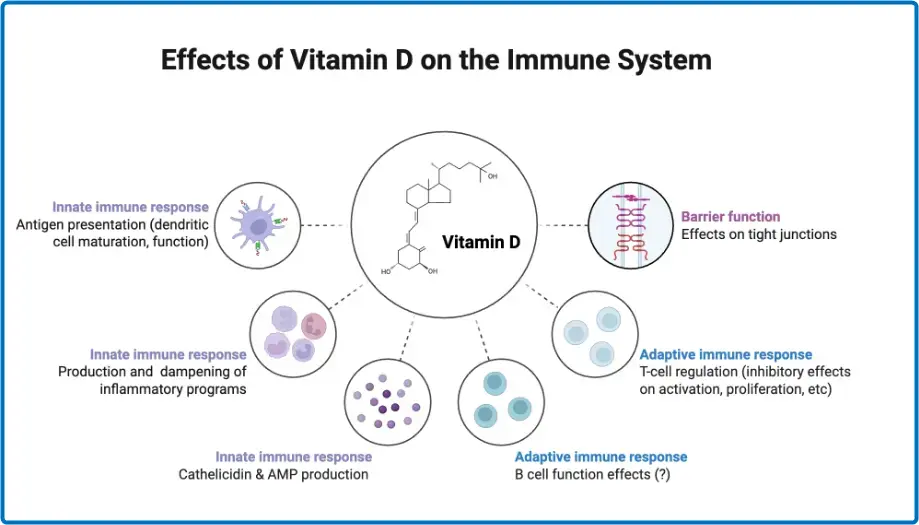
- Vitamin D₃ is converted to 25(OH)D in the liver, then to 1,25(OH)₂D, which acts on receptors in nearly every cell. In one trial, 600, 4,000 or 10,000 IU/day changed 162, 320 or 1,289 white-blood-cell genes [Shirvani 2019].
- US 25(OH)D averages about 21 ng/mL in winter and 29 in summer, with PTH moving the opposite way [Kroll 2015]. Winter levels hold at about 70% of summer because muscle releases stored 25(OH)D (Mason & Rybchyn).
- US deaths run about 25% higher in winter, driven mainly by cardiovascular and infectious diseases.
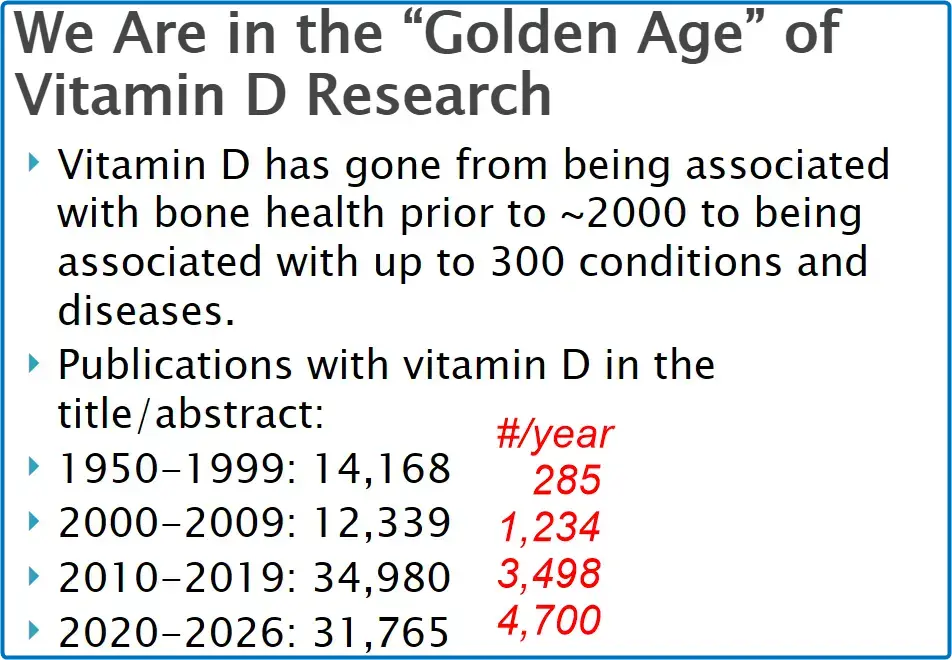
- NHANES average 25(OH)D has risen from about 25 to 30 ng/mL over 25 years (Fazili 2026). He calls this the "golden age of vitamin D": before 2000 it was linked only to bones, now to about 300 conditions.
Study types and regression dilution
- Ecological studies started the field: the Garland brothers' 1980 sunlight and colon-cancer hypothesis, and Grant's own NASA UVB maps. US UVB is higher in the West because of altitude and thinner ozone.
- Regression dilution is the theme of the talk. People's vitamin D levels drift after the baseline test, so long follow-up hides the effect. He repeatedly plots risk against follow-up time and extrapolates back to short follow-up.
Cancer
- Sunlight is linked to lower risk for about 23 cancer types, and blood 25(OH)D to lower risk for 12.
- High vs. low 25(OH)D means about 25% lower colorectal cancer risk [McCullough 2019].
- In Nebraska, 1,100 IU D₃ plus calcium cut cancer incidence in 1,179 postmenopausal women; calcium alone did not [Lappe 2007].
- Breast cancer was 82% lower at ≥60 vs. <20 ng/mL [McDonnell 2018].
- The VITAL trial (2,000 IU/day) found no benefit overall; only people with BMI <25 had about 25% less cancer. Grant asks whether that was because it had no calcium arm or didn't analyze by achieved level.
- In a Japanese trial, patients with p53-immunoreactive digestive cancers had relapse or death cut by about 70% (HR about 0.27–0.31), while other patients saw no benefit [Kanno 2023]. He says every cancer patient should get vitamin D as an adjunct.
Cardiovascular disease and stroke
- His 2025 review says vitamin D belongs in CVD prevention, alongside diet, other supplements, medication and exercise [Grant 2025].
- CVD risk rises mainly at low 25(OH)D [Wang 2012], yet VITAL mostly enrolled people above that range.
- For stroke, no effect shows beyond about 10 years of follow-up, but extrapolating to about 1 year gives roughly a 60% reduction [Grant & Boucher 2024]. Stroke mechanisms are reviewed in [Lasoń 2022].
Diabetes
- The D2d trial gave 4,000 IU/day to people with prediabetes, raising 25(OH)D from 28 to 54 ng/mL. The result, HR 0.88, was not significant [Pittas 2019].
- Re-analyzed by achieved level, each 25 nmol/L higher gave HR 0.75, and ≥125 vs. 50–74 nmol/L gave HR 0.29 [Dawson-Hughes 2020]. This is his main example of why trials should analyze by achieved level.
- Vitamin D helped only below the median BMI of 31.3 (26% lower risk) [Pittas 2023]. Obesity suppresses CYP2R1, the enzyme that makes 25(OH)D.
Dementia and brain
- Among 12,388 US participants, taking vitamin D was linked to 40% less dementia over 10 years. The effect was stronger in women, in people with normal cognition at the start, and in non-carriers of the APOE ε4 risk gene [Ghahremani 2023].
- About a 2× difference in dementia risk between <20 and >30 ng/mL appears at short follow-up [Grant 2024]. Mechanisms for depression and anxiety are in [Kouba 2022].
- As an aside, he notes Prevagen is sold as a jellyfish protein for the brain but contains 2,000 IU D₃ and earned $206M in 2024. He suspects the vitamin D does most of the work.
COVID-19 and infection
- SARS-CoV-2 positivity roughly halved from about 12% at 20 ng/mL to about 6% at ≥55 ng/mL [Kaufman 2020].
- In Barcelona, calcifediol given on admission cut ICU admission from 21% to 4.5% (OR 0.13) and deaths from 15.9% to 4.7% (OR 0.21) [Nogues 2021]. Calcifediol works right away, while D₃ takes days.
- He states his own view that the mRNA vaccines' emergency authorization required that no alternative treatments exist, and that media and social media were pressured to ignore vitamin D.
- He also cites his 2009 paper: during the 1918–19 flu pandemic, US areas with more UVB had fewer pneumonia deaths.
Pregnancy
- At the Medical University of South Carolina, mothers at ≥40 ng/mL had about 60% fewer preterm births, regardless of race [McDonnell 2017].
- In Iran, women started at an average of 11 ng/mL. The site that screened and treated them had 60% less preeclampsia, 50% less gestational diabetes and 40% fewer preterm births [Rostami 2018].
Guidelines and causality
- He rebuts the 2024 Endocrine Society guideline, which found trial benefit only for a few groups. He named under-18s, over-75s and pregnancy; the guideline also lists high-risk prediabetes.
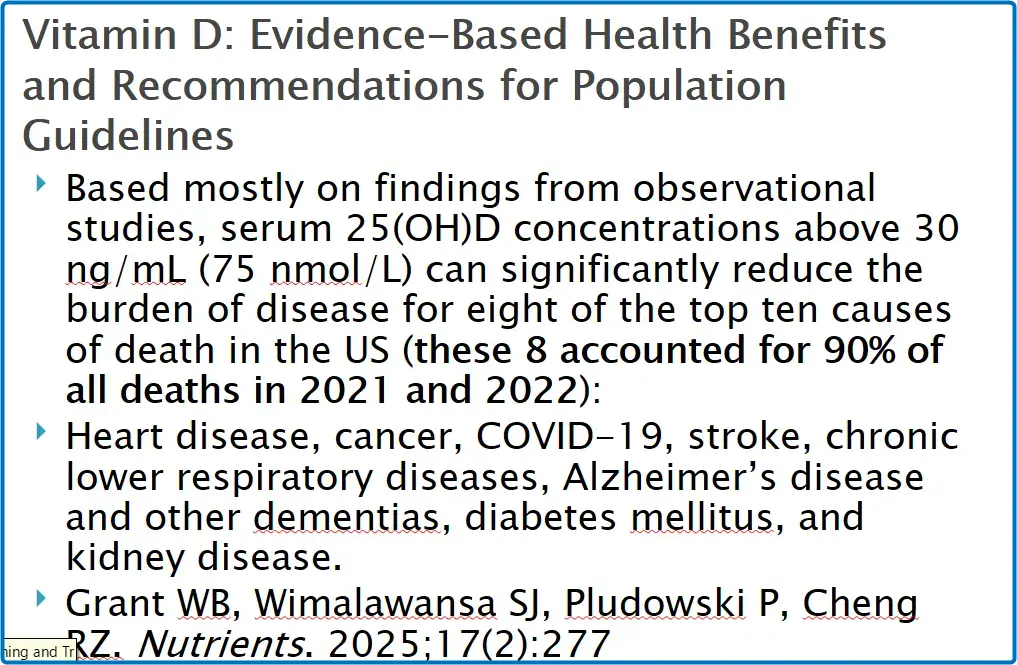
- His counter-review: ≥30 vs. <20 ng/mL reduces 8 of the top 10 US causes of death, which together account for 90% of deaths [Grant 2025].
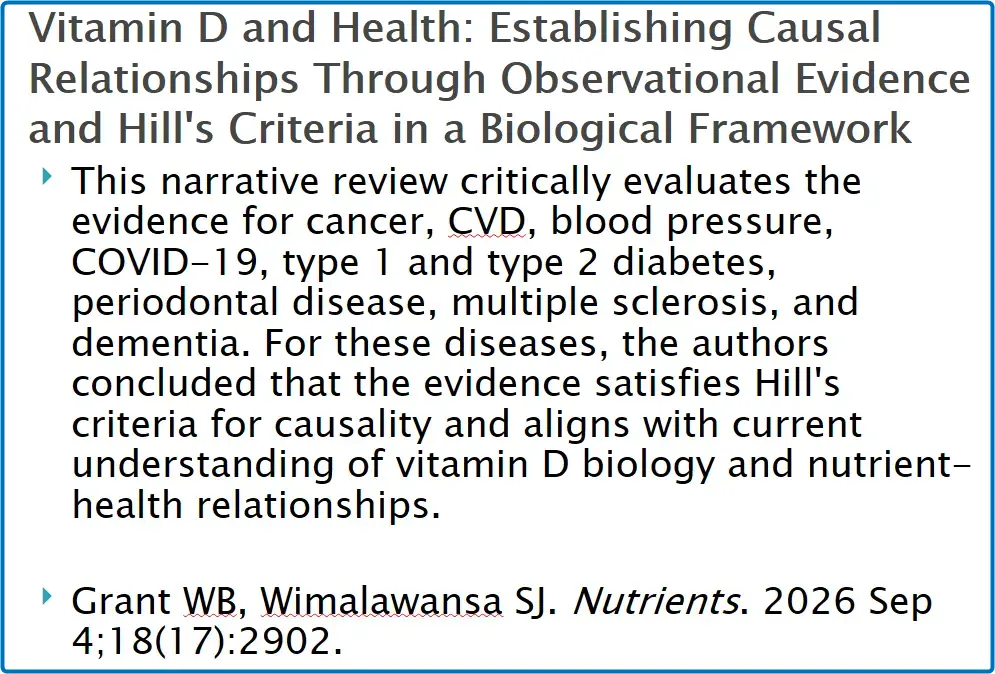
- His Hill's-criteria review covers about 20 analyses, 12 examined in detail. It concludes causality is met for cancer, CVD, blood pressure, COVID-19, type 1 and type 2 diabetes, periodontal disease, MS and dementia [Grant & Wimalawansa 2026].
- People with obesity have several micronutrient deficiencies at once (Alexa 2026), which may explain why vitamin D works less well for them.
Research priorities: effects of obesity and visceral fat; cofactors (calcium, magnesium, K₂); vitamin D as an adjunct to treatment; outcomes at 40–70 ng/mL; more Hill's-criteria analyses.
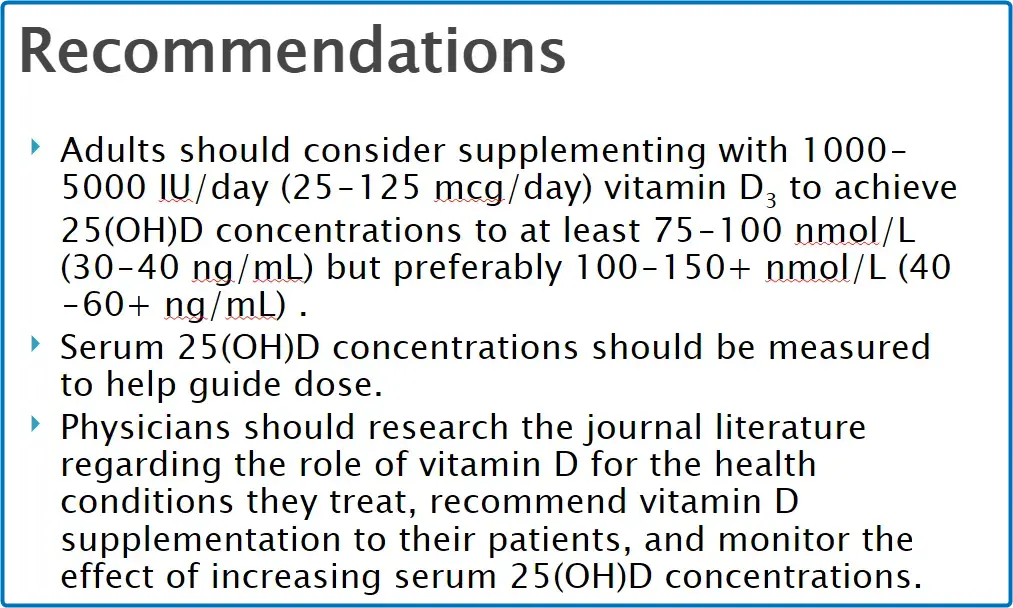
Recommendations: 1,000–5,000 IU/day of D₃ (not D₂), aiming for at least 30–40 ng/mL and preferably 40–60+. Test once or twice a year until the right dose is found. Physicians should read the literature for the conditions they treat, recommend vitamin D and monitor levels.
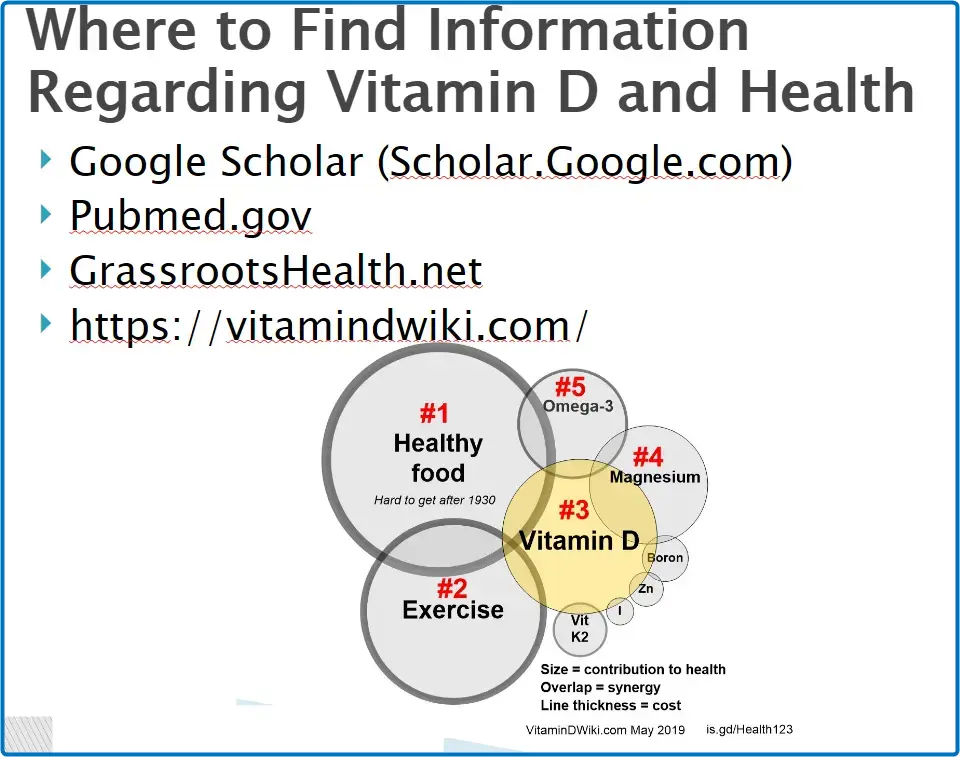
Where to find information (35:00–35:50): Google Scholar (his favorite, with about twice the journals of PubMed), PubMed, GrassrootsHealth, and VitaminDWiki. He says you have maintained VitaminDWiki for about 15 years and post to it daily. He also shows your Health123 chart and points out that vitamin D has the thinnest cost line, making it the most cost-effective item.