
Cola Soft Drinks reduce Calcium, Vitamin D, and Magnesium - many studies
A surf of the web indicates that:
There is phosphoric acid in cola drinks (both regular and diet)
Having more than ~ 1 liter per day of colas provides more acid than the body can deal with.
Increases acidity reduces the Calcium in the body – in bone and teeth
- Aspartimine also decreases Calcium levels
Vitamin D is consumed in the body in the process of trying to restore the lost Calcium
Reduces Magnesium Perplexity AI Jan 2025
Cola drinks reduce active Vitamin D not measured by standard test
Claude AI - Sept 2026
The pathway. Phosphoric acid is a cola-specific ingredient — non-cola sodas use citric acid. A phosphate load raises FGF23, and FGF23 suppresses renal synthesis of 1,25(OH)₂D by inhibiting CYP27B1 while stimulating the catabolic enzyme CYP24A1. Substrate 25(OH)D is untouched. So a cola drinker can show a perfectly respectable 25(OH)D and still be running low calcitriol, and no standard panel would catch it. That's exactly the blind spot you're pointing at.
The cola/non-cola discrimination already worked once — in bone.
Tucker's Framingham Osteoporosis analysis (n=2,538) found cola intake associated with significantly lower hip BMD in women, with daily consumers 3.7% lower at the femoral neck and 5.4% lower at Ward's area. Non-cola carbonated beverages showed nothing. Similar results for diet cola, and weaker but present for decaffeinated cola — so it's not the caffeine and not the HFCS. That's the cleanest existing support for your "both HFCS and diet" claim.
A second route that doesn't require calcitriol at all.
FGF23's obligate co-receptor is Klotho. In Framingham Offspring, 1,537 dementia-free participants followed a median 12 years produced 122 dementias, with higher FGF23 associated with increased incident dementia and AD. Separately, FGF23-null mice show memory deficits resembling Klotho knockouts. So the chain could run cola → phosphate → FGF23↑ → cognitive harm, with the calcitriol drop a parallel consequence rather than the necessary intermediate. That version is more robust, because it survives even if the calcitriol effect turns out small.
Where I'd push back before you commit to this.
The dose doesn't obviously work. A 12 oz cola contributes roughly 40–50 mg phosphorus against a typical US intake of 1,200–1,500 mg/day. Tucker found the same thing empirically: total phosphorus intake was not significantly higher in daily cola consumers — only the calcium-to-phosphorus ratio was lower. So if cola is doing something, it's more likely via calcium displacement or the Ca:P ratio than via absolute phosphate load, which weakens the FGF23 story specifically.
There's also a direct animal counterexample worth knowing: in mice, high dietary phosphate mainly upregulated hepatic CYP27A1 and CYP2R1 without changing plasma 1,25(OH)₂D, and FGF23 at the doses used didn't regulate any of the hydroxylases. That's one study and the dosing may not be comparable, but it's the experiment closest to your claim and it came out null.
And the confounder from before doesn't go away. Mild renal impairment raises FGF23 substantially and independently damages cognition — and diabetic diet-cola drinkers have more of it. The Framingham FGF23 authors flagged that they couldn't adjust for other mineral-metabolism measures.
The discriminating test. If a cohort split soda into cola vs. non-cola and the dementia signal appeared only in cola, that would be hard to explain by reverse causation — people managing diabetes switch to diet Sprite too. NOMAS almost certainly used a generic "diet soda" FFQ item and can't answer this. It's a reanalysis someone could do with existing data, and it's a fair thing to say out loud on the page.
- NOMAS 2026]
- Tucker 2006 AJCN]
- FGF23 & incident dementia, Framingham]
- Alzforum on FGF23/Klotho]
- Kägi 2018, dietary Pi & vitamin D enzymes]
- FGF23 & vitamin D metabolism review]
One additional sugary drink per day increased death rate by 7% - March 2019
Sugary Drinks Tied to Shorter Life Span New York Times
118,000 people followed for 30 years
"The optimal intake of these drinks is zero"
Diet soda increase waist size - (not mention vitamin D) March 2015
Diet Soda Intake Is Associated with Long-Term Increases in Waist Circumference in a Biethnic Cohort of Older Adults: The San Antonio Longitudinal Study of Aging
Sharon P.G. Fowler MPH1, Ken Williams MS1,2 andHelen P. Hazuda PhD1,*
Journal of the American Geriatrics Society Article first published online: 17 MAR 2015, DOI: 10.1111/jgs.13376
Objectives To examine the relationship between diet soda (DS) intake (DSI) and long-term waist circumference (WC) change (ΔWC) in the biethnic San Antonio Longitudinal Study of Aging (SALSA).
Design: Prospective cohort study.
Setting: San Antonio, Texas, neighborhoods.
Participants: SALSA examined 749 Mexican-American and European-American individuals aged 65 and older at baseline (baseline, 1992–96); 474 (79.1%) survivors completed follow-up 1 (FU1, 2000–01), 413 (73.4%) completed FU2 (2001–03), and 375 (71.0%) completed FU3 (2003–04). Participants completed a mean of 2.64 follow-up intervals, for 9.4 total follow-up years.
Measurements: DSI, WC, height, and weight were measured at outset and at the conclusion of each interval: baseline, FU1, FU2, and FU3.
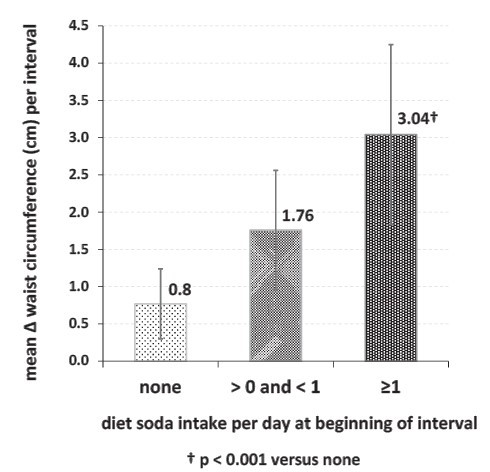
Results: Adjusted for initial WC, demographic characteristics, physical activity, diabetes mellitus, and smoking, mean interval ΔWC of DS users (2.11 cm, 95% confidence interval (CI) = 1.45–2.76 cm) was almost triple that of nonusers (0.77 cm, 95% CI = 0.29–1.23 cm) (P < .001). Adjusted interval ΔWCs were 0.77 cm (95% CI = 0.29–1.23 cm) for nonusers, 1.76 cm (95% CI = 0.96–2.57 cm) for occasional users, and 3.04 cm (95% CI = 1.82–4.26 cm) for daily users (P = .002 for trend). This translates to ΔWCs of 0.80 inches for nonusers, 1.83 inches for occasional users, and 3.16 for daily users over the total SALSA follow-up. In subanalyses stratified for selected covariates, ΔWC point estimates were consistently higher in DS users.
Conclusion: In a striking dose-response relationship, increasing DSI was associated with escalating abdominal obesity, a potential pathway for cardiometabolic risk in this aging population.
Download the PDF from VitaminDWiki
Described in Diet Soda Adds Inches to the Waist of Seniors, Researchers Say Mercola April 2015
Pop-cola acids and tooth erosion: an in vitro, in vivo, electron-microscopic, and clinical report. - 2010
Int J Dent. 2010;2010:957842. Epub 2010 Dec 2.
Borjian A, Ferrari CC, Anouf A, Touyz LZ.
McGill Faculty of Dentistry, Montreal, PQ, H3A 2B2, Canada.
Introduction. Manufactured Colas are consumed universally as soft drinks. Evidence about the acid contents of Cola-beverages and its effects on teeth is rare. Aim. To assess (i) cola acidity and buffering capacity in vitro, (ii) tooth erosion after swishing with colas in vivo (iii) scanning electron microscopic effects on teeth of colas, and tooth-brush abrasion, and (iv) report a clinical case of erosion from cola consumption.
Materials and Methods. (i) We measured six commercially available pop "Cola beverages", pH, and buffering capacities using a pH-Mettler Automatic Titrator, with weak solution of Sodium Hydroxide (ii) two cohorts, one with teeth, the second without teeth rinsed with aliquots of Cola for 60 seconds. Swished cola samples tested for calcium and phosphorus contents using standardized chemical analytical methods (iii) enamel, dentine, and the enamel-cemental junction from unerupted extracted wisdom teeth were examined with a scanning electron microscope after exposure to colas, and tested for tooth-brush abrasion; (iv) a clinical case of pop cola erosion presentation, are all described.
Results. Comparisons among pop colas tested in vitro reveal high acidity with very low pH. Buffering capacities in millilitres of 0.5?M NaOH needed to increase one pH unit, to pH 5.5 and pH 7 are reported. Rinsing in vivo with pop cola causes leeching of calcium from teeth ; SEM shows dental erosion, and pop-cola consumption induces advanced dental erosion and facilitates abrasion.
Conclusions. (i) Pop-Cola acid activity is below the critical pH 5.5 for tooth dissolution, with high buffering capacities countering neutralization effects of saliva; (ii) calcium is leeched out of teeth after rinsing with pop colas; (iii) SEM evidence explains why chronic exposure to acid pop colas causes dental frangibles; (iv) a clinical case of pop-cola erosion confirms this. PMID: 21151663 CLICK HERE for full text
Soft drinks cause soft bones, but is it also time to slay the sacred cow?- 2006
http://www.drbriffa.com/2006/10/09/soft-drinks-cause-soft-bones-and-is-it-time-to-slay-the-sacred-cow/
October 2006
Clipped – – – This month’s edition of the American Journal of Clinical Nutrition has published a study which found that women drinking four or more cola drinks a week were at increased risk of reduced bone density (1). And this is not the first evidence that has linked the drinking of fizzy drinks to weaker bones. A number of explanations are generally put forward to attempt to explain this phenomenon. A constituent of cola is phosphoric acid , which is believed to impart a degree of acidity within the body that increases the risk that calcium is leeched from the bone. Caffeine, another common component in cola drinks, is also believed to stimulate calcium loss.
WebMD: Soda and Osteoporosis: Is There a Connection? – Feb 2007
http://www.webmd.com/osteoporosis/features/soda-osteoporosis
Clip – – – –
“New research indicates that there may be more to the soda and osteoporosis connection than simply replacing the good stuff with the useless stuff.
Researchers at Tufts University, studying several thousand men and women, found that women who regularly drank cola-based sodas -- three or more a day -- had almost 4% lower bone mineral density in the hip , even though researchers controlled for calcium and vitamin D intake . But women who drank non-cola soft drinks, like Sprite or Mountain Dew, didn't appear to have lower bone density.”
Clip from Wikipedia entry on Osteoporosis
Soft drinks—some studies indicate that soft drinks (many of which contain phosphoric acid) may increase risk of osteoporosis; 21 Others suggest soft drinks may displace calcium-containing drinks from the diet rather than directly causing osteoporosis. 22
21 Tucker KL, Morita K, Qiao N, Hannan MT, Cupples LA, Kiel DP (2006). "Colas, but not other carbonated beverages, are associated with low bone mineral density in older women: The Framingham Osteoporosis Study". Am. J. Clin. Nutr. 84 (4): 936–42. PMID 17023723.
22 American Academy of Pediatrics Committee on School Health (2004). "Soft drinks in schools". Pediatrics 113 (1 Pt 1): 152–4. doi:10.1542/peds.113.1.152. PMID 14702469.
Cola at Advancing your health March 2012
According to findings from a study at Harvard, 9th and 10th grade girls who consume sodas are at 3X the risk for bone fractures compared to those who don’t.
Research out of Tufts University shows that “women–but not men–who drank more than three 12-ounce servings of cola per day
- had 2.3 percent to 5.1 percent lower bone-mineral density in the hip than women who consumed less than one serving of cola per day.”
- In a 2010 study from the Journal of American Dietetic Association, 170 girls were followed from age 5 to 15.
- Of those, the participants who drank soda at age 5 were less likely to drink milk throughout childhood than those who didn’t consume soda at age 5.
- Those who drank soda from the age of 5 were also more likely to consume diets lacking in calcium, fiber, vitamin D, protein, magnesium, phosphorus and potassium.
63% of Americans Actively Avoid Soda - Dec 2014
63% of Americans Actively Avoid Soda Mercola
41% in 2002; Long article about insulin, etc. Nothing about Calcium and Vitamin D
22 Ways Drinking Soda Will Shorten Your Life
Soda can cause a decline in kidney function.
Soda increases diabetes risk.
Caffeine in soda blocks the absorption of magnesium.
Soda increases obesity risk in children.
Soda increases heart disease in men
Soda depletes your mineral levels.
Soda is linked to Asthma.
VitaminDWiki suspects that decreased Vitamin D is the connection for many of the above
See also VitaminDWiki
Big Tobacco Hooked Children on Sugary Drinks using flavors, colors, and marketing
Sugary drinks associated with 5X worse Multiple Sclerosis (reduces vitamin D levels)– March 2019
HFCS is one of the many new reasons for vitamin D deficiency
National Estimates of Dietary Fructose Intake Increased from 1977 ...
surfers in Hawaii (PDF), who drank large amount of cola soft drink, had low levels of vitamin D
Too much fructose reduced both serum and active vitamin D in rats – April 2013
Fructose reduces levels of active vitamin D (not measured by standard tests) – April 2014
Fructose (High Fructose Corn Syrup) consumes 2X more Magnesium than sugar – May 2014
High-fructose diet slows recovery from brain injury - TBI, rats - Oct 2015
See also web
("corn syrup" OR fructose) "vitamin d" 32,000 hits in Google Scholar as of Jan 2025
CDC Executive Resigns After Being Caught Colluding With Coca-Cola to Salvage Soda Market Mercola July 2016
Taking the fizz out of diet soda May 2012 - summarized the results from many studies over the past decade
43% increase in heart attack and stroke if one per day
decrease bone mineral density
34% more metabolic syndrome: in group which dr - 2013
drank the most diet soda
67% increase in type 2 diabetes if one per day
55% increase in obesity
- Diet Sodas Tied to Dementia and Stroke NYT April 2017
- 2X more likely to have a stroke
- Sugary Drinks Tied to Accelerated Brain Aging NYT April 2017
- 1 or 2 sugary drinks a day ==> 5.8 years decrease in memory loss
- Soft drinks during pregnancy increased chance of Asthma or allergic rhinitis in child by 30% - PLOS 2013
Carmel coloring can cause Cancer
- Cancer-Causing Caramel Color Greger March, 2019
- ..."its manufacture can sometimes lead to the formation of a carcinogen called methylimidazole, which was identified as a cancer-causing chemical in 2007"
- "Pepsi may be causing thousands of cancer cases, especially non-California Pepsi products, which appear to be causing 20 times more cancer than Coke."
- Soda also increases risk of Asthma by 5X and decreases size of blood vessels in eyes ==> high blood pressure, etc
- Also has video summaries