
Test Proof that Vitamin D Works
Observation by Henry Lahore of VitaminDWiki Dec 2013
I am unaware of a single vitamin D clinical trial which used enough D for long enough that did not get great results.
Many Clinical Trials do not find a benefit bacause of one or more of the following:
- Have used too small a dose of vitamin D (often < 1,100 IU)
- Fails to have given vitamin D for too short of time (a few RCT lasted less than 5 weeks)
Fails to have given Vitamin D frequently enough. At least every 2 months for D3) - and at least weekly for D2
- Note: Infrequent dosing also causes unbalancing of the body's chemistry
Fails to provide a loading dose, or had too short a duration to restore the vitamin D levels
Fails to use D3 form, instead uses the less effective D2 form
- Fails to have a health range of Calcium or other important cofactors (especially for bone-related trials
- Also, differences in Magnesium can result in 30% change in response to vitamin D
- Magnesium is dependant on water, food, supplements
Fails to notice the pre-existing vitamin D levels - only those who are low will likely show a benefit
Fais to notice how/when the vitamin D was taken (which can change the response by as much as 2X)
Fais to reports on compliance (in one case 40% of the participants did not take the supplements consistantly)
Many Meta-Analysis do not find a benefit because one or more of the above reasons
- Many meta-analysis average together ALL of the trials
- Imagine a story about a meta-analysis if aspirin were being introduced now.
- There would be scores of RCT for aspirin not working with 3 mg doses
- There would be many RCT of aspirin not working with 30 mg doses
- There would be a few studies of aspirin WORKING with 300+ mg doses
- There would be many studies of small amounts of Willow bark (Vitamin D2 instead of Vitamin D3)
- Then were would be a meta-analysis of aspirin and Willow Bark
- - That meta-analysis would conclude that aspirin and bark do not work.
While about 200 RCTs will be published during 2014, I anticipate only adding 50 to the proofs table due to the reasons listed above
Also, some trials will not get started due to lack of people willing to go for years with < 500 IU of vitamin D
Note: 95% of the proofs for vitamin D were published after the IoM stopped looking at data.
See also VitaminDWiki: Random Controlled Trials with vitamin D intervention
Over 1000 Clinical Trials with Vitamin D INTERVENTION- Aug 2013
4000 IU Vitamin D intervention helped elderly bones – March 2010
890 IU of vitamin D and 1200 mg Calcium improved bone density – July 2010
Only vitamin D helped prevent falls after stroke – July 2010
Summary o f Vitamin D trials - Grant Jan 2012 many are intervention trials
Hip surgery followed by 100,000 IU, then 1000 IU of vitamin D daily – June 2010
20,000 IU vitamin D and MS – less fatigue and relapse Dec 2010
More intervention trials for Vitamin D than for the TOTAL of Vitamins A + C + E + K combined
Vitamin D= 915 , Others = 798 Vitamin A 188 + Vitamin C 269 + Vitamin E 236 + Vitamin K 105 ] as of Sept 2012
See also VitaminDWiki
HMOs will save millions of dollars with vitamin D has additional information on proof of treatment
Is it ethical to not give vitamin D in osteoporosis trials– NEJM Sept 2010
- Some Vitamin D RCT are not being created because the researchers do not want to deprive the benefits to half of the patients
- Some Vitamin D RCT are not being created because too many candidates are already taking vitamin D
List of all categories of Vitamin D Information and number of items in each
List of all Overviews of Vitamin D Overviews
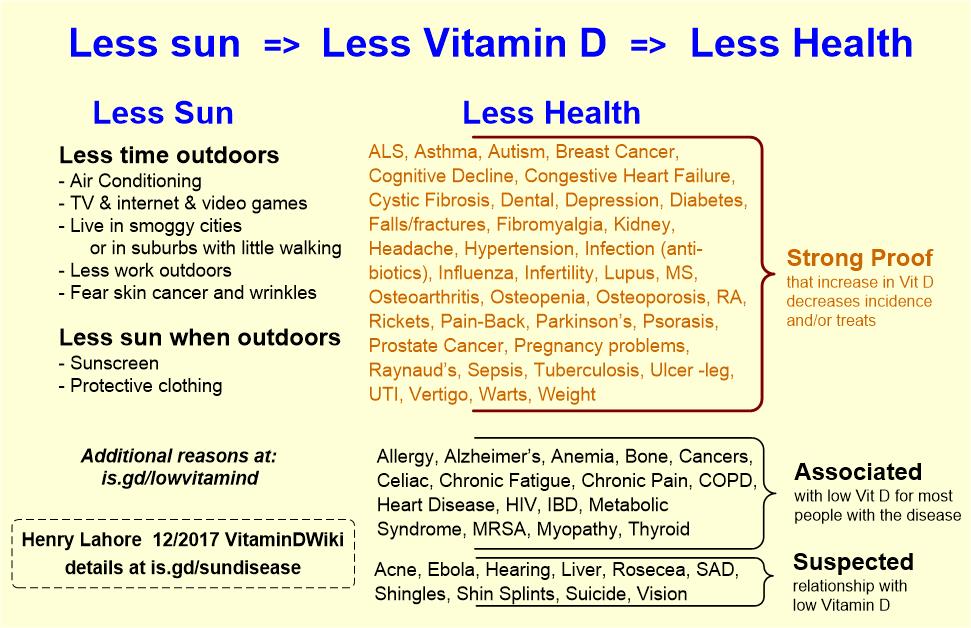
CLICK ON chart for more information and translation
Chart of Vitamin D benefits from 2012
Just a simple count, not any proof
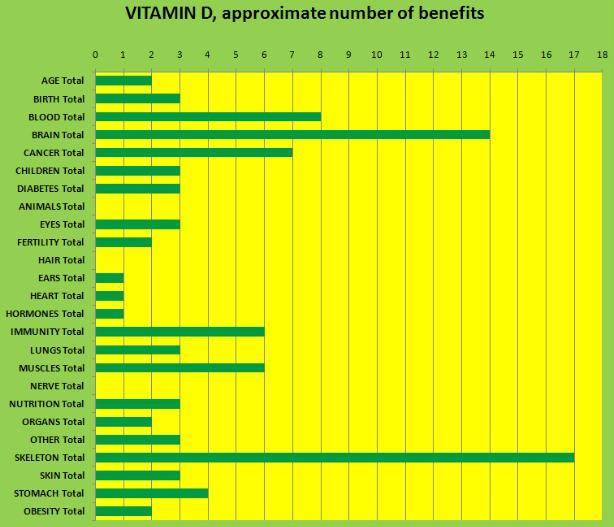
See also web
Medicine’s House of Cards – What Happens When We’ve Got It All Wrong Green Medical Info Nov 2013
- Studying nutrients the way we study drugs makes no sense, RCT should not be required for nutrients
Short url of this page= is.gd/proofvitd