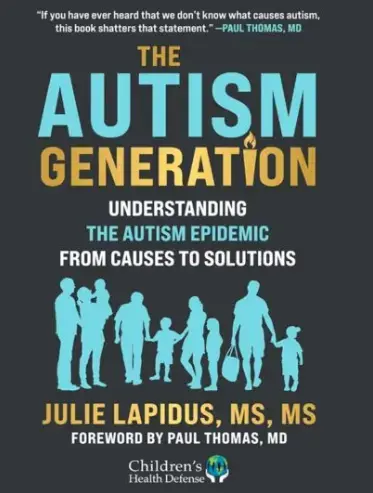
The Autism Generation - 2026 book
The Autism Generation: Understanding the Autism Epidemic from Causes to Solutions*, by Julie Lapidus (2026)
Claude Opus 5.5 Nov 2026
The book at a glance
- Publisher: Skyhorse Publishing, under its Children's Health Defense Books imprint. It came out in mid-2026 as a 624-page hardcover ($32.99), plus ebook and audiobook (NetGalley listing).
- Scope: It cites more than 1,392 references and includes many tables and charts.
- Author: Julie Lapidus is a holistic well-being coach, a licensed massage therapist and a self-described biohacking expert. She has researched autism and brain health for 16 years. She founded Autism Evolution and runs a coaching program, the Autism Wellbeing Accelerator, which has worked with hundreds of parents. Her brother is autistic, which is what drew her to the subject (The Defender).
Structure
The book has three parts (CHD Bookstore listing):
- A memoir of her brother's autism and his health journey.
- A history of vaccination and of exposures to substances that harm the nervous system (neurotoxins).
- A wellness guide for parents and health practitioners, drawing on functional medicine and biohacking. It ends with a "Thriving Baby Blueprint" for prospective parents.
Main argument: autism as an early warning
Lapidus sees autism as a sign of a wider decline in children's health. She cites these figures for U.S. children:
- 54% have a chronic illness.
- 1 in 6 have a developmental disorder, including 1 in 10 with ADHD and 1 in 31 with autism.
- 1 in 12 have asthma, and 1 in 13 have food allergies.
She calls autistic children "canaries in the coal mine." In her view, what is making them sick shows what is making many other children sick too.
The publisher presents the book as an answer to Robert F. Kennedy Jr.'s promise to identify the causes of autism by September 2025. It argues that existing research already showed the causes, and that there are many of them, both environmental and genetic (Bulk Bookstore listing).
"Neurodisruption"
This is the author's own model of what causes autism. She argues that the combined load of toxic exposures can disrupt how the brain develops. The exposures she lists are:
- prescription drugs
- pesticides
- toxic metals
- pollution
- other chemicals
Her hypothesis depends on a threshold. She proposes that anyone exposed to a high enough level of neurotoxins would develop a neurodevelopmental disorder such as autism, and she gives vaccines as one example of a source.
Vaccines: aluminum and mercury
The review says the book's biggest focus is aluminum and mercury in vaccines:
- Comparing schedules: She uses the drug makers' package inserts to compare the CDC childhood vaccine schedules of 1998 and 2025. By her figures:
- aluminum received by 18 months rose 13%, from 3,925 to 4,425 µg
- mercury received by age 18 rose 82%, from 275 to 500 µg
- Reference tables: She lists the aluminum, mercury and thimerosal content of each vaccine and traces how ingredients and schedules changed over time.
- Aluminum doses: She cites independent testing that found some vials held four times the aluminum stated on the label. She also cites a 2018 study that she says shows the FDA miscalculated safe aluminum levels.
- Thimerosal: This is a mercury-containing preservative. She argues that it was said to be removed from childhood vaccines in 2001 but stayed on the CDC schedule at levels above the EPA's safety limits for adults.
- By her calculation, a 12-month-old born in 2024 could receive twice as much mercury as one born in 1998.
- That would be 26 times the level the EPA considers safe for adults.
- Her conclusions:
- Vaccine policy should be reconsidered, including whether children should get any vaccines at all.
- Her research leaves her doubting that any vaccine is safe or clearly effective.
- Parents and doctors should read the package inserts themselves.
What families can do: the wellness guide
Much of the book is practical advice. It covers:
- nutrition, food allergies and sample meal plans
- supplements
- gluten-free and casein-free (dairy-protein-free) diets
- picky eating
- camel's milk
- sleep and biohacking
- reducing toxic exposures in the home and in the body
She argues that medication is a poor fit for autism. In her view, most of the drugs prescribed treat psychiatric symptoms, help little and sometimes make things worse. She says it is never too late to help. She reports improvements in older children and adults she has worked with.
The Thriving Baby Blueprint aims to lower the risk of neurodevelopmental disorders. It covers nutrition before conception and during pregnancy, exposures in the home, and avoiding mercury. The review doesn't name any specific supplements or doses, so I couldn't tell whether vitamin D, folate or omega-3s are covered.
Tone and readers
The book is written for parents, clinicians and advocates, and its tone is hopeful. Lapidus says she wouldn't have written it if there were no solutions to offer. She adds that working on a child's health often improves the whole family's health. Most of the advance praise comes from functional-medicine and natural-health authors.
How the vaccine claims compare with other research
The book's vaccine conclusions conflict with the largest studies:
- Aluminum: A Danish study followed about 1.2 million children born between 1997 and 2018. It was published in Annals of Internal Medicine in July 2025. It found no link between the total aluminum children received from vaccines and autism, ADHD or 48 other chronic conditions. The authors said they couldn't rule out small effects on some of the rarer conditions (KTVU report).
- Thimerosal: It was taken out of routine childhood vaccines by 2001. After that it stayed only in flu vaccine packaged in multi-dose vials, which were about 4% of the U.S. flu vaccine supply (PolitiFact).
- In 2025, the CDC's vaccine advisory committee (ACIP), after Kennedy replaced its members, recommended only thimerosal-free flu vaccines. Thimerosal is now being removed from all U.S. flu vaccines (HealthDay).
- So the book's mercury totals after 2001 seem to assume that a child gets every flu shot from a multi-dose vial, and that situation is being phased out.
- An Institute of Medicine review of more than 200 studies found no causal link between thimerosal and autism (PhillyVoice).
- The other side: Children's Health Defense and authors like Lapidus argue that those safety studies are flawed. The Defender's review of the book links to several articles making that case.
Sources:
- The Defender review, Nov 16, 2026
- NetGalley listing
- CHD Bookstore listing
- Bulk Bookstore listing
- KTVU: Danish aluminum study
- PolitiFact: thimerosal explainer
- HealthDay: thimerosal removed from flu vaccines
- PhillyVoice / The Conversation: thimerosal history
Related in VitaminDWiki
- Overview Autism and vitamin D
- 17 Autism risk factors: low Vitamin D, virus, vaccine, mercury etc. - many studies
- Transgender associated with autism, low vitamin D, low BMD, etc. - many studies
- Autism much more likely if poor Vitamin D Receptor – many studies
- 45% less Autism in offspring if 20 ng/mL more maternal Vitamin D - meta-analysis
- Autism and autoimmune diseases and high-dose Vitamin D - video and summary
- Autism associated with low Vitamin D (again) – Meta-Analysis
- Increased risk of ADHD (28 pct.) and Autism (58 pct.) if low vitamin D during pregnancy – meta-analysis
- Autism risk increased 30 percent by Cesareans (both low vitamin D) – meta-analysis
- Autism risk factors – many are associated with low vitamin D – meta-meta-analysis
- 24% lower risk of Autism for every 4 ng higher level of vitamin D during pregnancy - RCT
- Autistics have half of the response to Vitamin D – RCT
- ADHD 2 X more likely if Tylenol used a lot during pregnancy (Autism increased too)
- Parkinson’s and autism may start in the gut – microbiome podcast – Nov 2026
- Vaccines increase the risk of autism (30 studies)
- Autistics live 6 fewer years than others on Medicaid
- Autism in US preschoolers more than doubled between 2019 and 2024 - parent observation
- Wide variety of Autism treatments
- Autism rate in siblings reduced 4X by vitamin D: 5,000 IU during pregnancy, 1,000 IU to infants
- Autism decreased in 8 out of 10 children supplemented with vitamin D
- Increase in Autism prevalence matches increase in Vaccinations
- Liposomal Glutathione might fight Autism
- Autism appears to increase the risk of Alzheimer's by 2X to 6X
- Autism associated with low Vitamin D - PhD dissertation - Feb 2025
- Autism IS associated with childhood vaccines - CDC reversal Dec 2025
- Total Load Theory (Autism,etc. book Dec 2025
- 50% increased chance of Autism if military mom
- 450,000 US children have profound Autism (extremely low Vitamin D)
- Autism is strongly associated with 31 gut microbiota (bacteria, archaea, fungi, and viruses)
- Autism and the gut
- Vitamin D fights autism - trying to figure out how and why
- Autism
- Autism treated by an activator of the Vitamin D Receptor: supforaphane
- Autism 5.7 X more likely if both parents had high chemical intolerance
- Autism virtually non-existent if vitamin D levels greater than 44 ng while pregnant
- Autism 17 times more likely with excessive Folic Acid and B-12 (now added to bread)
- Omega-3 probably can decrease Autism and ADHD
- Lower IQ among Autistic Black children (5 in 10) than White (3 in 10)