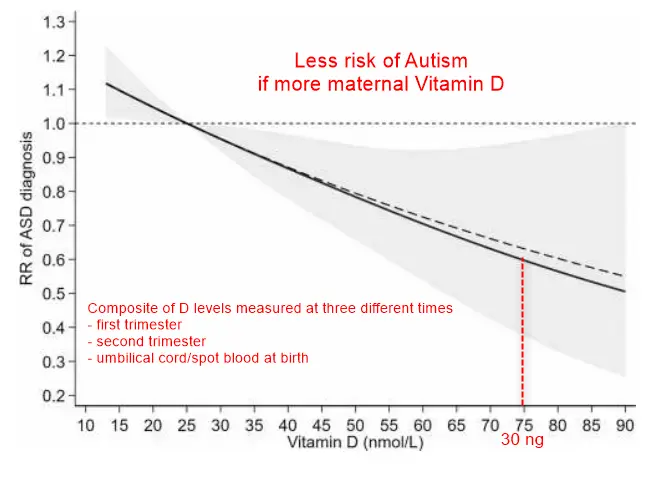
45% less Autism in offspring if 20 ng/mL more maternal Vitamin D - meta-analysis
The impact of maternal vitamin D levels during pregnancy and risk of autism spectrum disorder and attention deficit hyperactivity disorder diagnosis and symptoms in offspring: a systematic review and dose-response meta-analysis
European Child & Adolescent Psychiatry, June 3, 2026, https://doi.org/10.1007/s00787-026-03059-7
Laura Bandini, Beatrice Vinceti, Teresa Urbano, Giuseppe Plazzi, Tommaso Filippini, Marco Vinceti
Summary by Claude - August, 2026
Mothers with higher vitamin D levels during pregnancy had children with modestly lower rates of autism and ADHD — and the benefit kept increasing across the whole range measured, with no threshold where it stopped helping.
This is a systematic review and dose-response meta-analysis of 15 observational studies (cohort, case-cohort and case-control) covering 96,380 children aged 0–17, mostly from European cohorts. Maternal 25(OH)D was measured in the first trimester in six studies, the second trimester in seven, and from cord blood or newborn blood spots in three.
Comparing high versus low maternal vitamin D status: autism risk RR 0.91 (95% CI 0.87–0.96) from 8 studies, and ADHD risk RR 0.90 (95% CI 0.82–0.99) from 4 studies. The dose-response analysis found autism risk falling about 9% for every 10 nmol/L (4 ng/mL) increase in maternal serum level, linearly, with no plateau. Autism symptom scores and ADHD symptom scores were also lower with higher maternal levels.
What this does not show / limitations
- No supplementation and no RCTs — this is blood level versus outcome, so it cannot prove cause. No doses or achieved levels from treatment are reported anywhere.
- The dose-response curve only spans roughly 10–90 nmol/L (4–36 ng/mL). It says nothing about 100–150 nmol/L, the range many VitaminDWiki readers target.
- Autism and ADHD are strongly heritable and run with low vitamin D. Only 4 of 15 studies adjusted for maternal psychiatric diagnosis and only 1 for paternal, so the authors themselves warn the findings "could reflect such overall genetic association rather than support a protective role."
- The linear per-10 nmol/L estimate was RR 0.91 (95% CI 0.83–1.00) — the confidence interval just touches 1.00.
- ADHD results had very high heterogeneity (I² = 88%), and the ADHD-symptom analysis using a yes/no outcome was not statistically significant, RR 0.87 (95% CI 0.69–1.09).
- Funnel plot for autism suggested possible publication bias; trim-and-fill barely changed the result (RR 0.92).
- Heavily European cohorts — limited generalizability elsewhere.
Related in VitaminDWiki
- Incidence Autism and ADHD reduced 18 percent per 10 ng of Vitamin D during pregnancy – meta-analysis
- 24% lower risk of Autism for every 4 ng higher level of vitamin D during pregnancy - RCT
- 17 Autism risk factors: low Vitamin D, virus, vaccine, mercury etc. - many studies
- Autism risk is reduced by Vitamin D – early pregnancy or chlldhood – Umbrella review
- Prenatal vitamins – including vitamin D – reduced autism by 40%
- Increased risk of ADHD (28 pct.) and Autism (58 pct.) if low vitamin D during pregnancy – meta-analysis