
Autism in US preschoolers more than doubled between 2019 and 2024 - parent observation
Trends in Parent-Reported Developmental Disabilities: 2019–2024
Pediatrics, October 1, 2026, https://doi.org/10.1542/peds.2025-073828
Benjamin Zablotsky, Lindsey I. Black, Amanda E. Ng, Stephen J. Blumberg
Summary by Claude Opus 5.5 - October 2026
Practical takeaway: By 2023–2024, about 1 in 5 US children aged 3–17 (20.5%) had a parent-reported developmental disability diagnosis. That is up from 16.7% in 2019–2020, a 22% relative increase in about four years. Autism rose the fastest.
This is a CDC/NCHS analysis of the National Health Interview Survey, a nationally representative household survey of 39,217 children from 2019 to 2024. It is repeated cross-sectional (observational) data, peer-reviewed, with no conflicts of interest declared. Vitamin D was not measured.
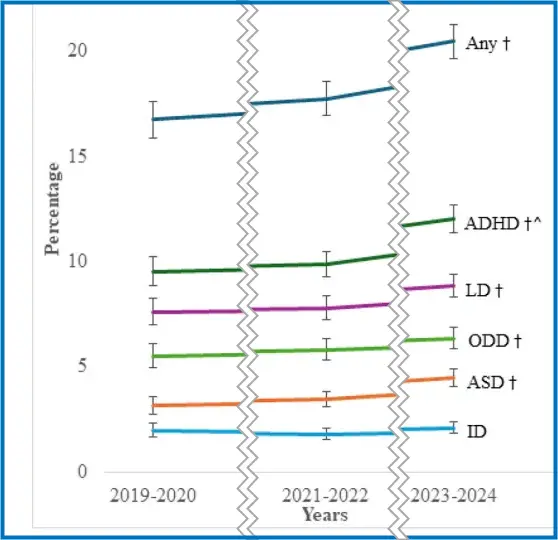
All ages
| Diagnosis | 2019–2020 | 2023–2024 | Relative change |
|---|---|---|---|
| Any of the 5 | 16.7% | 20.5% | +22% |
| ADHD | 9.5% | 12.0% | +26% |
| Autism | 3.1% | 4.5% | +42% |
| Learning disability | 7.6% | 8.8% | +16% |
| Other developmental delay | 5.5% | 6.4% | +16% |
| Intellectual disability | 1.95% | 2.08% | Not significant |
Autism increase vs age
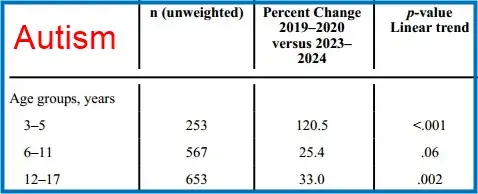
All of the increases stayed significant after adjusting for age, sex, race/ethnicity, income, and urbanization.
The largest autism increases were among children aged 3–5 (2.4% to 5.3%), children in nonmetropolitan areas (+86%), lower-income families (+61%), and girls (+58%). Non-Hispanic Black children had the highest autism prevalence in 2023–2024, at 5.5%.
The authors suggest "These increases could be related to earlier detection and awareness." They also note that the study was not designed to find out why prevalence rose.
What this does NOT show
- Why diagnoses rose: no data were collected on vitamin D, sun exposure, diet, medications, or any other exposure
- Whether more children are truly affected, or the same children are simply being diagnosed more often
- Clinically confirmed diagnoses: parents reported whether they had ever been told of a diagnosis, and this was not checked against medical or school records
- Fully consistent methods across years: during COVID in 2020, most interviews moved to telephone, and the child response rate averaged only 49%
- Anything about children under 3 or children living in institutions
AUTISM in VitaminDWiki
- Overview Autism and vitamin D
- Autism category
- Autism and autoimmune diseases and high-dose Vitamin D - video and summary
- Increase in Autism prevalence matches increase in Vaccinations
- Autism appears to increase the risk of Alzheimer's by 2X to 6X
- Liposomal Gluthathione proven to fight T2D, Oxidative Stress, NAFLD, RA, HIV, PD, Autism, RSV, etc
- Vitamin D nanoemulsion looks promising for treating Autism
- Wide variety of Autism treatments
- Autism treated by Vitamin D: Dr. Cannell - video