
Low Vitamin D and the gut problems: barrier, immunity, and microbiome - review
Vitamin D and Intestinal Diseases: Impact on Intestinal Immunity and Gut Barrier Function
Diseases (MDPI), 13 August 2026, https://doi.org/10.3390/diseases14080293
Erik Shorabaev, Amankeldi Sadanov, Baiken Baimakhanova, Saltanat Orasymbet, Irina Ratnikova, Bakhytzhan Kerimzhanova, Zhanar Assilova, Zaure Datkhayeva, Aknur Turgumbayeva
Summary by Claude - August, 2026
A narrative review (literature through May 2026, studies from 2004–2026) pulling together what vitamin D does in the gut and what the trials actually found.
Mechanism side: VDR signaling controls tight-junction proteins (ZO-1, claudins, occludin), keeps goblet and Paneth cells working, drives cathelicidin (LL-37) and β-defensins, pushes macrophages toward M2 and T cells toward Treg while suppressing Th1/Th17. Low D means impaired VDR signaling, a leakier barrier, dysbiosis, and more inflammation. VDR-knockout animals show more Bacteroidetes and Proteobacteria and fewer Firmicutes. The traffic runs both ways — gut bacteria also alter vitamin D metabolism, and lithocholic acid (a microbial bile-acid product) is itself a VDR agonist.
Clinical side, condition by condition:
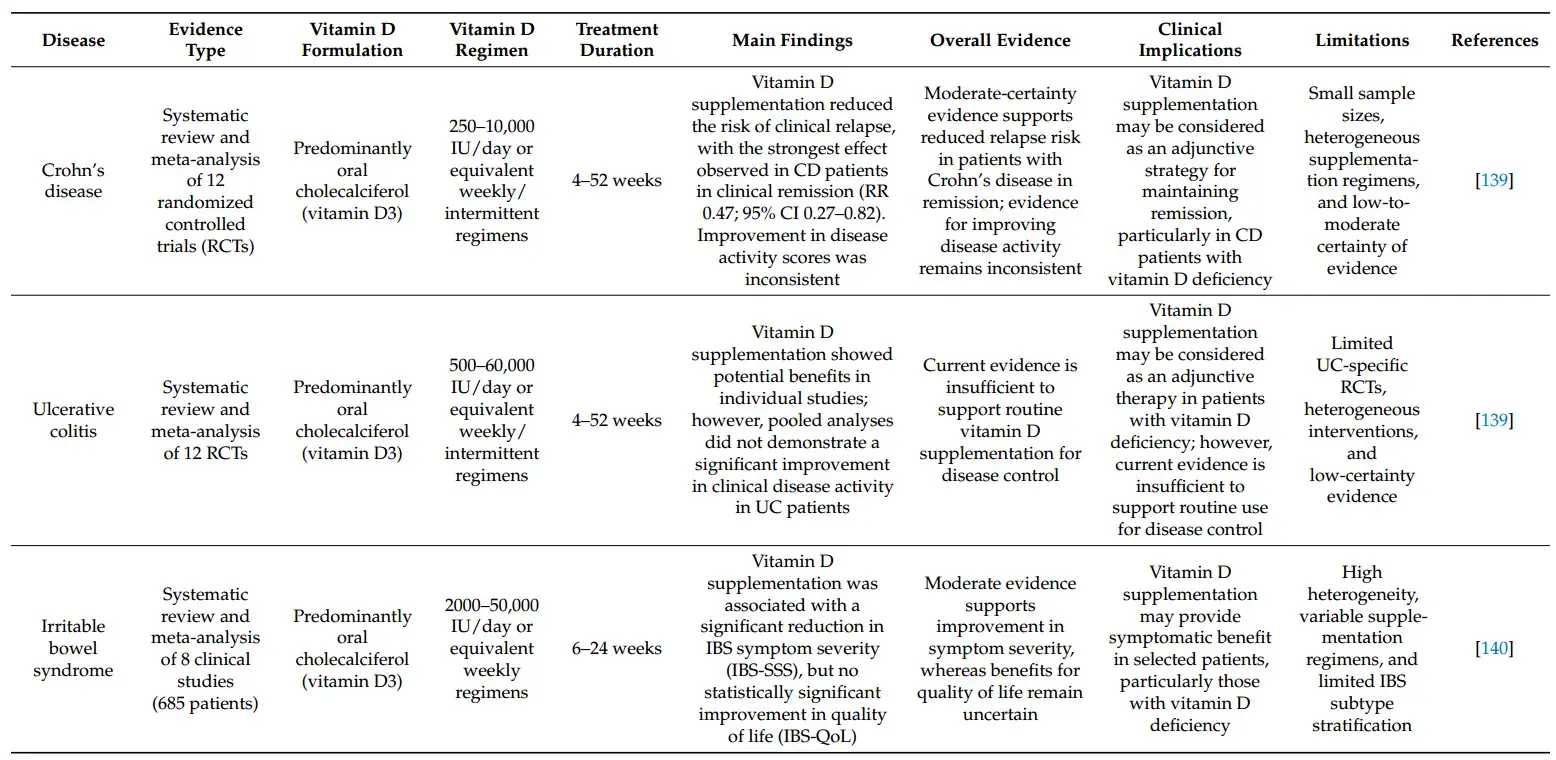
Crohn's — RR 0.47 (95% CI 0.27–0.82) for relapse in patients already in remission — but that headline figure comes from only 2 trials. Across all 12 RCTs (458 IBD patients) the pooled relapse risk was 0.64 (0.46–0.89).
- Ulcerative Colitis — 12 RCTs, 500–60,000 IU/day: individual studies encouraging. That's not a null result from twelve trials — it's near-absence of data.
- IBS — 8 studies, 685 patients, 2,000–50,000 IU/day for 6–24 weeks: symptom severity (IBS-SSS) dropped significantly; quality of life did not.
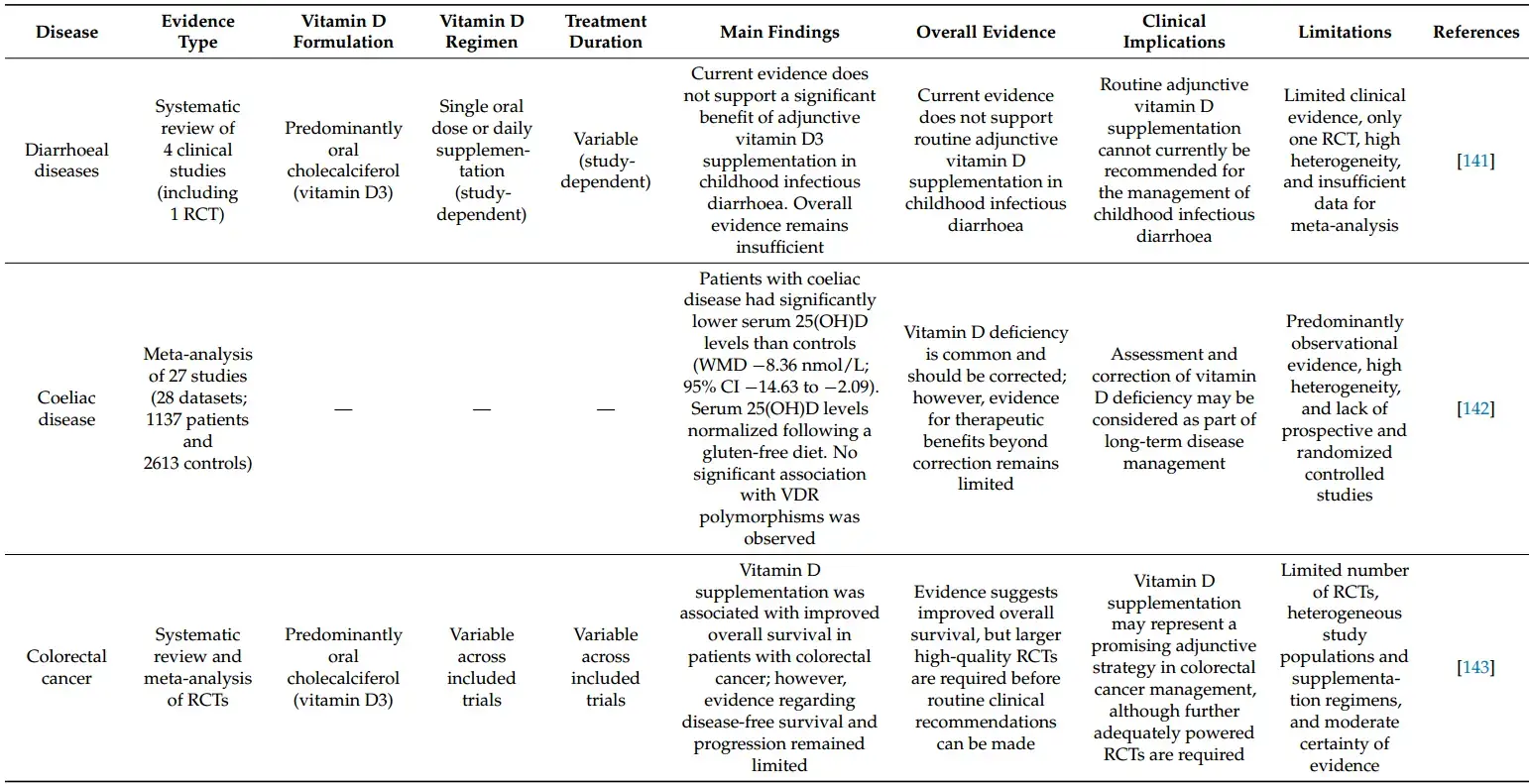
- Celiac — 27 studies, 1,137 patients vs 2,613 controls: 25(OH)D lower by 8.4 nmol/L (3.3 ng/mL), which normalized on a gluten-free diet. No VDR-polymorphism association.
- Childhood infectious diarrhea — 4 studies, only 1 RCT: no benefit.
- Colorectal cancer — supplementation associated with better overall survival; disease-free survival unclear.
What this does not show / limitations:
- No new data — this is a summary of other people's work, and a narrative one, without systematic search protocol or risk-of-bias scoring.
- Not one condition in Table 3 reports an achieved 25(OH)D level, so the 240-fold dose spread (250 to 60,000 IU) can't be tied to any blood level, which is likely why results look inconsistent.
- Deficiency is defined at the low bar of 20 ng/mL.
- Causation is unsettled throughout — low D in bowel disease may be malabsorption and inflammation rather than the cause; the authors say as much, calling for supplementation to "await confirmation from adequately powered randomized clinical trials."
- Much of the mechanism section rests on animal and in-vitro work. ( The paper's reference numbering is broken: Table 3 cites [139] for Crohn's/UC, [140] for IBS, [141] diarrhea, [142] celiac, [143] CRC. The reference list has 138 = Valvano (IBD), 139 = Chong (IBS), 140 = Uwaezuoke (diarrhea), 141 = Lu (celiac), 142 = Vaughan-Shaw (CRC), 143 = Pludowski (guidelines). Everything in Table 3 is shifted by one. Anyone who follows those numbers lands on the wrong paper. The drift appears to start somewhere in the 130s and continue to the end.
- The review discusses absorption barriers in Crohn's and celiac, then never once asks whether oral D3 in oil is the right delivery for a damaged gut. No calcifediol, no sublingual, no topical, no nanoemulsion — despite the UC study it cites having used nano vitamin D. - See Related in VitaminDWiki below
- The authors disclose using generative AI for language editing, and the funding is a phase III GI trial grant held by a microbiology institute with an interest in probiotic co-therapy.
Related in VitaminDWiki
Gut, Gut-Friendly Vitamin D
- Gut, microbiome, and Vitamin D - Narrative book chapter
- Gut-Friendly Vitamin D
- IBD treated by Vitamin D, provided enough or a gut-friendly form is used
- IBD (Colitis, Crohn’s) was active 6X more often if low vitamin D
Crohn's
- Crohn's and Vitamin D - many studies
- Gut bacteria of Crohn's disease patients improved by Vitamin D
- Crohn's disease in black children is worse in 6 ways
- Crohn's Disease relapse rate of 3 in 8 with 1,000 IU vs 0 in 12 with 10,000 IU of Vitamin D – RCT
- Crohn's Disease patients normalizing their Vitamin D levels decreased risk of surgery by 44 percent
Colitis
- Ulcerative Colitis and Vitamin D - many studies
- Ulcerative Colitis associated with a 90% reduced activation of Vitamin D Receptor
- Vitamin D as a therapy for colitis: A systematic review
Microbiome
- Microbiome
- Gut Microbiota: improved by Vitamin D – narrative review
- Gut microbiome altered by many nutrients – such as Vitamin D
Stressors: UPF, Microplastics, etc.
- Microplastics increase the risk of Colorectal Cancer by 11x, Heart attack by 4X, etc.
- Microplastics alter the gut microbiome in different ways
- Many more microplastics in ultra-processsed foods
- Microplastics change the gut microbiome
- 100+ Studies, One Verdict: The Lancet's Case Against Ultra-Processed Foods
- Crohn’s disease 1.8 X more likely if you eat a lot of Ultra-processed food
- If you eat ultra-processed foods, you need Vitamin D
- 20+ chronic stressors result in poor health (most are fought by Vitamin D)