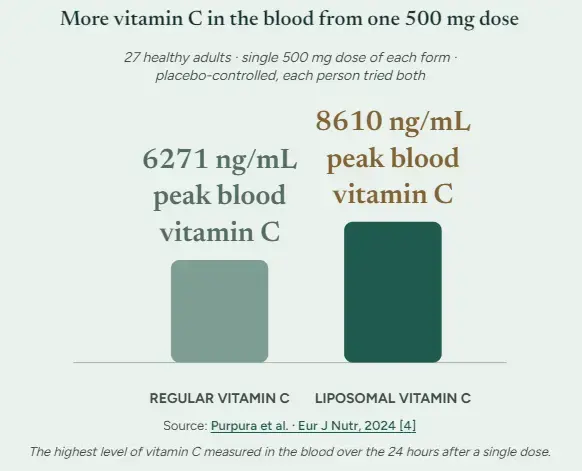
Vitamin C - Liposomal form may get about 40% more into the blood
Liposomal Vitamin C: Is It More Absorbable? Benefits & Dosage
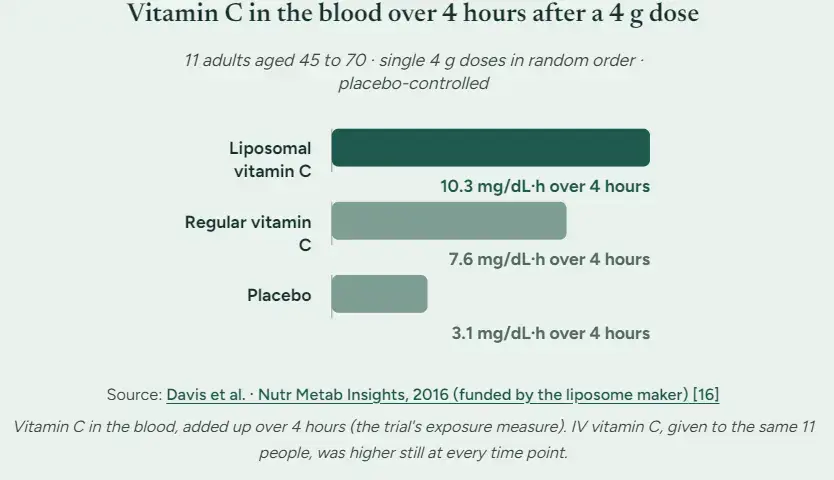
Long wide ranging article includes the following 2 charts
>100 companies sell Liposomal Vitamin C on Amazon
Related in VitaminDWiki
- The liposomal form of Vitamin D had the best response - RCT
- Far more effective forms of many supplements - liposomal, emulsion, etc.
- Liposomal is better than standard Vitamin D in 10 ways
- Liposomal 101
- Vitamin A forms include liposomal and nanoemulsion (gut friendly)
- Resveratrol - liposomal may be best form to increase cellular Vitamin D
- Topical vitamin C in DMSO shrank carcinomas: squamous cell (12 weeks) and basal cell (8 weeks)
- Vitamin C IV, which treats Sepsis, also treats COVID-19
- Vitamin C
- Transcutaneous enhancers (DMSO, etc) for Vitamin D, Vitamin C, Resveratrol, Magnesium, etc.
- Vitamin C is important for the common cold and much else
- Vitamin C videos reviewed
- Vitamin C helps COVID-19 (IV and oral) – review of 12 studies
More Vitamin C by adding it to filtered water that you sip fequently thru a straw
Claude AI - Nov 2026
Short answer: Probably yes. The physiology strongly supports it, and it's the reasoning behind Cathcart's divided-dose "bowel tolerance" method. But I didn't find any trial that directly compared sipping a solution all day with taking the same total in a few doses, so nobody has measured how much more you'd tolerate.
Why it should work
- The diarrhea is osmotic. It comes from ascorbate that isn't absorbed in the small intestine and reaches the colon. The 2 g/day upper limit is based on exactly this effect (NIH ODS).
- Absorption runs through a transporter (SVCT1) that saturates, so the share absorbed drops as the single dose gets bigger. About 87% of a 30 mg dose is absorbed, essentially all of 200 mg, and less than half of 1,250 mg (Levine 1996, Padayatty & Levine 2001).
- Sipping turns one large dose into many tiny ones, each small enough to be absorbed efficiently. More gets absorbed and less reaches the colon, so you can take more in total before loose stools start.
- Cathcart also reported that the dose people tolerate rises with how sick they are (Cathcart 1981).
What it won't do
- Raise blood levels much further. The kidneys get rid of ascorbate above their threshold. Modeling of the maximum tolerated oral regimen, 3 g every 4 hours, predicted a peak of only about 220 µmol/L (Padayatty 2004). Sipping gives steadier blood levels, not much higher peaks, and much of the extra you absorb ends up in urine.
- Count as proof via slow-release tablets. Those results are mixed. In one small study a timed-release capsule was absorbed 50% less (Linus Pauling Institute). In a study of smokers, plain and slow-release forms differed only slightly (Viscovich et al.). Sipping works more like many small doses than like a slow tablet.
Practical problems with the water bottle
- Teeth. Bathing your teeth in acid all day is the classic way enamel wears away. A meta-analysis linked vitamin C use to erosion (OR 1.16) (Li 2012), and there are case reports of severe wear (Bahal 2014). To reduce the risk:
- Use a straw.
- Rinse with plain water now and then.
- Don't brush within an hour of sipping.
- Or use a buffered form. Sodium ascorbate adds about 130 mg of sodium per gram of vitamin C, which matters at multi-gram doses. Calcium ascorbate is the other option.
- Breakdown in the bottle. In tap water containing copper and bicarbonate, 35% of added vitamin C oxidized within 15 minutes. The breakdown products included oxalic acid. Purified and bottled water caused very little loss (copper tap-water study). Use filtered or bottled water, keep the bottle cold and capped, and mix a fresh batch once or twice a day. Buffered solutions are closer to neutral, and vitamin C breaks down faster there than in acid. So the form that's easier on teeth is less stable in the bottle.
- Kidney stones. Absorbing more means making more oxalate. Levine's group saw urinary oxalate rise at 1 g/day (Levine 1996). Swedish men taking vitamin C supplements (typically 1 g tablets) had about twice the stone risk (Karolinska Institutet). US data showed a smaller increase in men taking ≥1 g/day and none in women (Ferraro 2016). The extra water you drink from the bottle helps a bit here. People with a history of oxalate stones, kidney disease, iron overload or G6PD deficiency should be cautious with high doses.
Bottom line: Sipping should raise the total dose you can take before diarrhea, and it keeps blood levels steadier. It doesn't get around the kidney's ceiling, and it brings its own problems: tooth erosion, breakdown in the bottle, and oxalate.
Sources:
- NIH ODS vitamin C fact sheet
- Levine 1996 PNAS
- Padayatty & Levine 2001 CMAJ
- Cathcart 1981
- Padayatty 2004 Ann Intern Med
- Linus Pauling Institute supplemental forms
- Viscovich et al. slow vs plain release
- Li 2012 erosion meta-analysis
- Bahal 2014 case report
- Copper tap-water stability study
- Karolinska Institutet kidney stone study
- Ferraro 2016