
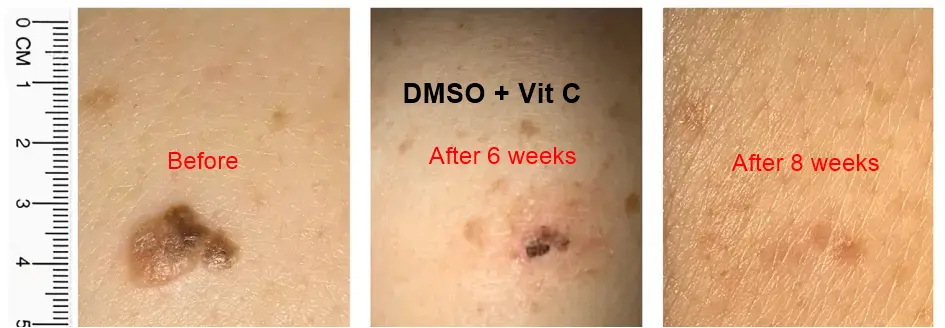
Topical vitamin C in DMSO shrank carcinomas: squamous cell (12 weeks) and basal cell (8 weeks)
Topical 30% Ascorbic Acid in Dimethyl Sulfoxide for the Treatment of Cutaneous Squamous Cell Carcinoma In Situ
Preprint October, 2025, https://doi.org/10.1101/2025.10.13.25337920
Patricia Miller, Jon Ward, Michael Morgan, Briant Burke
Summary by Claude - September, 2026
Patients painted a 30% vitamin C (ascorbic acid) solution in DMSO onto early squamous cell skin cancer twice a day. After 12 weeks, a repeat biopsy showed the cancer had cleared in 56% of lesions, and 94% of patients avoided surgery. This is a small open-label, single-arm trial (17 patients, 27 lesions), posted as a preprint that has not been peer-reviewed.
Every lesion was biopsy-confirmed squamous cell carcinoma in situ (SCCIS), which is cancer confined to the top layer of skin. Patients applied 30% (w/v) ascorbic acid in 95% DMSO / 5% water with a small cuticle brush, twice daily for 12 weeks.
Results:
- 15 of 27 lesions (56%) fully cleared on biopsy
- Mean lesion area fell from 1.06 to 0.30 cm² (−71%)
- Only 2 lesions (7%) did not respond
- Most remaining lesions had downgraded to precancer (actinic-keratosis-type atypia) and were then frozen off with cryotherapy
- "No participants reported pain, pruritus, burning, or ulceration during therapy." The only reaction was mild redness.
The same group earlier reported >80% clearance of basal cell carcinoma in 8 weeks with this formula, in a small randomized trial against imiquimod [Burke 2022].
The authors propose that high-dose vitamin C generates hydrogen peroxide, which cancer cells low in the enzyme catalase cannot neutralize. Vitamin D was not measured.
What this does NOT show
- That vitamin C caused the benefit: there was no placebo, no DMSO-only group, and no comparison treatment
- A lasting cure: follow-up ended at 12 weeks, so there are no recurrence data
- How many lesions still contained carcinoma at 12 weeks: only "complete resolution" was counted
- That the solution alone avoided surgery: the 94% includes cryotherapy of leftover lesions
- Statistical strength: results were analyzed descriptively, and 2 of 19 enrolled patients were lost to follow-up
- A matching trial registration: the cited NCT04279535 is the authors' earlier BCC trial. Their SCC registration [NCT05932511] describes an 8-week randomized comparison with imiquimod, which is not reported here.
- That treating an undiagnosed spot yourself is safe: every lesion here was biopsied before and after treatment
Randomized trial of topical ascorbic acid in DMSO versus imiquimod for the treatment of basal cell carcinoma - RCT 2022 also Burke
https://doi.org/10.1016/j.biopha.2022.112710
70% of patients in the imiquinod group showed residual hypopigmentation at 30mo follow up versus 0% in the ascorbate group.
Basal cell, Squamous cell, and Melanoma make up 99% of all Skin Cancers
Claude AI
Here's the ranking for the US, where the data are best. The top three account for more than 99% of cases. Everything from #4 down is rare, and several of the rarer ones are close enough in rate that their order could shift depending on which registry and years you use.
| Rank | Skin cancer | Approx. US new cases/yr | Rate / note | Ref |
|---|---|---|---|---|
| 1 | Basal cell carcinoma | ~3.6 million | ~80% of keratinocyte cancers | [SCF]; [ACS] |
| 2 | Cutaneous squamous cell carcinoma (SCC) | ~1.8 million | Includes keratoacanthoma and Bowen disease (in situ) | [Moffitt] |
| 3 | Melanoma | 112,000 invasive + 122,680 in situ (2026 est.) | 8,510 deaths est. | [AAD] |
| 4 | Merkel cell carcinoma | ~3,000 | ~7 per million, rising with aging population | [Paulson JAAD 2018] |
| 5 | Cutaneous T-cell lymphoma (57% mycosis fungoides) | ~2,500–3,000 | 8.55 per million (MF alone 5.42) | [ASCO Post]; [CJON] |
| 6 | Dermatofibrosarcoma protuberans | ~1,300 | ~4 per million; peaks age 20–39 | [NEJM JW] |
| 7 | Primary cutaneous B-cell lymphoma | ~1,000 | 3.1 per million | [Blood 2009] |
| 8 | Kaposi sarcoma | ~1,000 | Was 71% of cutaneous sarcomas in SEER | [Rouhani 2008] |
| 9 | Sebaceous carcinoma | ~800 | 3.2 (men) / 1.6 (women) per million | [Frey] |
| 10 | Extramammary Paget disease | ~400 | ~1.5 per million (French registry) | [Doubs registry] |
Just below the top 10 are atypical fibroxanthoma / pleomorphic dermal sarcoma, microcystic adnexal carcinoma, cutaneous angiosarcoma, and cutaneous leiomyosarcoma.
Caveats
- BCC and SCC aren't reported to cancer registries, so their numbers are estimates and probably undercounts. The ~5.4 million keratinocyte cancers a year occur in about 3.3 million people, because many people have more than one tumor [ACS].
- For #4–#10, I converted the published per-million rates to US case counts myself (US population ≈ 340 million). Most of those rates come from SEER data that are 10–20 years old, so treat the counts as rough.
- The Kaposi sarcoma figure is my estimate; I didn't find a current US count. The ranking is different worldwide: GLOBOCAN 2022 estimated about 35,000 Kaposi cases, mostly in HIV-affected sub-Saharan Africa, which would put it at #4 globally. That global figure is from memory, not checked in this search.
- Actinic keratosis is precancerous, so it's not on the list, although it's far more common than anything below #3.
DMSO and Vitamin C on Amazon
- One company has both in the same bottle has not checked the concentration vs study on this page
- Many others sell them separately
Related in VitaminDWiki
- [Cancer - Skin]
- Photodynamic therapy + Topical Vitamin D (Calcitriol) fights SCC (squamous cell cancer) in mice
- Squamous cell cancers of head and neck, vitamin D, and the immune system
- Skin Cancer (SCC) minimized if get sun time around noon
- Basal Cell Carcinoma and Vitamin D
DMSO