
Just 3 minutes a day of vigorous activity is associated with 4 percent less cancer - cohort
Device-measured movement behaviours and cancer incidence in a population sample of UK adults: Dual 24-hour analyses of postural and intensity compositions
BMC Medicine, 18 July 2026, https://doi.org/10.1186/s12916-026-05069-3
John J Mitchell, Raaj Kishore Biswas, Nicholas A. Koemel, Matthew N. Ahmadi, Joanna M Blodgett, Karen Canfell, I-Min Lee, Christine M Friedenreich, Armando Teixeira-Pinto, Peter A. Cistulli, Dorothea Dumuid, Anthony D. Okely, Abigail Fisher, Mark Hamer, Emmanuel Stamatakis
Summary by Claude - August, 2026
Getting out of a chair — even just to stand — was associated with lower cancer risk in this large study, and you do not have to exercise hard to see it.
This is a prospective cohort study of 59,218 UK Biobank adults (55% female, mean age 62) who wore a wrist accelerometer for 7 days and were then followed for a median of 8 years, during which 2,385 developed one of 13 cancers linked to physical inactivity. Because activity was device-measured rather than self-reported, the numbers are far more trustworthy than in most exercise research.
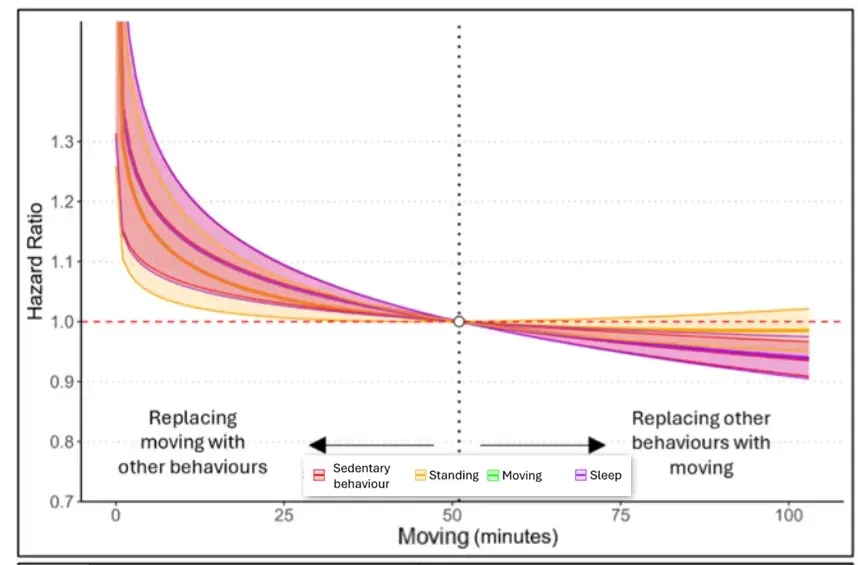
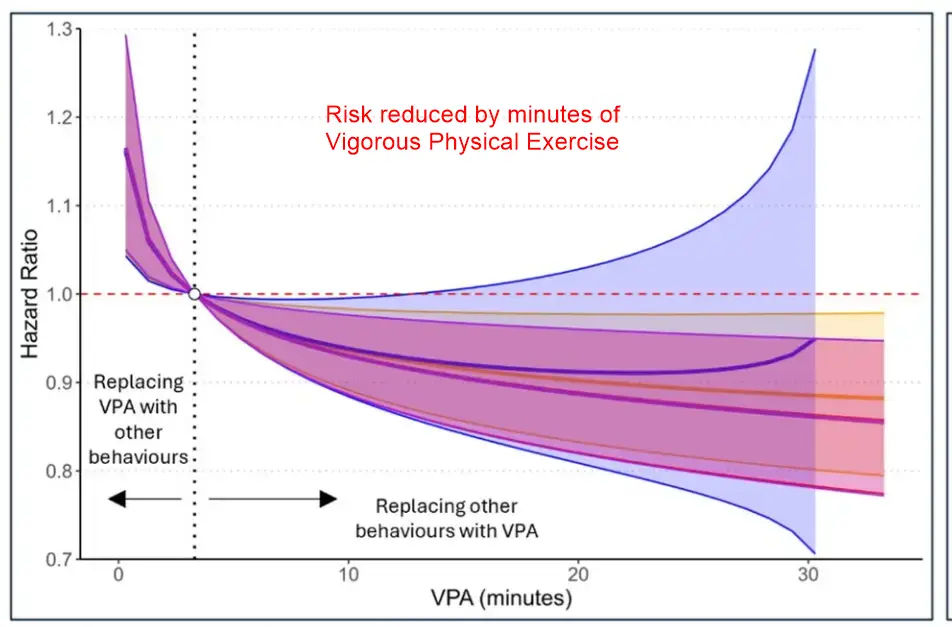
The average participant slept 7h39m, sat 11h13m, stood 4h17m, and moved only 51 minutes a day. Statistically swapping 15 minutes of sitting or sleep for moving was associated with a 2% lower cancer risk; 30 minutes swapped for standing gave about the same. Going the other way was worse — replacing 30 minutes of moving with sitting was associated with 8% higher risk. By intensity, vigorous activity was by far the most efficient: only 3 minutes a day in place of any other behaviour was associated with 4% lower risk, whereas light activity needed more than 90 minutes for a comparable effect. The authors note that "the VPA component within MVPA proved the critical intensity."
What this does not show / limitations: This is observational — it cannot prove that moving more prevents cancer. The "replace X with Y" figures are theoretical reallocations comparing different people, not what happens when one person changes habits. The vigorous-activity finding lost significance once the first two years of diagnoses were removed, hinting at reverse causation, and adjusting for BMI eliminated the sedentary-behaviour association entirely — suggesting body fat may be doing much of the work. Breast cancer, the most common site, showed no association at all. Participants were 96% white with known healthy-volunteer bias. Vitamin D levels were not measured, so whether outdoor time and sun exposure contribute to the benefit of "moving" is untested here.
Cancers
- Bladder
- Colon
- Endometrial
- Gastric cardia
- Head and neck
- Kidney
- Liver
- Breast ( no association)
- Lung
- Rectal
- Myeloma
- Oesophageal adenocarcinoma
- Myeloid leukemia
Related in VitaminDWiki
- 2.5 X reduced risk of cancer in 70 year-olds by a small amount of Vitamin D, Omega-3 and exercise – RCT
- 8 Huge health benefits if 4% of exercise is intense
- Exercise times vs Vitamin D from the sun
- Exercise and Vitamin D are synergistic - many studies
- Live 7 years longer free of major disease if eat well, not smoke, not obese, moderate drink and exercise (100,000 people)
- Exercise reduces cancer deaths, Magnesium RDA reduces deaths even more
- Off Topic – Light exercise extend life by 4.5 years – perhaps more than vitamin D