
Inflammatory biomarkers reduced by Vitamin D - umbrella analysis of 97 RCTs
The effects of vitamin D supplementation on inflammatory biomarkers: an umbrella study of meta-analysis on randomized controlled trials - June 2026
Inflammopharmacol (2026). https://doi.org/10.1007/s10787-026-02266-7 PDF behind paywall
Chou-Yi Hsu, Hassan Youssef Hussein, Karam Akram Al-akkam, Tushar B. Gajjar, Hamad AlMohamadi, Nodir Khonturaev, Sandeep Kumar Shukla, Safa Hussien Radhi, Aseel Smerat & Muhammad Shahid Iqbal
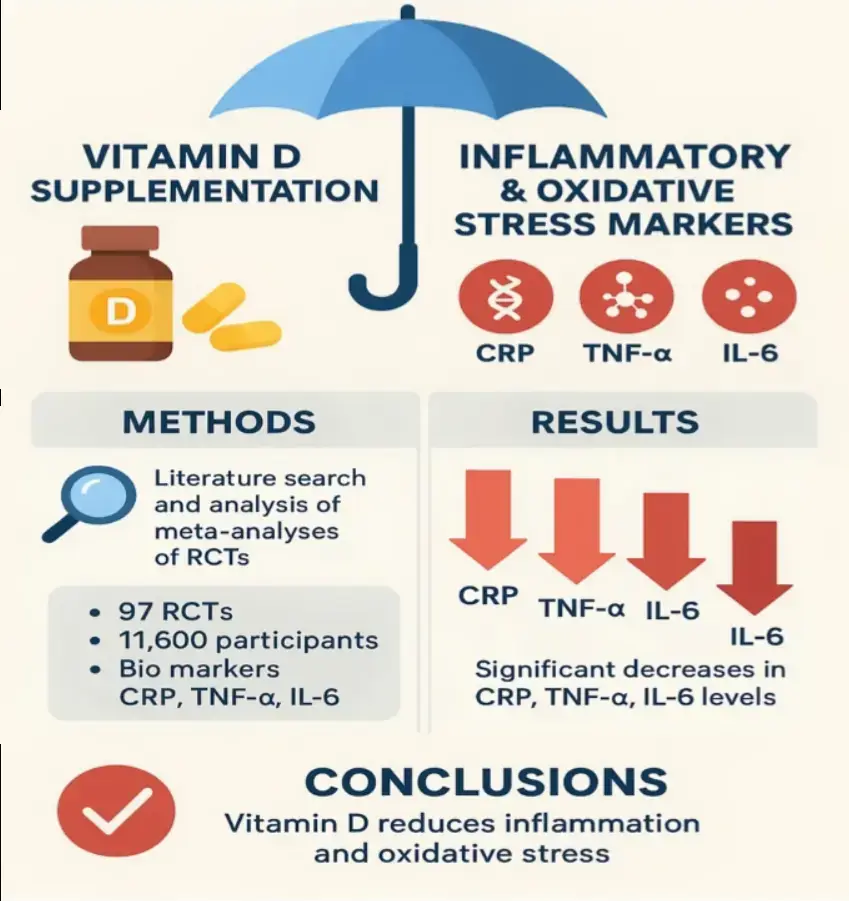
Background Vitamin D regulates bone metabolism and immune function, influencing inflammatory biomarkers such as CRP, TNF-α, and IL-6. Evidence from RCTs and meta-analyses on its anti-inflammatory effects remains inconsistent. To synthesize evidence from meta-analyses of RCTs on vitamin D supplementation and its effects on circulating inflammatory biomarkers, and to assess the quality and certainty of this evidence.
Methods A comprehensive literature search was conducted in PubMed, Embase, Web of Science, and Scopus from inception to January 2025. Eligible studies included systematic reviews and meta-analyses of RCTs reporting effects of vitamin D supplementation on inflammatory markers (CRP, hs-CRP, TNF-α, IL-1β, IL-6, IL-8, IL-10, oxidative stress markers, IgE). Data extraction was performed independently by two reviewers. Methodological quality was assessed using AMSTAR-2, and the certainty of evidence was graded with GRADE. Corrected Covered Area (CCA) was calculated to quantify overlap among primary studies.
Results This umbrella review analyzed seven meta-analyses covering 97 RCTs with ~ 11,600 participants on vitamin D supplementation’s effects on inflammation and oxidative stress markers. Vitamin D significantly reduced CRP, TNF-α, and IL-6 levels in individuals with abnormal glucose homeostasis (Hedges’g = − 0.67, − 0.81, and − 1.93, respectively; p < 0.001), and improved oxidative stress markers in pregnant women, evidenced by decreased MDA (Hedges’g = − 0.46) and increased TAC (Hedges’g = 2.13) and glutathione (Hedges’g = 4.37). In type 2 diabetes, a significant reduction in hs-CRP (Hedges’g = − 0.45, p = 0.005) and TNF-α (Hedges’g = − 0.75, p = 0.05) was observed. Conversely, studies in obese/overweight and asthmatic populations revealed no significant changes in inflammatory markers, except for a highly heterogeneous and potentially unreliable increase in IL-10 among asthma patients (Hedges’g = 18.85, p = 0.04).
Conclusions Vitamin D supplementation exerts significant anti-inflammatory and antioxidant effects, particularly in metabolic disorders, though evidence remains heterogeneous across populations and biomarkers.