
Gut bacteria reshape bile acids, which then signal the brain (partly via the Vitamin D Receptor) - review
Effects of bile acids and gut microbiota interactions on neurological and psychiatric disorders
Genes & Diseases 14 (2027) 102069, online Feb 6, 2026, https://doi.org/10.1016/j.gendis.2026.102069
Xiaoqi Pei, Xiaoli Wang, Hongji Lu, Jialin Wu, Lu Xu, Xiaoyin Chen, Li Deng, Huachong Xu
Summary by Claude Opus 5.5 - November 2026
Bottom line: Gut bacteria convert the bile acids made by the liver into dozens of "secondary" bile acids that act as signaling molecules, and some reach the brain. This review argues that a disturbed microbiome distorts the bile acid mix, and that the distortion is linked to brain disorders. Interesting biology — not yet a treatment guide.
Study type: Peer-reviewed narrative review (no systematic search, no pooled data) from a Traditional Chinese Medicine group at Jinan University, China. Government funded; no conflicts declared.
The vitamin D link: One of the five bile acid receptors covered is the Vitamin D Receptor (VDR). Lithocholic acid (LCA), made by gut bacteria, switches it on. In mostly cell and animal studies, VDR signaling then slows new bile acid production, blocks the NF-κB and NLRP3 inflammation pathways, raises the brain growth factor BDNF, and supports regulatory T cells.
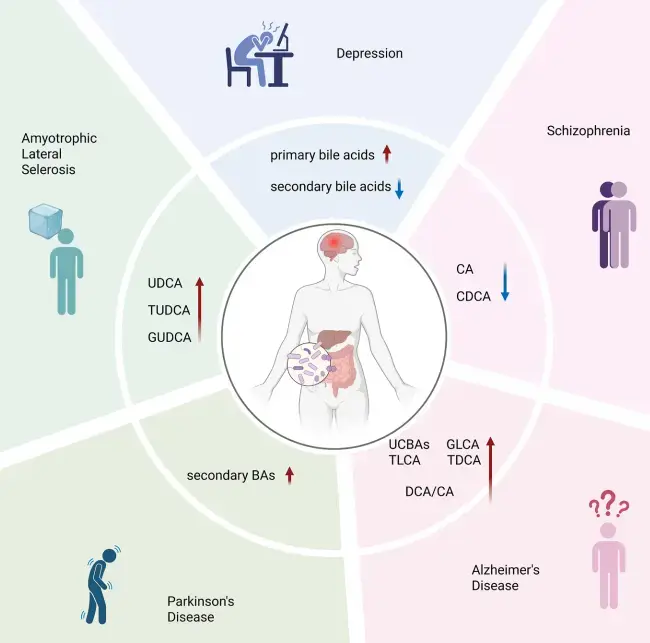
Bile acid changes reported (mostly small cross-sectional studies):
- Depression: primary bile acids up, secondary down
- Schizophrenia: CA and CDCA down
- Alzheimer's: secondary/primary ratio (e.g., DCA:CA) up, tracking poorer cognition and more amyloid and tau
- Parkinson's: lower microbial diversity; secondary DCA and LCA up
- ALS: UDCA, TUDCA and GUDCA trending up
- Cholestatic liver disease (bile buildup): more depression
What this does NOT show
- That too little bile causes these diseases. The shifts run in opposite directions in different diseases, and the authors concede "we cannot determine whether abnormal BA metabolism is a driver of the disease or merely a consequence of the disease state" — yet their conclusion calls the link "established."
- Anything about vitamin D supplements, doses or 25(OH)D levels; none were reviewed.
- Strong human evidence: most cohorts had under 100 people, and labs measure bile acids differently.
- Current ALS treatment: the TUDCA-containing drug Relyvrio, described here as FDA-approved, was withdrawn after its Phase 3 trial failed, and the TUDCA-ALS Phase 3 trial also missed its goal.
- UDCA for schizophrenia rests on a single case report.
Sources:
Related in VitaminDWiki
- Overview Gut and vitamin D
- Gut-Friendly Vitamin D
- 14th activator of the Vitamin D Receptor – butyrate from gut bacteria or supplement
- Exploring gut microbes in Human health and disease: pushing the envelope
- Gut, microbiome, and Vitamin D - Narrative book chapter
- Vitamin D improves the Gut Microbiota - review
- Gut microbiome massively changed by weekly vitamin D
- Gut microbiome altered by many nutrients – such as Vitamin D
- Vitamin D levels change Gut Microbiota – 25 study review
- Vitamin D might be fighting some cancers by increasing good microbiota
- Gut-Friendly Vitamin D
- Gut problems treated by Vitamin D (helps both innate and adaptive immunity - gut-friendly forms are best)
- Overview Parkinson's and Vitamin D
- Parkinson's Disease and gut microbiome - several studies
- Depression substantially reduced by Vitamin D, Omega-3, Magnesium, etc – many studies
- Depression treated by Omega-3 (again) – meta-analysis
- Omega-3 improves gut bacteria, reduces inflammation and depression
- Overview Schizophrenia and Vitamin D
- Schizophrenia relapses reduced 3X by Omega-3 – RCT
- ALS fought by vitamin D - many studies
- Amyotrophic Lateral Sclerosis patients helped by Omega-3 – RCT
- 130 ALS clusters – toxins and stressors that deplete or need vitamin D
- Vitamin D and MS, ALS, Autism, Alzheimer’s and other nervous system diseases – review
- Omega-3 improves gut bacteria, reduces inflammation and depression
- Hypothesis: Omega-3 reduces Alzheimer’s directly and via the gut