
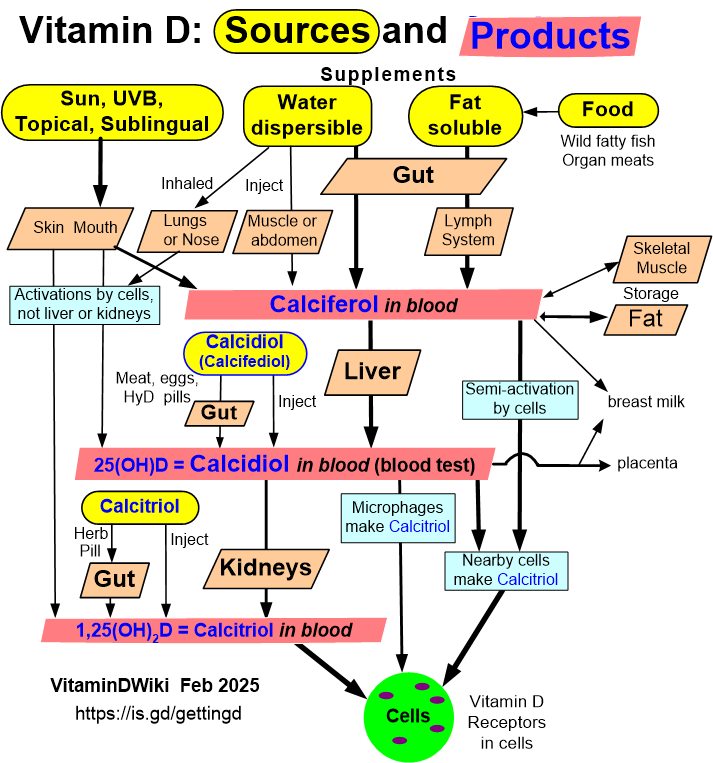
Fully activated Vitamin D does not change with altitude nor sunlight, but does increase for a while after a high dose of Vit. D
Calcitriol does NOT change with altitude, sunlight, or daily dosing
Claude AI: Oct 2026
Why it doesn't track sunlight
- Renal CYP27B1 (1α‑hydroxylase) is regulated by PTH, calcium, phosphate, FGF23 and calcitriol itself, not by substrate supply. Once 25(OH)D is above the deficiency range (~20–30 ng/mL), extra substrate doesn't raise output; the enzyme is already saturated and feedback (calcitriol inducing CYP24A1 and suppressing PTH) clamps the level. Serum calcitriol typically varies less than ~20% over a day.
- UVB trials bear this out: narrow‑band UVB raised 25(OH)D dose‑dependently with no change in PTH, and a winter UVB trial in osteoporotic women raised 25(OH)D while PTH (and effectively 1,25(OH)₂D) stayed put.
- Altitude only matters via UVB (~4–10% more per 1,000 m) plus cooler temperatures and more clothing, so the net effect on 25(OH)D is modest and inconsistent — and 1,25(OH)₂D is one step further removed.
Where it does move
- Starting from real deficiency: supplementing or sunning a deficient person can transiently raise 1,25(OH)₂D (sometimes above the normal range) as PTH is still high and substrate was the limiting factor. The level then falls back as PTH normalizes.
- Extreme 25(OH)D (>80–100 ng/mL) or CYP24A1 loss-of-function, sarcoidosis, etc., where regulation is bypassed.
- Hypoxia at altitude is a separate wrinkle: HIF signaling and altered PTH/FGF23 have been reported to shift calcitriol and 24,25(OH)₂D in some high‑altitude studies, but the data are thin and inconsistent.
- Local (extrarenal) 1,25(OH)₂D in immune cells, skin, placenta, etc. is substrate‑driven and does rise with 25(OH)D — it just doesn't show up in serum. That is the usual argument for why 25(OH)D, not calcitriol, is the clinically meaningful marker.
References:
- [Endotext – Vitamin D production, metabolism, mechanisms (Bikle)]
- [Linus Pauling Institute – Vitamin D regulation by PTH/FGF23]
- [Bikle 2014, Chem Biol – CYP27B1/CYP24A1 regulation figure]
- [Lesiak 2011 – NB‑UVB raises 25(OH)D, no PTH change]
- [Springer – UVB in postmenopausal osteoporosis, 25(OH)D up, PTH unchanged]
Calcitriol levels temporarily increase after a single dose
Claude AI
A large bolus produces a short-lived rise in serum 1,25(OH)₂D, peaking around day 1–3 and mostly fading within one to two weeks, after which the regulatory loop (CYP24A1 induction, PTH suppression, FGF23 rise) brings it back to baseline.
What the serial-sampling studies show
- 120,000 IU D3 (healthy adults, LC‑MS/MS at 0, 3, 7 days): 25(OH)D, 1,25(OH)₂D and 24,25(OH)₂D were all significantly up by day 3; the 1,25 rise tracked the 25(OH)D rise (r ≈ 0.79), while 24,25 kept climbing — the catabolic brake kicking in.
- 540,000 IU D3 in ICU patients (daily sampling for 7 days): 1,25(OH)₂D showed a transient, significant increase only in the treated group.
- 150,000 IU D3 bolus vs 5,000 IU/day in lactating mothers (days 1, 3, 7, 14, 28): the bolus diverted more 25(OH)D into 24,25(OH)₂D than daily dosing did, i.e. the system responded to the surge by ramping catabolism.
- 300,000 IU D2 IM (slower absorption) raised 1,25(OH)₂D and FGF23 at 3 months — a longer, flatter version of the same response, since the depot releases over weeks rather than hours.
- Rossini 2012 (600k/300k/100k IU D3): bone resorption marker sCTX rose at day 1 with 600k and within the first 3 days with 300k — consistent with a brief calcitriol spike, since calcitriol is what drives osteoclastic resorption.
Why it happens and why it's brief
A bolus floods the liver with substrate and pushes 25(OH)D up within 24–48 h. If the person started deficient, PTH is still elevated, so CYP27B1 is running hard and converts the extra substrate into calcitriol for a few days. Calcitriol then suppresses PTH, induces CYP24A1 (raising 24,25 and 1,24,25 metabolites), and raises FGF23 — all of which pull 1,25(OH)₂D back down. The size and duration scale with the dose and with how deficient the person was; a sufficient person given 50,000 IU may show little or no 1,25 change.
Practical reading
- Expect the bump to be visible at days 1–7, gone by ~2 weeks, and not visible at the 1‑month or 3‑month blood draws most trials use.
- This transient spike (plus the catabolic overshoot that follows) is the leading mechanistic explanation for the fall/fracture signal in the annual 500,000 IU trials, and the argument for loading doses ≤100,000–150,000 IU or splitting them over several days.
References:
- [Front Biosci 2022 – 120,000 IU bolus, metabolites at day 3 and 7]
- [Amrein 2011, Crit Care – 540,000 IU, transient 1,25(OH)₂D rise]
- [Ketha 2018 – 150,000 IU bolus vs 5,000 IU daily, 24,25/25 ratio]
- [300,000 IU D2 IM – 1,25(OH)₂D and FGF23 at 3 months]
- [Rossini 2012 – single 100k/300k/600k IU, bone turnover day 1–90]
- [Bowles – 50k/150k/500k IU bolus, free 25(OH)D and free 1,25(OH)₂D]
- [Kearns 2014 review – single large bolus doses]
All 3 forms provide benefits, but only 1 form is tested
Related in VitaminDWiki
- Monthly Vitamin D dosing was the most common (Italy - survey)
- Better than Daily
- Weekly, Monthly Vitamin D are typically better than daily - many studies ( Smoking does not decrease response to monthly Vitamin D – RCT
- IBS reduced by 50,000 IU of Vitamin D (weekly or bi-weekly) – Meta-analysis
- Weekly Vitamin D better than daily – lower cost, less pill burden, perhaps 1.5X better response – meta-analysis
- 50,000 IU Vitamin D weekly is often recommended (Amazon, etc)
- Major Depressive Disorder RCTs often use Vitamin D: 50,000 IU weekly or single 300,000 IU - Review
- Growing pains reduced in 91% of children with a single dose of Vitamin D
- Large dose Vitamin D before surgery was found to help by 35 studies