
Dark skin, low vitamin D, lost limbs: PAD amputations are 3x higher in Black Americans
Summary by Claude AI - Nov 2026
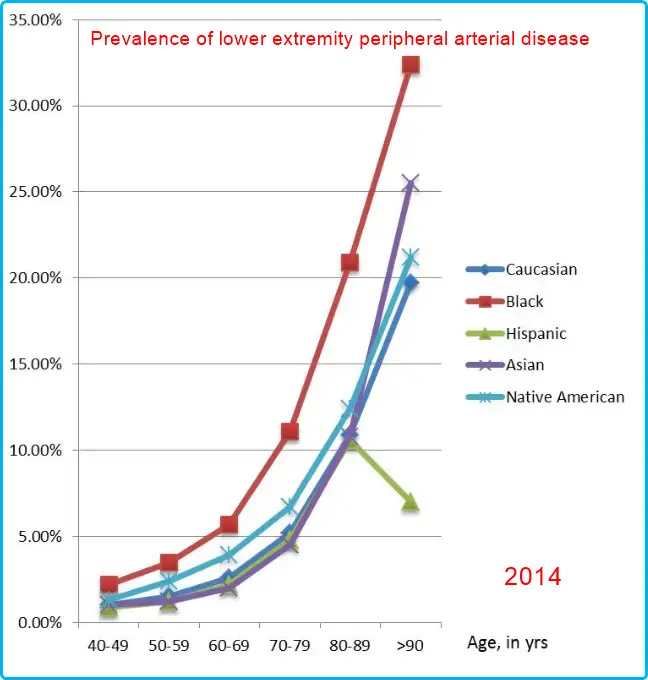
PAD is the main cause of leg amputations that aren't due to injury. Black Americans get PAD about twice as often as White Americans and lose a leg roughly 2–4 times as often. Low vitamin D is much more common with dark skin, and in observational studies it goes along with PAD, slower walking, foot ulcers and amputation. No trial has yet shown that correcting vitamin D prevents amputations.
PAD leads to amputation
In 125,674 US veterans followed for about 9 years, PAD alone raised amputation risk about 14-fold. PAD together with small-vessel disease (eyes, nerves or kidneys) raised it about 23-fold Beckman 2019.
The racial gap
| Measure | Black vs White | Source |
|---|---|---|
| PAD prevalence (NHANES) | Odds 2.11; still 1.67 after adjusting for income, education and risk factors | Reis 2008 |
| Major amputation, Medicare PAD patients | HR 2.79 | Secemsky 2025 |
| Amputation rate, Medicare PAD 2016–2022 | 4.1% vs 1.5% (all other races) | ISPOR 2024 |
| Amputation as the first treatment (meta-analysis of 17 studies) | OR 1.91 | J Surg Res 2024 |
| Amputation after a procedure to restore blood flow | OR 1.56 | J Surg Res 2024 |
The gap is closing only slowly. In a 2025 JAMA analysis, the share of Black PAD patients who had a major amputation fell from 2.9% to 2.5%, and it was still higher than for White patients in most states JAMA 2025. A 2025 Medicare study found the gap persisted despite national PAD screening campaigns Arvanitis 2025.
Causes other than vitamin D are large:
- More illness: more diabetes, high blood pressure and kidney disease.
- Less access: fewer visits to vascular specialists.
- No attempt to save the leg: data cited by Dr. Fakorede show 69% of amputees had no attempt to restore blood flow in the year before. Of those, 92% never had an angiogram Fakorede 2025.
- Possible bias: a 2025 machine-learning study of hospital data from five states found higher amputation rates among Black, Hispanic and Native American patients. This held after accounting for how sick they were and for hospital and neighborhood resources. The authors blame the unexplained part on implicit bias, but that is a guess from what's left over, not something they measured Strassle 2025.
Where vitamin D comes in
Dark skin makes less vitamin D from the same sun, so blood levels run much lower:
- 15.6 vs 25.8 ng/mL in Black vs White adults in Baltimore Powe 2013
- 18.9 vs 26.1 ng/mL in the ARIC study Rapson 2017
Key studies:
- NHANES, 4,839 adults: PAD prevalence was 8.1% in the lowest vitamin D quarter (<17.8 ng/mL) and 3.7% in the highest (≥29.2). After adjustment, the lowest quarter had 1.8 times the PAD prevalence. Each 10 ng/mL lower meant 35% more PAD Melamed 2008.
- NHANES by race: differences in vitamin D may explain nearly a third of the extra PAD in Black adults Reis 2008.
- ARIC, 11,789 adults followed 17 years: comparing <20 with ≥30 ng/mL, the risk of new PAD was 1.94 times higher in Black participants and 1.48 times in White participants. Adjusting also for diabetes, blood pressure and cholesterol weakened this to 1.64 in Black participants, which was no longer statistically significant. The difference between races could have been chance Rapson 2017.
- Meta-analysis: vitamin D below 20 ng/mL meant about 1.5 times the odds of PAD JCEM 2018.
- Walking: in people with PAD, levels below 12 ng/mL (30 nmol/L) went with losing about 70 ft of 6-minute walk distance per year, vs about 35 ft at 20–30 ng/mL McDermott 2014.
- Amputation and ulcers:
- A review found more amputations among PAD patients with low vitamin D Chua 2011.
- In a Chinese diabetic foot study, 85.7% of minor-amputation patients were deficient vs 60.6% of controls, and deficiency independently predicted amputation Dovepress 2025.
- In a meta-analysis of 7,586 people with diabetes, those with foot ulcers were 1.8 times as likely to be deficient and 2.5 times as likely to be severely deficient Lin 2022.
Trials
- PAD: I found no large trial testing vitamin D against PAD getting worse or against amputation. A Swiss trial of vitamin D and walking stopped after 4 participants NCT01559974.
- Diabetic foot ulcers: a Danish double-blind trial of 48 patients compared 6,800 IU/day with 800 IU/day for up to 48 weeks, and ulcers healed better on the high dose Halschou-Jensen 2023. A meta-analysis of supplementation trials found smaller ulcers and lower CRP and HbA1c 2023 meta-analysis. Most diabetic amputations start as a foot ulcer that won't heal, so these trials are the closest evidence there is.
Caveats
- Confounding: people who are heavier, smoke, are sicker or stay indoors tend to have both low vitamin D and PAD. A genetic study of about 206,000 Chinese and Danish adults found no causal link between vitamin D and heart attack or stroke, but it didn't test PAD Huang 2019. Two counterpoints:
- Genetic studies done mostly in people with adequate vitamin D can miss an effect that only shows up in deficient people.
- If vitamin D works partly by lowering diabetes and blood pressure, then adjusting for them, as ARIC did, would hide part of its effect.
- The binding-protein argument: Powe proposed that Black Americans have less vitamin D–binding protein, so their usable vitamin D is about the same despite low blood levels. Later work showed the lab test used misreads the binding-protein variant common in people of African ancestry, which undermines that conclusion Henderson 2016. ARIC also found that variants in the binding-protein gene didn't change the PAD link.
Spotting PAD on dark skin
Classic signs, such as a foot that turns pale when raised and dusky red when hanging down, are harder to see on dark skin. Nurses are taught to compare against the person's own unaffected skin and to check temperature arterial ulcer assessment.
The ankle-brachial index (ABI) blood-pressure test doesn't depend on skin tone. Since 2024 the American Diabetes Association recommends it for people with diabetes aged 50 and over who have no symptoms. In diabetes or kidney disease, hardened arteries can make the ABI look falsely normal, so toe pressures are needed Fakorede 2025.
Bottom line
A dark-skinned person with diabetes or PAD is very likely to be vitamin D deficient. Studies keep linking deficiency to new PAD, faster loss of walking ability, foot ulcers and amputation, and the ulcer-healing trials are positive. No trial has yet counted amputations, though. The proven ways to close the amputation gap are earlier ABI screening, trying to restore blood flow before amputating, and access to vascular specialists.
Sources:
- Beckman 2019 – Microvascular disease, PAD and amputation
- Reis 2008 – Vitamin D and racial disparity in PAD
- Secemsky 2025 – Race and community in Medicare PAD
- ISPOR 2024 – Medicare PAD disparities
- J Surg Res 2024 – Race and PAD outcomes meta-analysis
- JAMA 2025 – Temporal and geographic PAD treatment trends
- Arvanitis 2025 – Persistent CLTI disparities
- Fakorede 2025 – Amputation is not the answer
- Strassle 2025 – Bias and amputation rates
- Melamed 2008 – NHANES vitamin D and PAD
- Rapson 2017 – ARIC vitamin D and incident PAD
- JCEM 2018 – Vitamin D and PAD meta-analysis
- McDermott 2014 – Vitamin D and functional decline in PAD
- Chua 2011 – Vitamin D and PAD review
- Dovepress 2025 – Vitamin D and minor amputation in diabetic foot
- Lin 2022 – Vitamin D deficiency and diabetic foot ulcer meta-analysis
- NCT01559974 – Vitamin D and walking in PAD
- Halschou-Jensen 2023 – High-dose vitamin D for diabetic foot ulcers
- 2023 meta-analysis – Vitamin D supplementation for diabetic foot ulcers
- Powe 2013 – Vitamin D–binding protein in Black and White Americans
- Henderson 2016 – Binding-protein assay flaw
- Huang 2019 – Genetic (Mendelian randomization) study of vitamin D and vascular disease
- Arterial ulcer assessment on darker skin
The Amputations America Can Prevent - Nov 2026
TIME A few of the paragraphs without the hyperlinks:
- Black patients lose limbs at a rate three to four times higher than other racial groups, a staggering disparity that reflects a deeper crisis in our healthcare system. Yet many of these devastating outcomes are preventable.
- Most people reading this article have likely never heard of the disease, yet nearly everyone recognizes the word “amputation” without fully understanding the clinical, economic, and human consequences. Perhaps if we had called PAD a “leg attack” from the beginning, we would have conveyed the same urgency, recognition, and action that a heart attack commands.
- The consequences of undiagnosed PAD can be as deadly as many cancers, while the financial burden of preventable amputations on our health system—and ultimately taxpayers—is staggering. The most glaring costs include the financial burden on our healthcare system, the devastation of our workforce, and the loss of heads of households.
Some PAD images from the web
Related in VitaminDWiki
- Peripheral Arterial Disease (PAD) and Vitamin D - several studies
- Peripheral Arterial Disease patients have low vitamin D levels – meta-analysis
- Peripheral Arterial Disease 3.7 X more likely in diabetics with low vitamin D
- Peripheral Arterial Disease 3X less prevalent at 40 ng of vitamin D – 2008
- Diabetes (T2) 2X to 6X higher prevalence in some dark-skinned or poor people
- Overview Dark Skin and Vitamin D
- Low vitamin D before orthopedic surgery – dark skin 5X more likely
Obese diabetics with dark skins not benefit from 6,000 IU of vitamin D daily (no surprise) – RCT
- Darker-skinned people have more health problems (in the UK in this case) - Grimes & Campbell video with summary
- Chart of Vitamin D levels vs race
- African American Health Disparities are associated with low Vitamin D - Grant
- 10 reasons for poor response to Vitamin D (race, binding protein, etc.)
- All of the top 10 chronic health problems of blacks are associated with low vitamin D
- Do blacks have a 5 year life penalty due to low vitamin D
- Darker Skin Health Disparities might be eliminated by Vitamin D (no surprise)
- 80 year old blacks 3X more likely to be low on vitamin D than whites
- Diabetic foot ulcers healed 2X faster with 6,400 IU daily - RCT
- Venous ulcers healed 4X faster with weekly 50,000 IU vitamin D – RCT
- Diabetic Foot Ulcers helped by Vitamin D - meta-analyses many studies
- Diabetic foot complications -_ Vitamin D is the only changeable factor_ - umbrella of meta-analyses