
90% of people in Seoul, Nashville, and Athens probably need additional sources of Vitamin D to get thru winter
Estimating the summer 25-hydroxyvitamin D concentration needed to avoid winter vitamin D deficiency in Australia
J Clin Endocrinol Metab 2026 Nov 13:dgag402. doi: 10.1210/clinem/dgag402 PDF behind paywall
Vu Tran 1 2, Briony L Duarte Romero 1, Michael Clarke 3, Gunter Hartel 1, Donald S A McLeod 1 4 5, Roger L Milne 6, Craig Sinclair 7, Ann R Webb 8, David C Whiteman 1 2, Mary Waterhouse 1, Rachel E Neale 1 2
Context: Australian guidelines recommend an end-of-summer concentration of at least 60 nmol/L to avoid winter vitamin D deficiency.
Objective: To estimate (1) the risk of end-of-winter vitamin D deficiency (25-hydroxyvitamin D concentration [25(OH)D] < 50 nmol/L) according to end-of-summer 25(OH)D concentrations and (2) the required 25(OH)D concentration at the end of summer to avoid vitamin D deficiency through winter across Australian regions.
Design: Prospective population-based cohort study, nested within a randomized controlled trial (the Sun-D Trial).
Setting: We recruited residents of Australia's eastern states via the Australian electoral roll, media, and email lists.
Participants: Sun-D Trial control group participants who did not use vitamin D supplements (N = 251).
Main outcome measures: Vitamin D deficiency at end of winter.
Results: The overall prevalence of vitamin D deficiency at the end of winter was 41%. In those whose end-of-summer 25(OH)D concentration was ≥60 nmol/L, it was 31%. In the absence of vitamin D supplementation, end-of-summer 25(OH)D concentrations of 84 to 98 nmol/L, depending on location, are required to ensure a 90% probability of maintaining vitamin D adequacy through winter. Only 8% of participants in Victoria and Tasmania and less than half in other jurisdictions met these targets.
Conclusion: Higher end-of-summer 25(OH)D concentrations than currently recommended are required to avoid vitamin D deficiency in winter in Australia. Clinicians might consider recommending vitamin D supplementation during winter for patients who do not meet end-of-summer targets, as this is likely the most practical option for mitigating the risk of winter deficiency, particularly for people living at higher latitudes.
UVB in cities similar to Melbourne, Victoria, Australia
| City | Latitude | Matches Melbourne in | Annual avg | Peak month | Lowest month | Days/yr < 1.0 |
|---|---|---|---|---|---|---|
| Melbourne | 37.7°S | Reference | 6.0 | 13.1 (Jan) | 0.95 (Jun) | 32 |
| Adelaide | 34.9°S | Stand-in for Mildura's latitude | 6.6 | 13.8 (Jan) | 1.29 (Jun) | 1 |
| San Francisco | 37.8°N | Winter | 5.2 | 10.1 (Jul) | 1.01 (Dec) | 22 |
| Athens | 38.0°N | Winter | 5.1 | 10.1 (Jul) | 0.96 (Dec) | 30 |
| Lisbon | 38.8°N | Winter | 5.0 | 9.6 (Jul) | 0.95 (Dec) | 33 |
| Seoul | 37.4°N | Winter | 5.2 | 10.3 (Jul) | 0.93 (Dec) | 33 |
| Nicosia | 35.2°N | Whole year | 5.8 | 11.1 (Jul) | 1.31 (Dec) | 2 |
| Tokyo | 35.7°N | Whole year | 5.7 | 10.7 (Jul) | 1.27 (Dec) | 3 |
| Nashville | 36.1°N | Whole year | 5.7 | 10.4 (Jun) | 1.26 (Dec) | 4 |
| Mosul | 36.3°N | Whole year | 5.9 | 11.6 (Jul) | 1.17 (Dec) | 6 |
| Dubai | 25.3°N | Neither (summer falls short) | 8.5 | 12.4 (Jul) | 3.61 (Dec) | 0 |
| Taipei | 25.0°N | Neither (summer falls short) | 9.0 | 12.5 (Jun) | 4.14 (Dec) | 0 |
| Isfahan (1,620 m) | 32.7°N | Summer | 7.5 | 13.3 (Jun) | 1.95 (Dec) | 0 |
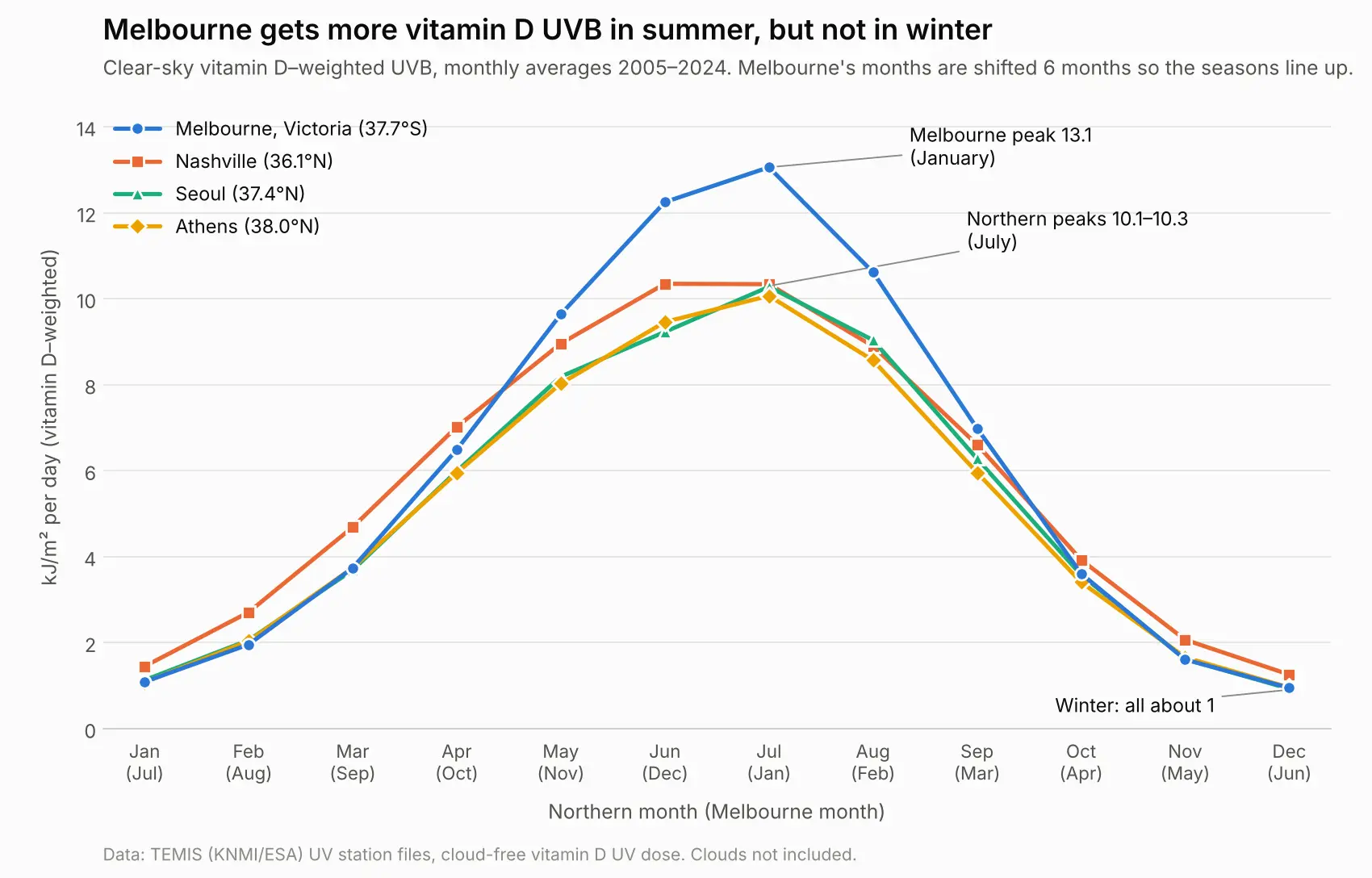
Details at Claude - Opus AI Nov 2026
Related in VitaminDWiki
- Overview UV and vitamin D
- Air Pollution reduces Vitamin D production - many studies
- Many diseases increase with latitude (low UV, Vitamin D)
- Does Less Sun mean More Disease
- Tanning: Worshipped for millennia, demonized by Dermatologists for 40 years, is coming back
- How to safely get Vitamin D at home from a UV lamp or LED
- 2200X more problems from no UVB than too much UVB - WHO 2006
- Tanning beds and Vitamin D - many studies
- Parkinson’s patients 50X less likely to get even a little sun– meta-analysis
- Note: Study does not state an acceptable low vitamin D level for winter