
Many Americans now have a direct financial stake in staying healthy
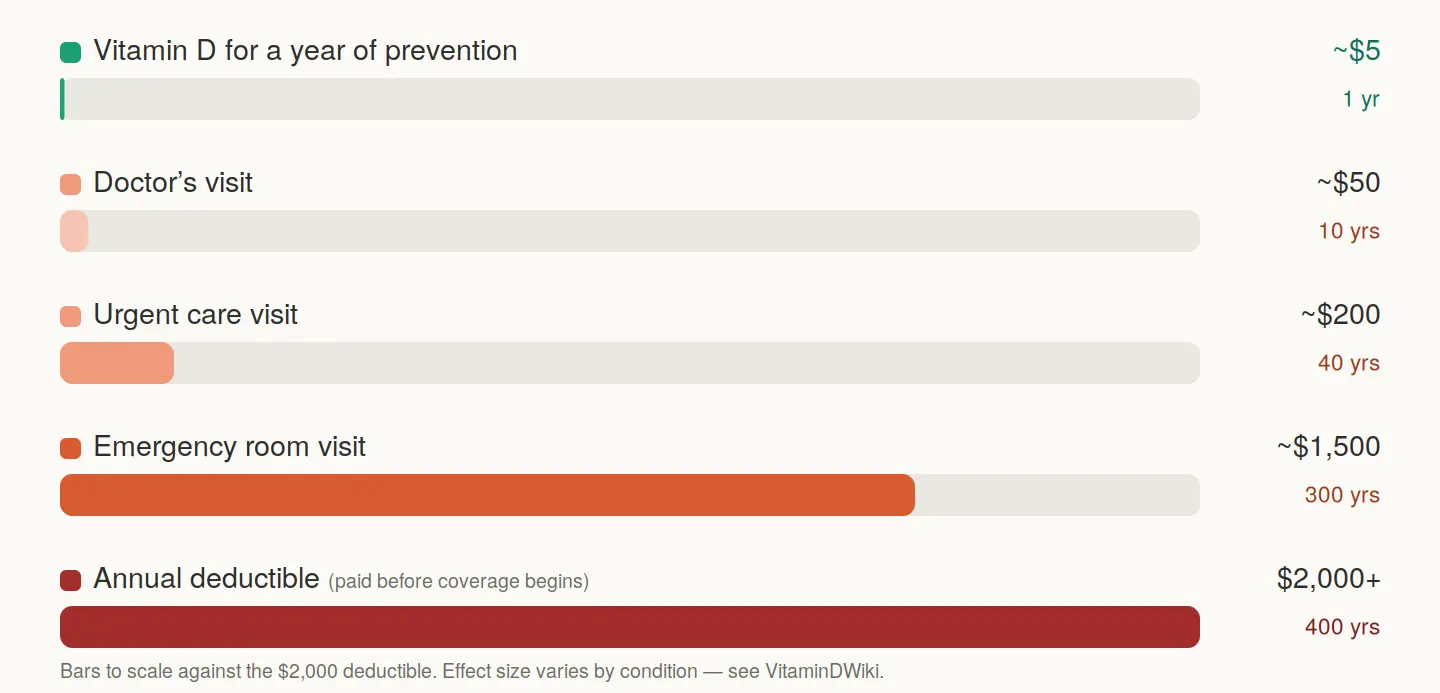
U.S. health insurance has shifted a large share of routine costs onto patients themselves. Roughly 4 in 10 working-age adults (ages 18–64) are now either uninsured or carry a health-plan deductible above $2,000 — meaning they pay out of pocket for most everyday care before any insurance benefit begins.¹ ² ³ By a broader measure of coverage adequacy, nearly half (44%) of working-age adults were uninsured, had a gap in coverage, or were underinsured during 2024.⁴
For these tens of millions of people, avoiding a single prescription, doctor visit, or hospital stay is no longer just better health — it is money kept in their own pocket. Staying healthy has become a direct personal economic interest, not an abstract public-health goal.
Vitamin D is among the least expensive preventive measures available: adequate D3 supplementation costs only about $5 per year.⁵ For the large share of the population that is vitamin D deficient, correcting that deficiency is associated with lower risk and reduced severity across many conditions documented throughout VitaminDWiki. Because the annual cost is so small, even a single avoided sick day, prescription, or visit repays it many times over — the cost-benefit asymmetry favors supplementation regardless of how large the per-condition effect turns out to be.
Evidence note: The size of any health-cost reduction depends on the specific condition and on how deficient a person was to begin with. The supporting evidence is strong for some outcomes and limited for others; VitaminDWiki documents both, by condition.
The economics of one avoided visit
Consider what a single illness costs a person who hasn't met their deductible — which, by definition, is most of the year for the tens of millions described above. They pay the full negotiated price out of pocket. A routine urgent care visit runs roughly $150–$300, and more once basic tests or an X-ray are added.⁶ A single emergency-room visit averages $1,000–$2,500 or more.⁷ Against those numbers, the arithmetic of prevention is stark: a full year of vitamin D3 costs about $5. One avoided urgent care visit pays for roughly 40 years of supplementation; one avoided ER visit pays for 300 years of it. Put differently, supplementation only has to prevent a single such event across an entire lifetime to come out far ahead — and for someone correcting a genuine deficiency, the documented reductions in infection risk, severity, and other outcomes make that a low bar to clear, not a stretch. The cost is so small relative to the downside it guards against that the decision favors supplementation even under conservative assumptions about how large the benefit turns out to be.
References
CDC / National Center for Health Statistics, Health Insurance Coverage: Early Release of Estimates from the National Health Interview Survey, 2024 — 23.1 million adults ages 18–64 (11.6%) were uninsured in 2024. https://www.cdc.gov/nchs/data/nhis/earlyrelease/insur202506.pdf
CDC / NCHS, National Health Statistics Reports No. 214 (Dec. 5, 2024) — among privately insured people younger than age 65, 41.7% were enrolled in a high-deductible health plan (2023). https://www.cdc.gov/nchs/data/nhsr/nhsr214.pdf
KFF, 2025 Employer Health Benefits Survey — 34% of covered workers are in a plan with a single-coverage deductible of $2,000 or more (53% at small firms). https://www.kff.org/health-costs/2025-employer-health-benefits-survey/
The Commonwealth Fund, State of Health Insurance Coverage in the U.S.: 2024 Biennial Survey — only 56% of working-age adults were insured all year with coverage adequate for affordable access to care; the remaining 44% were uninsured, experienced a coverage gap, or were underinsured. https://www.commonwealthfund.org/publications/surveys/2024/nov/state-health-insurance-coverage-us-2024-biennial-survey
Method note: No single official statistic reports "uninsured or deductible over $2,000" as one figure for working-age adults; the ~4-in-10 estimate combines the CDC uninsured rate (footnote 1) with deductible-distribution data (footnotes 2–3). The ~$5/year cost reflects bulk/generic D3 at a moderate maintenance dose; higher doses run somewhat more.
Multiple 2025–2026 cost surveys place a typical out-of-pocket urgent care visit at roughly $150–$300, rising with diagnostic tests or imaging; under a high-deductible plan the patient pays this full amount until the deductible is met. Sources: Mira Health (2025); Solv Health (2026); HSA for America (2025).
An uninsured or pre-deductible emergency-room visit averages approximately $1,000–$2,500 or more, depending on services and location. Source: Solv Health (2026). https://www.solvhealth.com/health/how-much-does-urgent-care-cost-without-insurance
Data assembled by Claude AI
Related in VitaminDWiki
- One pill every two weeks gives you all the vitamin D most adults need
50,000 IU of Vitamin D once every two weeks proven to prevent/treat: Diabetes + Heart Failure + Chronic Pain + Depression + Autism + Breast Cancer + Colon Cancer + Prostate Cancer + BPH (prostate) + Preeclampsia + Premature Birth + Falls + Cognitive Decline + Respiratory Tract Infection + Influenza + Tuberculosis + Chronic Obstructive Pulmonary Disease + Lupus + Inflammatory Bowel Syndrome + Urinary Tract Infection + Poor Sleep + Growing Pain + Multiple Sclerosis + PMS + Schizophrenia + Endometriosis + Smoking - If Vitamin D could be patented, it would be the highest-selling drug- Grant podcast May 2026
- A drug that could reduce all these health problems is worth a Trillion dollars - video Holick
- Top 10 chronic health problems of children, women, pregnancies, seniors, and darker skins are fought by Vitamin D
- Vitamin D has been found to be cost-effective by many studies
- The top 10 medical expenses can all be decreased by vitamin D
- Medical problems are thought to be a cause of 66 percent of bankruptcies
- Perhaps 4,000 dollars annual less health care costs if supplement with 5 dollars of Vitamin D
- Daily, weekly, and bi-weekly VitaminD dosing got to the same level
- 50,000 IU of Vitamin D once every 2 weeks achieved 40 ng in 3 months – RCT
- Can get 50,000 IU Vitamin D anywhere on the globe
- 4 X fewer visits to Dr. after getting high level of vitamin D (Interview with transcript)