
Vitamin D levels increased in Saudi Arabia over a decade (more sun or supplements)
Decreasing prevalence of vitamin D deficiency in the central region of Saudi Arabia (2008-2017)
The Journal of Steroid Biochemistry and Molecular Biology, Vol 212, Sept 2021, 105920, https://doi.org/10.1016/j.jsbmb.2021.105920
Nasser M.Al-Daghria Syed Danish Hussaina Mohammed G.A.AnsariaMalak N.K.KhattakaNajiAljohanib YousefAl-Salehacde Mohammed Y.Al-HarbifShaunSabicoaMajed S.Alokaila
📄 Download the PDF from VitaminDWiki
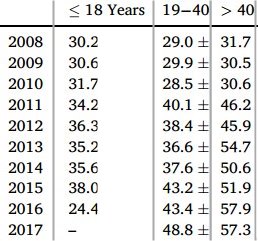
Adjusted vitamin D levels - in nmol
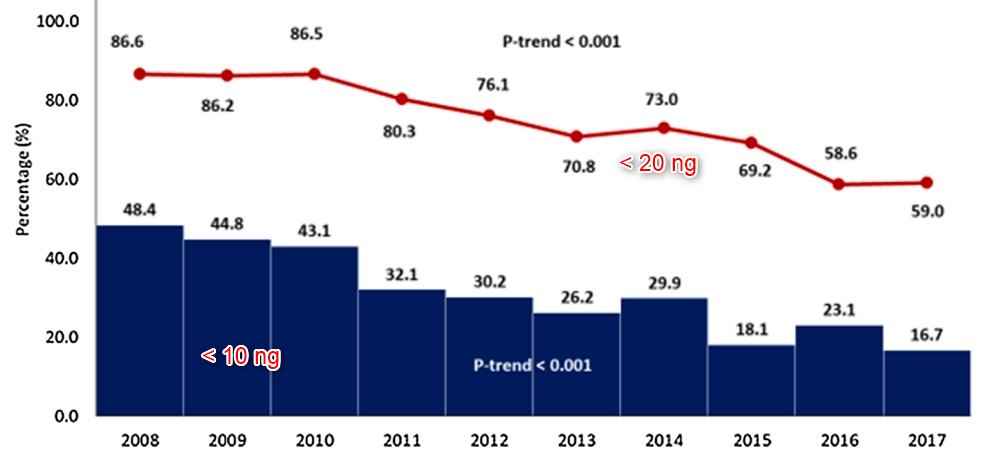
Fewer in Saudi Arabia with <10 ng and <20 ng
Objective
Widespread vitamin D deficiency (serum 25-hydroxyvitamin D < 50 nmol/L) in Saudi Arabia (SA) has been documented, yet a time trend is needed to establish where the prevalence is headed. This study aims to fill this gap.
Study Design and Setting
This cross-sectional series (N = 7360) were conducted in the central region of SA from 2008 to 2017. Participants of all ages were taken from multiple cohorts that included the Biomarker Screening in Riyadh (2008–2010; N = 1460), the Osteoporosis Registry (2014–2017; N = 1225), Gestational Diabetes Mellitus cohort (2014–2017, N = 281), Vitamin D School Project (2011–2017; N = 3039) and Prediabetes cohort (2012–2017; N = 1355) master databases.
Results
Vitamin D deficiency in SA has a 10-year prevalence of 73.2 %. Between 2008–2017, the prevalence of vitamin D deficiency decreased from 87.1% to 64.7% for participants aged 18−40 years (p-trend<0.001), and from 86.2% to 45.7% in participants aged > 40 years (p-trend<0.001). During this period, vitamin D deficiency in females decreased from 80.1% to 69.6% (p-trend<0.001), whereas in males, it decreased from 93.2% to 49.3% (p-trend<0.001). Serum 25(OH)D was observed to have an overall increase of 2.2 ± 0.1 nmol/l (p < 0.001) along with the seasonally adjusted annual increase of 1.3 ± 0.2 nmol/l from 2008 to 2017 (p < 0.001).
Conclusion
The decreasing trend in vitamin D deficiency in SA across all demographics suggests successful public health campaigns over time. It will be interesting to investigate further whether the general improvement in the vitamin D status at the community level also translated in lesser incidences of vitamin d-related diseases over time.