
Repeat heart attacks cut in half when vitamin D was dosed to reach > 40 ng - RCT
Targeted vitamin D supplementation and major adverse cardiovascular events after myocardial infarction: the TARGET-D trial
European Heart Journal, Sept 7, 2026, https://doi.org/10.1093/eurheartj/ehag611 PDF behind paywall
Heidi T May, Viet T Le, Jeffrey L Anderson, Leslie Iverson, Tami L Bair, Stacey Knight, Kirk U Knowlton, Benjamin E Peterson, Joseph B Muhlestein
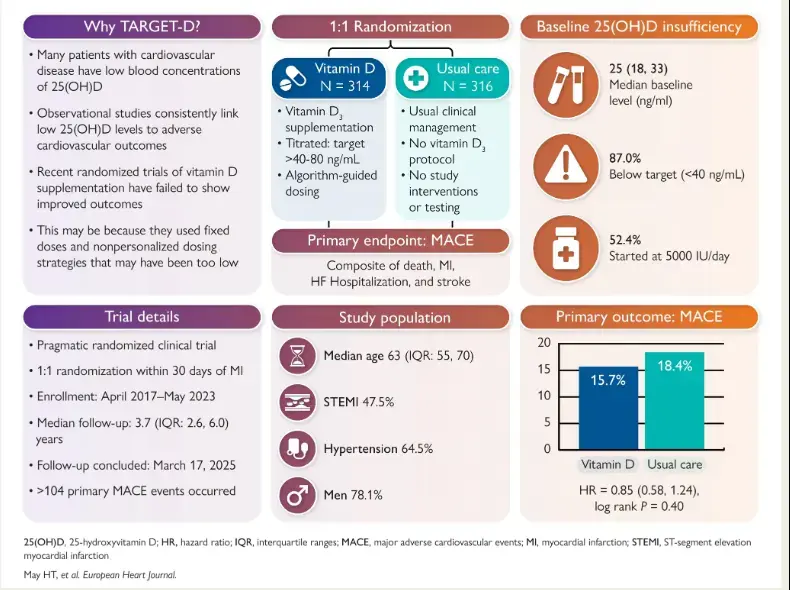
Summary by Claude Opus 5.5 - October 2026
Takeaway: People who had just had a heart attack had their vitamin D tested, and their dose was raised until blood levels passed 40 ng/mL. Over about 4 years this roughly halved the rate of a second heart attack: 3.8% vs 7.9% (HR 0.48, p = 0.03). The trial's main combined outcome was death, heart attack, heart-failure hospitalization or stroke. That outcome was not significantly reduced: 15.7% vs 18.4% (HR 0.85, p = 0.40). The authors' conclusion: "Targeted vitamin D supplementation and ongoing titration did not significantly reduce major adverse CV events."
Study: This was a randomized, open-label (no placebo), peer-reviewed trial at Intermountain Health, Utah. It enrolled 630 adults within 31 days of a heart attack between 2017 and 2023. Median age was 63, and 78% were men. Average follow-up was 4.2 years. It was funded by a private foundation with no industry involvement. Median starting 25(OH)D was 25 ng/mL, and 87% were at or below 40.
Vitamin D3 dosing (treatment group, daily):
- Starting level below 25 ng/mL → 5,000 IU
- 25–30 → 3,000 IU; 30–35 → 2,000 IU; 35–40 → 1,000 IU; above 40 → none
- Retested every 3 months; dose doubled while still ≤ 40; reduced if above 80 ng/mL
- Median 5.2 months to pass 40; 79% passed it at least once; 21% never did
- At the last recorded dose, 56% were taking ≥ 5,000 IU/day, including 12% on 10,000 IU
The study did not measure vitamin D levels in the usual-care group.
Outcomes (all randomized patients):
| Outcome | Vitamin D (n = 313) | Usual care (n = 316) | HR (95% CI) |
|---|---|---|---|
| Combined (primary) | 15.7% | 18.4% | 0.85 (0.58–1.24) |
| Heart attack | 3.8% | 7.9% | 0.48 (0.24–0.96) |
| Death, any cause | 8.9% | 9.2% | 0.98 (0.58–1.65) |
| Heart-failure hospitalization | 4.2% | 3.5% | 1.21 (0.54–2.69) |
| Stroke | 1.6% | 0.9% | 1.69 (0.41–7.09) |
| Cardiovascular death | 5.4% | 4.7% | 1.16 (0.58–2.31) |
The per-protocol analysis looked at the 247 patients who actually exceeded 40 ng/mL. In them, the combined outcome was 11.3% vs 18.4% and deaths were 4.9% vs 9.2%; neither difference was statistically significant. Kidney stones occurred in 21 people in each group. Non-significant trends favored vitamin D for new atrial fibrillation (3.8% vs 6.2%) and fractures (9.9% vs 13.0%).
What this does NOT show:
- It does not show that vitamin D reduces deaths or total cardiovascular events. The primary result is null, and its confidence interval allows anything from a 42% reduction to a 24% increase.
- The halving of heart attacks is a secondary outcome, based on 37 events in total and not adjusted for multiple comparisons. The authors and the editorial both call it hypothesis-generating.
- The trial was underpowered. Enrollment was cut short by COVID (890 were planned), and the authors estimate about 1,600 per group would be needed.
- There was no placebo. The vitamin D group had more study visits, which may have affected their care.
- The per-protocol results favor people who survived long enough to reach 40 ng/mL (survivor bias).
- Baseline levels were measured within a month of a heart attack, when 25(OH)D can be temporarily low.
- It covered one Utah health system, mostly white men. People already taking more than 1,000 IU/day were excluded. It says nothing about people without heart disease.
An accompanying editorial by Davis and Manson concludes that current evidence does not support routine vitamin D for heart-disease prevention.
- PubMed abstract
- Editorial: Davis & Manson
- ClinicalTrials.gov NCT02996721
- Detailed review of full paper (Spanish)
Sources:
YouTube interview of Benjamin Pederson (author)
YouTube - Oct 2026, 71 minutes
Summary by Claude AI
(03:16–04:19) Arterial mechanism: Endothelial and smooth-muscle cells have vitamin D receptors. Low vitamin D means less nitric oxide, stiffer arteries and more wall inflammation. Low D also tends to go with insulin resistance. Inflamed soft plaque cracks, and the clot that forms on it causes the heart attack or stroke. Brewer frames vitamin D as acting on the inflammation part of that chain.
(04:19–05:45) Why earlier trials failed, and the new trial: He says the big trials gave everyone a fixed 2,000 IU and never measured blood levels. A Utah heart-institute RCT (this matches Intermountain's TARGET-D) enrolled 630 patients just after a heart attack. Half got usual care. The other half got D3 titrated by repeated testing to 40–80 ng/mL. Baseline averaged 25 ng/mL, and 87% were at or below 40.
(06:14–07:53) Four-year results: The composite of death, MI, heart failure and stroke fell from 18.4% to 15.7%, which was not significant. Heart attacks alone fell from 7.9% to 3.8%, which was significant. Brewer calls the MI finding a strong signal and the overall trial inconclusive, because death, HF and stroke each had too few events. At 17:14 Dr. Vega restates it as "87% below 30," which conflicts with Brewer's "at or below 40."
(07:53–10:05) Brewer's target levels: The 20 and 30 ng/mL thresholds came from bone health and rickets prevention. His long-standing range is 50–90 ng/mL, and he now leans toward the lower end, about 50–70. His action points:
- Below 40: needs attention.
- Around 100: reassess, mainly because added benefit is doubtful, not because 100 is dangerous.
- Above 150: risk of severe toxicity (high calcium, kidney damage, rarely death).
He also cites a pooled analysis of three prediabetes RCTs showing about 15% less progression to diabetes. His bottom line is "test, don't guess."
(10:05–16:22) Rant on uncertainty: Debates about vitamin D, LDL, ApoB and statins all have settled and unsettled parts. Demanding certainty and picking teams leaves people either doing nothing or overdosing. He extends this to politics and cites Feynman's idea of degrees of certainty. His four questions:
- What happened?
- What supports that account?
- What would make me reconsider?
- Would I accept this explanation from the other side?
(25:16–31:45) Caller Don (post-MI): He reached 79.2 ng/mL on 10,000 IU/day, and his doctor cut him to 5,000 IU plus 400 mcg K2 MK-7. Brewer says 5,000 IU is a reasonable starting dose, but the resulting level matters more than the dose. He advises retesting after about a month and staying above 40 and below 150.
(38:04–42:21) Caller Ruth: She rose from 4 to 40 ng/mL on 5,000 IU of D3+K2. Brewer says most clinicians now want at least 40, and he keeps patients at 45–50 on 5,000 IU. He reports he is about 50 ng/mL on 5,000 IU/day himself.
(44:38–46:16) Caller Joanne, on Morley Robbins's copper hypothesis: Robbins argues vitamin D is excessive relative to copper. Brewer doesn't rule it out but doesn't engage further. Joanne thanks him for naming an upper threshold.
(1:03:28–1:08:47) Caller Sherry (osteoporosis, CAC of 1156): She asked whether heavy calcium supplements in her 40s, taken without K2, caused her arterial calcification. Brewer says no: the main driver is vascular inflammation from undiagnosed metabolic disease, and calcification is part of healing. For osteoporosis he recommends "mega-dose" K2 of about 45 mg. He didn't name the form, but 45 mg/day is the MK-4 dose used in Japan for osteoporosis. She takes 2,000 IU D3.
Other topics:
- (20:52–25:16) Soft-plaque plan: test, cut glycemic carbs, exercise with intensity, fix sleep and stress, then supplements, then medications.
- (35:16–37:33) Access to AI-analyzed CCTA (Cleerly, HeartFlow) is hampered by Medicare payment flip-flopping, not by differences in quality.
- (55:19) A CAC above 1,000 often means plaque that has calcified and stabilized.
- (1:00:58) Don't combine nattokinase with aspirin or prescription blood thinners.
- Throughout: promotion of the Dr. Brewer AI app and an upcoming book.
Related in VitaminDWiki
- Suspect that the study failed to wait for the Vitamin D levels to get >40 ng for at least a few months before counting cardio events
- Heart Failure and Vitamin D - many studies
- Heart Failure and Vitamin D meta-analyses - many studies
>40 ng
- 40 ng Vitamin D perhaps optimal for reduced mortality – Meta-analysis
- 50,000 IU of Vitamin D once every 2 weeks achieved 40 ng in 3 months – RCT
- 80+ health problems substantially reduced when Vitamin D is above 40 ng
- Another Vitamin D consensus for 40-60 ng – India
- Vitamin D update – 40-60 ng ideal, 50K biweekly maintenance
- 40-50 ng level of Vitamin D often recommended
- Is 50 ng of vitamin D too high, just right, or not enough