
Parkinson's patients were twice as likely to be Vitamin D deficient, and get less midday sun
Association of serum vitamin D deficiency and inadequate sunlight exposure with Parkinson's disease risk: A pilot study in Bangladesh
Heliyon (Cell Press / Elsevier), 25 September 2026, https://doi.org/10.1016/j.heliyon.2026.e45499
Md. Rabiul Islam, Md Sahabuddin, Nusrat Hossain Sheba, Zenat Zebin Hossain
Summary by Claude Opus 5.5 - September 2026
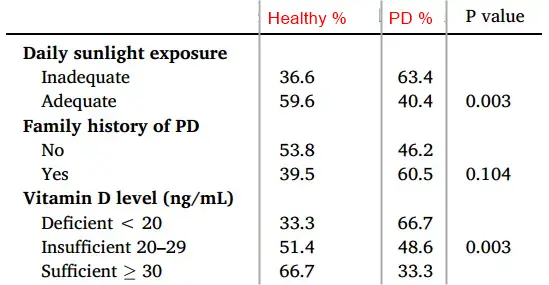
Bangladeshi adults with vitamin D below 20 ng/mL had about 3 times the odds of having Parkinson's disease (PD). Those getting little midday sun had about 2.3 times the odds. This was in a sunny, low-latitude country.
This is a small observational study at a single hospital. The authors call it cross-sectional, but in practice it compares people with and without PD. It included 87 patients with neurologist-confirmed PD and 88 "neurologically healthy" patients (systematically sampled) from the same neuromedicine department of a Dhaka hospital, April 2023 – June 2024. Mean age was 63. Anyone taking vitamin D supplements was excluded.
25(OH)D was measured by immunoassay. The average was 24.4 ng/mL, and only 29% of participants reached 30 ng/mL. "Adequate" sun meant more than 1 hour between 11 am and 2 pm, at least 3 days a week, with at least 18% of skin uncovered and no sunscreen.
| Group | People | % with PD | Adjusted odds of PD (95% CI) |
|---|---|---|---|
| 25(OH)D below 20 ng/mL | 54 | 66.7% | 3.02 (1.22–7.48) |
| 25(OH)D 20–29 ng/mL | 70 | 48.6% | 1.56 (0.70–3.45), not significant |
| 25(OH)D 30+ ng/mL | 51 | 33.3% | 1.0 (reference) |
| Inadequate midday sun | 71 | 63.4% | 2.31 (1.16–4.62) |
| Adequate midday sun | 104 | 40.4% | 1.0 (reference) |
Odds were adjusted for age, sex, income, family history of PD, smoking and smokeless tobacco. Vitamin D and sun were in the same model, so low sun stayed linked to PD even after accounting for blood vitamin D. That could hint at benefits of sunlight beyond vitamin D, or it could simply reflect PD patients going outdoors less. The authors state their design "cannot establish causality."
What this does NOT show
- That low vitamin D or low sun causes PD. Both were measured after diagnosis. PD reduces mobility and time outdoors, so either could be a result of the disease. PD duration and severity were not reported.
- A precise effect size. With only 175 people, the 3.02 odds ratio could be anywhere from 1.2 to 7.5.
- Average 25(OH)D for PD patients vs. controls, which was not reported.
- Effects of season, diet, physical activity, body weight or clothing. None of these were adjusted for.
- Whether taking vitamin D prevents or slows PD. Nobody was supplemented.
Related in VitaminDWiki
- Parkinson's disease: none in Massi, who have the highest level of Vitamin D
- Parkinson's symptoms are worse in the winter - low vitamin D?
- Risk of Parkinson’s decreases with time in summer sun
- Vitamin D associated with Parkinson’s Disease in 55 studies, more studies needed
- Parkinson’s Disease Summer School – therapies included 60-80 ng of Vitamin D
- Parkinson’s patients 50X less likely to get even a little sun – meta-analysis
- Parkinson’s disease 2 times less likely if get 2 hours of daily sun