
Insulin problems reduced by Curcumin if not also take Omega-3 – RCT
Curcumin and/or omega-3 polyunsaturated fatty acids supplementation reduces insulin resistance and blood lipids in individuals with high risk of type 2 diabetes: a randomised controlled trial
Lipids in Health and Disease 201918:31; https://doi.org/10.1186/s12944-019-0967-x
Rohith N. Thota, Shamasunder H. Acharya and Manohar L. Garg
Download the PDF from VitaminDWiki
Background
Lowering insulin resistance and dyslipidaemia may not only enhance glycaemic control but also preserve the β-cell function, reducing the overall risk of developing type 2 diabetes (T2D). The current study was aimed to evaluate the effects of curcumin and/or long-chain omega-3 polyunsaturated fatty acids (LCn-3PUFA) supplementation on glycaemic control and blood lipid levels in individuals at high risk of developing T2D.
Methods
This was a 2 × 2 factorial, randomised, double-blinded, placebo-controlled study.
Participants were allocated to either
double placebo (PL) or
curcumin plus placebo matching for LCn-3PUFA (CC), or
LCn-3PUFA plus placebo matching for curcumin (FO), or
curcumin plus LCn-3PUFA (CC-FO)
for twelve weeks. Primary outcome of the trial was glycaemic indices (HbA1C, fasting glucose and insulin). Insulin resistance and sensitivity is measured using homeostatic model assessment model.
Results
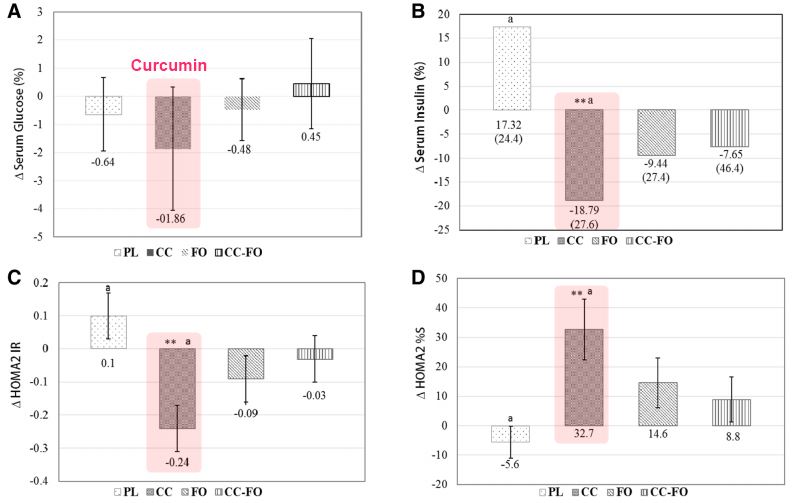
A total of sixty-four participants (PL, n = 16; CC, n = 15; FO, n = 17, CC-FO, n = 16) were included in the final analysis. Post-intervention, HbA1c and fasting glucose remained unchanged across all the groups. Insulin sensitivity was significantly improved in the CC supplemented group (32.7 ± 10.3%) compared to PL (P = 0.009). FO and CC-FO tended to improve insulin sensitivity by 14.6 ± 8.5% and 8.8 ± 7.7% respectively, but the difference did not reach significance. Triglyceride levels were further increased in the PL (26.9 ± 7.4%), however, CC and CC-FO supplementation reduced the triglycerides, FO resulted in the greatest reduction in triglycerides (− 16.4 ± 4.5%, P < 0.001).
Conclusion
Reduction in insulin resistance and triglycerides by curcumin and LCn-3PUFA appears to be attractive strategies for lowering the risk of developing T2D. However, this study failed to demonstrate complimentary benefits of curcumin and LCn-3PUFA on glycaemic control.
Trail registration ACTRN12615000559516.