
CPAP 2X more likely if very low Vitamin D 2 years before - Meta-analysis
Vitamin D Deficiency Is Associated with a Higher 5-Year Risk of Obstructive Sleep Apnea and CPAP Use in Older Adults: An Anchor-Based Network Meta-Analysis
Medicina 2026, 62(5), 935; May 2026 https://doi.org/10.3390/medicina62050935
by Jui-Kun Chiang 1,†ORCID,Hsueh-Hsin Kao 2,†,Po-Han Chiang 3,* andYee-Hsin Kao 4, TAIWAN
Background and Objectives: Continuous positive airway pressure (CPAP) is the standard first-line treatment for patients with obstructive sleep apnea (OSA). Patients with OSA exhibit a higher prevalence of vitamin D deficiency, and CPAP treatment has been reported to improve vitamin D levels. Therefore, the aim of this study was to investigate the association between vitamin D deficiency and the risk of patients receiving a diagnosis of OSA or utilizing CPAP, using the TriNetX research network to obtain real-world data.
Materials and Methods: A retrospective cohort study using the TriNetX database was conducted to investigate the relationship between vitamin D deficiency and patients with risk of receiving an OSA diagnosis or patients treated with CPAP in older adults (≥65 years). Patients were stratified into four groups according to serum 25-hydroxyvitamin D [25(OH)D] levels: severe deficiency (D10, ≤10 ng/mL), mild deficiency (D20, 11–20 ng/mL), insufficient vitamin D status (S30, 21–30 ng/mL), and normal vitamin D status (N100, 31–100 ng/mL).
After 1:1 propensity score matching (PSM) to adjust for baseline covariates, patients were followed for up to 5 years for newly diagnosed OSA and CPAP use (an administrative-clinical outcome influenced by non-disease-related factors such as healthcare access and clinical practice), with vitamin D status assessed at the index date. An anchor-based network meta-analysis was also performed to integrate direct and indirect evidence across groups.
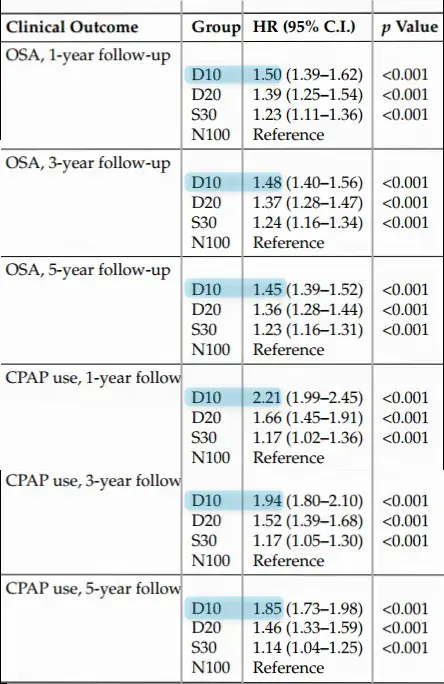
Results: A total of 2,289,855 eligible patients were included and stratified into four groups: D10 (n = 161,610; 7.06%), D20 (n = 404,954; 17.68%), S30 (n = 648,989; 28.34%), and N100 (n = 1,074,302; 46.92%). Across the six pairwise comparisons, pre-matching baseline imbalances showed consistent patterns: lower vitamin D groups (particularly D10 and D20) generally had older age at index (in comparisons with S30 or D20), a higher proportion of males, and higher proportions of Black/African American patients, whereas higher vitamin D groups (especially N100 and S30) had higher proportions of White patients (and, in some comparisons, Asian patients). Comorbidity differences were modest overall, and these imbalances were substantially reduced after PSM. In both pairwise PSM analyses and the anchor-based network meta-analysis, severe vitamin D deficiency was observationally associated with the risk of receiving an OSA diagnosis and CPAP use. An observational trend appeared across vitamin D categories (D10 > D20 > S30), suggesting an association. The associations were strongest at 1 year and gradually attenuated over the 3- and 5-year follow-up periods. An E-value greater than 3 was observed only for the comparison between the D10 and N100 groups.
Conclusions: In this real-world analysis of older adults, vitamin D deficiency, particularly severe deficiency, was observationally associated with increased 5-year risk of receiving an OSA diagnosis and CPAP use. Similarly, anchor-based network meta-analysis also showed an association between vitamin D deficiency severity and the risk of receiving an OSA diagnosis and CPAP use.