
Calcitriol response to single large doses - small RCT
Effects of High Dose Bolus Cholecalciferol on Free Vitamin D Metabolites, Bone Turnover Markers and Physical Function
Nutrients, August 29, 2024, https://doi.org/10.3390/nu16172888
Simon D. Bowles, Richard Jacques, Thomas R. Hill, Richard Eastell, Jennifer S. Walsh
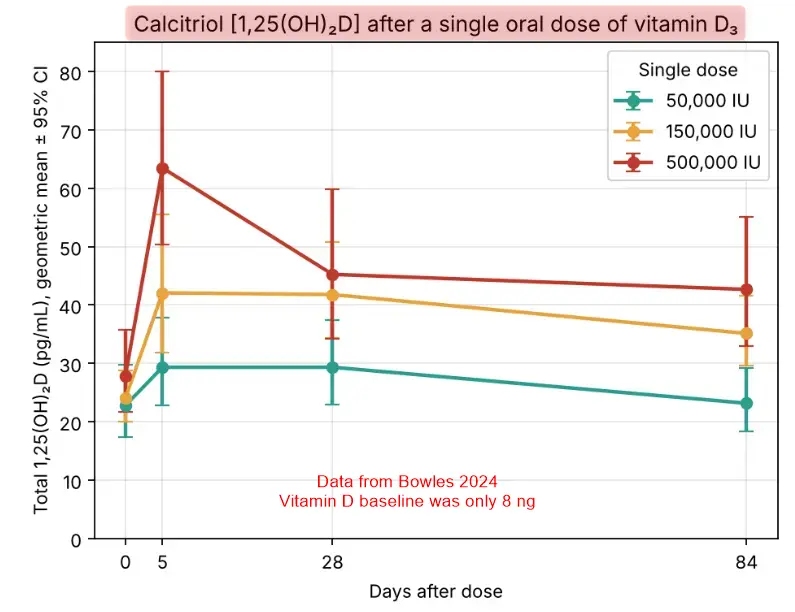
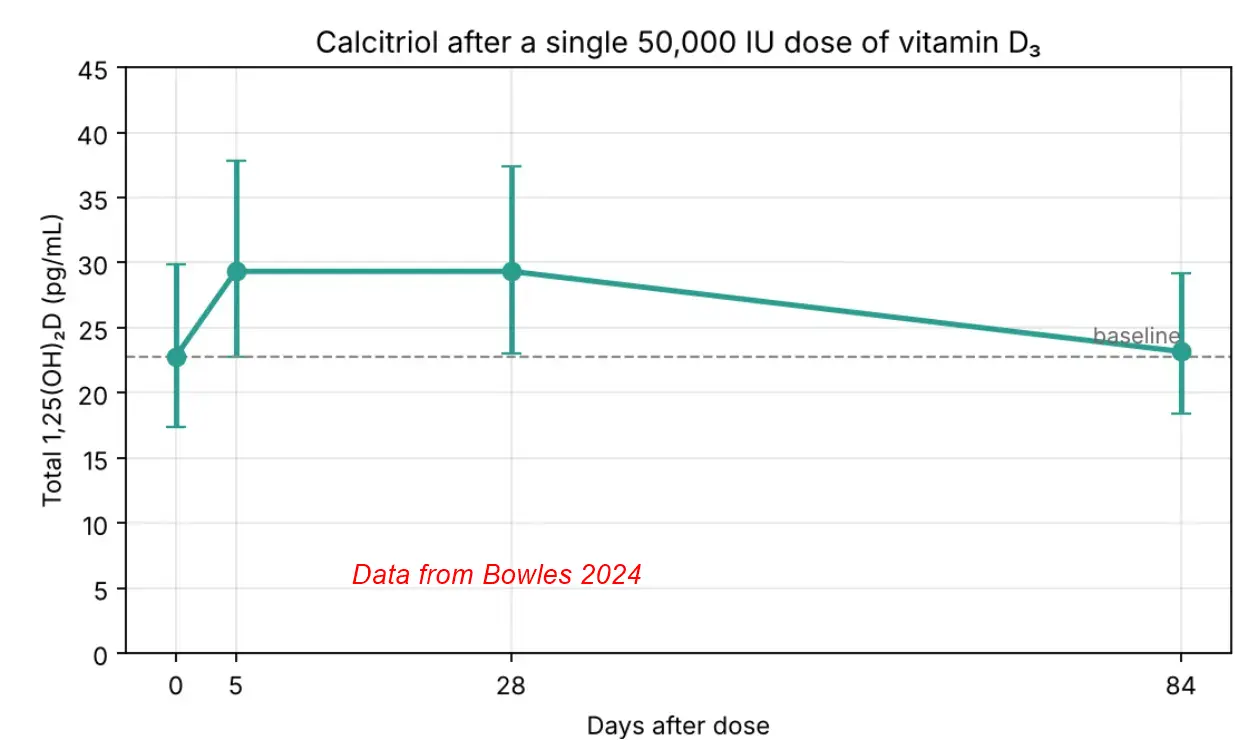
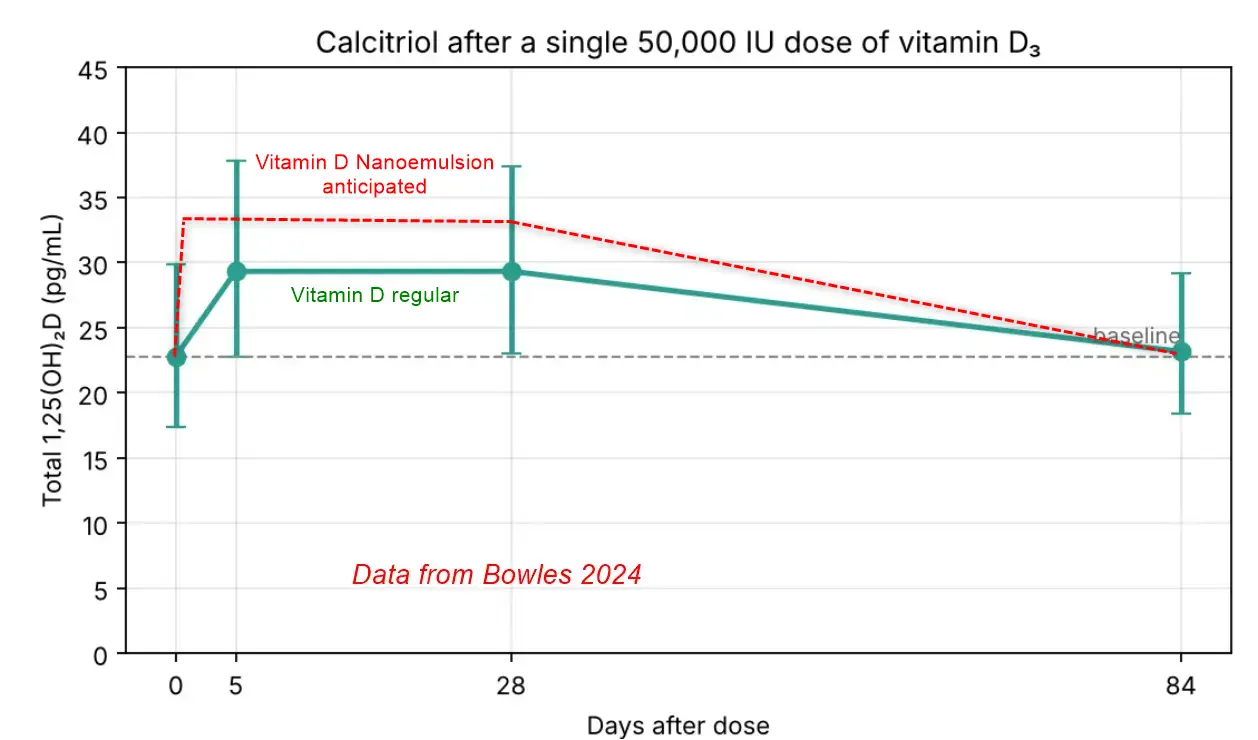
Summary by Claude - October, 2026
Practical takeaway: a single oral dose of up to 500,000 IU of vitamin D3 was well tolerated in healthy older women, did not raise blood calcium, and did not cause a disproportionate surge in "free" vitamin D — but the largest dose did produce a short-lived spike in bone turnover markers one week later, which the authors suggest might help explain the extra fractures seen in earlier annual-bolus trials.
This was a small, double-blinded randomized trial (33 vitamin D–deficient postmenopausal women, 25(OH)D < 30 nmol/L, Sheffield, UK, winter only) comparing one oral bolus of 50,000, 150,000, or 500,000 IU D3, with 27 vitamin D–sufficient women as untreated controls. Blood was drawn at baseline and days 5, 28, and 84.
Achieved 25(OH)D (from ~21 nmol/L at baseline):
- 50,000 IU: 47 nmol/L at day 5, 33 at day 84
- 150,000 IU: 69 nmol/L at day 5, 52 at day 84
- 500,000 IU: 154 nmol/L at day 5, 119 at day 28, 77 at day 84
Free 25(OH)D and free 1,25(OH)₂D rose in the same proportion as the total forms — no evidence of vitamin D binding protein saturation. Serum and ionized calcium were unchanged in every group; urinary calcium rose modestly and PTH fell, as expected. Grip strength, physical performance (SPPB), postural blood pressure, and aldosterone:renin ratio did not change, and no falls occurred. Only the 500,000 IU group showed a transient rise at day 5 in bone resorption (CTX-I +26%) and formation markers (osteocalcin +23%, PINP +9%), returning to baseline by day 28–84. The authors conclude the mechanism behind bolus-related falls "remains unclear."
What this does NOT show / limitations
- Very small (11 per arm, below the planned 28), so null results on physical function and blood pressure are weak evidence of safety, not proof.
- No placebo group, and participants were healthy — earlier fall/fracture trials involved frailer, older people with higher baseline vitamin D.
- First blood draw was day 5, so the true peak 25(OH)D may have been missed.
- Free 1,25(OH)₂D was calculated, not measured.
- Three months is too short to say anything about fractures, and the clinical meaning of the brief bone-marker spike is unknown.
Related in VitaminDWiki
- Fully activated Vitamin D does not change with altitude nor sunlight, but does increase for a while after a high dose of Vit. D
- Nanoemulsion Vitamin D is faster and better - many studies
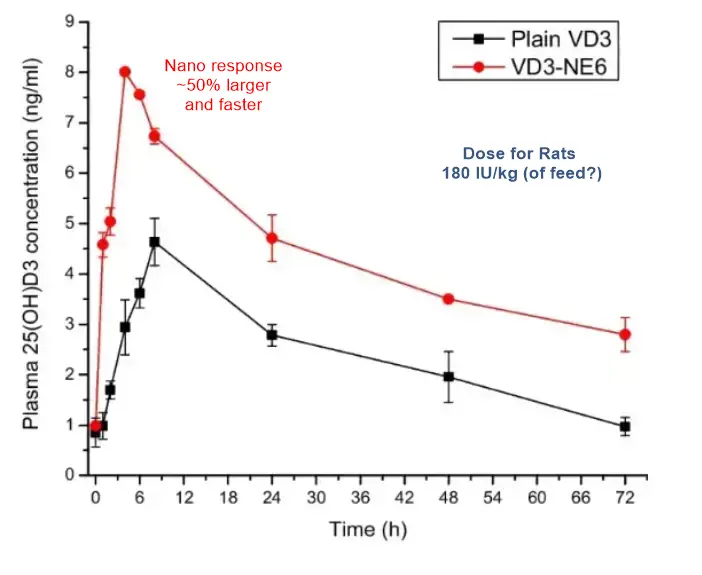
- Single 600,000 IU dose of nanoemulsion Vitamin D is safe and effective to fight COVID, even if delay until enter ICU – RCT
- COVID-19 defeated 3x faster by 420,000 IU Vitamin D nanoemulsion – RCT
- Vitamin D can start working in minutes — if you pick the right form
- Nanoemulsion, nanoliposome, and conventional Vitamin D compared
- Vitamin D: liposomal and nanoemulsion forms - Chat-GPT
Calcitriol ( often by prescription only)
- Calcitriol
- To get more Calcium during pregnancy active Vitamin D (Calcitriol) at least doubles
- 2260 diseases found to be fought by fully-activated Vitamin D (Calcitriol)
*Active Vitamin D (Calcitriol) reference ranges, why too high is a problem
highly regulated by the body - Fully-activated Vitamin D (Calcitriol) is produced inside and outside of the kidneys