
Vitamin D can start working in minutes — if you pick the right form
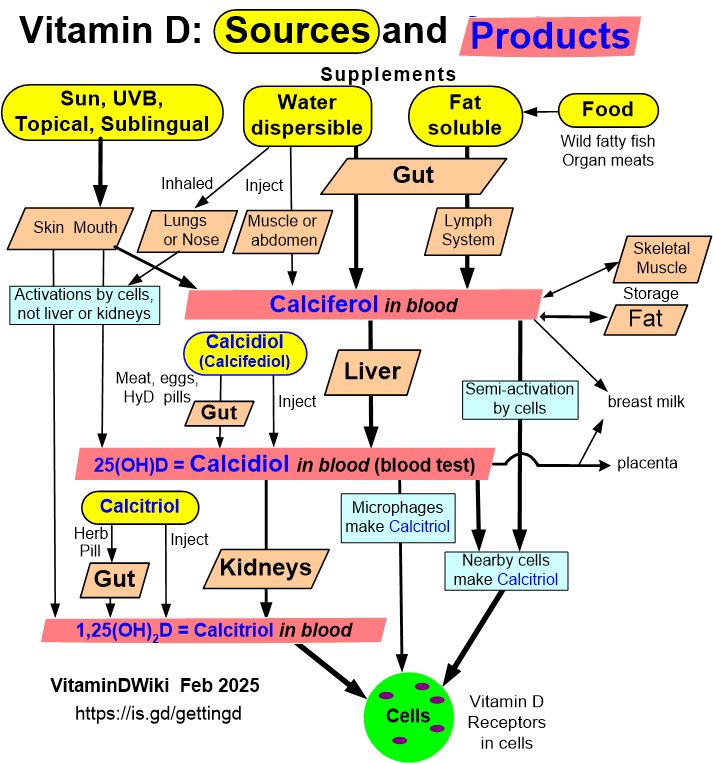
Speed of response: minutes to weeks
- nanoemulsion inhaled (minutes)
- nanoemulsion swished in mouth (minutes)
- inhaled vitamin D
through nose if need in brain
through mouth if needed in lungs - Calcitriol injection - prescription only (hour)
- nanoemulsion oral (hour)
- topical (hour
- liposomal (hours)
- patch (hours)
- powder in pill - water dispersible (day)
Pour powder into water, then swish water in mouth for 2 minutes - oil in capsule or liquid (days)
- injection (weeks)
When a Fast Response is wanted
- You or a person near you is getting symptoms of a possible viral infection
- Accident that requires hospitalization
- In Intensive Care Unit (ICU)
- Stop asthma, etc. attack
A slow response (injection) is wanted when unsure a person will take the supplement
Additional concerns: fat needed, time of day, increased bio-availability, genes, co-factors, gut-friendly
Response time for injections - Claude AI April 2026
Calcitriol (1,25(OH)₂D) injection — 1 hour.
It's already the active hormone, so it binds VDR immediately with no conversion needed. Plasma peak is roughly 1 hour after IV. PTH suppression is detectable within a few hours, with maximum suppression around 24–48 hours. Plasma half-life is short (~5–8 hours), but biological effects persist 3–5 days because of nuclear VDR binding. This is why dialysis units dose it 3×/week IV.
Calcidiol (25(OH)D, calcifediol) injection - 4 hours
Hours to raise the serum marker, but ~1–4 days for full downstream effect. Serum 25(OH)D rises within 4–8 hours of an IM or oral dose (compare to weeks for D3 to plateau). However, the biological effect still requires 1α-hydroxylation in the kidney (or peripherally) to calcitriol, so PTH and calcium effects lag the 25(OH)D rise by roughly a day or two. Half-life is ~15 days, so a single dose holds levels up for weeks.
Related in VitaminDWiki
- Fast responses to Vitamin D – loading dose, nanoemulsion and Calcifediol
- Response to Vitamin D - many studies
- Responses to 3600 IU Vitamin D or Calcifediol
- Some supplements: Vitamin D, Vitamin K, Omega-3, etc. must be taken with fatty meals
- Microencapsulated Vitamin D better than oil-based in 6 ways
- 30-40 % of people dislike swallowing pills (note: there are many other forms of Vitamin D)
- Perhaps 10% of people will do better with Calcidiol than Vitamin D
- Fast responses to Vitamin D – loading dose, nanoemulsion and Calcifediol
- Gut-Friendly Vitamin D
- Getting Vitamin D into your blood and cells has
Liposomal
- Liposomal Vitamin D3 compared with Calcidiol(Calcifediol)
- 5 X faster response to Liposomal Vitamin D than oil-based Vitamin D
- Liposomal Vitamin D appears to have a 3X faster and better response
Oil Based
- Vitamin D in powder (Bio-Tech) better than in oil (Thesis with Cystic Fibrosis patients)
- Olive oil problem with Vitamin D (again)
Tags at the bottom of page include : injection, Topical, Nanoe, Liposomal Calcidiol, Gut-Friendly