
60,000 IU weekly vitamin D beat physiotherapy alone for chronic low back pain - RCT
Combined Effects of Physiotherapy and Vitamin D Supplementation on Pain, Disability, and IL-6 Expression in Chronic Low Back Pain: A Randomized Controlled Trial
Life (MDPI), 4 August 2026, https://doi.org/10.3390/life16081288
Abdulaziz A. Albalwi, Hamad S. Al Amer, Rashid Mir, Shahul Hameed Pakkir Mohamed, Jamsheed Javid, Mohammad Muzaffar Mir, Waad Alamri, Yousef M. Alshehre, Ahmad A. Alharbi: Saudi Arabia
Summary by Claude - September, 2026
If you have chronic low back pain and your vitamin D is low, correcting it while doing physical therapy appears to work better than physical therapy alone — and it lowers inflammation that PT by itself does not touch.
This was a randomized controlled trial of 60 adults in Tabuk, Saudi Arabia, all with back pain lasting over 3 months and all with confirmed 25(OH)D below 20 ng/mL. Half got physiotherapy alone (interferential current plus supervised core exercise, twice weekly for 6 weeks); half got the same physiotherapy plus 60,000 IU of vitamin D3 weekly for 6 weeks (about 8,600 IU/day averaged out).
Results at 6 weeks:
- Pain (0–10 scale): fell 3.62 points with vitamin D vs. 2.16 without
- Disability (Oswestry): fell 9.7 percentage points vs. 5.6
- IL-6: fell from 27.1 to 18.2 pg/mL with vitamin D — essentially unchanged (26.6 → 26.0) without
- 25(OH)D: rose from 19.7 to 31.7 ng/mL (+12) with supplementation; the PT-only group did not move (18.7 → 19.7)
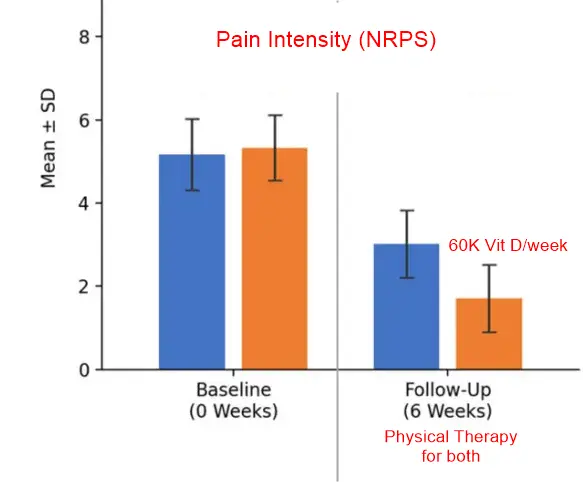
The IL-6 result is the interesting one. Physiotherapy relieved pain without changing the inflammatory marker at all, which fits the idea that the two arms were working through different mechanisms. The paper notes that "hypovitaminosis D and CLBP may be mediated through the IL-6 pathway."
What this does not show / limitations. No placebo capsule and no blinding of patients or therapists — for self-reported pain and disability, expectation effects cannot be ruled out. There was no vitamin D-only arm, so the supplement's independent effect can't be separated. Importantly, while both groups improved by clinically meaningful amounts, the extra benefit from vitamin D was 1.5 pain points and 4.1 disability points — both below the minimal clinically important difference thresholds the authors themselves cite. No mediation analysis was run, so the IL-6 pathway remains a hypothesis. Six weeks only, single center, 60 people, everyone deficient at the start — this says nothing about supplementing people who already have adequate levels, and earlier meta-analyses in unselected populations found no benefit. Finally, the paper contains several internal numerical inconsistencies (the abstract and discussion report endpoint values as if they were changes, some confidence intervals are impossible, and the between-group statistical tests described in the Methods are never actually reported).