Practical Vitamin D Supplementation Using Machine Learning
J Bone Metab. 2020 May;27(2):111-117. doi: 10.11005/jbm.2020.27.2.111
Tyler Fugere 1, Zhongning Jim Chen 1, Issam Makhoul 1
Women with breast cancer.
Wrongly considered than 20 ng was a high enough level of vitamin D
Need more to get to 30 ng of 40 ng
Need more if overweight or obese
Unclear how long for the vitamin D levels to plateau
There may be a on-line calculator - investigating
*
One pill every two weeks gives you all the vitamin D most adults need
*
Every 2 weeks __Diabetes + Heart Failure + Chronic Pain + Depression + Autism + Breast Cancer + Colon Cancer + Prostate Cancer + Preeclampsia + Premature Birth + Falls + Cognitive Decline + Respiratory Tract Infection + Influenza + Tuberculosis + Chronic Obstructive Pulmonary Disease + Lupus + Inflammatory Bowel Syndrome + Urinary Tract Infection + Poor Sleep + Weight Loss + Growing Pain (22 problems)__
18 additional Health Problems fought when taking 50,000 IU Vitamin D weekly
| ADHD |
Attention-Deficit Hyperactivity Disorder treated by weekly 50,000 IU of vitamin D – RCT Nov 2018 |
| Asthma |
Asthma reduced by weekly 50,000 IU of vitamin D – RCT Aug 2014 |
| Depression |
Depression in adolescent girls reduced somewhat by 50,000 IU weekly for 9 weeks – July 2017 |
| Diabetic Nephropathy |
Diabetic nephropathy (Kidney) treated by 50,000 IU of vitamin D weekly – RCT Jan 2019 |
| Hashimoto's thyroiditis |
Hashimoto's thyroiditis helped by weekly 50,000 IU of vitamin D – RCT May 2019 |
| Hay Fever |
Hay Fever treated by Vitamin D (50,000 IU weekly) – RCT July 2019 |
| Hives |
Hives treatment augmented by 60,000 IU Vitamin D weekly – RCT June 2015 |
| Hypertension – pulmonary |
Pulmonary hypertension reduced in some people with weekly 50,000 IU vitamin D for 3 months – 2016 |
| Kidney Disease |
Hemodialysis patients (CKD) helped by weekly 50,000 IU of vitamin D – Jan 2017 |
| Migraine |
Migraine headaches reduced with 50,000 IU vitamin D weekly – RCT July 2015 |
| Multiple Sclerosis relapse |
No multiple sclerosis relapses during pregnancy if 50,000 IU of Vitamin D weekly – RCT April 2015 |
| Osteoarthritis – knee |
Knee osteoarthritis treated with vitamin D, weekly 50,000 IU – May 2015 |
| Pain - Back |
Chronic Back Pain relieved by weekly 60,000 IU of vitamin D – Jan 2017 |
| Pain – Chronic |
7 improvements in lives of veterans with chronic pain with 50,000 IU vitamin D weekly – June 2012 |
| Pain – Fibromyalgia |
Fibromyalgia treated with Vitamin D (50,000 IU weekly for 3 months) – 2016, 2017, 2018, 2019 |
| PMS |
PMS in teens reduced 3X by 50,000 IU vitamin D weekly – Jan 2018 |
| Sports Performance |
Athletes helped by weekly 50,000 IU Vitamin D – RCT Aug 2019 |
| Ulcers – Venous |
Venous ulcers healed 4X faster with weekly 50,000 IU vitamin D – RCT Oct 2012 |
---
*
50,000 IU Vitamin D weekly provided enough benefit for combat sport athletes – March 2020
*
Vitamin D supplementation guidelines (adults – 50,000 IU per week) – Feb 2017
* Authors: Pawel Pludowski, Michael F. Holick, William B., Grant, .... Sunil J. Wimalawansa
*
AI: Exciting opportunity for Vitamin D Researchers
* *
Intervention - non daily category listing has
items along with related searches
* Better than Daily category listing has
items along with related searches**
*
IBS diarrhea treated by weekly 50,000 IU of Vitamin D – RCT March 2020
*
Optimal vitamin D supplementation strategies (D3 - weekly or monthly) – Feb 2017
*
VitaminDWiki pages containing "50,000" in title 163 as of Dec 2021
📄Download the PDF from VitaminDWiki
Background: Patients with breast cancer are at increased risk of developing osteoporosis. Maintaining normal levels of vitamin D may decrease the risk of osteoporosis, and vitamin D levels must be corrected in patients who develop osteoporosis before beginning bone modifying agents. Therefore, it is important to correct insufficient vitamin D levels in a timely manner. In clinical practice, current guidelines for replacement regimens often fail to rapidly correct vitamin D levels. The goal of this study was to review data in order to predict what replacement regimen(s) were most effective at repleting vitamin D levels.
Methods: For this retrospective cohort study, data was collected from medical records of 2,164 female patients with breast cancer with Institutional Review Board approval. Total level change per week was the primary outcome and was compared for the most commonly used vitamin D replacement regimens adjusted for age, race, body mass index, creatinine clearance, endocrine therapy, and initial level.
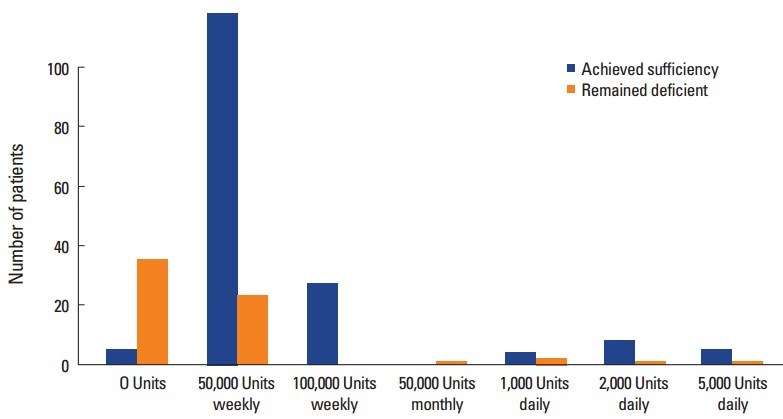
Results: Higher weekly doses of vitamin D supplementation had a more significant impact on the rate of correction compared to lower daily doses. Generalized linear model was used to develop an online calculator that predicts time to vitamin D level correction adjusted for significant patient characteristics for 5 common replacement regimens as well as no intervention.
Conclusions: When choosing a vitamin D replacement regimen for patients with vitamin D deficiency, we recommend clinicians use the online calculator to ensure that the chosen regimen will enable the patient to reach vitamin D sufficiency in a timely manner.