
1 minute of vigorous activity matched 53 minutes of light (wearables, 73,000 adults) - cohort
Wearable device-based health equivalence of different physical activity intensities against mortality, cardiometabolic disease, and cancer
Nature Communications, Oct 2025, https://doi.org/10.1038/s41467-025-63475-2
Raaj Kishore Biswas, Matthew N. Ahmadi, Adrian Bauman, Karen Milton, Nicholas A. Koemel, Emmanuel Stamatakis
Summary by Claude - November, 2026
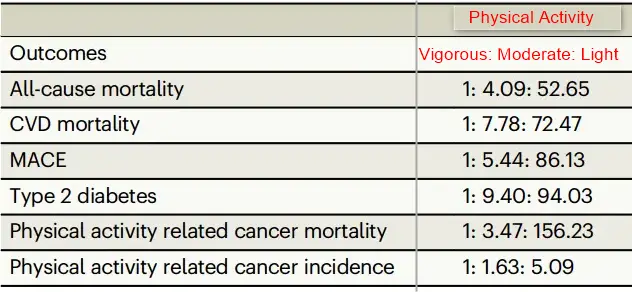
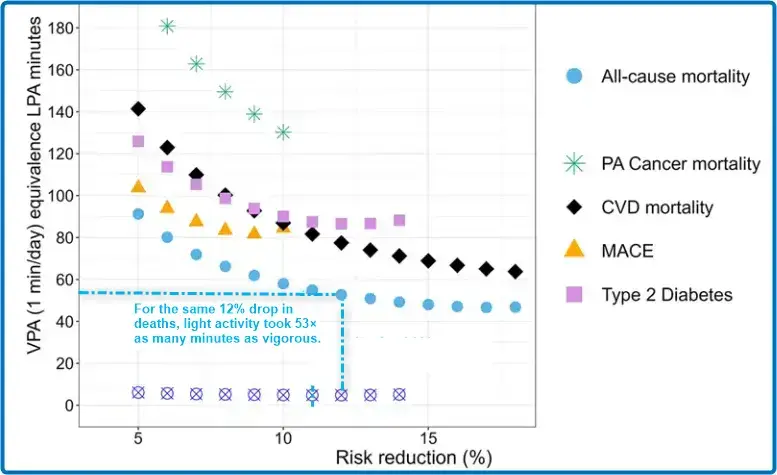
When time is short, intensity matters. In this large wearable study, 1 minute of vigorous activity was associated with the same drop in death risk as about 4 minutes of moderate activity or 53 minutes of light activity. Current guidelines (150–300 min moderate or 75–150 min vigorous per week) assume 1 vigorous minute equals just 2 moderate minutes.
This is a prospective cohort study of 73,485 UK Biobank adults (mean age 62, 56% women). They wore a wrist accelerometer for one week in 2013–15 and were followed for a mean of 8 years (2,675 deaths). A machine-learning classifier sorted every 10 seconds of movement into light, moderate, or vigorous. For each outcome, the authors found how many minutes of each intensity were associated with the same risk reduction (5% to 35%) and expressed the results as ratios.
Vigorous activity's advantage over moderate ranged from 3.5× (activity-related cancer deaths) to 9.4× (type 2 diabetes) — about 2 to 4 times the value guidelines assume. Light activity lagged far behind: its association with lower death risk leveled off below 20%, while moderate and vigorous activity reached 35%. The authors conclude that "not even the largest amounts of daily LPA can elicit the beneficial effects" of moderate or vigorous activity.
| Outcome | 1 min vigorous = moderate min | 1 min vigorous = light min | 1 min moderate = light min | Light activity linked to lower risk? |
|---|---|---|---|---|
| All-cause mortality | 4.1 | 53 | 12.9 | Yes, weakly |
| CVD mortality | 7.8 | 72 | 9.3 | No (not significant) |
| Major heart events (MACE) | 5.4 | 86 | 15.8 | No (not significant) |
| Type 2 diabetes | 9.4 | 94 | 10.0 | Yes, weakly |
| Activity-related cancer deaths | 3.5 | 156 | 45.0 | No (not significant) |
| Activity-related cancer incidence | 1.6 | 5.1 | 3.1 | No (not significant) |
What this does not show / limitations
- Cause and effect: people able to do vigorous activity are probably fitter and healthier to begin with. Only events in the first year were excluded, so slowly developing illness could still inflate the ratios.
- Lasting habits: activity was measured for one week and assumed to hold for 8 years.
- Precision: the ratios are modeled from dose-response curves. Their very narrow confidence intervals come from bootstrapping the model's own predictions and, as the authors state, are not tests of statistical significance.
- Light activity's links with cardiovascular death, heart events, and cancer were not significant, so the light-activity ratios for those outcomes are unreliable.
- "Vigorous" meant absolute intensity on a wrist sensor, not effort relative to a person's fitness. Participants were 40–79 and healthier than average (5.5% response rate).
- The core models did not adjust for BMI or vitamin D, although UK Biobank measured 25(OH)D at enrollment. Vigorous outdoor activity also raises vitamin D, so vitamin D could be a hidden contributor — untested here.
- The senior author is a paid consultant with equity in a physical-activity company.
See also web (same research group)
- About 4 minutes a day of vigorous bursts in daily life associated with 26–30% lower mortality - Nature Medicine, Dec 2022
- 1 minute of vigorous incidental activity matched 2.8–3.4 min moderate or 35–48 min light for heart events - Circulation, April 2025
Sources:
- Biswas et al., Nature Communications 2025
- UK Biobank listing (publish date)
- Stamatakis et al., VILPA, Nature Medicine 2022
- Ahmadi et al., Eur Heart J 2022 abstract
- Stamatakis et al., Circulation 2025
44 studies cited this study just 13 months after publication
- Wearables for Physical Activity Guideline Development and Health Surveillance: Converging Research and Practice Agendas - Oct 2026 PDF
- Intensity-specifc physical activity and mortality in 147,414 adults: a pooled accelerometer analysis. Sept 2026 0 Similar results in Germany. https://doi.org/10.1186/s12966-026-01980-3
Related in VitaminDwiki
- Just 3 minutes a day of vigorous activity is associated with 4 percent less cancer - cohort
- 8 Huge health benefits if 4% of exercise is intense
- Intense exercise increases vitamin D receptor activation
- Exercise, exerkines, and Vitamin D
- Exercise times vs Vitamin D from the sun
- Off Topic – Light exercise extends life by 4.5 years – perhaps more than vitamin D
- High intensity exercise increases Vitamin D Receptor activation for a few hours - Dec 2025
- The Longevity and Brain Benefits of Vigorous Exercise - Patrick video
- 2 Vitamin D pills per month may be as good as 10 hours of exercise
- Off Topic – Light exercise extend life by 4.5 years – perhaps more than vitamin D
- Vitamin D raised after intense exercise if initially low and can burn fat
- Exercise and Vitamin D are synergistic - many studies
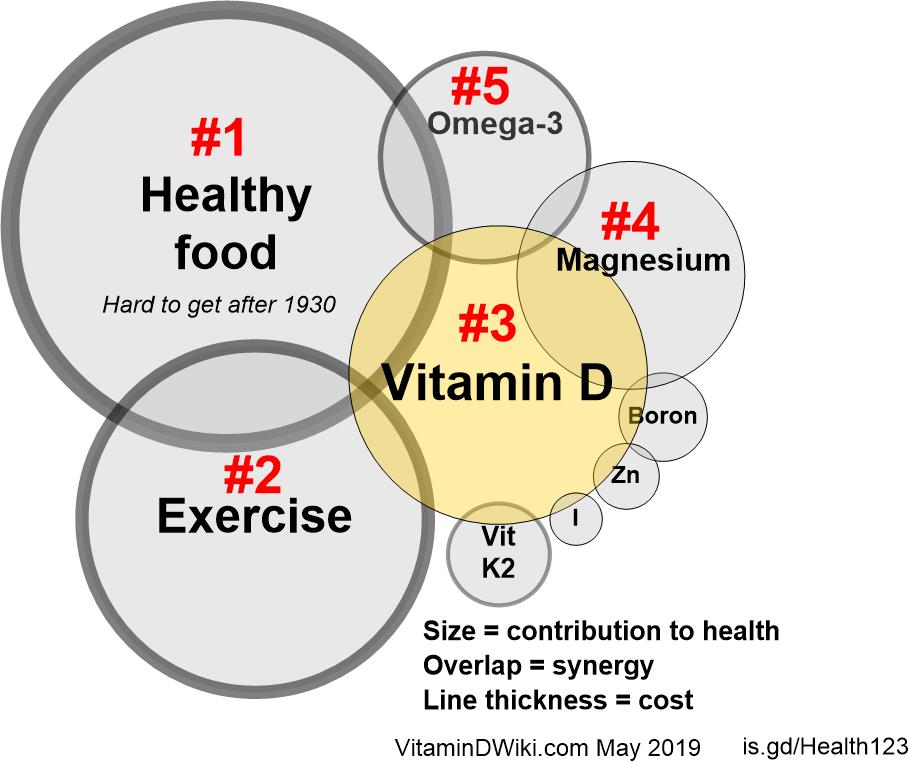
At age 80, the founder of VitaminDWiki averages 3 minutes of intense exercise daily
- Protein, muscles, bones and Vitamin D - many studies
he has also been taking Vitamin D, Protein, magnesium, and Creatine