
Vitamin K2 substantially reduces risk of T2 Diabetes (7 percent for every 10 ug) – review
Effect of Vitamin K2 on Type 2 Diabetes Mellitus: A Review
Diabetes Research and Clinical Practice, DOI: http://dx.doi.org/10.1016/j.diabres.2017.11.020
Yan Li Yan Li, Jie peng Chen, Jie peng Chen, Lili Duan, Shuzhuang Li, Shuzhuang L, Shuzhuang Li

📄 Download the Accepted Manuscript PDF from SciHub via VitaminDWiki
Highlights
• Studies showed vitamin K2 intake reduced 7% T2DM risk with each 10-μg increment.
•Vitamin K2 has a more significant effect than vitamin K1 on T2DM.
•Vitamin K2 increased insulin sensitivity via osteocalcin metabolism.
•Vitamin K2 improved IR via anti-inflammatory property and lipid-lowering effects.
•Vitamin K2 suppresses inflammation via inactivating NF-κB signalling pathway.
•Vitamin K2 supplementation decreases fat accumulation and serum triglycerides.
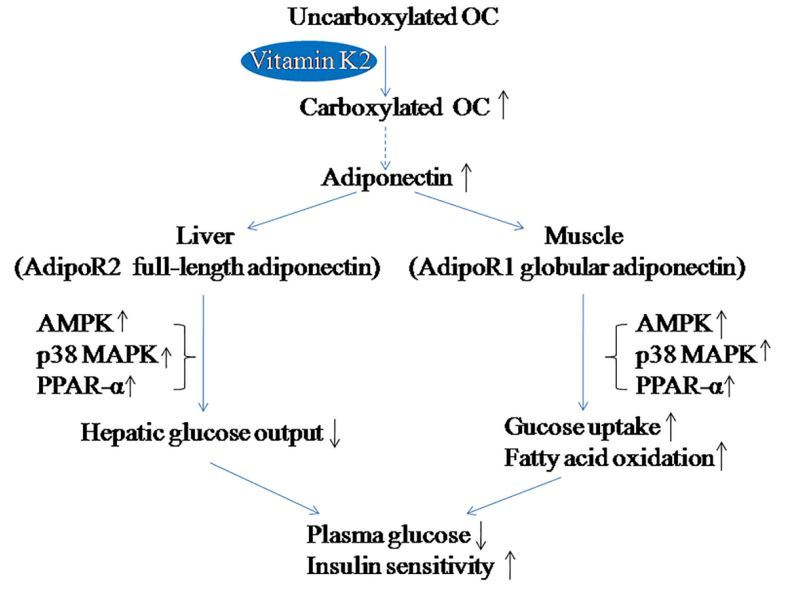
Type 2 diabetes mellitus (T2DM) continue to be a major public health problem around the world that frequently presents with microvascular and macrovascular complications. Individuals with T2DM are not only suffering from significant emotional and physical misery, but also at increased risk of dying from severe complications. In recent years, evidence from prospective observational studies and clinical trials has shown T2DM risk reduction with vitamin K2 supplementation. We thus did an overview of currently available studies to assess the effect of vitamin K2 supplementation on insulin sensitivity, glycaemic control and reviewed the underlying mechanisms. We proposed that vitamin K2 improved insulin sensitivity through involvement of vitamin K-dependent-protein osteocalcin, anti-inflammatory properties, and lipid-lowering effects. Vitamin K2 had a better effect than vitamin K1 on T2DM. The interpretation of this review will increase comprehension of the development of a therapeutic strategy to prevent and treat T2DM.
References
Dam, H. The antihaemorrhagic vitamin of the chick. BIOCHEMICAL JOURNAL. 1935;29:1273–1285.
Rees, K., Guraewal, S., Wong, Y.L., Majanbu, D.L., Mavrodaris, A., Stranges, S. et al, Is vitamin K consumption associated with cardio-metabolic disorders?. A systematic review. Maturitas. 2010;67:121–128.
Widhalm, J.R., Ducluzeau, A.L., Buller, N.E., Elowsky, C.G., Olsen, L.J., Gilles, J.C. Basset1. Phylloquinone (vitamin K1) biosynthesis in plants: two peroxisomal thioesterases of lactobacillales origin hydrolyze 1,4-dihydroxy-2-naphthoyl-coa. Plant Journal. 2012;71:205–215.
Binkley, S.B., MacCorquodale, D.W., Thayer, S.A., Doisy, E.A. THE ISOLATION OF VITAMIN K1. The Journal of Biological Chemistry. 1939;:219–234.
Gundberg, C.M., Markowitz, M.E., Mizruchi, M., Rosen, J.F. Osteocalcin in human serum: a circadian rhythm. The Journal of clinical endocrinology and metabolism. 1985;60:736–739.
Knapen, M.H., Braam, L.A., Drummen, N.E., Bekers, O., Hoeks, A.P., Vermeer, C. Menaquinone-7 supplementation improves arterial stiffness in healthy postmenopausal women. A double-blind randomised clinical trial. Thrombosis and haemostasis. 2015;113:1135–1144.
Yoshida, M., Jacques, P.F., Meigs, J.B. et al, Effect of vitamin K supplementation on insulin resistance in older men and women. Diabetes Care. 2008;31:2092–2096.
Beulens, Joline, W.J., Van Der, A. et al, Dietary Phylloquinone and Menaquinones Intakes and Risk of Type 2 Diabetes . Diabetes Care. 2010;33:1699–1705.
- Note: this is the reference for the 10 micrograms of Vitamin K 📄 Download the PDF from VitaminDWiki
- 90 citations for the study as of Dec 2017
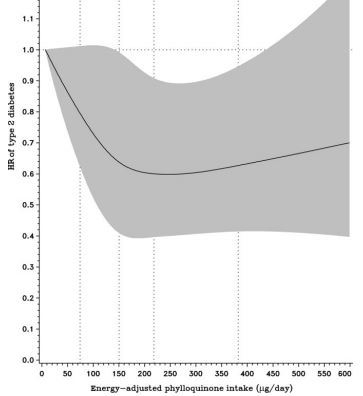
- Risk of Diabetes reduced by 40% if "energy adjusted" Vitamin K2 intake was >150 micrograms/day
Choi, H.J., Yu, J., Choi, H., An, J.H., Kim, S.W., Park, K.S. et al, Vitamin K2 supplementation improves insulin sensitivity via osteocalcin metabolism : a placebo-controlled trial. Diabetes Care. 2011;34:e147.
Asemi, Z., Raygan, F., Bahmani, F., Rezavandi, Z., Talari, H.R., Rafiee, M. et al, The effects of vitamin D, K and calcium co-supplementation on carotid intima-media thickness and metabolic status in overweight type 2 diabetic patients with CHD. British Journal of Nutrition. 2016;116:286–293.
Manna, P., Kalita, J. Beneficial role of vitamin K supplementation on insulin sensitivity, glucose metabolism, and the reduced risk of type 2 diabetes : A review. Nutrition. 2016;32:732–739.
Berkner, K.L. The vitamin k-dependent carboxylase. Annual Review of Nutrition. 2005;25:127–149.
Dowd, T.L., Rosen, J.F., Li, L., Gundberg, C.M. The three-dimensional structure of bovine calcium ion-bound osteocalcin using HNMR spectroscopy. Biochemistry. 2003;42:7769–7779.
Booth, S.L., Centi, A., Smith, S.R., Gundberg, C. The role of osteocalcin in human glucose metabolism: marker or mediator?. Nature reviews Endocrinology. 2013;9:43–55.
Lee, N.K., Sowa, H., Hinoi, E., Ferron, M., Ahn, J.D., Confavreux, C. et al, Endocrine regulation of energy metabolism by the skeleton. Cell. 2007;130:456–469.
Pittas, A.G., Harris, S.S., Eliades, M., Stark, P., Dawson-Hughes, B. Association between serum osteocalcin and markers of metabolic phenotype. The Journal of clinical endocrinology and metabolism. 2009;94:827–832.
Saleem, U., Mosley, T.H. Jr., Kullo, I.J. Serum osteocalcin is associated with measures of insulin resistance, adipokine levels, and the presence of metabolic syndrome. Arteriosclerosis, thrombosis, and vascular biology. 2010;30:1474–1478.
Gravenstein, K.S., Napora, J.K., Short, R.G., Ramachandran, R., Carlson, O.D., Metter, E.J. et al, Cross-sectional evidence of a signaling pathway from bone homeostasis to glucose metabolism. The Journal of clinical endocrinology and metabolism. 2011;96:E884–E890.
Shea, M.K., Gundberg, C.M., Meugs, J.B. et al, Gamma-carboxylation of osteocalcin and insulin resistance in older men and women. The American Journal of Clinical Nutrition. 2009;90:1230–1235.
Hwang, Y., Jeong, I., Ahn, K., Chung, H.Y. The uncarboxylated form of osteocalcin is associated with improved glucose tolerance and enhanced ss-cell function in middle-aged male subjects. Diabetes/Metabolism Research and Reviews. 2009;25:768–772.
Knapen, M.H. Association of vitamin K status with adiponectin and body composition in healthy subjects: uncarboxylated osteocalcin is not associated with fat mass and body weight. British Journal of Nutrition. 2012;:1017–1024.
Pollock, N.K., Bernard, P.J., Gower, B.A. et al, Lower Uncarboxylated Osteocalcin Concentrations in Children with Prediabetes Is Associated with {beta}-Cell Function. Journal of Clinical Endocrinology and Metabolism. 2011;96:E1092–E1099.
Desbois, C., Hogue, D.A., Karsenty, G. The mouse osteocalcin gene cluster contains three genes with two separate spatial and temporal patterns of expression. Journal of Biological Chemistry. 1994;269:1183–1190.
Cousin, W., Courseaux, A., Ladoux, A., Dani, C., Peraldi, P. Cloning of hOST-PTP: the only example of a protein-tyrosine-phosphatase the function of which has been lost between rodent and human. Biochemical and biophysical research communications. 2004;:259–265.
Gundberg, C.M., Nieman, S.D., Abrams, S., Rosen, H. Vitamin K status and bone health: an analysis of methods for determination of undercarboxylated osteocalcin. The Journal of clinical endocrinology and metabolism. 1998;83:3258–3266.
Zhang, Y., Ma, C., Zhao, J., Xu, H., Hou, Q., Zhang, H. Lactobacillus casei Zhang and vitamin K2 prevent intestinal tumorigenesis in mice via adiponectin-elevated different signaling pathways. Oncotarget. 2017;8:24719–24727.
Weyer, C., Funahashi, T., Tanaka, S. et al, Hypoadiponectinemia in obesity and type 2 diabetes: close association with insulin resistance and hyperinsulinemia. Journal of Clinical Endocrinology and Metabolism. 2001;5:1930–1935.
Tschritter, O., Fritsche, A., Thamer, C., Haap, M., Shirkavand, F., Rahe, S. et al, Plasma adiponectin concentrations predict insulin sensitivity of both glucose and lipid metabolism. Diabetes. 2003;:239–243.
Matsubara, M., Katayose, S., Maruoka, S. Decreased plasma adiponectin concentrations in nondiabetic women with elevated homeostasis model assessment ratios. European journal of endocrinology. 2003;148:343–350.
Cnop, M., Havel, P.J., Utzschneider, K.M., Carr, D.B., Sinha, M.K., Boyko, E.J. et al, Relationship of adiponectin to body fat distribution, insulin sensitivity and plasma lipoproteins: evidence for independent roles of age and sex. Diabetologia. 2003;:459–469.
Lihn, A.S., Pedersen, S.B., Richelsen, B. Adiponectin: action, regulation and association to insulin sensitivity. Obesity Reviews. 2005;:13–21.
Yamauchi, T., Kamon, J., Yusuke, I., Atsushi, T., Takehiko, Y., Shunhun, K. et al, Cloning of adiponectin receptors that mediate antidiabetic metabolic effects. Nature. 2003;:762–769.
Feve, B., Bastard, J.P. The role of interleukins in insulin resistance and type 2 diabetes mellitus. Nature Reviews Endocrinology. 2009;5:305–311.
Mofrad, M.D. Potential Role of TNF-alpha in the Pathogenesis of Insulin Resistance and Type 2 Diabetes. trends in endocrinology and metabolism. 2000;:212–217.
Hotamisligil, G.S. Inflammatory pathways and insulin action. International Journal of Obesity and Related Metabolic Disorders. 2003;27:S53–S55.
Rehman K, Akash MSH. Mechanisms of inflammatory responses and development of insulin resistance: how are they interlinked? 2016;23:87..
Kern, P.A., Ranganathan, S., Li, C., Wood, L., Ranganathan, G. Adipose tissue tumor necrosis factor and interleukin-6 expression in human obesity and insulin resistance. American Journal of Physiology: Endocrinology and Metabolism. 2001;:E745.
Emanuelli, B., Peraldi, P., Filloux, C., SawkaVerhelle, D., Hilton, D., Vanobberghen, E. SOCS-3 is an insulin-induced negative regulator of insulin signaling. Journal of Biological Chemistry. 2000;275:15985–15991.
Chen, G., Goeddel, D.V. TNF-R1 signaling: A beautiful pathway. Science. 2002;:1634–1635.
Fasshauer, M., Klein, J., Neumann, S., Eszlinger, M., Paschke, R. Hormonal regulation of adiponectin gene expression in 3T3-L1 adipocytes. Biochemical and biophysical research communications. 2002;:1084–1089.
Maeda, N., Takahashi, M., Funahashi, T. et al, PPARgamma ligands increase expression and plasma concentrations of adiponectin, an adipose-derived protein. Diabetes. 2001;50:2094–2099.
Ohsaki, Y., Shirakawa, H., Miura, A., Giriwono, P.E., Sato, S., Ohashi, A. et al, Vitamin K suppresses the lipopolysaccharide-induced expression of inflammatory cytokines in cultured macrophage-like cells via the inhibition of the activation of nuclear factor κB through the repression of IKKα/β phosphorylation. The Journal of Nutritional Biochemistry. 2010;21:1120–1126.
Reddi, K., Henderson, B., Meghji, S., Wilson, M., Poole, S., Hopper, C. et al, Interleukin 6 production by lipopolysaccharide-stimulated human fibroblasts is potently inhibited by naphthoquinone (vitamin K) compounds. Cytokine. 1995;7:287–290.
Assimacopoulos-Jeannet, F. Fat storage in pancreas and in insulin-sensitive tissues in pathogenesis of type 2 diabetes. International Journal of Obesity and Related Metabolic Disorders. 2004;:S53–S57.
Nagasawa, Y., Fujii, M., Kajimoto, Y., Imai, E., Hori, M. Vitamin K2 and serum cholesterol in patients on continuous ambulatory peritoneal dialysis. Lancet (London, England). 1998;351:724.
Kawashima, H., Nakajima, Y., Matubara, Y., Nakanowatari, J., Fukuta, T., Mizuno, S. et al, Effects of vitamin K2 (menatetrenone) on atherosclerosis and blood coagulation in hypercholesterolemic rabbits. Japanese journal of pharmacology. 1997;75:135–143.
Sogabe, N., Maruyama, R., Baba, O., Hosoi, T., Goseki-Sone, M. Effects of long-term vitamin K(1) (phylloquinone) or vitamin K(2) (menaquinone-4) supplementation on body composition and serum parameters in rats. Bone. 2011;48:1036–1042.
Dam, V., Dalmeijer, G.W., Vermeer, C., Drummen, N.E., Knapen, M.H., van der Schouw, Y.T. et al, Association Between Vitamin K and the Metabolic Syndrome: A 10-Year Follow-Up Study in Adults. The Journal of clinical endocrinology and metabolism. 2015;100:2472–2479.
Iki, M., Tamaki, J., Fujita, Y., Kouda, K., Yura, A., Kadowaki, E. et al, Serum undercarboxylated osteocalcin levels are inversely associated with glycemic status and insulin resistance in an elderly Japanese male population: Fujiwara-kyo Osteoporosis Risk in Men (FORMEN) Study. Osteoporosis International. 2012;:761–770.
Trumbo, P., Yates, A.A., Schlicker, S., Poos, M. Dietary Reference Intakes: Vitamin A, Vitamin K, Arsenic, Boron, Chromium, Copper, Iodine, Iron, Manganese, Molybdenum, Nickel, Silicon, Vanadium, and Zinc. Journal of the Academy of Nutrition and Dietetics. 2001;101:294–301.
European Food Safety Authority. Vitamin K2 added for nutritional purposes in foods for particular nutritional uses, food supplements and foods intended for the general population and Vitamin K2 as a source of vitamin K added for nutritional purposes to foodstuffs, in the context of Regulation (EC) N° 258/97 - Scientific Opinion of the Panel on Dietetic Products. Nutrition and Allergies. EFSA Journal. 2008;6.
Ferron, M., Hinoi, E., Karsenty, G., Ducy, P. Osteocalcin differentially regulates beta cell and adipocyte gene expression and affects the development of metabolic diseases in wild-type mice. Proc Natl Acad Sci U S A. 2008;105:5266–5270.