
Window daylight (about 5X brighter than office lamps) increased time in normal glucose range in type 2 diabetes - RCT
Natural daylight during office hours improves glucose control and whole-body substrate metabolism
Cell Metabolism, January 6, 2026 (online December 18, 2025), https://doi.org/10.1016/j.cmet.2025.11.006
Jan-Frieder Harmsen, Ivo Habets, Andrew D. Biancolin, … Patrick Schrauwen, Charna Dibner, Joris Hoeks
Summary by Claude Opus 5.5 - November 2026
Takeaway: People with type 2 diabetes who worked beside a large window spent more time in the normal glucose range than when they worked under ordinary office lamps. But the window light was also about 5 times brighter, so this trial cannot tell whether "natural" light or simply more light made the difference.
Study: Randomized crossover trial of 13 adults with well-controlled type 2 diabetes (average age 70, 8 women) in Maastricht, the Netherlands, April–October 2022. Each person lived in the research facility for 4.5 days under each light condition (08:00–17:00), at least 4 weeks apart, with identical meals, sleep times and activity. No vitamin D was given and 25(OH)D was not measured. Window glass blocks the UVB that makes vitamin D, and the authors state "participants were not exposed to UVB."
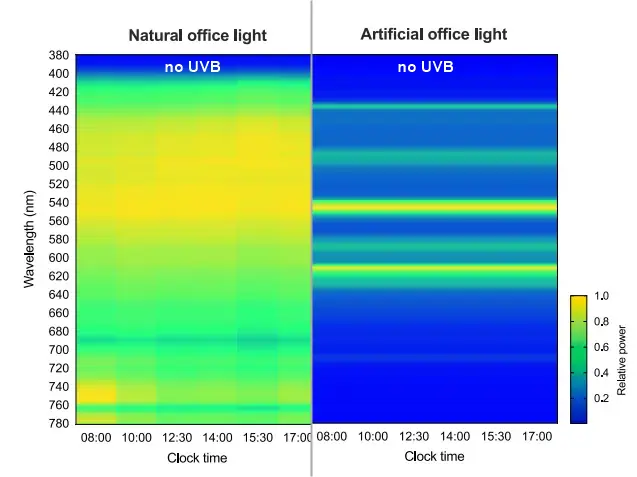
Light at eye level (read from the paper's Figure 1D)
| Time | Window daylight | Office lamps |
|---|---|---|
| 08:00 | ≈530 lux | 300 lux |
| 10:00 | ≈1,760 lux | 300 lux |
| 12:30 | ≈2,230 lux | 300 lux |
| 14:00 | ≈1,880 lux | 300 lux |
| 15:30 | ≈1,420 lux | 300 lux |
| 17:00 | ≈1,000 lux | 300 lux |
| Day average | ≈1,600 lux (≈5X) | 300 lux |
| Body-clock (melanopic) average | ≈1,500 lux (≈7X) | ≈200 lux |
Even the brightest window reading is far below outdoor daylight, which is often 10,000 lux or more.
Results, daylight vs lamps
- Average glucose (the primary outcome): 7.4 vs 7.8 mmol/L (133 vs 141 mg/dL), not significant
- Time in 4.4–7.2 mmol/L (80–130 mg/dL): 50.9% vs 43.3% (p = 0.036, 10 people with complete data)
- Time in the standard 3.9–10 mmol/L (70–180 mg/dL) range: 83.0% vs 78.6%, not significant
- More fat and less carbohydrate burned during the day; higher melatonin 21:00–23:00
- Muscle body-clock genes shifted; no blood metabolite, lipid or gene differences survived correction for multiple testing
What this does NOT show / limitations
- The main outcome (average glucose) did not improve; the positive result is a secondary measure in 10 people
- Brightness, color spectrum and change across the day all differed at once. No brightness-matched lamp group was tested, so the benefit cannot be credited to daylight itself
- Only 4.5 days, summer only, older participants; no HbA1c or long-term outcomes
- Not a vitamin D effect
- Funded partly by VELUX Stiftung, a foundation started by the inventor of the VELUX window; the authors declare no competing interests
Huge difference in light spectra
Related in VitaminDWiki
- Photoproducts are made in the skin from UVA, UVB, visible, and IR light
- Nitric oxide (from Sun, UVA, Vitamin D) reduces cardiovascular problems
- Many wavelengths of light provide health benefits, not just UV
- The risks and benefits of sun exposure – Holick
- Ways to block UVA but not the UVB which makes vitamin D