
Why Vitamin D trials in athletes disagree: any benefit may hide in the stressed subgroup - review
Vitamin D Insufficiency as a Nutritional Stress Amplifier: An Evidence-Weighted Framework for Adaptive Reserve under Exercise and Energy-Deficit Stress
The Journal of Nutritional Biochemistry (Elsevier), Journal Pre-proof, accepted Oct 30, 2026, https://doi.org/10.1016/j.jnutbio.2026.110533
Roberto Coccurello
Summary by Claude Opus 5.5 - November 2026
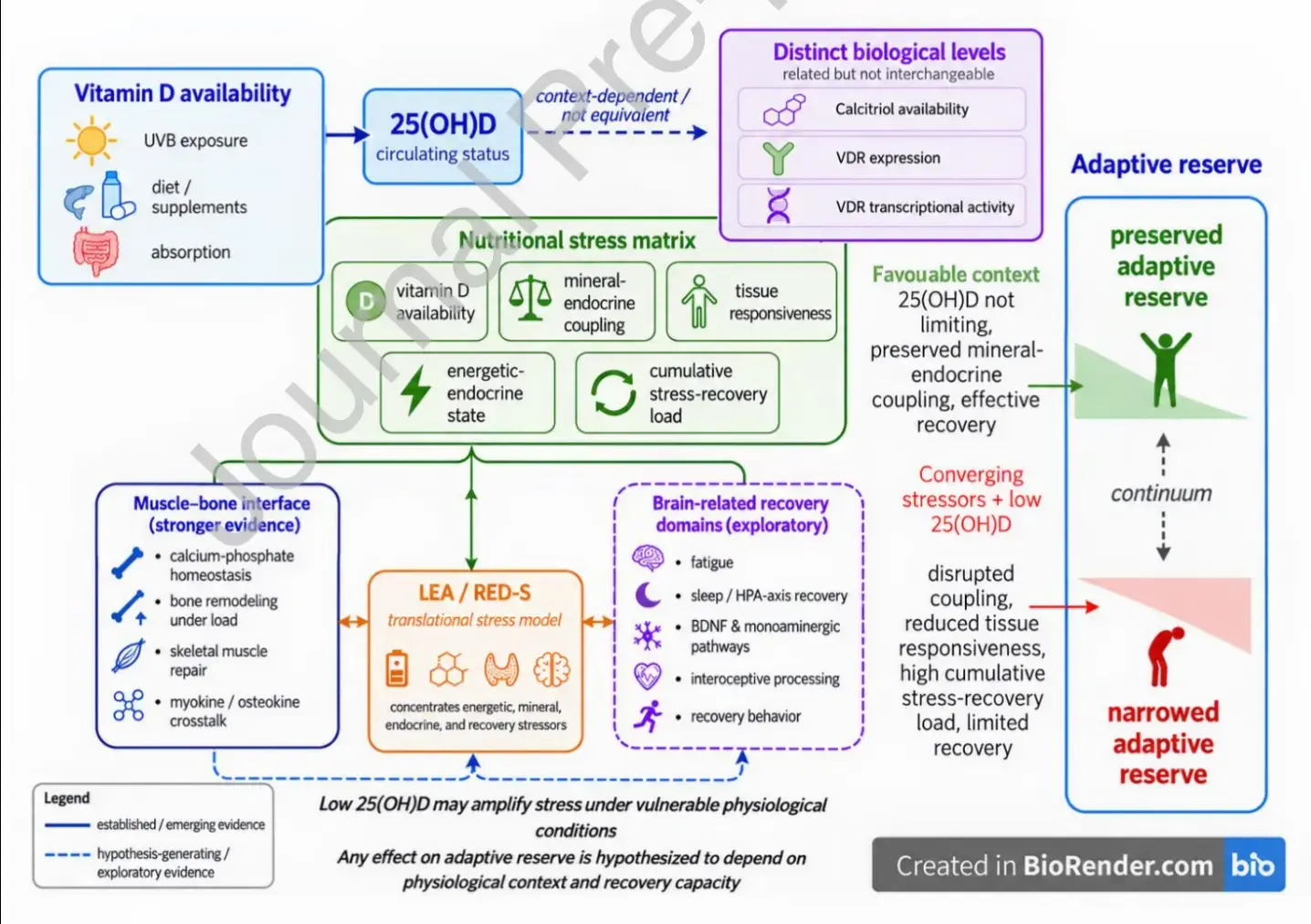
Takeaway: Low vitamin D probably does little harm to a well-fed, well-rested athlete, but it may deepen the damage when other stresses pile up: too few calories, too little calcium, disrupted hormones, heavy bone loading, poor sleep, or incomplete recovery. The author calls this a "nutritional stress amplifier."
This is a single-author narrative review that proposes a hypothesis. It draws on 119 sources chosen by the author, with no systematic search, pooled analysis, or risk-of-bias rating, and it contains no new data.
The author grades the evidence:
- Established: vitamin D's control of calcium, phosphate, PTH, and FGF23, and of bone remodeling under load. Low vitamin D has been linked to stress fractures in athletes and military recruits, and calcium plus vitamin D reduced stress fractures in female Navy recruits.
- Emerging: muscle repair (muscle VDR, myostatin, irisin), and low energy availability / RED-S as the setting where vitamin D should matter most.
- Preclinical or hypothesis only: fatigue, sleep, stress hormones, BDNF, dopamine, serotonin, mood.
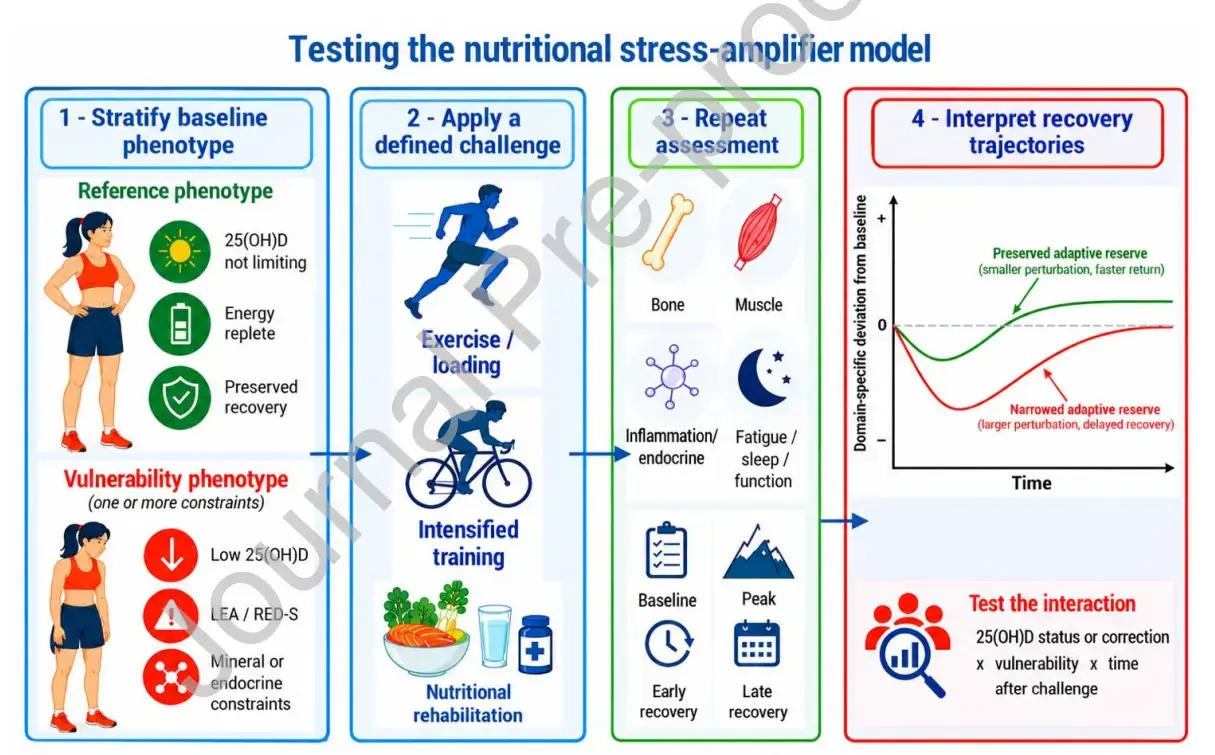
Mixed results from athlete trials may partly reflect pooling: a small benefit in vulnerable athletes "can easily disappear when deficient, insufficient, and sufficient athletes are pooled." Form and baseline also matter. Vitamin D in endurance runners was followed by lower muscle-damage and inflammation markers after eccentric exercise Zebrowska 2020, while vitamin D2 in NASCAR pit crew athletes lowered their D3 levels and was associated with more muscle damage Nieman 2013.
The proposed test is to track recovery curves (bone turnover, muscle damage, inflammation, fatigue, sleep) after a standardized challenge, rather than rely on a single resting blood test. The model predicts the largest vitamin D effects at the lowest starting levels and in athletes already short of energy or calcium.
What this does NOT show
- No new data: the "stress amplifier" is an untested hypothesis, as the author repeatedly says.
- It does not show that vitamin D alone improves performance, speeds recovery, or prevents stress fractures. RED-S is caused by under-fueling, and vitamin D cannot replace restoring energy intake.
- The brain, sleep, and mood links are explicitly labeled exploratory.
- No dose, loading dose, or target level is recommended. The review treats 20 ng/mL as the bone-health adequacy cutoff and 30 ng/mL only as an older, study-defined boundary.
- In explaining mixed trial results, it weighs baseline level, dose, form, and season, but not whether trials ran long enough, or used a loading dose, for vitamin D to act before outcomes were measured.
- One author chose the studies without formal screening, so the evidence may tilt toward studies that fit the framework.
Vitamin D Insufficiency as a Nutritional Stress Amplifier.pdf
Related in VitaminDWiki
- Overview Sports and vitamin D
- Muscles and Vitamin D - many studies
- Less muscle inflammation after exercise if high level of Vitamin D (50 ng)
- Typical stress fracture during US Navy training cost 14,953 dollars, most had less than 40 ng Vitamin D
- Military and Vitamin D - many studies
- Child soccer players who were deficient were helped by a single 200,000 IU vitamin D dose - RCT
- 20+ chronic stressors result in poor health (most are fought by Vitamin D)
- Mental stress, physical stress associations with low vitamin D - many studies