
Vitamin D Cyp gene: VitaminDWiki summary
Chat GPT Summary - Oct 2026
VitaminDWiki: Summary of the CYP gene collection
Source: VitaminDWiki — Pages tagged “Cyp”
The collection contains 91 pages covering cytochrome P450 (CYP) genes, vitamin D metabolism, genetic differences in vitamin D response, and associations with a wide range of health conditions. The central theme is that vitamin D status depends on more than how much vitamin D a person consumes: it also depends on how the body processes, activates, uses, and breaks down vitamin D.
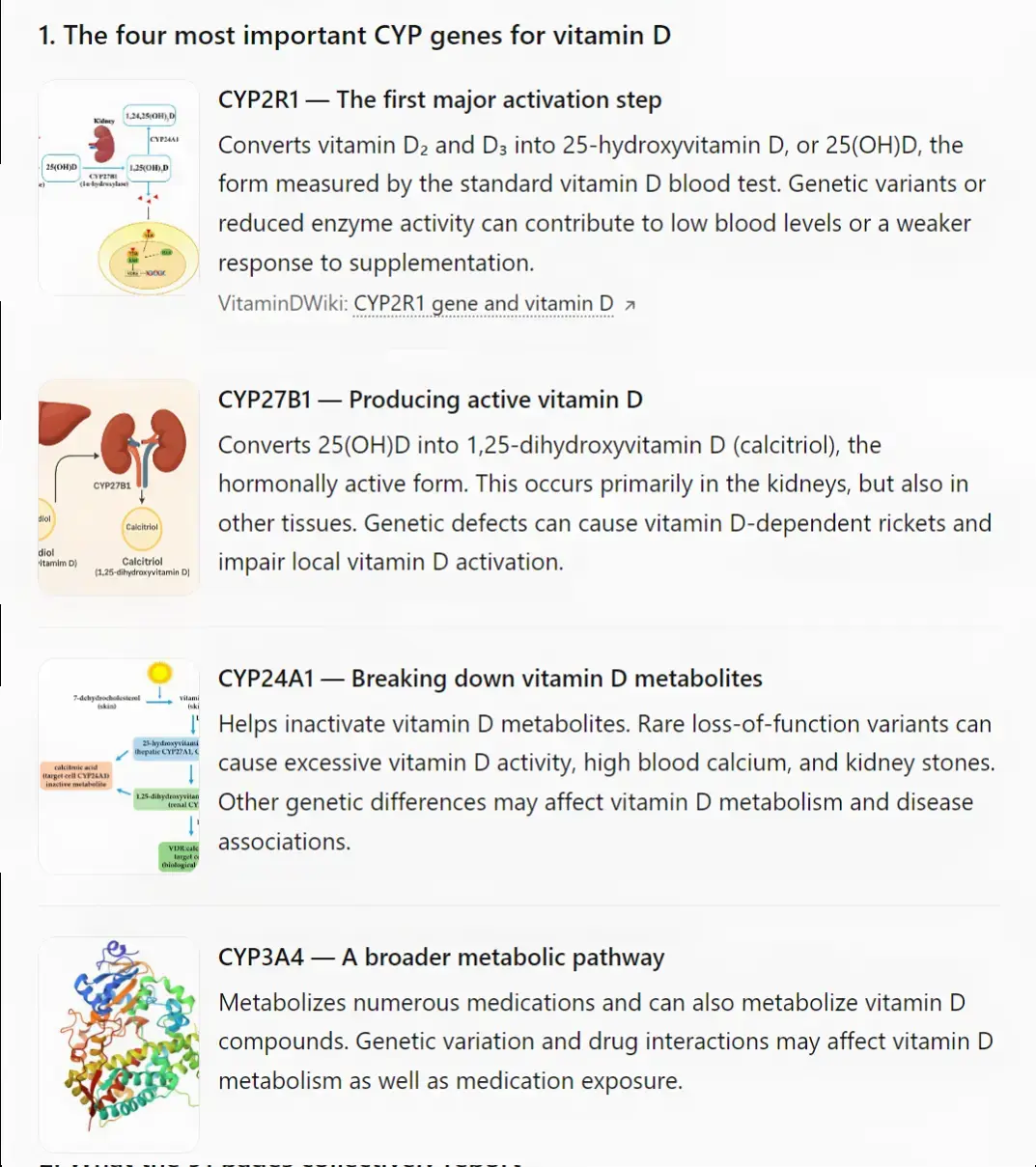
1. The four most important CYP genes for vitamin D
2. What the 91 pages collectively report
A. Genetic differences in vitamin D response
Some people show smaller increases in blood 25(OH)D after supplementation. The collection discusses CYP2R1, CYP24A1, and other genes as possible contributors. One study examined how DNA methylation of CYP2R1 and CYP24A1 relates to differences in vitamin D response.
B. Disease associations
The pages discuss genetic associations involving cancer, multiple sclerosis, diabetes, autoimmune conditions, neurological diseases, cardiovascular conditions, and respiratory infections. These findings vary in strength and frequently represent associations rather than proof that a gene variant causes a disease.
Browse the complete CYP collection
C. Medication interactions
CYP3A4 is particularly relevant because it processes many medications. Drugs that alter CYP3A4 activity can change the metabolism of vitamin D compounds, while vitamin D metabolism itself may differ among individuals. The clinical effect depends on the particular drug and pathway.
D. Environmental and metabolic influences
Some pages investigate whether obesity, diabetes, fasting, and other metabolic conditions alter CYP expression. For example, a rodent study reported reduced liver CYP2R1 expression during fasting and diabetes. This provides a possible mechanism, but does not establish the size or clinical importance of the same effect in humans.
Read the fasting and diabetes study
3. Particularly important findings
These are useful starting points from the collection, selected for their relevance to vitamin D metabolism.
| VitaminDWiki page | Why it matters |
|---|---|
| CYP24A1 gene and vitamin D — many studies | Explores vitamin D breakdown, genetic variants, calcium regulation, and disease associations. |
| CYP2R1 gene reduces response to vitamin D — many studies | Focuses on variation in the conversion of vitamin D into 25(OH)D. |
| CYP2R1 gene probably responsible for low vitamin D response — RCT | Highlights research into genetic influences on supplementation response. |
| CYP2R1 mutations also cause vitamin D-deficient rickets | Illustrates the direct clinical consequences of severe defects in vitamin D processing. |
| Rare CYP24A1 mutations and vitamin D accumulation | Important for understanding why certain people develop hypercalcemia or kidney stones related to vitamin D metabolism. |
The links in this table lead to the tag collection, where you can select the individual articles by title.
4. What this means for vitamin D testing and supplementation
The collection suggests several useful distinctions:
- Blood level versus activation: A 25(OH)D blood test measures the circulating storage/status metabolite. It does not directly measure how much active calcitriol is produced in every tissue.
- Low response versus resistance: A small rise in 25(OH)D after supplementation may reflect differences in absorption, metabolism, body composition, adherence, or other factors. It does not by itself prove a genetic problem.
- Activation versus breakdown: CYP27B1 and CYP24A1 affect different sides of the active-vitamin-D pathway. Treating them as interchangeable would be misleading.
- Genetic associations versus clinical proof: An association between a CYP variant and a disease does not establish that changing vitamin D intake will prevent or treat that disease.
- Safety matters: Rare CYP24A1 defects can cause vitamin D-related hypercalcemia and kidney stones. People with unexplained high calcium or recurrent kidney stones should receive medical assessment before increasing vitamin D substantially.
5. My overall assessment
The most useful contribution of this VitaminDWiki collection is its systems-level view of vitamin D metabolism. It draws attention to the fact that vitamin D status depends on a network of enzymes, transport proteins, receptors, and regulatory processes—not simply the amount taken as a supplement.
For further research, I would prioritize three questions:
- Who responds poorly to vitamin D supplementation? Examine CYP2R1 variants alongside measured baseline and follow-up 25(OH)D levels.
- Who may accumulate too much vitamin D activity? Examine CYP24A1 defects, calcium levels, kidney function, and kidney-stone history.
- How much do these genetic differences change clinical outcomes? Give greatest weight to well-designed human studies and randomized trials, rather than extrapolating from animal studies or disease associations.
The important qualification is that the 91 pages are a curated collection of material, not 91 independent demonstrations of clinical benefit. The strength of evidence differs considerably among the articles.
For VitaminDWiki readers, the central takeaway is that individual differences in vitamin D metabolism are biologically real, but genetic explanations for a particular person's vitamin D response need to be demonstrated rather than assumed.
Claude Summary Oct 2026
The "Cyp" tag page lists 91 VitaminDWiki pages about the cytochrome P450 genes that make, activate and break down vitamin D. They are sorted overviews first, then meta-analyses, then RCTs, then newest. The common thread is that a person's CYP gene variants, or anything that changes how much of these enzymes is made, can change how much vitamin D reaches the cells, sometimes regardless of the blood 25(OH)D level. [Cyp tag page]
By gene
- CYP24A1 (breakdown/deactivation) is the largest group. It covers cancer risk (breast, pancreatic, oral, colon, bladder, prostate), MS onset age, male suicide attempts, hypertension, lupus, hepatitis C, and weight gain. It also covers the opposite problem: rare loss-of-function mutations (about 1 in 300 people) that let vitamin D accumulate, causing calcium problems, kidney stones and infant toxicity. Other pages show cancer cells raising CYP24A1 to protect themselves, and suppressing it improving breast-cancer chemotherapy. [[CYP24A1 overview](https://vitamindwiki.com/pages/cyp24a1-gene-and-vitamin-d-many-studies/)] [Restored by curcumin, resveratrol etc.]
- CYP2R1 (liver 25-hydroxylation) is mainly about poor response to supplementation. Examples include an RCT, a 12 ng/mL spread due to variants, and 3.7× higher insufficiency risk. Other pages cover rickets, MS (1.4×), COVID severity (5×), NSCLC lethality, and suppression of CYP2R1 by obesity, a high-fat diet, fasting and diabetes. [[CYP2R1 overview](https://vitamindwiki.com/pages/cyp2r1-gene-reduces-response-to-vitamin-d-many-studies/)] [RCT]
- CYP27B1 (1α-hydroxylation to active vitamin D) pages cover activation failures that a blood test misses. These include ALS, every Parkinson's brain examined, MS, lupus, type 2 diabetes (2×), recurrent miscarriage, cystic fibrosis lungs, COVID deaths, and a rickets cluster (1 in 30) in a region of Quebec. Another page shows UVB raising skin CYP27B1 even with poor kidneys. [[CYP27B1](https://vitamindwiki.com/pages/cyp27b1/)] [Many health problems]
Others:
- CYP3A4 links vitamin D to drug interactions (ivermectin, anti-epileptics) and colon cancer.
- CYP27A1 appears in obese children, neurodegeneration and psoriasis/NB-UVB.
- CYP11A1 covers the alternative pathway, with a Dec 2025 circadian-rhythm hypothesis and a COVID cytokine-storm page.
- CYP21A2 has one page.
[[CYP3A4](https://vitamindwiki.com/pages/changes-in-cyp3a4-gene-affects-vitamin-d-health-reactions-to-some-drugs-etc/)] [[CYP11A1](https://vitamindwiki.com/pages/vitamin-d-gene-cyp11a1/)] [Poor CYP genes overview]
Cross-cutting themes
- Non-responders. Several pages combine CYP variants with GC/VDBP, LIPC and PDE3B. One reports 7× more non-response with poor CYP24A1 or VDBP, and another finds that methylation of CYP2R1/CYP24A1 predicts dose response.
- Modifiers of CYP activity. These include Roundup, phosphorus intake (pigs), scalp acupuncture (rats), and curcumin, resveratrol and glutathione.
Title fixes
A few page titles have typos:
- "CP27B1" should be CYP27B1 (breast cancer and receptors page)
- "CYP2RI" should be CYP2R1 (DBP page)
- "CYP27B" should be CYP27B1 (cystic fibrosis page)
- "CYP24a" should be CYP24A1 (acupuncture page)
- "CYP2R" should be CYP2R1 (COVID hospitalization page)
- "NSLC" should be NSCLC (lung cancer page)
- "half of much" should be "half as much" (mice page)
Also, the tag's "cyp-2" URL suggests a second "Cyp" tag may exist, which could be splitting these pages.
Sources: