
Visceral fat can be determined for free in just a few minutes
Simple At-Home Test to Measure Your Visceral Fat (Zero Cost!) - 6 minute video
Transcript
(00:00) So, we released a video last week with diet tips to lose visceral fat. And you guys asked a great question. Well, how do I measure my visceral fat? How do I know if I have visceral fat in the first place? Great question. So, everybody has some visceral fat, that's normal, but the question is how much, right? And so, the gold standard are imaging tests like an MRI or a CT scan.
(00:24) Those tests can be expensive and in some cases they involve radiation, so it's kind of a drag. There's another test called a DXA scan which can also give you a measure of your visceral fat, but it's also pretty expensive. Not everybody has access to that. So, there's actually a simpler way, simple test you can do at home.
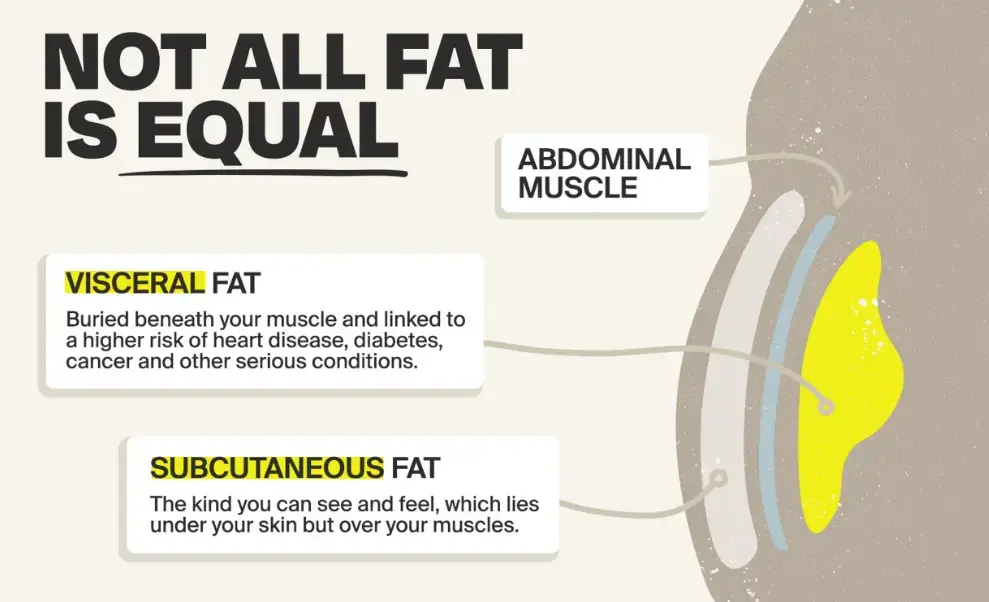
(00:51) You don't need anything special, no equipment and it's completely free of as an estimation of your visceral fat, and it's pretty good. The problem is your waist circumference can't distinguish between visceral fat, the fat that's inside the organs or right outside the organs, and the fat that's under the skin, what we call the subcutaneous fat. The waist circumference is going to have both of those mixed in.
(01:15) And for the purposes of metabolism and health, it's the visceral fat that we're mainly concerned with and that we're trying to reduce. Even though for aesthetic purposes, we always want to get rid of our subcutaneous fat, that fat right under the skin. If we're trying to get a raging six-pack or something like that, that's the fat you're targeting.
(01:36) But for general health and for long-term health outcomes, it's the visceral fat that's the most damaging. So scientists came up with a pretty smart idea. If the waist circumference mixes the visceral fat with this subcutaneous fat, we want to know the visceral fat, but there's no way to know that directly just by looking at someone cuz it's internal, right? By definition, it's inside the body.
*(01:57) So, what if we can figure out the subcutaneous fat component and remove that from the waist circumference and then we'll be left with the visceral fat. So, that's exactly what they did. They looked for a metric that was also simple and free that reflected the subcutaneous fat and they looked at a number of measurements in the body and they landed on thigh circumference.
(02:21) So the diameter of your thigh, they figured out that that reflects your subcutaneous fat but doesn't reflect the visceral fat. They came up with a simple formula that subtracts the thigh circumference from the waist circumference. It gives you an estimate of your visceral fat. And this formula was significantly better than just the waist circumference alone. In one study, they even show that the DXA scan couldn't beat this formula.
Note: DXA also scans for Bone Mineral Density
(02:41) The formula was at least as good, at least as accurate at estimating visceral fat than a DXA scan, which is can be pretty costly. So, that's pretty impressive. And even more interesting, just with this formula, just by knowing waist circumference and thigh circumference, _they could predict someone's odds of having diabetes or metabolic syndrome or even their odds of dying of heart disease. _
(02:59) That's pretty cool for a simple method you can measure at home and doesn't cost anything. So, we're going to go through how to do this step by step. The key thing is to measure the waist circumference and the thigh circumference properly. So, all you're going to need is a measuring tape, just regular measuring tape, and a bathroom scale. And that's it.
*(03:18) That's all you need. So, for the waist circumference, you're going to stand up straight. Then, you're going to locate the top of your hipbone. It's going to be on your side. And you also want to locate the bottom of your ribs. So, your lowest rib, you're going to want to place the measuring tape midway between those two points.
(03:37) That's going to be roughly at the level of your belly button, maybe a little bit above. You're going to breathe normally. Exhale normally. Don't force the air out. And at the end of the exhale, you're going to wrap the tape around. You want it to be snug. You don't want it to be loose, but you don't want to dig it into your skin.
(03:52) So, no cheating, no pulling hard to make the waist circumference tighter. We're only cheating ourselves here. And you want the value in centimeters. If your measuring tape only has inches, don't worry. We'll come back to this in a second. Now, we're going to the thigh circumference. And we're actually going to measure what's called the proximal thigh circumference.
(04:11) So, proximal just means closer to the body, closer to the torso. So, it's the thickest point of your thigh. Right under your butt cheek, between the buttocks and the leg, there's a little crease. We call that the gluteal crease or gluteal fold. You're going to want to measure right under that. So that's where the measuring tape is going to go.
*(04:29) And same as the waist, you want it tight, but not digging into your skin. And record that value in centimeters also. Now you have those two values. That's really all you need, assuming you know your height and your weight. We're ready to calculate your visceral fat.
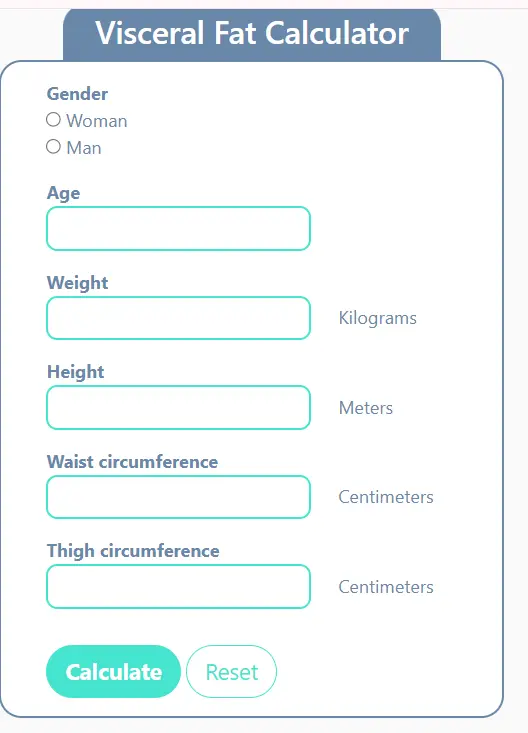
(04:45) All of these values are going to go into a little formula that these scientists figured out. Don't worry, for the math allergic, I found a calculator online that does all of this math for you. https://www.lih.lu/en/visceral-fat-calculator/
(05:01) We're going to go through step by step and we're going to look at the numbers that it spits out. So, first it's going to ask you your gender. That's because males and females have different fat distribution. Then your age, then your weight in kilos. If you have your weight in pounds only, I'll link below a little converter you can quickly convert. Height in meters. Same thing.
(05:19) If you only know your height in feet, I'll add below a little converter that you can use to do this quickly. And it's asking you for your height and your weight because it's going to calculate your BMI and it's going to use that to adjust the value of the visceral fat as well. Okay. Now, here's our waist circumference that we measured and finally our thigh circumference that we measured as well.
(05:38) And then hit calculate and it's going to spit out your result, the estimated amount of visceral fat that you have. Now, they use a cutoff of 130 cm squared. So their definition is over 130 there's significant visceral fat. This is a pretty strict cutoff. So if you're over 130, you don't need to panic. That's pretty common.
(06:03) It means you could be a little leaner and we can work on it. The good news is now you know it and most people have no idea how much visceral fat they have. How do we get rid of it? Well, we covered it in last week's video with some diet tips to reduce visceral fat. And we got a lot more content coming on this topic. So, meet me in there."
Images from the web
https://www.lih.lu/en/visceral-fat-calculator/