
Gut E. coli from depressed patients lowered vitamin D and caused depression-like behavior in mice
Gut microbiota-expressed sulfotransferase sulfonates 25-hydroxyvitamin D3 and promotes depression
Brain, Behavior, and Immunity Oct 2026 10.1016/j.bbi.2026.107043 FULL PDF is behind a paywall
Zijun Li, Junchi Mei, Shaoting Wang, Juan, Siqing Mei, Rui Peng
Highlights
- Escherichia coli from patients with depression could degrade 25[OH]D3.
- Sulfotransferase in Escherichia coli sulfonates 25[OH]D3 into 25[OH]D3-3- sulfate.
- 25[OH]D3 decline and 25[OH]D3-3-sulfate production could induce depressive-like behaviors.
- The prevalence of Escherichia coli and sulfotransferase are higher in depressive patients.
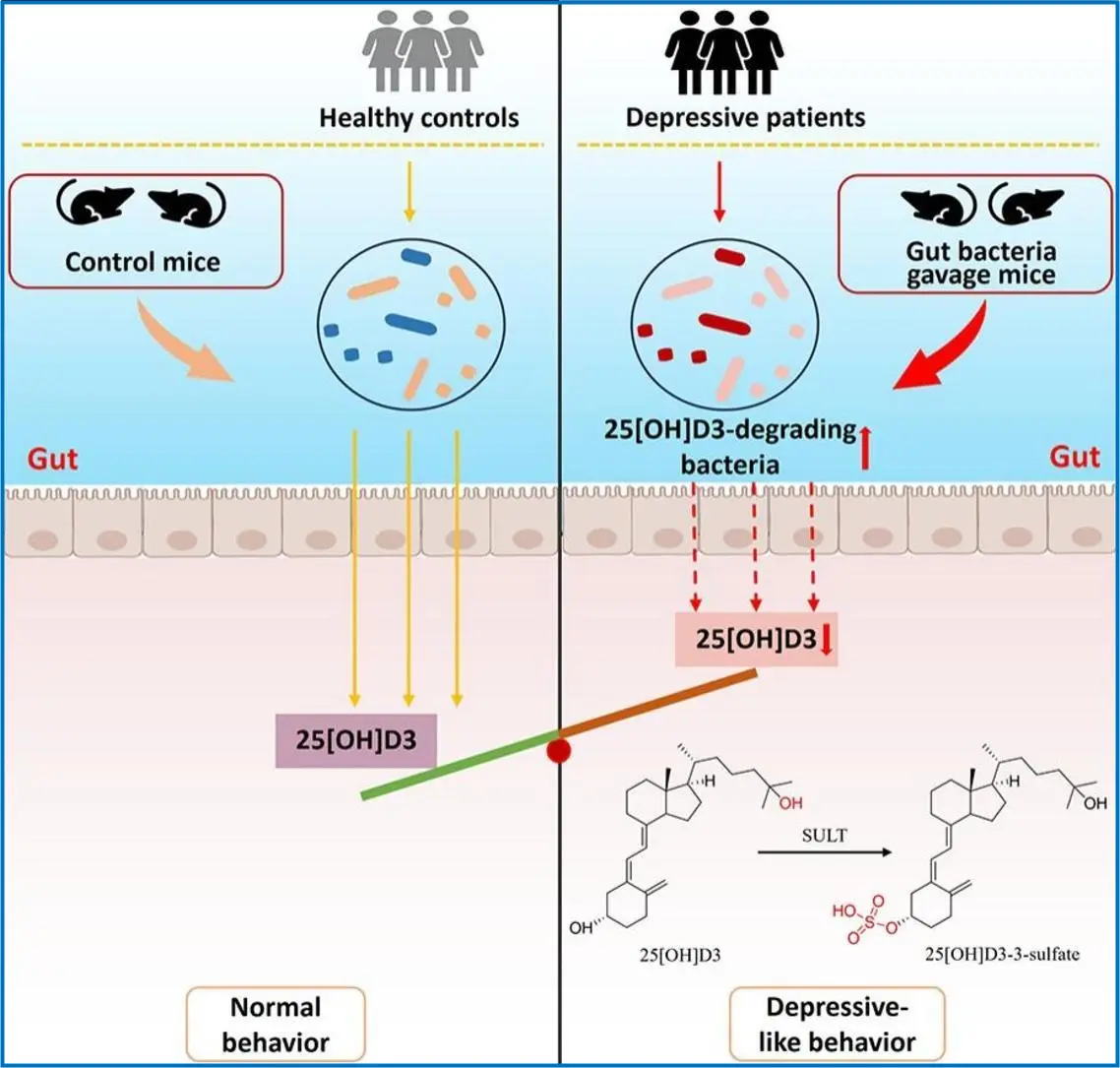
Vitamin D deficiency (VDD) has been associated with depressive symptoms, but the underlying cause of this deficiency remains unclear. Here, we isolated and cultured Escherichia coli (E. coli) from the feces of depressive patients with VDD and found that this bacterium could metabolize 25-hydroxyvitamin D3 (25[OH]D3) in vitro. In vivo, oral gavage of E. coli induced a decline in circulating 25[OH]D3 levels and elicited depressive-like behaviors in mice. The gene encoding the 25[OH]D3-metabolizing enzyme in E. coli was identified as a sulfotransferase (SULT). A recombinant strain engineered for heterologous expression of SULT similarly reduced serum 25[OH]D3 levels and induced depressive-like behaviors. Interestingly, 25[OH]D3-3-sulfate, the sulfonation product of 25[OH]D3, also produced depressive-like behaviors in mice. Finally, both the prevalence of E. coli and the abundance of the SULT gene were strongly increased in depressive patients when compared to healthy controls. Our findings indicate that SULT expressed by gut microbiota may contribute to depressive symptoms by promoting 25[OH]D3 sulfonation and increasing 25[OH]D3-3-sulfate levels. However, further clinical and mechanistic studies are required to translate these findings to human depression.
What this does NOT show
It does not show this happens in people. Every causal step — bacteria lowering 25(OH)D3, and the sulfate causing depression-like behavior — was done in mice. The human data is a head-count of bacteria and genes, nothing more.
It does not show the bacteria caused the patients' low vitamin D. Depressed patients had more E. coli and more of the SULT gene. The abstract does not report whether the patients with the most SULT had the lowest 25(OH)D — which is the comparison that would matter.
It does not show which came first. Depression changes diet, activity, sunlight exposure, inflammation, and medication, all of which reshape gut bacteria. The flora difference could be a result of depression rather than a cause.
It does not show that ordinary gut E. coli does this. Nearly everyone carries E. coli. The study used strains cultured from depressed patients and delivered them by gavage. Strain, dose, and gut location may all be doing work here.
It does not show that more vitamin D fixes it. No rescue experiment is reported. Whether extra D3 — or a different dosing schedule — overcomes the loss is untested.
It does not show that 25(OH)D3-3-sulfate is harmful in humans. Your own liver makes this exact metabolite via SULT2A1, blood levels are comparable to 25(OH)D3 itself, and it binds vitamin D binding protein tightly — which is why it has been proposed as a storage form, not a toxin [Wong 2018] [Gao 2018]. Gut-made and liver-made sulfate may differ in amount or in where they are released, but the paper does not address this.
It does not explain how gut bacteria reach 25(OH)D3. The likely route is enterohepatic circulation — bile delivers 25(OH)D3 and its conjugates to the intestine, where over 85% is normally reabsorbed [Arnaud 1975]. The authors do not state this, and it remains an inference.
Sources:
- [Wong 2018 DMD — SULT2A1 makes 25(OH)D3-3-sulfate]
- [Gao 2018 DMD — hepatic transport of 25(OH)D3 conjugates into bile]
- [Arnaud 1975 — enterohepatic circulation of 25(OH)D3 in man]