
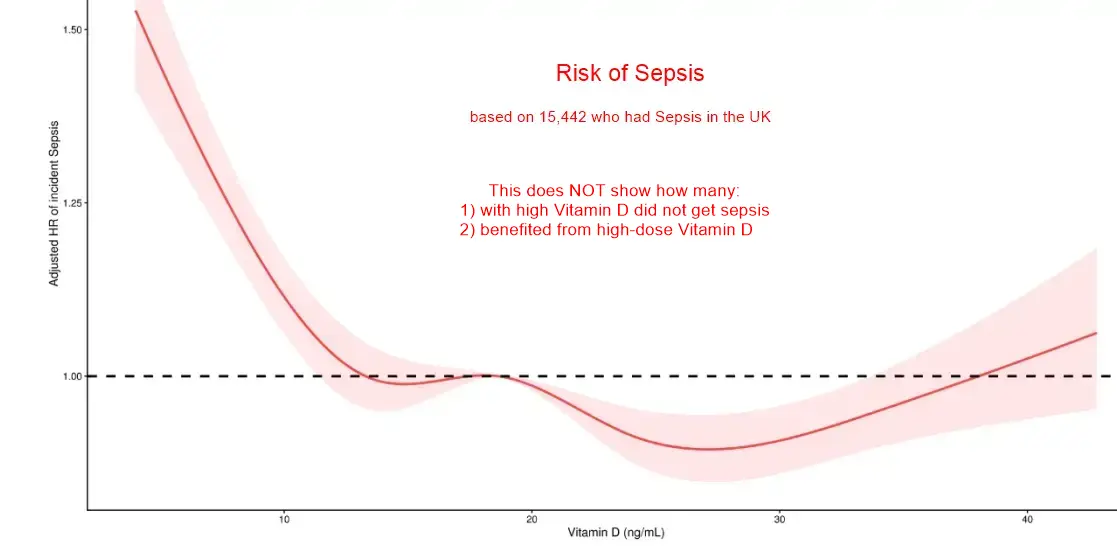
Sepsis is ~2X more likely if Vitamin D deficient - meta-analysis
Vitamin D Status and Sepsis Outcomes: A PRISMA-Compliant Umbrella Review and Meta-Analysis
Review Nutrients. 2026 Mar 9;18(5):869. doi: 10.3390/nu18050869.
Background: Vitamin D plays an important role in immune regulation, and vitamin D deficiency has been increasingly associated with susceptibility to infection and adverse outcomes in critically ill patients. Numerous systematic reviews and meta-analyses have examined the relationship between vitamin D status, vitamin D receptor (VDR) gene polymorphisms, and sepsis; however, the evidence remains fragmented.
Objective: The aim of this work was to synthesize high-level evidence on the association between vitamin D deficiency, VDR gene polymorphisms, vitamin D supplementation, and sepsis-related outcomes through a PRISMA 2020-compliant umbrella review. Methods: An umbrella review of systematic reviews and meta-analyses published between 2014 and 2025 was conducted using PubMed, PubMed Central, and journal archives. Eligible studies included adult, pediatric, and neonatal populations and evaluated sepsis incidence, mortality, disease severity, secondary outcomes, and genetic associations. Data were synthesized qualitatively due to overlap of primary studies and heterogeneity. Conceptual forest plots and funnel plots were used to summarize evidence direction and potential publication bias.
Results: Nineteen systematic reviews and meta-analyses encompassing over 300 primary studies were included.
Vitamin D deficiency was consistently associated with an increased risk of sepsis, higher mortality, and greater disease severity across adult and pediatric populations.
Stronger associations were observed in children and neonates, including higher PRISM III scores, increased need for mechanical ventilation, and longer hospital stays. VDR gene polymorphisms were modestly but consistently associated with increased sepsis susceptibility. In contrast, vitamin D supplementation did not demonstrate a consistent reduction in sepsis risk or mortality.
Conclusions: Vitamin D deficiency is a robust marker of sepsis risk, severity, and poor prognosis, whereas current evidence does not support vitamin D supplementation as an effective treatment for established sepsis.
Association of vitamin D with sepsis incidence and mortality: a large population-based prospective cohort study - March 2026
Crit Care. 2026 Mar 29. doi: 10.1186/s13054-026-05977-z
Related in VitaminDWiki
- Sepsis is both prevented and treated by Vitamin D - many studies
- Click on SEPSIS tag at the bottom of this page to see 40+ Sepsis pages