Root Canals healed better in 4 ways if >20 ng of Vitamin D
Baseline serum 25-hydroxyvitamin D levels as a predictor of periapical healing and clinical success after primary root canal treatment: A prospective, observational, and cohort study
J Conserv Dent Endod 2026 May;29(5):485-490. doi: 10.4103/JCDE.JCDE14126
Manish Sharma 1, Monali Nikalje 2, Rahul Tiwari 3, Sanghamitra Jena 4, Harisha Dewan 5, Mohammed Mustafa 6
Root Canal 50% more likely to be successful if > 20 ng
Background: Systemic host factors, such as serum 25-hydroxyvitamin D(25[OH]D), may influence periapical healing after root canal treatment (RCT); however, prospective clinical evidence remains limited.
Aim: To evaluate whether baseline serum 25(OH)D levels predict periapical healing and 12-month clinical success following a primary RCT.
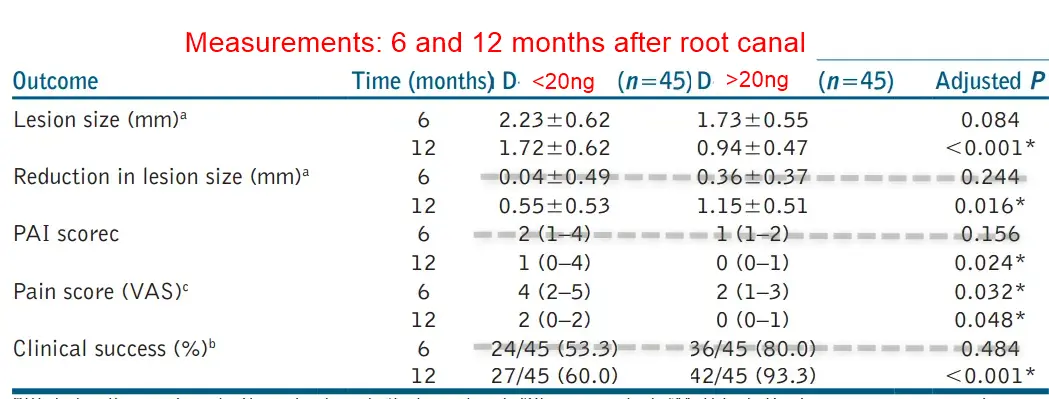
Materials and methods: Ninety systemically healthy adults (18-50 years old) requiring primary RCT of single-rooted teeth were enrolled. Participants were categorized as Vitamin D-deficient (<20 ng/mL) or sufficient (≥20 ng/mL). The lesion size, periapical index (PAI), pain (Visual Analog Scale), and clinical success were assessed at 6 and 12 months.
Statistical analysis: This comprised repeated-measures tests, independent group comparisons, receiver operating characteristic (ROC) analysis, and multivariable logistic regression adjusted for baseline lesion size, with P < 0.05 indicating significance.
Results: Both groups demonstrated significant improvement over time (P < 0.05). At 12 months, the sufficient group demonstrated greater lesion reduction, lower PAI and pain scores, and higher clinical success (93.3% vs. 60.0%; P < 0.001). Vitamin D sufficiency independently predicted success (adjusted odds ratio, 6.62; P = 0.009). ROC analysis identified 20.4 ng/mL as the optimal predictive cutoff.
Conclusion: Baseline serum 25(OH)D sufficiency was associated with improved periapical healing and clinical success after primary RCT.