
Pregnancy and Vitamin D: 250 IU daily average did not help
Effects of maternal commercial supplementation on 25-hydroxyvitamin D levels in newborns: a retrospective cohort study in a single center, Saitama, Japan, 2022-2023
Endocr J. 2026 Feb 2;73(2):243-249. doi: 10.1507/endocrj.EJ25-0266
Kazumi Morisawa 1, Kazushige Ikeda 2, Mariko Hida 1, Kaori Hara-Isono 1
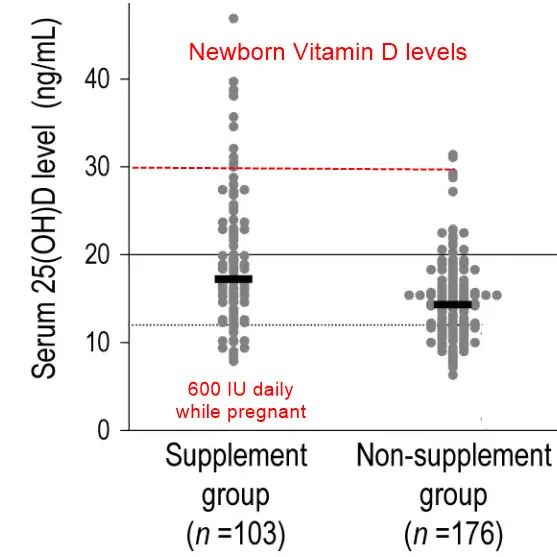
Vitamin D (VD) insufficiency in pregnant women is a serious health problem worldwide. To prevent VD insufficiency during pregnancy, several guidelines recommend 600 IU/day VD for all pregnant women. In Japan, no national guidelines for preventing VD insufficiency have been implemented, and no study has evaluated adequate VD intake in pregnant women; however, the number of pregnant women taking commercial dietary supplements containing VD has increased in recent years. This study aimed to examine the effects of maternal commercial supplementation of VD on 25-hydroxyvitamin D (25(OH)D) levels in newborns. We retrospectively analyzed the serum 25(OH)D levels in 279 four-days-old newborns born at the Saitama City Hospital from 2022 to 2023. Newborns were classified into a supplement group (mothers who took VD-containing commercial supplements regularly throughout pregnancy; n = 103) and a non-supplement group (mothers who did not take any supplements during pregnancy; n = 176). The study findings revealed that serum 25(OH)D levels in newborns in the supplement group were higher than those in the non-supplement group (median [interquartile range]: supplement group 17.2 [14.6, 22.9] vs. non-supplement group 14.3 [11.6, 16.7], p < 0.001). In the supplement group, approximately 70% of newborns still showed VD insufficiency. Although the maternal use of VD-containing commercial supplements during pregnancy increased the serum 25(OH)D levels in newborns at four days of age, additional measures, such as VD supplementation for newborns, are needed to improve neonatal VD status.
Related in VitaminDWiki
- Many pregnant women are deficient when taking the recommended amount of Vitamin D
- A paltry 400 IU Vitamin D recommended during pregnancy - NICE UK
- Turkey recommended 1200 IU Vitamin D during pregnancy, only 1 in 7 took more than 1,000 IU
- Pregnancy complications cut in half by 4,400 IU of Vitamin D
- 6,400 IU of Vitamin D is safe and effective during breastfeeding – RCT Dec, 2020
- American College of Nurse‐Midwives continues to state that 600 IU Vitamin D is enough