
Parkinson's Disease decline is associated with poor Vitamin D receptor
Vitamin D receptor FokI polymorphism preferentially modulates cognitive vulnerability in Parkinson's disease: Evidence from an Indian cohort
J. of Neuroimmunology, Aug 2026, https://doi.org/10.1016/j.jneuroim.2026.579072 PDF behind paywall
Randrita Pal, Nilansu Das, Hrishikesh Kumar, Sanjit Dey, Supriyo Choudhury, Barnali Ray Basu
 Summary by Claude - August 2026
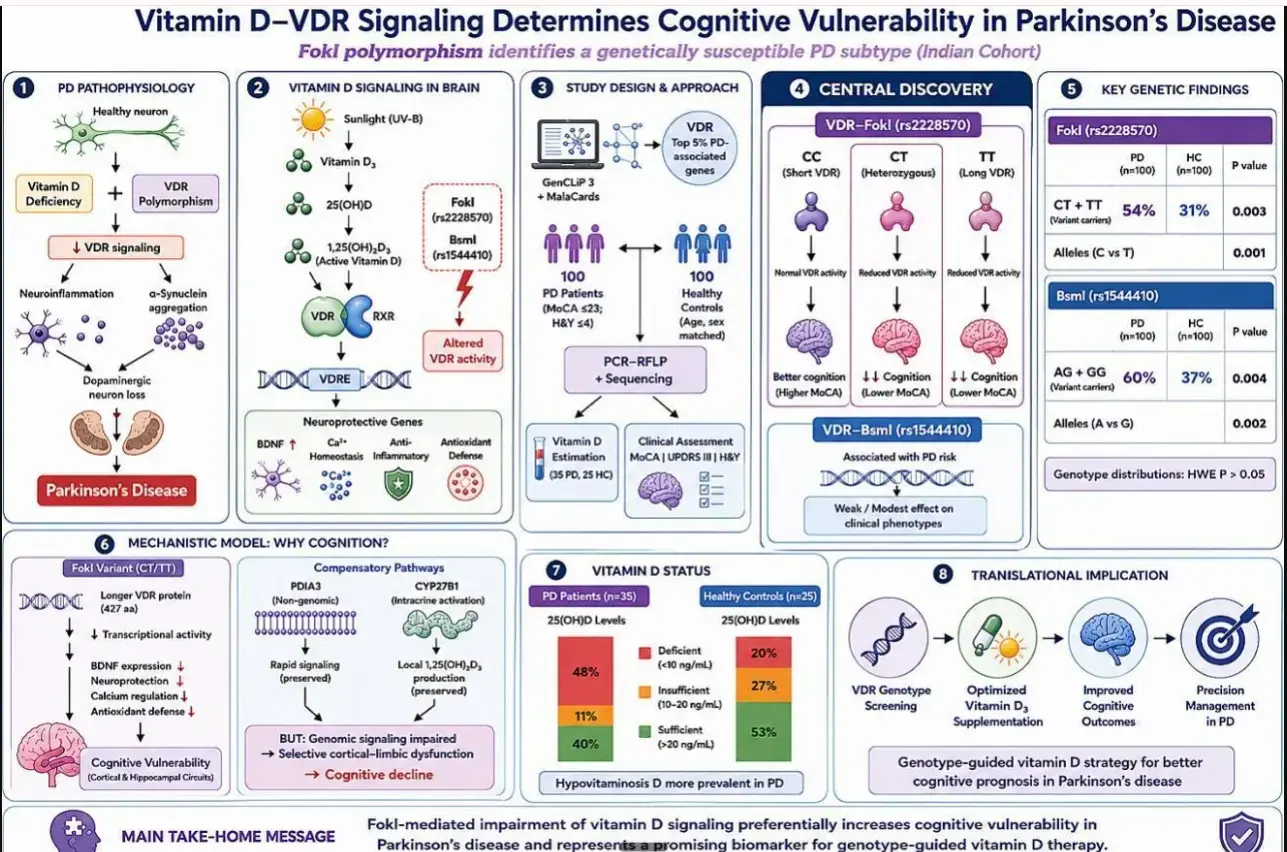
A case-control genetic association study — the first of its kind in an Indian population, per the authors — compared 100 Parkinson's disease (PD) patients (diagnosed by movement-disorder neurologists using UK Brain Bank Criteria, with mild-to-moderate cognitive impairment, MoCA ≤23) against 100 age- and sex-matched healthy controls. Both groups were genotyped for two vitamin D receptor (VDR) polymorphisms — FokI (rs2228570) and BsmI (rs1544410) — by PCR-RFLP, confirmed by sequencing.
FokI variant carriers (CT+TT genotypes) were more common in PD than controls (54% vs 31%, p=0.003), and the T allele was overrepresented in PD (p=0.001). Within the PD group, FokI genotype correlated with cognitive scores (MoCA, p=0.03), with CT and TT carriers showing poorer cognitive outcomes than CC carriers.
The BsmI variant (AG+GG, 60% vs 37%, p=0.004; A vs. G allele, p=0.002) was also associated with PD risk but had only a weak-to-modest link to clinical severity. In a smaller subgroup with serum vitamin D testing (35 PD, 25 controls), hypovitaminosis D was more prevalent in PD patients than controls. The authors conclude "the VDR gene rs2228570 C>T variant is a genetic risk factor for cognitive decline in PD patients," proposing that the FokI variant yields a longer, less transcriptionally active VDR protein, reducing VDR-driven neuroprotective gene expression.
Funding was institutional/fellowship-based (Surendranath College; West Bengal government), with no competing interests declared.
What this does not show / limitations: This is a single-center, cross-sectional case-control study — it shows association, not causation. Vitamin D levels were measured in only a 35/25 subset of the full 100/100 cohort, underpowering that specific comparison. A reported subgroup finding (lower-BMI and male patients "more vulnerable") appears exploratory/post-hoc, with no mention of correction for multiple comparisons. This review is based on the publicly viewable ScienceDirect preview (abstract highlights, introduction, and discussion/conclusion snippets) rather than the full paywalled text, so exact effect sizes, confidence intervals, adjusted models, and full Results/Methods detail (e.g., disease duration, medication use as confounders) could not be verified.
Related in VitaminDWiki
- Parkinson’s Disease 3 X more likely if a poor Vitamin D Receptor – May – 2022
- Parkinson’s Disease might be fought by Vitamin D and the activation of the Vitamin D Receptor
- 2X more Parkinson's disease if modified vitamin D receptor genes – meta-analysis
- VDR activators for Parkinson's Disease: Resveratrol, Sulforaphane, Butyrate, etc.