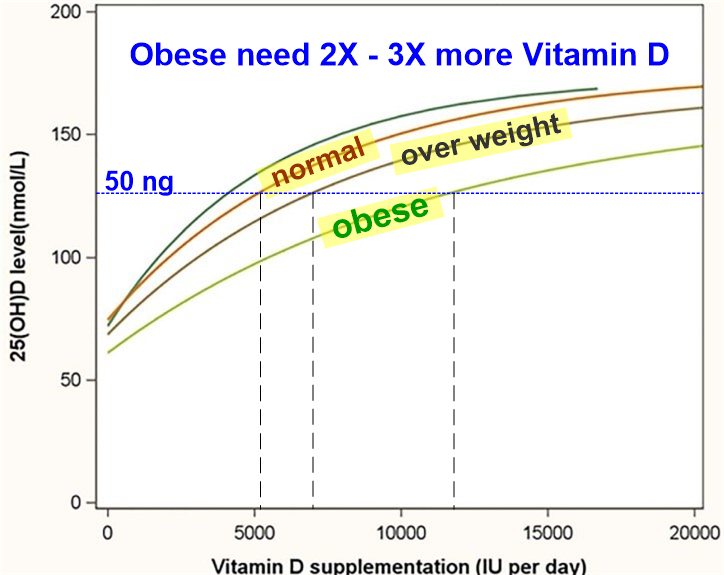
Obese people should get 100%-200% more Vitamin D, but only get 0-100% increase in drugs
How to read the percentages:
Each one compares the same 175 cm (5′9″) man at 140 kg (BMI 46) with that man at 70 kg (BMI 23). At 140 kg his ideal weight is still about 70 kg, his adjusted weight (ideal + 0.4 × excess) is 98 kg, his estimated lean weight is 78 kg, and his body surface area rises from 1.85 to 2.61 m². So dosing by total weight gives +100%, while dosing by adjusted weight, lean weight or BSA all come out near +40%.
| Health problem | Drug | Dosing basis in obesity | Increase, 140 vs 70 kg | Refs |
|---|---|---|---|---|
| Vitamin D status | Vitamin D₃ | 2–3× for obese (BMI ≥30) | +100% to +200% | Ekwaru 2014 Drincic |
| Cancer | Most cytotoxic chemo | BSA from actual weight, uncapped | +41% | ASCO 2021 |
| Cancer | Carboplatin | Adjusted weight; GFR capped at 125 | +30% | Protocol aCG study |
| Cancer | Checkpoint inhibitors | Labeled flat dose | 0% | ASCO 2021 |
| Surgical infection prevention | Cefazolin | 2 g; 3 g if ≥120 kg | +50% | Obes Surg 2018 |
| Serious MRSA infection | Vancomycin | Actual weight; 3 g load cap; AUC-guided | Load +70% to +100% | Vanco audit Vanco obesity |
| Gram-negative infection | Gentamicin | Adjusted weight | +40% | ZSFG protocol |
| Clot prevention, hospital | Enoxaparin | 40 mg/day → 40 mg twice daily at BMI ≥40 | +100% (+250% weight-based) | Ann Pharmacother Sabers 2024 |
| Clot treatment | Enoxaparin | 1 mg/kg actual weight, often trimmed | Up to +100% | Enoxaparin review |
| Clot treatment | Apixaban, rivaroxaban | Standard fixed dose | 0% | ISTH summary |
| Ischemic stroke | Alteplase | 0.9 mg/kg, max 90 mg | +43% (capped) | Diedler 2011 |
| Anesthesia induction | Propofol | Lean body weight | +40% | WikEM |
| Intubation | Succinylcholine | Total body weight | +100% | OpenAnesthesia |
| Intubation | Rocuronium | Ideal body weight | 0% | OpenAnesthesia |
| Hypothyroidism | Levothyroxine | Ideal weight or lean mass | 0% to +40% | AAFP 2022 LBM study |
| Lupus, rheumatoid arthritis | Hydroxychloroquine | ≤5 mg/kg actual; 400 mg/day ceiling | +14% (capped) | Hospitalist |
| Emergency contraception | Levonorgestrel | 3 mg if >70 kg or BMI >26 | +100% | FSRH 2019 |
| Emergency contraception | Ulipristal | Double dose not recommended | 0% | FSRH 2019 |
Two notes on the table. The vitamin D figure applies to the obese category as a whole, not specifically to 140 kg. The carboplatin example assumes age 60, creatinine 1.0 mg/dL and AUC 5: 515 mg rises to 671 mg; using actual weight would hit the 750 mg cap instead.
The pattern
- +100% or more (dosed by total weight): drugs that distribute into fat or whose effect scales with total mass. Examples: vitamin D, succinylcholine, the vancomycin loading dose, and enoxaparin.
- About +40% (dosed by lean weight, adjusted weight or BSA): most drugs cleared by the kidneys or liver, because organ size and lean mass grow much less than fat. Examples: chemo, gentamicin, propofol, levothyroxine.
- 0% or capped: fixed-dose drugs with a flat dose–response (apixaban, checkpoint inhibitors), drugs that stay out of fat (rocuronium), and drugs where a safety ceiling overrides weight (alteplase, hydroxychloroquine, the carboplatin GFR cap).
Details worth knowing
- Vitamin D: In 17,614 volunteers, Ekwaru recommended 2–3× the dose for obese people and 1.5× for overweight people. That matched the Endocrine Society's 2011 guideline [Ekwaru 2014]. Drincic found obese adults needed about 2.5 IU/kg for each 1 ng/mL rise in 25(OH)D, so the need scales with total weight [Drincic]. The 2024 Endocrine Society guideline gives no obesity-specific dose and recommends against routine 25(OH)D testing in adults with obesity [Endo 2024]. Vitamin D's upper multiplier (3×) goes beyond what plain total-weight scaling would predict. Weight-based enoxaparin prophylaxis is the only other drug here that comes close.
- Enoxaparin: At BMI ≥40, 40 mg twice daily is recommended, with higher doses considered at BMI ≥50 [Ann Pharmacother]. In one study, 0.5 mg/kg twice daily reached the anti-Xa target in 90.5% of patients, compared with 29.1% on 40 mg twice daily [Sabers 2024].
- DOACs: The 2021 ISTH guidance allows standard-dose rivaroxaban or apixaban for VTE at any weight, but not dabigatran or edoxaban [ISTH summary].
- Alteplase: Because of the cap, stroke patients over 100 kg got 0.82 mg/kg on average instead of 0.90. Their outcomes were similar and their bleeding risk was higher, which supports keeping the cap [Diedler 2011].
- Hydroxychloroquine: Retinal toxicity works against higher doses here. Some clinicians calculate both 5 mg/kg of actual weight and 6.5 mg/kg of ideal weight and use the lower of the two, up to 400 mg/day [Hospitalist].
- Emergency contraception: Standard levonorgestrel seems less effective above 70 kg or BMI 26. FSRH suggests ulipristal first and double-dose levonorgestrel if ulipristal isn't suitable, though the double dose's effectiveness is unproven. The copper IUD is not affected by weight [FSRH 2019].
Hospitals differ on these rules, especially on where the caps sit.
Related in VitaminDWiki