
More sun-protection habits = less Vitamin D in Chinese students (dose-response) - observational
High burden of vitamin D deficiency in Chinese university students: impact of sun protection culture
Frontiers in Nutrition, 28 July 2026, https://doi.org/10.3389/fnut.2026.1889729
Shikang Su, Simin Sun, Wenhao Ji, Huanhao Cai, Ziyang Lin, Wanlei Yang, Bin Fang, Yu Qian
Summary by Claude - August, 2026
Avoiding the sun to keep your skin pale has a measurable cost. This cross-sectional study of 174 university students in Hangzhou, China (latitude ~30°N, blood drawn May-June 2025 - the sunniest part of the year) found average serum 25(OH)D of just
- 29 nmol/L (11.7 ng/ml). 93% were below 50 nmol/L (20 ng/ml)
- and 59% were below30 nmol/L (12 ng/ml).
- Only 6.9% reached 50 nmol/L.
- For comparison, 17 students who trained outdoors - same campus, same ethnicity, same skin type - were 71% sufficient.
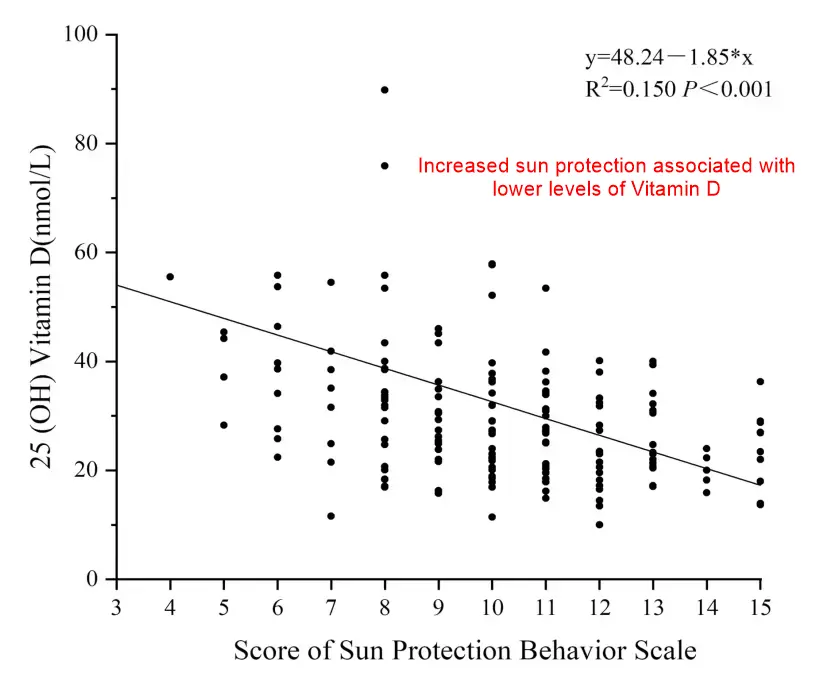
The likely reason: sun avoidance driven by a cultural preference for fair skin. 64% of students wanted lighter skin than they had; only 1.7% wanted darker. 91% used at least one sun-protection measure and 48% used two or three at once (shade, sunscreen, covering clothing). Over half spent under 30 minutes a day outdoors, averaging 28 minutes. Sun-protection score correlated inversely with 25(OH)D (r = -0.387, p < 0.001) and survived adjustment for age, sex, BMI, sun-exposure minutes, activity, smoking and drinking (β = -0.217, p = 0.007). Median 25(OH)D fell stepwise with each added protective habit: 31.5 → 30.5 → 23.5 nmol/L. PTH rose in the heaviest sun-avoiders (4.70 vs 3.46 pmol/L), the expected compensation.
The authors warn that "extreme long-term sun avoidance may impair vitamin D synthesis and peak bone mass accumulation."
What this does not show / limitations
- Cross-sectional - it cannot prove sun avoidance caused the low levels.
- Vitamin D supplement use was never asked about. The authors call this a major unmeasured confounder.
- Sun habits were self-reported; no SPF, application amount, skin area exposed, or actual UV measurement.
- One city, one campus, convenience sample, subtropical latitude - not generalizable to northern China or rural populations.
- The 17 outdoor students are a descriptive reference only. No statistical test was run on that comparison.
- Bone-formation markers (PINP, osteocalcin, β-CTX) were higher in the least protected group, the opposite of the classic deficiency pattern. The authors attribute this to weight-bearing exercise outweighing mild PTH elevation - a plausible but untested explanation.
- No fracture, bone-density, or any clinical outcome was measured.