
Vitamin D and probiotics reduces type II diabetes
Vitamin D and Prebiotics May Benefit the Intestinal Microbacteria and Improve Glucose Homeostasis in Prediabetes and Type 2 Diabetes. - 2013
Endocr Pract. 2013 Jan 21:1-40.
Barengolts E.
Section of Endocrinology, Department of Medicine, University of Illinois Medical Center and Jesse Brown VA Medical Center, Chicago, Illinois.
Objective: To review the role of human large bowel microbacteria (microbiota) in the glucose homeostasis, to address vitamin D (VD) and prebiotics interactions with microbiota, and to summarize recent randomized clinical trials (RCT) of VD and prebiotics supplementation in prediabetes and T2DM.
Methods: Primary literature was reviewed in the following areas: composition and activity of human microbiota associated with prediabetes and T2DM, the mechanisms of the interactions between microbiota and glucose homeostasis, the interaction of microbiota with VD/prebiotics, and RCT of VD/prebiotics use in prediabetes and T2DM.
Results: The human microbiota comprise 100 trillion bacteria with the genome that is 150 fold larger t[han the human genome. Data from the animal models and human studies reveal that "obesogenic" diet results into the initial event of microbiota transformation from symbiosis to dysbiosis. The microbial antigens [e.g. Gram(-) bacteria and lipopolysaccharide] translocate to the host interior and trigger increased energy harvesting and Toll-like receptor activation with subsequent inflammatory pathways signaling. The "double hit" of steatosis (ectopic fat accumulation) and "-itis" (inflammation) and contribution of "co-risks" (e.g. vitamin D deficiency) are required to activate molecular signaling including impaired insulin signaling and secretion that ends with diabetes and diseases associated with T2DM. Dietary changes (e.g. prebiotics, vitamin D supplementation) may ameliorate this process if started at the time prior to the process becoming irreversible.
Conclusion: The emerging evidence suggests the important role of microbiota for glucose homeostasis. The vitamin D supplementation and prebiotics use may be considered for improving prediabetes and T2DM management.
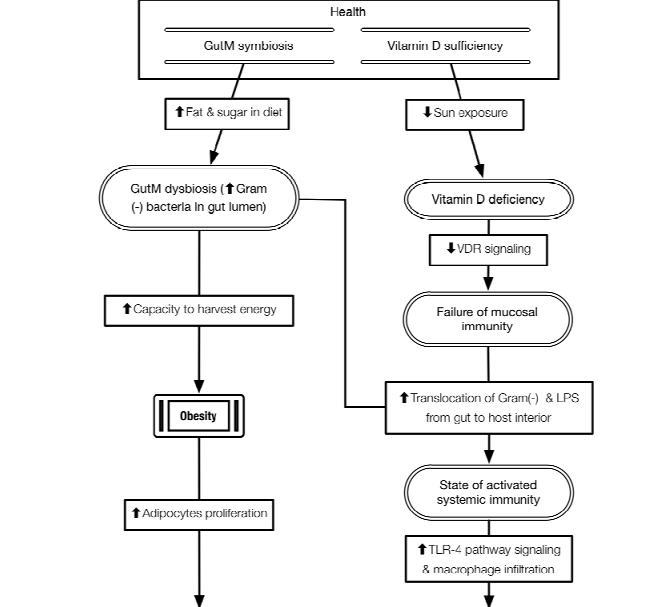

Role of Gut Microbiota in Bridging Vitamin D Deficiency and Type 2 Diabetes Mellitus Pathogenesis - March 2026
Microorganisms 2026, 14(3), 628; https://doi.org/10.3390/microorganisms14030628
by Yinghua Zhan 1,Jing Liu 2,Qiannan Di 3 andLixin Na 1,3,* China
Type 2 diabetes mellitus (T2DM) is a complex metabolic disorder. The nutritional status of vitamin D, an essential micronutrient, is closely linked to the onset and progression of T2DM. A growing body of research has shown that gut microbiota and its metabolites are emerging as a biological link connecting vitamin D and systemic glucose metabolism. Gut dysbiosis is prevalent in T2DM patients, which is characterized by reduced gut microbial diversity, increased abundance of pathogenic bacteria, and abnormal production of key metabolites such as short-chain fatty acids, bile acids and tryptophan derivatives. These abnormal changes in gut microecology and metabolites can impair intestinal barrier integrity and induce chronic low-grade inflammation in the body, and vitamin D deficiency may further exacerbate these abnormal processes. The evidence suggests that the regulatory effect of vitamin D on systemic glucose metabolism may be partially achieved through gut microbiota-related pathways. This review aims to explore whether, and by what mechanisms, the gut microbiota mediates the regulatory effect of vitamin D on T2DM. It also intends to conduct an analysis of the potential molecular mechanisms underlying the interactions between vitamin D, gut microbiota and T2DM, so as to provide a new theoretical basis and research ideas for the prevention and intervention of T2DM.
Related in VitaminDWiki
Vitamin D treatment of diabetes (50,000 IU every 2 weeks) augmented by probiotic – RCT June 2018 hypothesis seems correct
Probiotics increased vitamin D levels 22 percent in those with excess cholesterol – April 2013
Prediabetes reduced by monthly 60,000 IU of vitamin D – RCT May 2015
Diabetes risk increased by 50 percent if had 5 courses of antibiotics – Aug 2015
Antibiotic usage US map is very similar to obesity US map - June 2015
Click on tag at bottom of page to see Microbiota studies
- Click on tag at bottom of page to see Probiotics studies