
Dialysis water and tubing add microplastics to the blood - review
Microplastics and the Kidney: A Narrative Review of Human Evidence, Molecular Mechanisms of Cell Injury, and Future Directions
Int. J. Mol. Sci. (MDPI), October 10, 2026, https://doi.org/10.3390/ijms27208978
Edoardo La Porta, Micaela Gentile, Marco Quaglia, Serena Ducoli, Sara Massardo, Daniela Verzola, Nicoletta Mancianti, Pasquale Esposito
Summary by Claude Opus 5.5 - October 2026
Microplastics have been found in human urine and kidney tissue. Lab and animal studies show they can injure kidney cells. There is not yet human evidence that they cause kidney disease. People on dialysis may be the most exposed and are the least studied.
This is a narrative review by 8 Italian nephrologists and materials scientists. It is not a systematic review and has no pooled data. It does not mention vitamin D.
Human evidence (small studies)
- Particles 1–29 µm were found in 10 kidney samples and 10 urine samples.
- Kidneys hold less plastic than the brain and about as much as the liver.
- Kidney-cancer tissue had more microplastics than the tissue next to it.
- In 50 healthy volunteers, more urinary microplastics went with more urine albumin, an early sign of kidney damage (OR 2.18). This was a one-time snapshot.
Dialysis
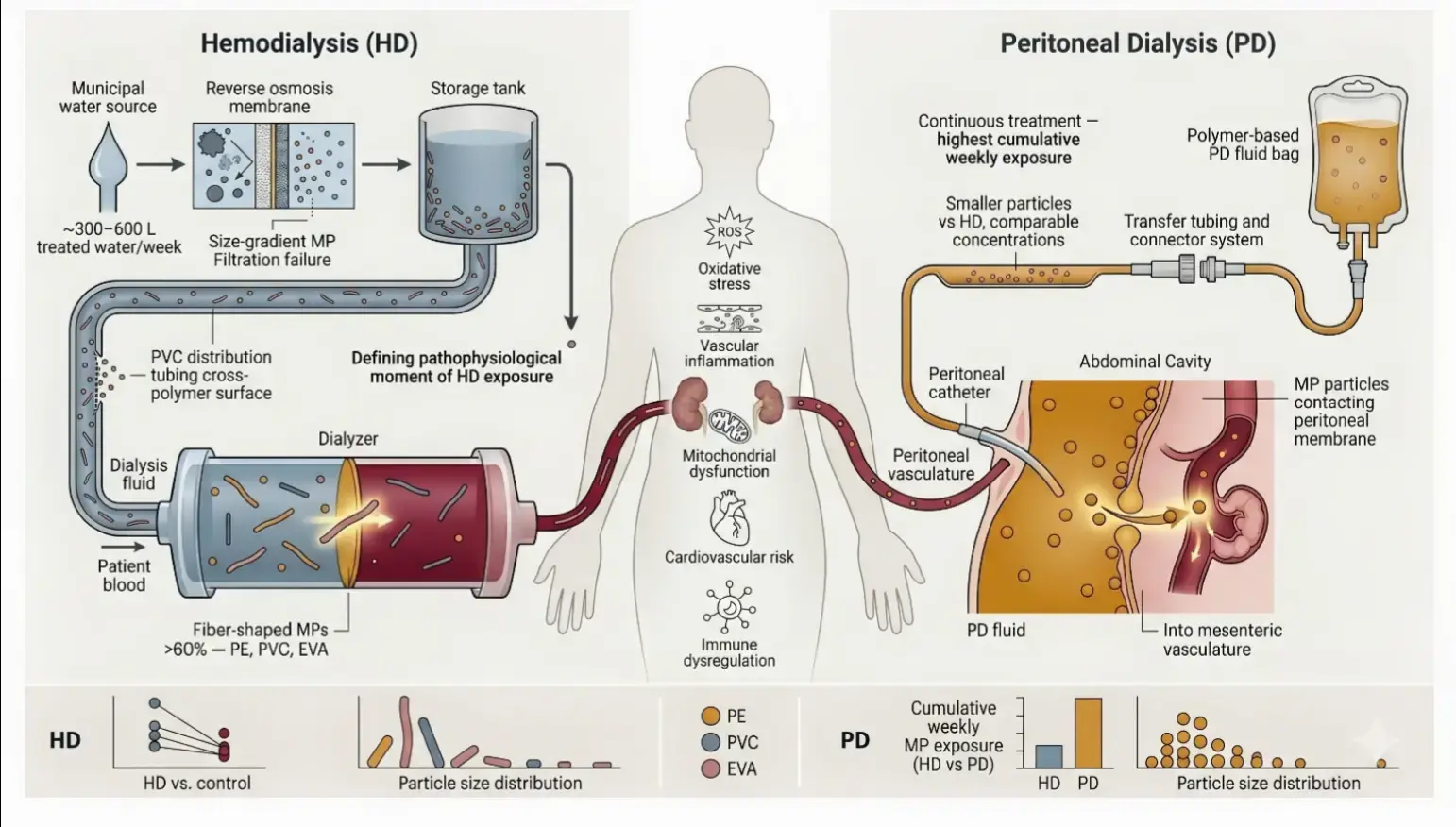
- Hemodialysis exposes a patient to about 300–600 liters of treated water each week. Reverse osmosis was not designed to remove plastic particles.
- Microplastics, mostly fibers, were found in every dialysis fluid sample tested.
- Blood microplastics rose after a single dialysis session (9 patients, no blank controls). The particles were most likely shed by the tubing.
- Dialysis patients had about 2.5× more blood microplastics than controls (9,132 vs 3,554 particles/g), but this missed significance (p = 0.06).
Mechanisms (cells and mice): oxidative stress, mitochondrial damage, inflammation, several kinds of cell death, and fibrosis.
The authors conclude: "Whether microplastics will prove to be clinically relevant nephrotoxins remains uncertain."
What this does NOT show
- No human study shows that microplastics cause kidney disease.
- Animal and cell studies mostly used polystyrene beads at doses far above human exposure.
- Lab studies use nano-sized particles, while human studies can only detect larger ones, so the two can't be compared directly.
- Measurement methods differ so much that particle counts can't be compared across studies.
- It gives no information on whether vitamin D protects the kidneys from microplastics.
Related in VitaminDWiki
- Microplastics causing problems in humans, etc. (Vitamin D can help) - many studies
- Microplastics reduce Vitamin D and Magnesium, Vitamin D reduces MP toxicity - May 2025
- Many ways to remove microplastics from water, even in the home
- Chronic Kidney disease and vitamin D deficiency
- Kidney Dialysis, low Vitamin D, low Magnesium - many studies
- Peritoneal Dialysis removes protein, Vitamin D, magnesium, etc.
- Peritoneal dialysis probably consumes a lot more vitamin D than haemodialysis
- Microplastics causing problems in humans, etc. (Vitamin D can help) - many studies