
Diabetic Retinopathy associated with low Vitamin D - many studies
93 million people with diabetic retinopathy (DR) (6.8% of global population)
17 million with proliferative DR,
21 million with diabetic macular edema,
28 million with vision-threatening DR.
- Meta-Analysis for Eye disease (META-EYE) study group. Global prevalence and major risk factors of diabetic retinopathy. Diabetes Care. 2012;35:556–564
Diabetic retinopathy about 2X more likely if low Vitamin D - meta-analysis, April 2026
Association between serum vitamin D levels and the risk of diabetic retinopathy: a meta-analysis
Front Med (Lausanne). 2026 Apr doi: 10.3389/fmed.2026.1771156 Yi Lan 1, Xinyi Ke 1
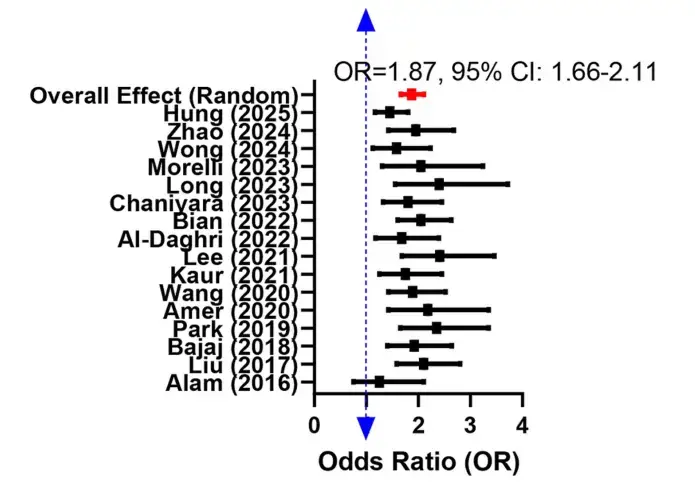
Aim: This meta-analysis was conducted to quantitatively synthesize existing evidence on the relationship between serum 25-hydroxyvitamin D [25(OH)D] levels and diabetic retinopathy (DR).
Methods: A systematic search of PubMed, Embase, the Web of Science, and the Cochrane Library was performed for obtaining observational studies published between January 2015 and February 2026. The included studies reported adjusted effect estimates for the association between 25(OH)D levels and DR. A random-effects model was used to calculate pooled odds ratios (ORs) with 95% confidence intervals (CIs). Subgroup analysis was performed to explore the sources of heterogeneity based on ethnicity, diabetes type, study design, and vitamin D assay method. A sensitivity analysis was conducted to evaluate the robustness of the pooled results. Publication bias was assessed using Begg's funnel plot and Egger's linear regression test.
Results: This meta-analysis included 16 relevant studies, and the pooled results showed that low serum vitamin D levels were associated with a higher likelihood of developing DR (OR = 1.87, 95% CI: 1.66-2.11). Subgroup analyses revealed stronger effect sizes in Asian populations (OR = 1.97, 95% CI: 1.63-2.38) and type 1 diabetes mellitus (T1DM) patients (OR = 2.15, 95% CI: 1.70-2.72). The sensitivity analysis confirmed the robustness of the findings, and publication bias was not observed.
Conclusion: Low vitamin D levels were associated with higher odds of developing DR, and this association was particularly evident in Asian individuals and T1DM patients. These findings suggest the importance of monitoring vitamin D levels in the management of DR.
Sight-threatening diabetic retinopathy 1.8 X more likely if vitamin D <20 ng - meta-analysis May 2022
Associations between vitamin D status and sight-threatening and non-sight threatening diabetic retinopathy: a systematic review and meta-analysis
Journal of Diabetes & Metabolic Disorders (2022) https://doi.org/10.1007/s40200-022-01059-3
Mike Trott, Robin Driscoll, Enrico Iraldo & Shahina Pardhan

Background
Vitamin D levels have been shown to be associated with diabetic retinopathy, however to date, no review has examined the relationship between vitamin D and sight threatening diabetic retinopathy (STDR) and non-sight threatening diabetic retinopathy (NSTDR). The aim of this review, therefore, was to pool associations between vitamin D deficiency (25(OH)D < 20 ng/mL) and STDR/NSTDR. A further aim was to examine associations between circulating 25(OH)D levels and STDR/NSTDR.
Methods
A systematic review of major databases was undertaken for studies published from inception to 22/04/2022, using a pre-published protocol. Studies reporting prevalence of STDR or NSTDR versus a control group with diabetes and no DR or DME and either (a) vitamin D deficiency prevalence, or (b) circulating 25(OH)D levels, were included. A random effects meta-analysis was undertaken.
Results
Following screening, 12 studies (n = 9057) were included in the meta-analysis. STDR was significantly associated with vitamin D deficiency (OR = 1.80 95%CI 1.40–2.30; p = <0.001), whereas NSTDR was not (OR = 1.07 95%CI 0.90–1.27; p = 0.48). Both conclusions were graded as low credibility of evidence. Furthermore, circulating 25(OH)D levels were significantly associated with both NSTDR (SMD = -0.27 95%CI -0.50; −0.04; p = 0.02) and STDR (SMD = −0.49 95%CI -0.90; −0.07; p = 0.02), although these were graded as low credibility of evidence.
Conclusion
Vitamin D deficiency is significantly associated with STDR (including DME), but not with NSTDR. Given the well-reported associations between vitamin D deficiency and other unfavourable outcomes, it is important that vitamin D deficiency is managed appropriately and in a timely manner to reduce the risk of blindness in people with diabetes.
Download the PDF from VitaminDWiki
Growing Crisis—9.6M in America with Diabetic Retinopathy—1.84M at Risk of Blindness—Blacks & Latinos Hit Hardest - June 2023
Dark skins reduces Vitamin D levels in blood
Diabetes reduces VitaminD levels in both blood and cells.
"Blacks have higher VTDR prevalence rates (8.7%) as well as Hispanics (7.1%) than Whites (3.6%) "
Sadly, I convinced a friend with Retinopathy to take vitamin D, but her doctor said >2,000 IU could be toxic
I had recommended 4,000 IU = the upper allowable limit at the time.
She has been blind for the past 8 years
My recomendation in 2022 would still be an average of 4,000 IU - but taken as 50,000 IU once every 2 weeks along with any of the Vitamin D Receptor activators (daily) listed above