
Dental implants lost 2X more jawbone in 3 years when Vitamin D was < 20 ng - observational
Association Between Serum 25-Hydroxyvitamin D Status and Long-Term Marginal Bone Loss Around Dental Implants
Journal of Clinical Medicine (MDPI), 7 October 2026, https://doi.org/10.3390/jcm15197719
Okan Özen, Vesile Elif Toy
Summary by Claude Opus 5.5 - October 2026
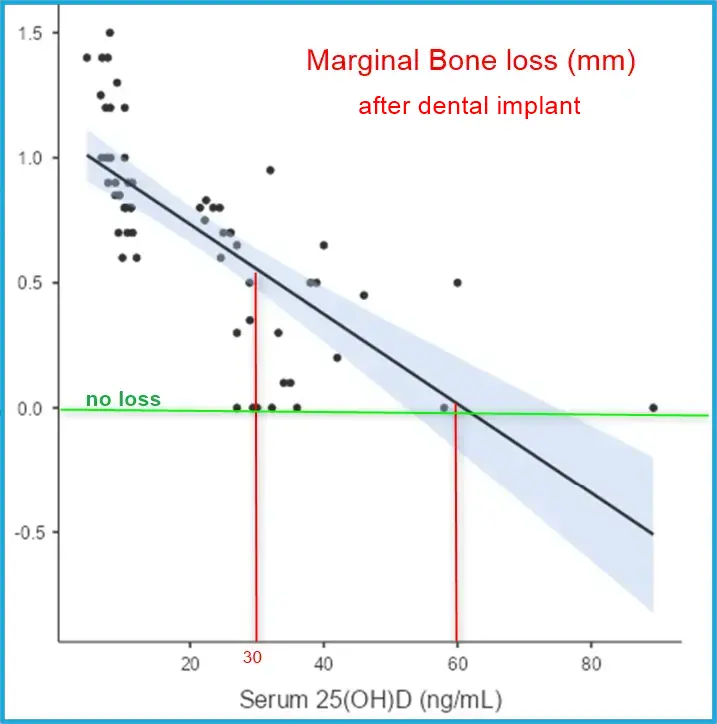
Bottom line: People with very low vitamin D (average 9 ng/mL) when their dental implants were loaded lost more than twice as much jawbone around the implants over the next ~3 years as people above 20 ng/mL (0.98 mm vs. 0.42 mm).
This was a retrospective cohort study of 60 healthy adults (ages 39–60) with 136 implants at a university dental clinic in Turkey. Vitamin D (25(OH)D) was measured once, in April–May, just before the crowns were attached. No vitamin D was given; levels reflect each patient's own status. An examiner who did not know the vitamin D results measured bone loss on X-rays taken at loading and again 34–48 months later (average 39 months).
- Low group (30 patients): 25(OH)D 4.6–12.0 ng/mL, average 9.0
- Higher group (30 patients): 21.5–89.3 ng/mL, average 34.3 (median 29.7)
- The low group had 0.55 mm more bone loss (95% CI 0.35–0.70)
- After adjusting for age, sex, follow-up time, plaque, pocket depth, and gum width, each 10 ng/mL higher vitamin D was associated with 0.18 mm less bone loss
- 3 low-D patients lost an implant vs. 0 in the higher group (too few to be significant, p = 0.24)
- Gum-health measures (plaque, bleeding, pocket depth) did not differ, so the extra bone loss showed on X-ray without clinical warning signs
What this does NOT show
- That taking vitamin D reduces bone loss: no one was given vitamin D, so this is association, not proof
- Long-term vitamin D status: there was a single blood test, and supplement use during follow-up is unknown
- A smooth dose-response: no patient fell between 12 and 21.5 ng/mL, which exaggerates the overall correlation (r = −0.86)
- A robust effect size: with an alternative bone-loss measure (average of both sides instead of the worse side), the effect shrank by more than half, though it stayed significant
- Implant brand, size, and position were not recorded; this was a single center with 60 patients
- Disease: a ~0.5 mm difference over 3 years is not by itself peri-implantitis, and implant survival was not established
Ozen2026vitaminDdentalimplantbone_loss.pdf
Dental similar to Tooth Implant
The one small difference in usage is that “tooth implant” usually suggests replacing a single tooth: a titanium or zirconia post in the jaw, an abutment, and a crown. “Dental implant” is the clinical term and also covers implants that anchor bridges or full dentures, such as All-on-4.
Same procedure, same materials, same cost range. Only the vocabulary differs.