
CYP24A1, which blocks Vitamin D, is restored by Curcumin, Resveratrol, Glutathione, etc
Claude AI Feb 2026
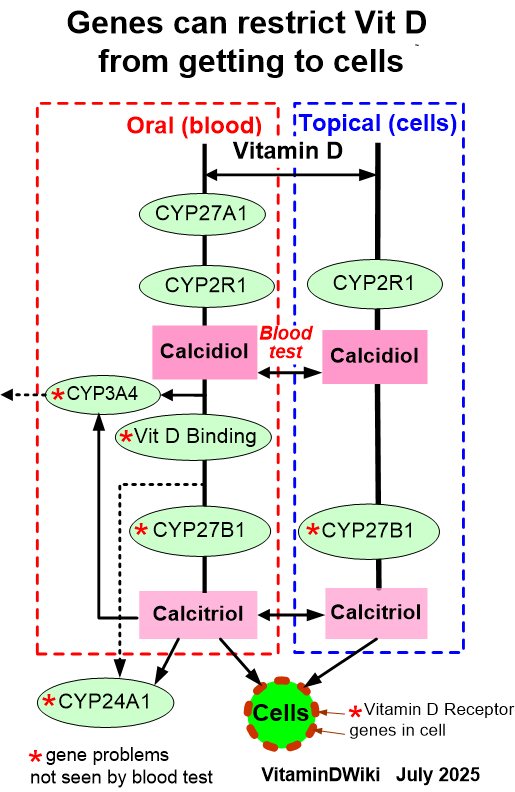
CYP24A1 is the enzyme (24-hydroxylase) that breaks down active vitamin D metabolites (both 25(OH)D and 1,25(OH)₂D), so inhibiting it can help maintain higher vitamin D levels. Here are the main categories of known CYP24A1 inhibitors:
Pharmaceutical/Synthetic Compounds
- Ketoconazole – a broad-spectrum azole antifungal that non-selectively inhibits several CYP enzymes, including CYP24A1
- VID400 – a more selective synthetic CYP24A1 inhibitor developed for research
- CTA091 / CTA018 (terameprocol derivatives) – designed as selective CYP24A1 inhibitors, explored in cancer research contexts
- SDZ 89-443 – an early azole-type CYP24A1 inhibitor
- Liarozole – a retinoic acid metabolism-blocking agent that also inhibits CYP24A1
Natural/Dietary Compounds
- Genistein – a soy isoflavone, shown to inhibit CYP24A1 expression/activity
- Quercetin – a flavonoid found in many fruits and vegetables
- Luteolin – another flavonoid with CYP24A1-inhibiting properties
- Kaempferol – a flavonoid in many plant foods
- Curcumin – from turmeric, reported to downregulate CYP24A1 expression
- EGCG (epigallocatechin gallate) – the main catechin in green tea
- Resveratrol – found in grapes and red wine, has shown some CYP24A1 inhibitory activity
Mechanisms vary — some of these directly inhibit the enzyme's catalytic activity (like the azole drugs), while others work by downregulating gene expression of CYP24A1 (like many of the flavonoids, often via epigenetic mechanisms).
This is a topic of active research interest, particularly in oncology (since cancer cells often upregulate CYP24A1 to evade vitamin D's anti-proliferative effects) and in optimizing vitamin D status. Would you like me to search for any recent developments on this?
CYP24A1: the pivotal regulator of vitamin D homeostasis, pathophysiology in metabolic and genetic disease, and emerging target for precision medicine
Drug Metab Rev 2026 Feb;58(1):69-84. doi: 10.1080/03602532.2025.2608610 PDF behind Paywall
CYP24A1 (25-hydroxyvitamin D3 24-hydroxylase) functions as the essential catabolic ‘off-switch’ of the vitamin D endocrine axis. As a mitochondrial cytochrome P450 enzyme, it tightly regulates calcitriol (1,25(OH)2D3) levels through a remarkably sensitive negative feedback mechanism, capable of a 20,000-fold transcriptional response—by converting biologically active vitamin D metabolites into the inactive end-product calcitroic acid. Its expression is governed by opposing endocrine cues from Parathyroid Hormone (PTH) and Fibroblast Growth Factor 23 (FGF23), with FGF23-mediated induction of CYP24A1 playing a key role in lowering calcitriol during states of phosphate excess.
Pathogenic loss-of-function variants in CYP24A1 underlie Idiopathic Infantile Hypercalcemia (IIH) type 1, whereas acquired dysregulation contributes significantly to chronic kidney disease (CKD). In CKD, sustained FGF23 elevation drives aberrant CYP24A1 activation, promoting functional vitamin D deficiency and secondary hyperparathyroidism.
Emerging studies also implicate inflammation-induced CYP24A1 upregulation in metabolic diseases and cancer, establishing it as a molecular basis for vitamin D resistance. The advent of selective CYP24A1 inhibitors represents a promising therapeutic strategy to optimize vitamin D signaling and control hypercalcemia. Incorporating pharmacogenetic markers (e.g. rs2248359) and functional indices such as 24,25(OH)2D measurements supports individualized vitamin D dosing and advances precision medicine for vitamin D-related disorders.
Related in VitaminDwiki
- Suppression of CYP24A1 gene got more Vitamin D to cells to fight Breast Cancer
- Get Multiple Sclerosis while younger if have a poor CYP24A1 vitamin D gene
- Poor genes (DBP, CYP24A1, CYP2R, etc.) restrict Vitamin D to cells, increasing COVID hospitalization
- CYP24A1 gene and Vitamin D - many studies
 Click here for more information
Vitamin D Resistance or Response