
Butyrate, a short-chain fatty acid, helps the gut and may help the brain
Study: Short-Chain Fatty Acids May Influence the Gut-Brain Connection
What the article claims
By Claude AI - June 2026
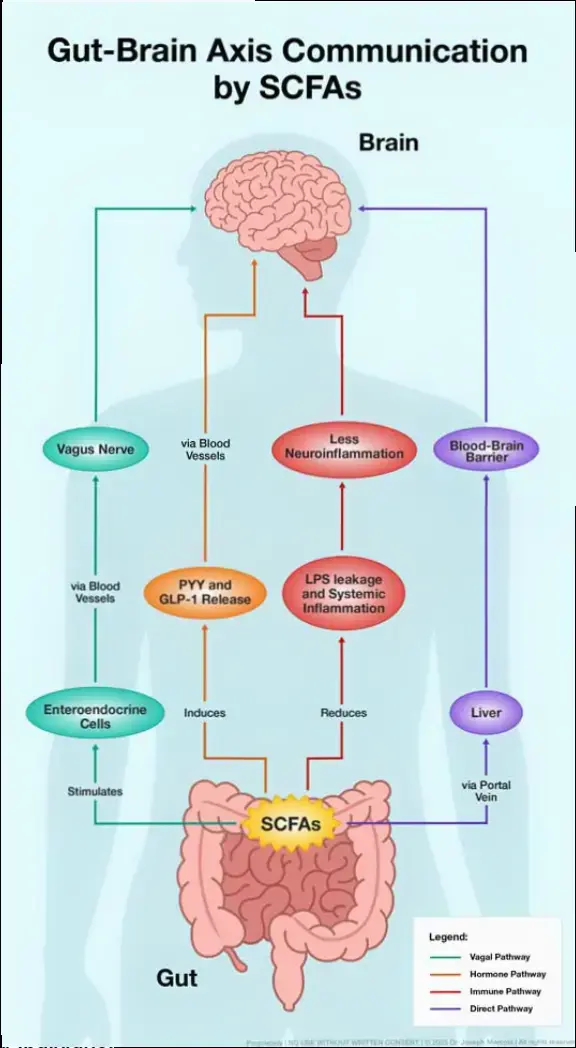
The core biology is mainstream and largely sound: butyrate is a short-chain fatty acid produced when gut bacteria ferment dietary fiber, it's the primary fuel for colonocytes via mitochondrial beta-oxidation, it inhibits HDAC enzymes, and it participates in gut-brain signaling through the vagus nerve, immune pathways, enteroendocrine hormones (GLP-1, PYY), and direct metabolite action. None of that is controversial. The article also, to its credit, has been heavily hedged — "associated with," "research suggests," "preclinical," "may" appear constantly, and there's an explicit note that animal and lab findings may not translate to humans. That's more epistemic caution than older Mercola content typically showed.
Where the evidence gets thin
The hedging language masks a consistent move: real mechanistic/preclinical findings get bridged to clinical claims about mood, memory, stress resilience, Alzheimer's, depression, autism, and PTSD — conditions where butyrate has essentially no robust human RCT support. The HDAC→BDNF→learning/memory chain, for instance, is real at the molecular level but the leap to human cognition is almost entirely animal data. The article gestures at this ("early-stage research is exploring") but the framing still invites the reader to act on it.
The "leaky gut → systemic inflammation → brain disease" narrative is presented as a settled causal pipeline. In reality it's a plausible hypothesis with mixed human evidence; causality and direction of effect are genuinely unresolved for most of the listed conditions (Parkinson's, T2D, depression). Associations are repeatedly stated, then the corrective ("these are associations rather than established causal links") appears once, buried in the FAQ.
The single citation problem
For an article spanning a dozen disease states, there is exactly one numbered reference: a January 2026 Digestive and Liver Disease paper, cited to support a small ulcerative colitis butyrate-enema study. Everything else — the Hadza fiber figures, the "5–10% reaches the bloodstream," the "SCFA drops within days of a Western diet," the population microbiome comparisons — is asserted without sourcing. The primary "source" the article keeps pointing to is Mercola's own paper ("SCFAs Modulate Gut-Brain Axis Function"), which is self-published, not peer-reviewed, and functions here as a download lead rather than evidence.
The conflict of interest is structural, not incidental
This is the part worth flagging hardest. The article is built as a funnel. It promotes a preordered book (Gut Cure: Stop the Rot), a second book (Weight Loss Cure), a downloadable "simplified paper," a newsletter signup, and Mercola's supplement marketplace — multiple times each, with countdown timers. The health content is the vehicle; the conversion is the point. That doesn't make the biology wrong, but it means every borderline claim should be read as optimized for "you need to fix this" rather than for accuracy.
The dietary advice is a mix
Some is reasonable and even cautious: start low if your gut is irritated, reintroduce resistant starch (cooled potatoes, green bananas) and inulin sources gradually, don't megadose fiber into an inflamed gut. The "heal first with easy carbs like white rice and whole fruit, then add fermentable fiber" sequencing is defensible for people with genuine dysbiosis or SIBO-type symptoms.
But two threads are weaker. First, the "avoid fiber initially" advice — while legitimate for a subset — is presented broadly enough that it could steer people away from fiber who'd benefit from it; the population-level evidence overwhelmingly favors more fiber, not less. Second, the linoleic acid / "vegetable oils disrupt your microbiome" claim is Mercola's signature position and is not well-supported by human gut-microbiome data; it's stated as established fact here without a single citation. The recommendation of ghee/tallow/butter over seed oils is presented as settled gut science when it is, at best, contested.
Bottom line
Solid, uncontroversial SCFA biology wrapped around speculative clinical extrapolation, sourced almost entirely to the author's own unpublished material, and structured as a sales funnel for two books and a supplement line. The hedging language is genuinely better than older Mercola pieces, but it functions as liability cover rather than honest evidence-grading — the reader is still nudged toward strong conclusions the cited evidence doesn't carry. If you're mining it for VitaminDWiki-style content, the defensible core is: butyrate biology, colonocyte fueling, the GLP-1/PYY link, and the gradual-reintroduction dietary logic. The mood/cognition/neurodegeneration claims and the seed-oil thread need independent sourcing before you'd want to stand behind them.
One factual note: the article's own numbers are internally inconsistent — the body says traditional intakes of "80 to 150 grams" of fiber (Hadza) while the FAQ says "50 to 100 grams." That kind of slippage is a tell for how carefully the figures were checked.
Related in VitaminDWiki
- Gut health is improved by Vitamin D Receptor activators such as Butyrate
- Fiber makes Butyrate, which reduces gut inflammation – Dr. Greger
- 14th activator of the Vitamin D Receptor – Butyrate (from gut bacteria, or supplement)
- My wife has consumed 50 bottles of Sodium Butyrate for gut issues as of June 2026